
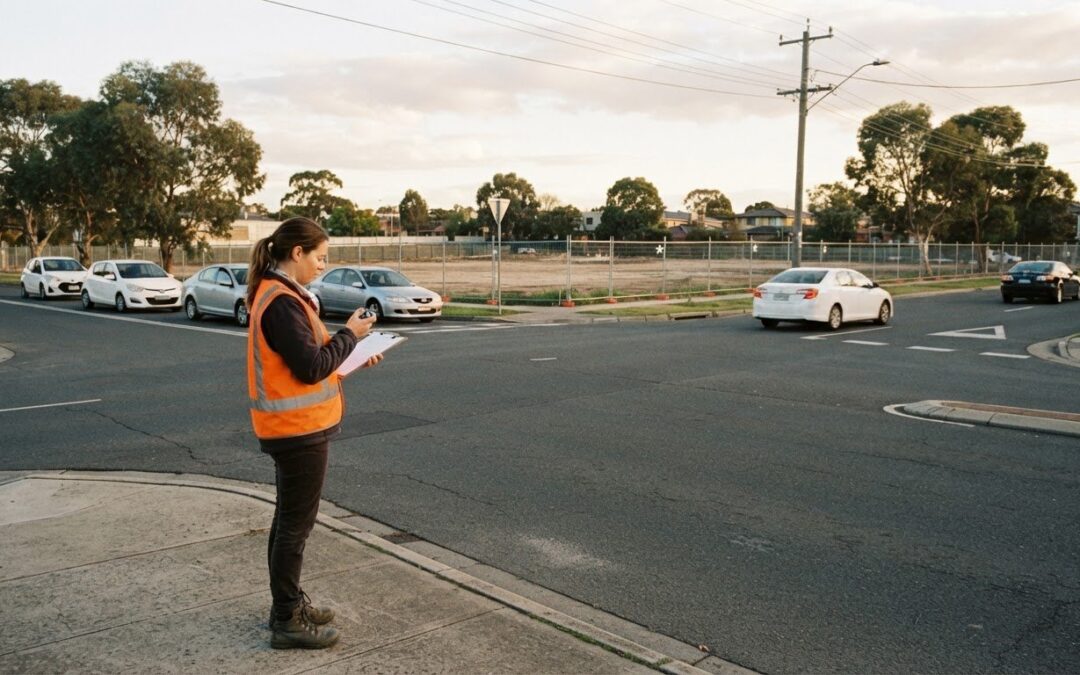
A signal warrant and approval to install a signal are not the same decision. For Australian developments, traffic signal warrant analysis for developers brings projected trips, hourly counts, warrant tests and intersection conditions into one assessment. An engineering study can explain how a development may change traffic operations and whether a signal is justified, while the relevant road authority’s requirements still guide the decision.
It’s reasonable to expect traffic counts to give a clear yes-or-no answer. In practice, the timing and pattern of traffic, the development’s projected demand and the intersection’s operation all matter. One busy hour may not tell the whole story.
This article explains how projected traffic is assessed, how hourly volumes relate to warrant tests, and what an engineering study can establish when no warrant is met. It also explains how a Traffic Impact Assessment can connect development forecasts with intersection impacts and planning decisions.
Key Takeaways
- Projected development traffic can inform signal assessment, but forecasts need to be considered alongside intersection operation and the relevant road authority’s requirements.
- A single busy hour may not satisfy a warrant based on repeated hourly conditions; understand how the applicable test treats the timing and pattern of counts.
- An engineering study can assess traffic and safety evidence even when a warrant test is not met, but the study and the signal-installation decision are distinct.
- Corresponding major- and minor-street counts matter: under the US MUTCD, Warrant 2 requires four qualifying hourly points, which need not be consecutive.
- According to the Federal Highway Administration, an engineering study may count vehicles entering from each approach hourly during 12 hours of an average day.
Can projected traffic be used for a development site?
Yes. An engineering study can estimate future hourly volumes when representative counts are unavailable, then compare them with the criteria used by the responsible Australian road authority. The assessment also considers how the development could affect intersection operation.
Signal impacts on intersection operation
Intersection operation describes how traffic volumes, delays and signal phasing affect movement through a junction. For a development, projected trips can change turning demand and waiting times on individual approaches.
Stopped-time delay measures how long vehicles are stationary, often summarised across an approach in vehicle-hours. The applicable road authority’s criteria and the intersection context determine the threshold used for assessment. Peak-hour volume tests also depend on the relevant guidance and defined count periods. Considering these measures together helps show whether a signal would address an identified operational issue.
Avoiding unwarranted signals and delays
A warrant assessment tests whether the available evidence supports considering a signal. An unwarranted signal can add delay and congestion, so a busy intersection alone does not show that installation is appropriate. The analysis should relate observed conditions to development forecasts and the authority’s criteria.
Developers can also assess alternatives such as a roundabout, turn lanes, or changes to access and turning arrangements. The right treatment depends on intersection geometry, movement patterns and operational constraints. Road ownership, approval conditions and project agreements determine responsibility for design, construction and ongoing maintenance; there is no universal rule.
Data and surveys for warrant analysis
A warrant assessment needs traffic evidence that represents both the intersection and the development’s expected demand. This may include turning counts for each approach, hourly volumes, vehicle delays, and relevant crash or pedestrian information.
Site surveys record the geometry that shapes traffic movements, including approach lanes, the intersection layout and access points. The study relates projected development traffic to existing counts and proposed access arrangements, keeping forecasts distinct from observed conditions. This helps reviewers understand how assumptions affect the assessment.
Approvals and assessment challenges
The responsible road authority assesses signals on roads it controls. A local council may be involved when the road is council-controlled. The decision-maker therefore depends on road ownership and the state or territory approval process. No single agency governs every intersection across Australia.
An assessment can be challenged if counts do not represent the periods being tested, forecast assumptions lack a clear basis, or the analysis uses criteria that do not match the authority’s guidance. Inconsistent turning counts or overlooked access effects can also weaken the evidence. Clearly linking forecasts, intersection conditions and the applicable test helps address these issues.
Can one very busy hour satisfy the four-hour warrant?
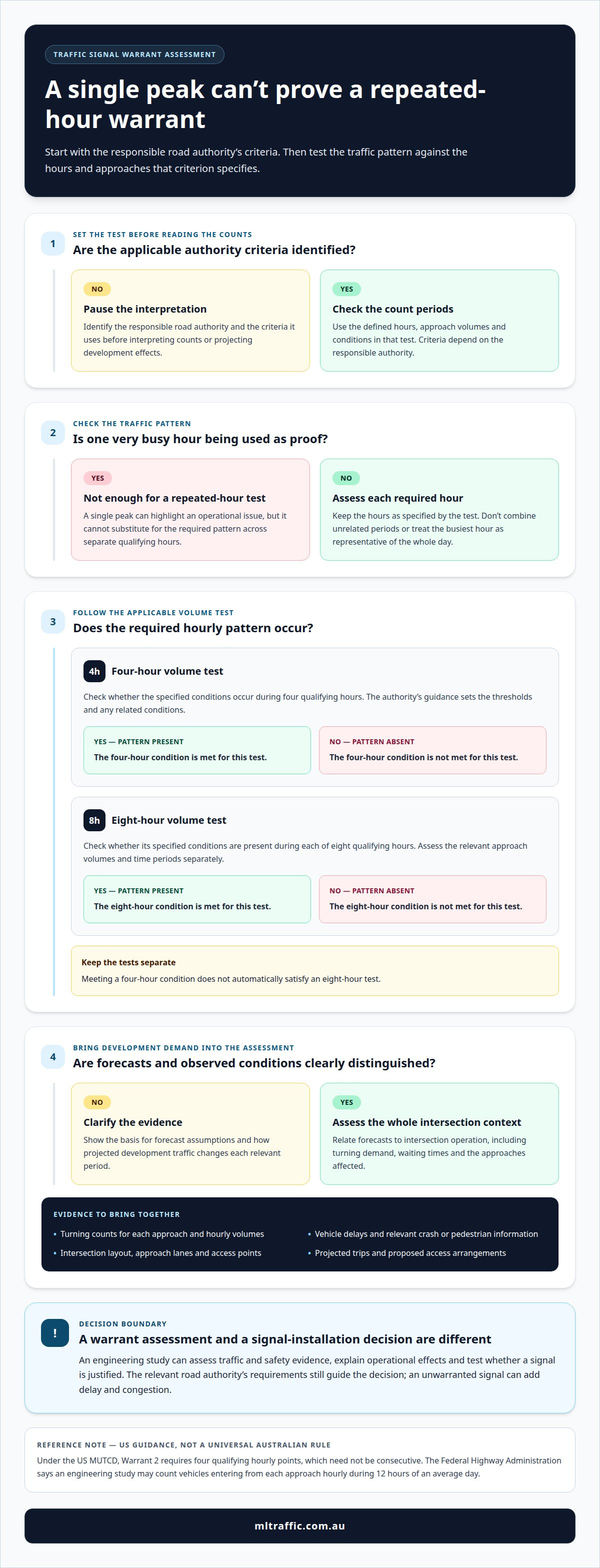
Not when the applicable test requires qualifying traffic conditions across four separate hours. A single peak can highlight an operational issue, but it cannot substitute for a repeated-hour criterion. In Australia, the responsible road authority’s adopted criteria determine the periods and volume conditions used. Identify those criteria before interpreting counts or projecting the development’s effects.
A four-hour volume test examines whether the required conditions occur during four qualifying hours of an average day. Assess the hours as specified by the test, rather than combining unrelated periods or treating the busiest hour as representative of the whole day. This matters when a development generates a sharp peak, such as concentrated traffic around a shift change or retail trading period.
An eight-hour volume test asks whether its specified conditions are present during each of eight qualifying hours. Meeting a four-hour condition does not automatically satisfy an eight-hour test. Assess the relevant approach volumes and time periods separately for each test.
Four-hour and eight-hour volume tests
Volume warrants use defined criteria to assess recurring demand, rather than relying on a daily total alone. The applicable road authority’s guidance sets the thresholds and any related conditions. A count schedule should show the hours assessed and traffic volumes for each relevant approach, allowing reviewers to see whether the required pattern is present.
For example, a proposed development might add substantial traffic during the afternoon peak but relatively little at other times. That peak can inform the intersection operations assessment, but it does not establish that a separate four-hour or eight-hour condition is met. The analysis should distinguish observed counts from projected development traffic and explain how the forecast changes each period.
What connected-vehicle data can show
Connected-vehicle data can add context about movement patterns, travel times and changing intersection demand. Used alongside classified turning counts and site observations, it may help show when queues form and which approaches experience delays.
That information still needs to be interpreted against the authority’s chosen criteria. Data coverage, unusual travel days and the fact that a development has not opened can affect whether observed patterns represent the conditions being assessed. An engineering study can estimate hourly volumes for projected conditions and compare them with the applicable tests.
For development access, turning paths can also show how vehicles use the entry layout. A Vehicle Swept Path Assessment can complement traffic analysis by examining vehicle movements through the access.
Can an engineering study support a signal when no warrants are met?
An engineering study can assess whether a signal is justified even when a warrant test is not met. It provides evidence for the road authority’s decision, but does not itself approve signal installation.
Engineering studies and installation decisions
An engineering study evaluates traffic and safety evidence to determine whether signal control is appropriate at an intersection. For a development, it can consider existing conditions alongside forecast trips, turning movements, delays and site access effects. This broader assessment helps explain how the proposal may affect intersection operation.
The work typically defines the study area, assembles relevant traffic and safety data, assesses intersection conditions, and documents findings for authority review. The time required depends on data availability and suitability, the study scope and the authority’s review process. The study supports a decision but does not guarantee installation.
Intersection signal installation criteria
Signal installation criteria are the conditions and evidence a road authority applies when considering signal control. They may include traffic volumes, delays, safety and vehicle movements through the intersection. The assessment should identify the criteria used and explain how the evidence relates to each one.
If no applicable warrant is met, the study can still describe other operational or safety issues. For example, it may document recurring difficulty entering the major road or forecast turning demand from a proposed development. Those findings inform the authority’s broader assessment but do not establish that a signal must be installed.
A development approval may require a signal to be planned or modified if a provision or assessment identifies a need. The authority’s decision and approval conditions establish what the project must address.
Applicable standards and state guidelines
In Australia, the responsible road authority’s adopted traffic signal guidance and applicable project approval requirements govern the assessment. The responsible authority depends on the road and jurisdiction. The study should name the criteria it applies rather than assume one warrant threshold governs every Australian intersection.
Clear documentation lets reviewers follow the basis of the assessment. It should identify count periods, approaches considered, the forecast scenario and safety evidence. If the authority requests further analysis, the report can address the specific issue, such as missing turning movements or unclear development assumptions.
Approval preparation follows a sequence: establish the applicable criteria, assemble suitable evidence, assess intersection operation, then submit the findings for review. The schedule depends on data readiness, study complexity and authority review. A transparent report distinguishes the warrant outcome from the final decision on signal installation.
Corresponding major- and minor-street hourly counts
Warrant tests that compare two streets depend on paired counts, not isolated totals. For each period assessed, the major-street and minor-street volumes must correspond to the same time. Pairing the wrong hours can distort how intersection demand relates to the applicable test. Under the US MUTCD, these methods illustrate count matching; they are not automatically Australian warrant criteria.
For the US MUTCD Warrant 2, four separate corresponding hourly points must fall above the applicable curve. The qualifying hours need not be consecutive. Each point pairs the major-street volume with the minor-street volume recorded during that same hour. A major-street count from one period cannot be matched with a minor-street count from another.
The curve comparison considers both approaches’ volumes together. A high major-street volume may coincide with a low minor-street volume, while another hour may show a different balance. Assess each paired point against the applicable curve. The test is met only when four distinct hourly points meet that condition, not when one hour produces a high combined total.
Time intervals matter. Under US MUTCD Section 4C.01, an evaluated hour may consist of four consecutive 15-minute periods, with corresponding major- and minor-street periods. This allows the hourly record to reflect changes within the hour while preserving the match between streets. For example, the first quarter-hour on each street belongs in the same comparison period.
Other warrants use different count rules. The US MUTCD Crash Experience warrant requires relevant major- and minor-street volumes to meet the stated 80% columns for any 8 hours of an average day. That condition is not the same as Warrant 2’s four points above a curve. The analysis must identify which warrant applies before interpreting paired volumes.
A clear count schedule shows how the comparison was made. It should identify the date, periods assessed, approach volumes and warrant test used. For projected development traffic, keep forecast values distinct from observed counts, then pair major- and minor-street volumes for each period assessed. This makes the result traceable and exposes mismatched intervals before they affect the conclusion.
For Australian projects, use the relevant road authority’s assessment criteria rather than treating US MUTCD examples as national rules. The same technical discipline applies: align the periods, retain both street volumes and use the correct test. Showing these steps lets reviewers understand how each qualifying point was assessed.
Traffic signal warrant analysis for development projects
In Australia, a traffic signal warrant analysis assesses intersection traffic and safety evidence against the criteria applied by the responsible road authority. For a development, it helps show how projected trips may affect the need for signals, but the assessment does not itself approve installation.
The development connection matters because a site can change intersection traffic patterns, not just add vehicles to a road. New access movements may increase turning demand, affect queues or change how vehicles enter the major road. A useful assessment sets out existing conditions and forecast development traffic separately, then explains how each affects the intersection.
According to the Federal Highway Administration, an engineering study may count vehicles entering an intersection from each approach hourly during 12 hours of an average day. This provides a structured record of daily variation. It can help distinguish a short peak from demand that recurs across several periods, while identifying which approaches carry the relevant movements.
For development analysis, connect the counts to the proposal. The traffic forecast should explain expected trip generation, likely travel routes for site traffic, and which turning movements use the intersection. It should distinguish existing traffic from development-generated demand, so reviewers can see the proposal’s contribution rather than relying on a combined total.
Next, the engineering assessment compares the evidence with the road authority’s applicable criteria. It should identify the test used, the count periods and whether the analysis considers current or projected conditions. Report clearly if a criterion is not met. Other evidence, such as delays or safety conditions, can still inform the authority’s broader decision.
Development timing also affects the assessment. A proposal that opens in stages may produce different traffic patterns as each stage becomes occupied. Forecast assumptions should align with the development scenario being assessed. A clear explanation helps reviewers understand whether a projected volume represents an early stage, full development or another defined condition.
The practical takeaway is to treat warrant analysis as one part of development planning, not as a guarantee that signals will be installed. It connects traffic forecasts with intersection evidence and authority criteria. This distinction helps developers understand what the analysis supports, what it cannot establish, and how signal considerations fit alongside access and traffic-impact decisions.
Project teams plan around the roadway network warrant: a major route with peak-hour entering volume of at least 1,000 vehicles per hour and five-year projected volumes meeting specified warrants. It also considers total existing or immediately projected entering volume of at least 1,000 vehicles per hour for each of four hours.
ML Traffic Engineers Australia
ML Traffic Engineers Australia helps developers assess how projected site traffic may affect nearby intersections and planning decisions. Turn to the team when a proposal needs traffic evidence to support an approval or clarify the effect of expected trips.
A Traffic Impact Assessment (TIA) Report can examine development traffic and intersection impacts, providing a structured basis for planning discussions. It relates forecast movements to site access and the surrounding network, helping decision-makers understand the project’s traffic implications. It does not replace the road authority’s signal criteria or determine whether a signal will be installed.
For a development where traffic forecasts and intersection operation need to be assessed together, contact ML Traffic Engineers Australia to discuss the project.
Set the next development decision on clear evidence
Plan traffic assessment alongside your development design, rather than waiting for approval questions. Early coordination connects site access, projected trips and intersection impacts to decisions shaping the proposal. It also gives the assessment a clear role: to inform planning and engineering discussions, not presume a signal outcome.
A traffic signal warrant analysis for developers can form part of a broader development assessment. A Traffic Impact Assessment (TIA) Report addresses traffic effects, while Vehicle Swept Path Assessment and Car Parking Demand Assessment can inform access and parking design. Together, these inputs help present a fuller picture of how the proposal will function.
ML Traffic Engineers Australia can help relate development traffic to the transport questions raised by your project. Discuss your development with ML Traffic Engineers Australia and take the next planning decision forward with a clear, evidence-led assessment.
Frequently Asked Questions
What if the peak-hour warrant is the only warrant met?
A peak-hour warrant can support further consideration, but it does not by itself require signal installation. The US MUTCD identifies Warrant 3 with peak-hour traffic volumes; that is a US example, not a national Australian rule. For a development, the assessment should explain which peak-hour conditions qualify and how they relate to the site’s expected traffic. The responsible road authority makes the decision under its applicable criteria.
What traffic volume, pedestrian, crash, and delay thresholds justify traffic signals?
Thresholds depend on the governing criteria. As US MUTCD examples, the pedestrian warrant uses 100 pedestrians in each of any four hours, or 190 in any one hour, with fewer than 60 adequate crossing gaps per hour. Its crash warrant requires five qualifying reported crashes within a 12-month period. Its peak-hour delay route uses 4 vehicle-hours for a one-lane minor approach or 5 for a two-lane approach. These are not Australian national thresholds.
How are signal warrant criteria assessed at intersections and development access points?
The assessment identifies the intersection, relevant approaches and applicable authority criteria, then relates traffic evidence to those conditions. Development access can affect turning demand at a nearby junction, so its location and expected movements form part of the operational context. For example, a forecast dominated by right turns may have different implications from one generating mainly left turns. The analysis should make that movement pattern clear.
How does development-generated traffic affect signal warrants and approval conditions?
Projected trips can alter approach volumes and turning patterns, potentially changing whether a warrant condition is met. The assessment separates existing traffic from the development’s forecast contribution, then explains the scenario used, such as a staged or completed proposal. A development provision or warrant analysis may indicate a need to plan or modify a nearby signal. Any resulting approval conditions depend on the relevant authority’s decision.

Disclaimer
The content on www.mltraffic.com.au, including all technical articles, guides, and resources, is provided for general informational and educational purposes only. It is not intended to constitute professional advice in traffic engineering, transportation planning, development approvals, or any other technical or legal field.
While ML Traffic Engineers makes every reasonable effort to ensure the accuracy, completeness, and timeliness of the information published, we do not provide any warranties or representations (express or implied) regarding its reliability, suitability, or availability for any particular purpose. Any reliance you place on the content is strictly at your own risk.
In no event shall ML Traffic Engineers, its directors, employees, authors, or affiliates be liable for any direct, indirect, incidental, special, consequential, or punitive damages (including, without limitation, loss of profits, data, or business opportunities) arising out of or in connection with the use of, or inability to use, any information provided on this website.
The articles and guides on this site are not a substitute for engaging a qualified, registered professional traffic engineer (such as an NPER or RPEQ engineer) to assess your specific project requirements. For tailored advice, compliance assessments, or traffic engineering services, please contact a competent professional.
This disclaimer may be updated from time to time without notice. By accessing or using this website, you agree to be bound by the most current version of this disclaimer.
