
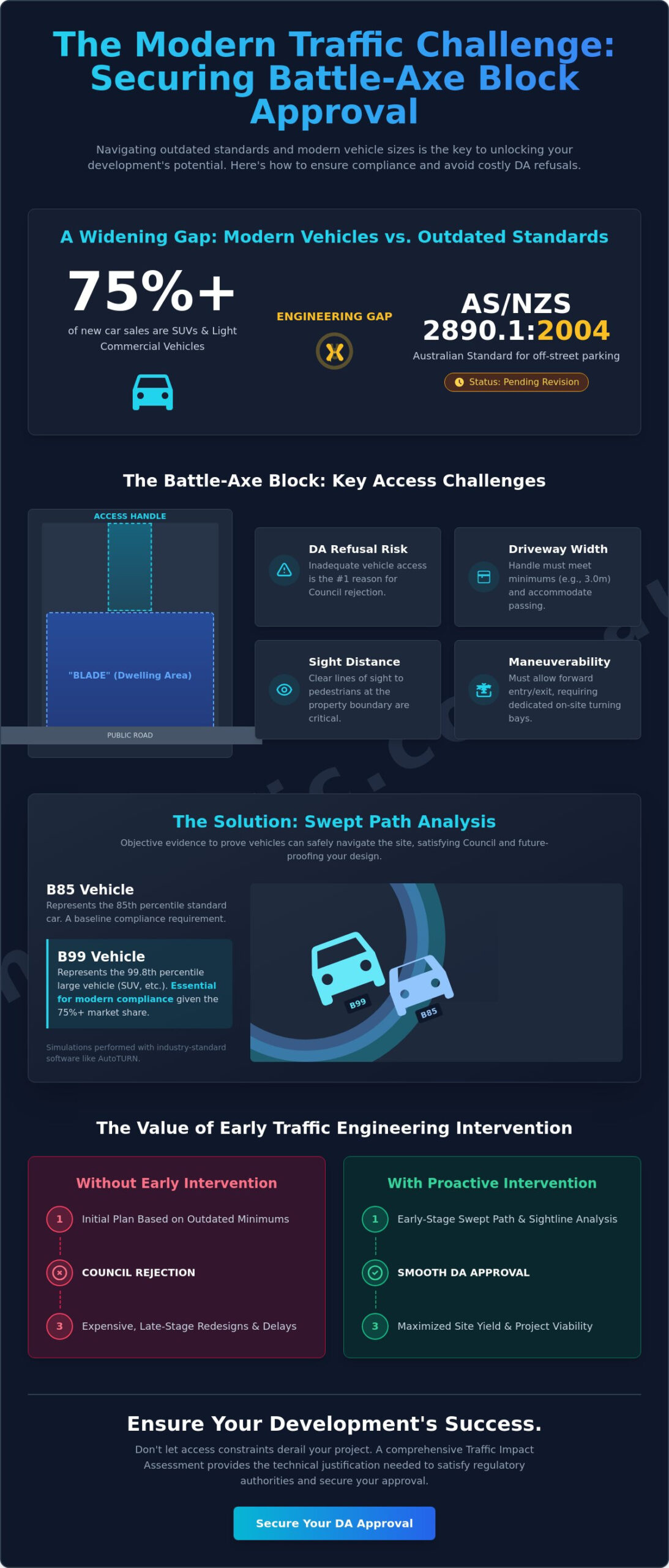
Over 75% of new car sales in Australia are now SUVs and light commercial vehicles, yet the current Australian Standard for off-street parking relies on vehicle dimensions from 2004. This shift creates a significant engineering gap, as AS/NZS 2890.1:2004 is currently listed with a status of Pending Revision. When designing traffic solutions for battle-axe block developments, relying solely on outdated minimums is a primary reason for Council rejection. You need an access design that accounts for modern vehicle sizes and anticipated regulatory changes to avoid costly redesigns late in the process.
It’s a common frustration to watch a viable subdivision stall because a driveway fails to meet technical swept path requirements or sight distance criteria. Maximizing site yield while satisfying strict regulatory checklists is a precision engineering challenge where compliance dictates the viability of the entire project. This article provides a masterclass in the technical traffic requirements for rear-lot subdivisions to ensure your design secures Council approval. We’ll examine the necessity of vehicle swept path analysis, the impact of the AS 2890.1 pending revision, and how to future-proof your development against increasing Council scrutiny.
Key Takeaways
- Understand why driveway constraints are the primary cause of DA refusal and how to mitigate access risks during the initial planning phase.
- Learn to utilize software-driven swept path analysis to provide robust traffic solutions for battle-axe block developments that satisfy Council requirements.
- Master the core specifications of AS 2890.1 to design compliant parking layouts and prevent vehicle grounding on steep driveway ramp grades.
- Discover how a comprehensive Traffic Impact Assessment (TIA) justifies your development’s safety and maneuverability to regulatory authorities.
- Identify the benefits of early-stage traffic engineering intervention to maximize limited site space and avoid expensive, late-stage design revisions.
Understanding Traffic Access Challenges in Battle-Axe Developments
A Battle-axe block, or flag lot, is defined by its specific geometry. It features a rear “blade” for the dwelling and a narrow “handle” for street access. While these lots provide privacy, they present significant engineering hurdles for any developer. Inadequate vehicle access is the leading cause for Development Application (DA) refusal in rear-lot subdivisions. Implementing effective traffic solutions for battle-axe block developments requires a precise balance between maximizing building footprints and satisfying non-negotiable safety standards.
Councils focus heavily on the safe interaction between pedestrians and vehicles within these narrow corridors. Visibility is often compromised in long driveways, which increases the risk of collisions. If an access design doesn’t prove that a vehicle can safely enter and exit without obstructing the public road, the project will stall. Assessment officers require technical traffic solutions for battle-axe block developments that eliminate blind spots and prevent traffic congestion on the primary thoroughfare.
To understand the importance of durable infrastructure in these specialized accessways, watch this technical overview:
The “Handle” Problem: Width and Sightlines
The width of the access handle dictates the feasibility of the entire subdivision. Most local councils mandate specific minimum widths based on the number of dwellings served. For a single dwelling, a 3.0-meter width is a common baseline. This requirement increases for dual occupancies or multi-unit developments to accommodate vehicle passing bays or dedicated pedestrian paths. Sight distance at the property boundary is equally vital. Drivers must have a clear line of sight to pedestrians on the footpath before the vehicle’s nose enters the roadway. Managing this transition requires a meticulous Sight Distance Assessment to ensure compliance with local Development Control Plans (DCPs).
Internal Maneuverability Constraints
Vehicles must enter and exit rear-lot developments in a forward direction. Reversing onto a public road from a battle-axe handle is rarely permitted due to safety risks. This mandate necessitates a dedicated turning area, or reversing bay, within the blade of the lot. Providing this maneuverability on a constrained site is difficult. Every square meter used for a turning circle is a square meter lost for the building or private open space. Engineers must also account for service vehicle access. If a fire truck cannot navigate the handle or turn within the site, the DA won’t proceed. Meticulous planning at the start of the project prevents these constraints from becoming deal-breakers.
Swept Path Analysis: Proving Vehicle Maneuverability
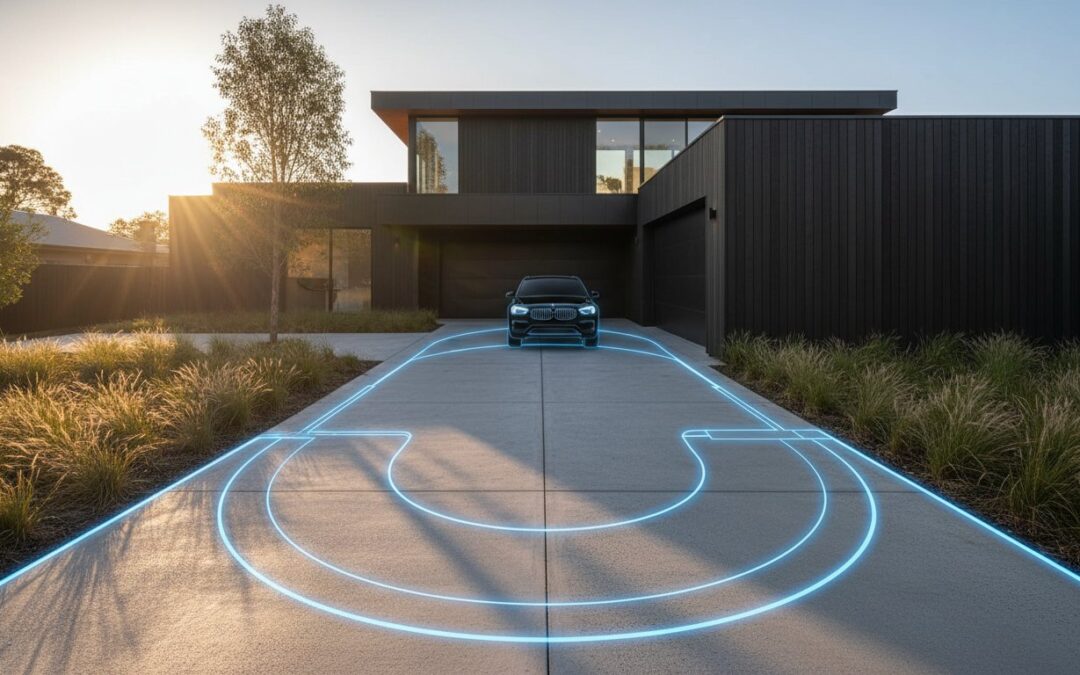
Swept path analysis provides the objective evidence required by Council to prove that vehicles can navigate a site without impacting structures or other road users. Assessment officers no longer accept simple geometric assumptions. Instead, they require sophisticated simulations to validate traffic solutions for battle-axe block developments. We utilize AutoTURN software to create these simulations, mapping the exact path of a vehicle’s body and its wheel clearances during complex maneuvers. This analysis dictates the necessary width of the driveway handle and the specific dimensions of internal turning areas.
Compliance hinges on meeting the requirements for B85 and B99 vehicles as defined in AS 2890.1. The B85 vehicle represents the 85th percentile car, while the B99 represents the 99.8th percentile vehicle, typically a large SUV or luxury car. Given that SUVs now account for over 75% of new car sales, proving B99 compliance is essential to ensure the development remains functional for modern residents. If a swept path reveals a conflict with a building corner or a boundary fence, the design must be revised before the DA is submitted. You can find more detail on these engineering requirements in our specialized traffic services.
The Forward-In, Forward-Out Requirement
Councils strictly prohibit vehicles from reversing onto public roads from battle-axe blocks due to the high risk of collisions with passing traffic and pedestrians. Swept path analysis is the technical proof of safe vehicle movement. To satisfy this requirement, we design on-site turning facilities such as T-Heads or L-Heads. These configurations allow a driver to perform a clean three-point turn within the “blade” of the lot. Our simulations ensure these areas are large enough for a B99 vehicle to turn comfortably without multi-point shunting that exceeds Council standards.
Accounting for Heavy Vehicles
Residential developments must also accommodate service vehicles under AS 2890.2. This includes delivery vans and emergency service vehicles that may need to enter the rear lot. Without accurate swept path modeling, these larger vehicles risk becoming trapped or causing property damage. The WA residential subdivision policy provides a clear framework for how these lots should be configured to maintain safety and accessibility. For a deeper technical breakdown of these modeling techniques, review our Swept Path Analysis: A Complete Guide for Australian Developments. Meticulous planning at this stage prevents the “trapped vehicle” scenario that often leads to DA refusal.
Compliance with AS 2890.1: Driveway and Parking Design
AS/NZS 2890.1:2004 is the foundational standard for off-street car parking in Australia. While this remains the enforceable benchmark, it’s currently listed with a status of Pending Revision. This is a critical consideration for any developer. Modern vehicle dimensions have shifted significantly since 2004, with SUVs and light commercial vehicles now accounting for over 75% of new car sales. Engineering effective traffic solutions for battle-axe block developments requires designing beyond the 2004 minimums to ensure the site remains functional for modern residents. Failure to account for these larger vehicle footprints often leads to congestion and maneuverability issues that Councils won’t overlook.
Long driveway handles present unique operational challenges. When a driveway exceeds 30 meters, Councils typically require passing bays to manage two-way traffic flow. These bays must be strategically placed to allow vehicles to pass without one driver having to reverse a significant distance. This is a safety requirement that prevents “deadlocks” within the accessway. Our technical assessments ensure that these bays are sized correctly and positioned where visibility is highest, satisfying both AS 2890.1 and local Development Control Plan (DCP) requirements.
Driveway Ramp Grade Assessments
Steep topography is a common hurdle in rear-lot subdivisions. AS 2890.1 specifies a maximum gradient of 1 in 4 (25%) for domestic driveways, but the gradient itself isn’t the only factor. Transitions are mandatory at the top and bottom of steep ramps to prevent vehicle grounding or scraping. A 2.0-meter transition at half the main grade is generally the minimum requirement to protect the vehicle’s undercarriage. We provide a specialized Driveway Ramp Grade Assessment to certify these levels. For a technical deep dive, review our article on AS 2890.1 Explained: The Ultimate Guide to Compliant Car Park Design.
Parking Demand and Layout Optimization
Council DCPs dictate the specific number of resident and visitor parking spaces required for a development. In the constrained “blade” of a battle-axe lot, layout optimization is essential. We position carports and garages to maximize the available turning area, ensuring that parked vehicles don’t impede the primary access path. This requires a meticulous Car Park Design that balances high site yield with the functional requirements of AS 2890.1. Meticulous planning here prevents the need for costly redesigns if the Council determines the parking layout is non-compliant or impractical for daily use.
Navigating the Council Approval Process for Rear Lots
Securing a Development Application (DA) for a rear-lot subdivision requires more than just a compliant site plan. It demands a formal demonstration that the proposed access design won’t compromise the safety or efficiency of the existing road network. Councils view battle-axe developments as high-risk due to the potential for traffic congestion and pedestrian conflict at the property boundary. A professional Traffic Impact Assessment (TIA) Report serves as the primary evidence to address these concerns, providing the technical justification necessary for approval.
Assessment officers prioritize two main factors: traffic generation and road safety. They need to know exactly how many additional vehicle movements the development will create and whether the existing infrastructure can absorb them. By providing comprehensive traffic solutions for battle-axe block developments, engineers can preemptively address these questions. A well-structured report mitigates the risk of receiving a Request for Further Information (RFI), which can delay a project by weeks or months. Providing all technical data upfront, including swept paths and sightline certifications, streamlines the assessment process.
Senior-level engineering oversight is critical during this high-stakes phase. When a report carries the signature of an experienced principal, it signals to the Council that the design has undergone rigorous professional scrutiny. This level of accountability is often the deciding factor in complex subdivisions where driveway widths or turning areas are at the absolute minimum of the allowable range. Meticulous documentation of every technical requirement ensures that the Council has no grounds for refusal based on traffic concerns.
Preparing the Traffic Impact Statement
For minor subdivisions, Councils often require a Traffic Impact Statement rather than a full-scale assessment. This document focuses on the specific constraints of the site, documenting compliance with both local Development Control Plans (DCPs) and National Standards. It must clearly outline how the design manages vehicle entry and exit, parking demand, and pedestrian safety. To understand the full scope of these documents, refer to our Traffic Impact Assessment: The Definitive Guide for Australian Developers.
The Importance of Senior Principal Involvement
Trust is a valuable currency in the planning process. Having a seasoned expert lead your project ensures that the person who initiates the client relationship is the one performing the technical work. This personnel continuity promise eliminates the communication gaps common in larger firms. Expert representation is particularly valuable during disputes over technicalities, such as sight distance requirements or the placement of passing bays. If your project faces scrutiny, you need a direct line to the experts who designed the solution. Contact us today to secure senior engineering oversight for your DA submission.
Professional Traffic Engineering: Securing Your DA Approval
Securing a successful outcome for a rear-lot subdivision depends on the quality of the technical documentation submitted to Council. ML Traffic Engineers provides specialized traffic solutions for battle-axe block developments that withstand rigorous regulatory scrutiny. We understand that access is the most common point of failure in these applications. Our approach is meticulous, results-oriented, and focused on achieving compliance without sacrificing the commercial viability of your site. We ensure every design accounts for the 75% dominance of SUVs in the current Australian vehicle market, even as AS 2890.1 remains in a pending revision status as of May 2026.
Our firm operates with a strict no-gatekeepers approach. You gain direct access to senior traffic engineering experts who manage your project from inception to final certification. This personnel continuity promise means the expert who understands your site’s specific constraints is the one performing the technical work. We prioritize clear communication and technical accuracy to build trust with Council assessment officers. By delivering authoritative data upfront, we minimize the likelihood of project delays caused by repetitive information requests.
Early intervention in the design phase is the most effective way to avoid the high costs of late-stage revisions. If a driveway handle is too narrow or a turning circle is insufficient, it’s better to identify these issues before the site plan is finalized. We provide the engineering justification needed to maximize limited site space while satisfying safety standards. Our goal is to provide a compliant access design that secures your DA approval efficiently.
Comprehensive Traffic Assessment Services
Our suite of technical services is designed to cover every requirement on the Council checklist. We provide the following specialized assessments:
- Vehicle Swept Path Analysis: Using AutoTURN to simulate B99 vehicle movements.
- Traffic Impact Assessment (TIA) Reports: Comprehensive documentation for subdivision approval.
- Driveway Ramp Grade Assessment: Certifying gradients and transitions to prevent vehicle grounding.
- Car Park Design: Optimizing layouts to meet resident and visitor demand.
- Sight Distance Assessment: Ensuring safe entry and exit at the property boundary.
Explore our full range of traffic engineering services to see how we support diverse project environments.
Start Your Development with Confidence
A technical review of your battle-axe site plan is the first step toward a compliant design. We provide the authoritative engineering data required to support your DA and resolve potential disputes with Council regarding access widths or traffic generation. Our senior principals are directly accountable for the success of your submission. Reach out to our senior principals today to discuss your development and secure a professional traffic solution.
Secure Your Development Approval with Engineering Precision
Successful rear-lot subdivisions require technical precision from the initial site plan. Adherence to AS 2890.1 and AS 2890.2 standards, combined with software-driven swept path analysis, ensures your design accommodates modern vehicle dimensions and satisfies Council safety criteria. These traffic solutions for battle-axe block developments provide the objective evidence assessment officers demand for DA approval. Meticulous planning at the early stages eliminates the risk of reversing maneuvers onto public roads and ensures all driveway ramp grades are compliant.
ML Traffic Engineers brings over 15 years of traffic engineering experience to every project. We offer direct access to senior principals who manage your assessment from start to finish, ensuring personnel continuity and accountability. Our expertise in car park design and sight distance assessments provides the reliability you need to navigate the planning process. Don’t risk project delays or costly redesigns due to inadequate access planning. We provide the technical justification required to maximize your site yield while maintaining full regulatory compliance.
Get a compliant traffic assessment for your battle-axe development to ensure your project moves forward with confidence. We look forward to securing your successful DA outcome.
Frequently Asked Questions
What is the minimum driveway width for a battle-axe block in Australia?
The minimum driveway width for a single-dwelling battle-axe block is typically 3.0 meters, though this requirement increases to 5.5 meters or more for multi-dwelling developments to allow for vehicle passing. You must consult your local Council’s Development Control Plan (DCP) for specific variations. Implementing effective traffic solutions for battle-axe block developments requires adhering to these width standards to ensure the handle of the lot accommodates standard vehicle clearances.
Do I need a swept path analysis for a single-dwelling battle-axe development?
Yes, Councils frequently require a vehicle swept path analysis even for single-dwelling battle-axe blocks if the site configuration is constrained. This technical simulation proves that a vehicle can turn within the rear blade of the lot and exit in a forward direction. It is a critical component of traffic solutions for battle-axe block developments to prevent property damage and ensure functional accessibility for residents.
Can I reverse out of a battle-axe driveway onto a public road?
Reversing from a battle-axe driveway onto a public road is generally prohibited by Australian Councils due to significant safety risks. Traffic engineering standards require that vehicles enter and exit the site in a forward direction to maintain clear sightlines and prevent traffic flow disruption. This mandate necessitates the inclusion of on-site turning facilities, such as T-heads or reversing bays, within the development design.
What is a B85 vehicle and why is it used in traffic assessments?
A B85 vehicle represents the 85th percentile car, meaning 85% of vehicles on Australian roads are smaller than or equal to these specific dimensions. It serves as the standard design vehicle for residential parking and maneuvering in traffic assessments. However, because SUVs now constitute over 75% of new car sales, engineers also utilize B99 vehicle dimensions to ensure the site accommodates larger modern vehicles.
How steep can a driveway ramp be for an Australian residential lot?
Under AS 2890.1, the maximum gradient for a domestic driveway ramp is 1 in 4, or 25%. Any ramp exceeding a 1 in 8 gradient requires transition sections at the top and bottom to prevent vehicle grounding. These transitions are typically 2.0 meters long and set at half the main ramp grade to protect the vehicle’s undercarriage during the change in slope during entry and exit.
What happens if my battle-axe driveway doesn’t meet AS 2890.1 standards?
If a battle-axe driveway fails to meet AS 2890.1 standards, the Council will likely issue a Request for Further Information (RFI) or refuse the Development Application entirely. Failure to provide compliant traffic solutions for battle-axe block developments indicates that the access is unsafe or impractical. Correcting these issues late in the process often results in high redesign costs and potential loss of building footprint to accommodate larger turning areas.
Does Council require a full Traffic Impact Assessment for a two-lot subdivision?
Most Councils require at least a Traffic Impact Statement for a two-lot subdivision to address access safety and parking demand. While a full-scale Traffic Impact Assessment (TIA) is typically reserved for larger developments, the specific requirements depend on the local Council’s threshold. This report provides the technical justification needed to prove that the additional lot won’t negatively impact the surrounding road network or existing traffic flow.
Why is sight distance so important for rear-lot developments?
Sight distance is critical for rear-lot developments because it ensures drivers can see pedestrians on the footpath and oncoming traffic before exiting the narrow driveway handle. Inadequate visibility at the property boundary is a primary safety concern for assessment officers. A formal sight distance assessment confirms that the development provides clear lines of vision, reducing the risk of collisions at the street interface during daily use.

Disclaimer
The content on www.mltraffic.com.au, including all technical articles, guides, and resources, is provided for general informational and educational purposes only. It is not intended to constitute professional advice in traffic engineering, transportation planning, development approvals, or any other technical or legal field.
While ML Traffic Engineers makes every reasonable effort to ensure the accuracy, completeness, and timeliness of the information published, we do not provide any warranties or representations (express or implied) regarding its reliability, suitability, or availability for any particular purpose. Any reliance you place on the content is strictly at your own risk.
In no event shall ML Traffic Engineers, its directors, employees, authors, or affiliates be liable for any direct, indirect, incidental, special, consequential, or punitive damages (including, without limitation, loss of profits, data, or business opportunities) arising out of or in connection with the use of, or inability to use, any information provided on this website.
The articles and guides on this site are not a substitute for engaging a qualified, registered professional traffic engineer (such as an NPER or RPEQ engineer) to assess your specific project requirements. For tailored advice, compliance assessments, or traffic engineering services, please contact a competent professional.
This disclaimer may be updated from time to time without notice. By accessing or using this website, you agree to be bound by the most current version of this disclaimer.
