
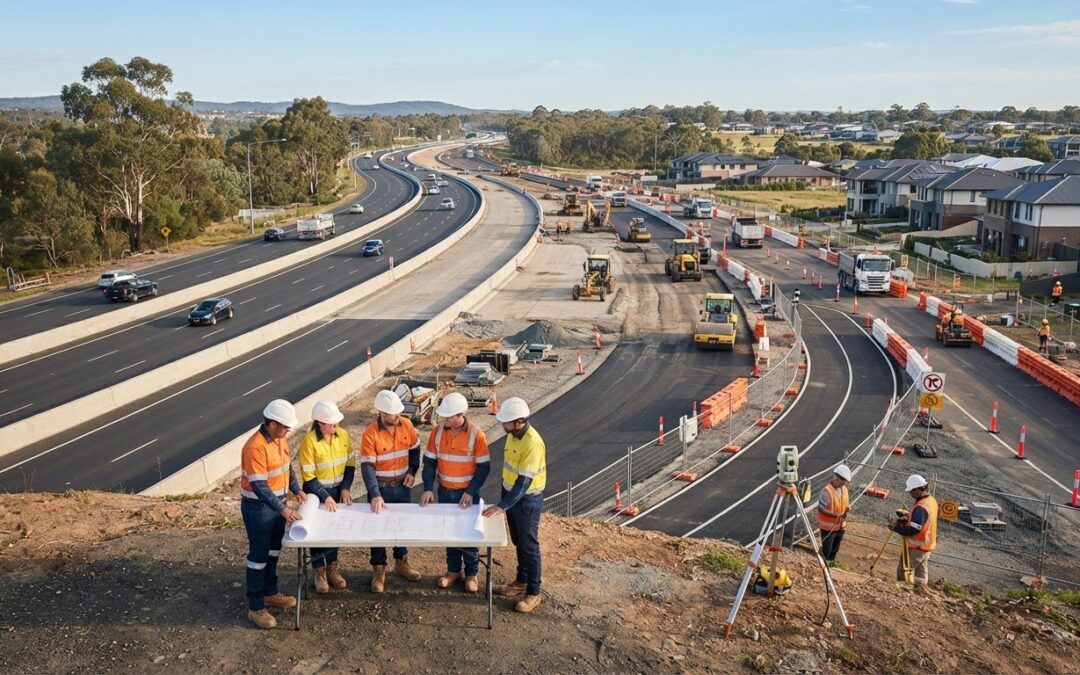
What if the traffic arrangement that works for the first stage becomes unsafe or impractical as construction moves on? A traffic staging plan for multi-stage development needs to change with the works, not simply mark out one detour and leave it in place. Each traffic switch can affect road users, nearby businesses, pedestrians, cyclists and emergency access.
Planning the stages takes coordination. The construction sequence, temporary access, traffic movements and approval requirements all need to align. Assumptions can quickly become outdated when site conditions or the programme change.
This article explains how to turn a construction sequence into workable traffic stages, with practical checks for vehicle movements, pedestrian routes, business access and emergency access. It also covers how to compare staging options and coordinate traffic arrangements with civil works and relevant approval pathways. You’ll learn when project-specific traffic engineering advice may help test assumptions before they are put into practice.
Key Takeaways
- Build each traffic stage around the construction sequence, so arrangements reflect the work areas and access needs at that point.
- Use a traffic staging plan for multi-stage development to map stage changes, test movements and identify assumptions that need confirmation.
- Compare staging options using consistent criteria, including safety, access continuity, constructability, programme dependencies and network impacts.
- Before each traffic switch, check the latest drawings, site conditions, access arrangements, temporary controls and applicable authority requirements.
- Consider specialist traffic engineering input when constrained road space, complex access or frequent stage changes make impacts difficult to assess.
Why traffic staging plans matter in multi-stage road duplication projects
A traffic staging plan sets out how road users will move through and around a project as construction progresses. For a road duplication, the arrangement may need to change as crews establish work areas, build new road space, alter temporary alignments and switch traffic onto completed sections. A traffic staging plan for multi-stage development links those changes to the construction sequence, rather than treating traffic arrangements as a one-off layout.
It serves a different purpose from a project-wide Traffic Impact Assessment (TIA), which considers broader effects on the surrounding transport network. Construction-phase management documents can address how works are coordinated and delivered, while staging information focuses on access and movement during each phase. For wider network context, see this Traffic Impact Assessment guide. The general principles of road traffic control also include directing vehicles around construction zones.
Bentley OpenRoads’ video includes a visual staging example for a roadway improvement project:
What changes between construction stages?
Available road space and work-zone boundaries can shift as a project moves from initial earthworks to construction, tie-ins and completion. Temporary alignments may alter lane positions and turning paths. Access points may also move, close temporarily or operate differently. Review each changeover to check how vehicles, pedestrians and cyclists will travel through or beside the work area.
A generic staging template can miss site-specific dependencies, such as a driveway that must remain usable until alternative access is ready. Base each stage on current design information, the construction programme and the sequence of works. Check the transition between stages as carefully as the arrangements within each stage.
Which project outcomes should staging protect?
The aim is to provide clear, workable movement around active works while managing exposure to conflicts. Staging should consider more than general traffic flow. Depending on the site, review:
- Safe and legible routes for vehicles, pedestrians and cyclists.
- Property access and business deliveries or servicing.
- Public transport movements and stop access, where affected.
- Emergency vehicle access and any constraints during changeovers.
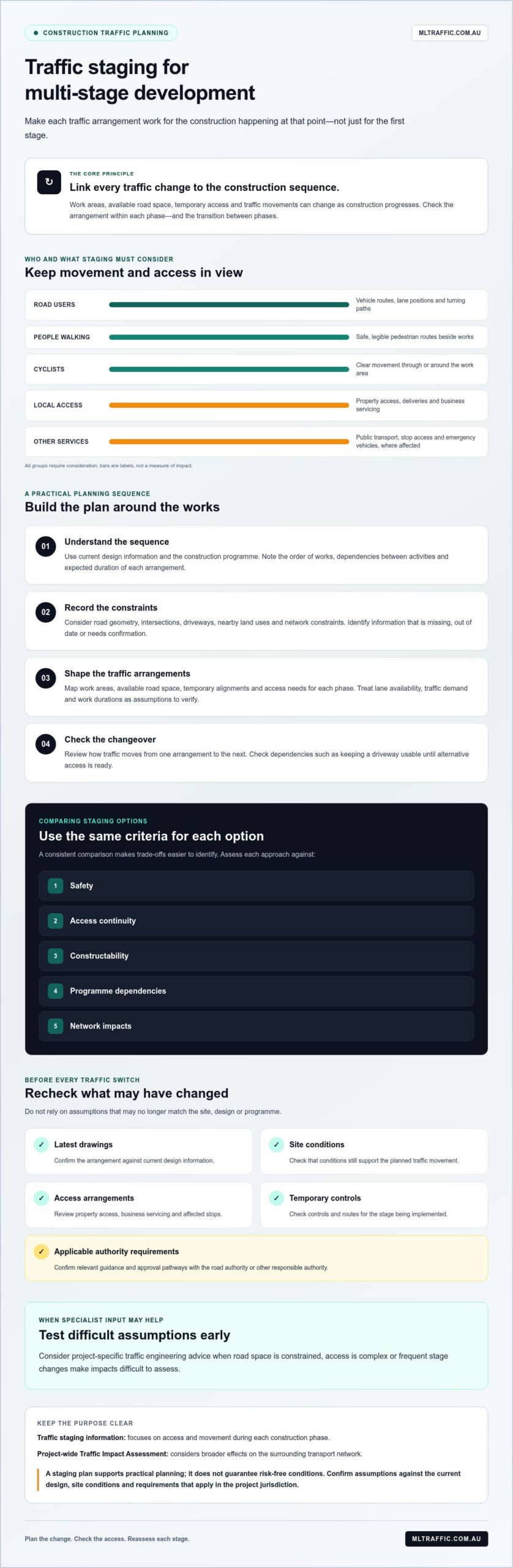
A staging plan connects each traffic change to the construction sequence, so access and movement can be assessed for every phase of a road project. It supports practical planning, but it does not guarantee risk-free conditions. Confirm assumptions against the current design, site conditions and requirements that apply in the project jurisdiction.
How to develop traffic staging around the construction sequence
Start with the works, then design the traffic arrangements around them. A traffic staging plan for multi-stage development should reflect the current design and construction programme, including the order of works, dependencies between activities and the expected duration of each arrangement. Treat lane availability, traffic demand and work durations as assumptions to verify with the project team, not as fixed facts.
Develop traffic arrangements in the context of the construction staging and the requirements that apply in the project’s Australian jurisdiction. Confirm relevant guidance and approval pathways with the road authority or other responsible authority. For related construction-phase planning context, see the traffic engineering services available for project-specific assessment.
Map constraints before setting the stage sequence
Build a constraint register before choosing a staging option. Record existing road geometry, intersections, driveways and other access points, nearby land uses and known network constraints. For each item, note whether the information is current, what is missing and who can confirm it, such as the design team, construction team or relevant road authority.
Then test how temporary alignments may affect turning movements, sight lines and vehicle access. Flag movements that need technical review instead of assuming they will work in the field. Check the staging drawings, work-area limits, access requirements and construction dependencies against the latest design and programme.
Define, test and review each stage
Set out the stages in construction order. For each one, identify the work area, the road space available to users, access arrangements and traffic movements that need checking. Test whether the proposed layout can accommodate expected vehicle paths and whether pedestrian and cyclist routes remain clear and practical. Review traffic demand and duration assumptions with the project team.
Assess transitions as distinct steps, not just lines between stage drawings. Before traffic moves to a new arrangement, confirm that the relevant construction interface is ready and the planned signs, barriers and road markings can be put in place. Assign responsibility for confirming the change and communicating it to affected parties, in line with project processes and applicable requirements.
- Confirm: current design, programme, staging drawings and authority requirements.
- Map: road geometry, access, land uses and network constraints.
- Define: work areas, traffic arrangements and dependencies for each stage.
- Test: vehicle, pedestrian and cyclist movements, including access and sight lines.
- Review: stage changeovers, assumptions and responsibilities with the project team.
A stage is only workable if its changeover is planned as carefully as the traffic arrangement that follows. Recheck assumptions whenever the construction sequence or design changes, so the staging remains aligned with the works.
How to compare alternative traffic staging approaches
Compare options against the same criteria, rather than judging them by one assumed outcome such as fewer traffic switches or a shorter programme. A traffic staging plan for multi-stage development should show how each option affects road users and whether the construction team can deliver it within the proposed sequence. The preferred approach depends on site conditions, design constraints and project objectives. There is no universal staging method.
Compare traffic impacts and access continuity
For each option, assess through-movements, turning access, property frontages and pedestrian routes. If a diversion or temporary arrangement is proposed, check its route, capacity and suitability with the project team and relevant authority. Record any movement or access that may be restricted, who or what may be affected, and what information is still needed to assess the impact.
Test construction practicality and stage dependencies
Ask whether crews and equipment can complete the work within the available space and sequence. Check dependencies between activities such as drainage, pavement, utilities or structures, where relevant. A traffic switch may rely on an area being completed first, so record that prerequisite and who is responsible for confirming it. Do not describe an option as safer or faster without project-specific evidence.
The table below is a comparison framework, not a recommendation. The options are illustrative; confirm their feasibility against the design, programme and site conditions.
| Illustrative option | Potential benefit | Constraint or trade-off | Confirm before comparison |
|---|---|---|---|
| Keep traffic on the existing alignment while works proceed beside it | May maintain a familiar route | Available work space may be limited | Lane availability, separation from works and access needs |
| Shift traffic onto a temporary alignment | May release space for construction | Can change turning paths and frontage access | Geometry, vehicle movements, pedestrian routes and tie-in readiness |
| Use a diversion for a stage | May allow works across the existing route | Could add demands to other roads or affect access | Route suitability, capacity, impacts and authority input |
Use the same review record for each option. Note expected traffic and access effects, construction dependencies, unresolved assumptions and who must verify them. This makes trade-offs visible without implying that one arrangement is preferable in every context.
Staging information supports project planning, but it does not replace approval processes or other required traffic management documentation. Confirm the applicable pathway and documents for the project jurisdiction, then assess the proposed approach against current design and programme information.
What to check before implementing each traffic stage
Before a traffic switch, check that the staging information still matches the design, construction programme and conditions on site. A traffic staging plan for multi-stage development is useful only while its assumptions remain current. Site inspections and updates from the construction team can reveal changes, such as a shifted work area, an unavailable access point or a delayed activity that affects the proposed arrangement.
Review safety, access and operational details
Use a documented pre-stage check. Compare the layout with current site conditions and confirm applicable requirements with the relevant authority for the project jurisdiction. Check:
- Current drawings, document versions and the limits of the work area.
- Vehicle paths, pedestrian and cyclist routes, and separation from active works.
- Access to adjoining properties, including arrangements for essential servicing.
- Visibility, signs, temporary road markings and barriers against the stage layout.
- How emergency access will be maintained or managed during the stage and changeover.
- Who is responsible for each review, decision and on-site implementation activity.
Confirm that the proposed routes and access arrangements are practical for the conditions expected when the stage begins. If site conditions differ from the drawings, have the appropriate project representatives review the discrepancy rather than relying on an outdated assumption.
Coordinate approvals, communication and change control
Identify which project representatives need to review a stage, who can authorise a change and what must be confirmed before the traffic arrangement changes. Keep a clear record of drawing versions, assumptions, review dates, unresolved matters and decisions. Confirm the latest approved documents and applicable authority requirements before each switch. Approval processes vary, so verify the pathway for the project instead of treating a previous stage’s review as automatic approval for the next.
Engineering advice and plan preparation help assess and document proposed arrangements. They are separate from physically installing signs or barriers and directing traffic. Confirm who is responsible for those on-site activities and how they will follow the current approved documents.
Where a project-specific review of staging impacts or access arrangements would help, explore the relevant traffic engineering services. A clear check-and-change process helps keep each stage aligned with the design and actual site conditions.
When traffic engineering support can improve a multi-stage development plan
Specialist traffic engineering input may be useful when a project involves complex property access, repeated traffic switches or limited road space. These conditions can make it difficult to assess each stage in isolation. A project-specific review can help test whether proposed traffic arrangements align with the design and construction sequence, identify assumptions that need confirmation, and assess potential effects on access and the surrounding network.
For a traffic staging plan for multi-stage development, a traffic engineer can review the available staging options and relevant technical inputs. This may include assessing traffic impacts through a Traffic Impact Assessment and, for NSW projects, preparing a Traffic Guidance Scheme where it suits the project scope. The required advice depends on the site and applicable jurisdiction requirements. Engineering consultancy is separate from road construction and the physical implementation of traffic control.
What information helps scope traffic staging advice?
Provide the current design and construction programme, site constraints, known access requirements and any staging drawings already prepared. Also identify the options under consideration, outstanding project decisions and feedback received from the relevant authority. Flag assumptions that are not yet confirmed, such as when a work area will be available or whether a particular access must remain open.
Scope and deliverables depend on project conditions and jurisdiction-specific requirements. Confirm the applicable approval pathway and required documentation for the project before setting expectations for the review.
How to move from staging concept to project review
A practical review can follow a clear sequence:
- Share: Provide current design, programme information, known constraints and existing staging concepts.
- Confirm: Agree on the questions to assess, relevant jurisdiction requirements and required deliverables.
- Review: Test staging assumptions against the design, access needs and construction dependencies.
- Document: Record advice, outstanding matters and items requiring confirmation by the project team or authority.
ML Traffic Engineers Australia provides traffic engineering consultancy support, including Traffic Impact Assessments and Traffic Guidance Schemes for NSW projects. The appropriate service depends on the project scope. To discuss your requirements, contact the traffic engineering consultancy.
Review each stage against current project information, then verify the proposed arrangements for the site and its jurisdiction.
Keep every traffic stage aligned with the works
A workable traffic staging plan for multi-stage development follows the construction sequence and accounts for changing access, road space and site conditions. Compare staging options against consistent criteria, then check each stage and its transition against current drawings, site conditions and applicable authority requirements.
Project-specific review can help identify assumptions that need testing before a traffic switch. ML Traffic Engineers Pty Ltd has more than 15 years of experience providing Traffic Impact Assessments and traffic engineering services. The business serves clients nationally, with Traffic Guidance Schemes and Management Plans available for NSW projects.
If your project has complex access, constrained road space or multiple stage changes, discuss the project information and review requirements with a traffic engineering consultant. Discuss your traffic staging requirements with ML Traffic Engineers Pty Ltd and take the next step towards a considered, stage-by-stage approach.
Frequently Asked Questions
What is a traffic staging plan for a road duplication project?
A traffic staging plan shows how road users will move through and around a road project as construction progresses. It links each traffic arrangement to a construction phase, including changes to available road space, work areas, access points and temporary alignments. It can also identify movements and access needs that require review. The plan should reflect the project’s design and construction sequence, rather than rely on a generic layout.
How do you plan traffic staging for a multi-stage development?
Start with the current design and construction programme. Map road constraints, access points and affected movements, then define each stage in construction order. Assess vehicle, pedestrian and cyclist routes, property access and relevant servicing needs. Check dependencies between works and traffic switches, and review how each stage transitions to the next. Confirm assumptions with the project team and verify proposed arrangements against current site conditions and requirements for the project jurisdiction.
Does every road duplication project need a traffic staging plan?
Whether a separate traffic staging plan is required depends on the project scope, construction method and applicable approval or road authority requirements. Road duplication can change road space and access over time, so project teams should assess whether staging needs to be documented for review and coordination. Confirm the approval pathway and required documents with the relevant authority for the project jurisdiction. Do not assume one project’s documentation requirements automatically apply to another.
What should a traffic staging plan include?
It should describe the traffic arrangement for each construction phase and show how that arrangement relates to the work area and programme. Depending on the project, useful details may include temporary alignments, available road space, vehicle movements, pedestrian and cyclist routes, property access and stage transitions. Include relevant assumptions, dependencies and items requiring confirmation. The scope and level of detail should reflect project conditions and applicable authority requirements.
How is a traffic staging plan different from a Traffic Management Plan?
A traffic staging plan focuses on how traffic arrangements change between construction phases. A Traffic Management Plan may address broader construction-phase traffic management matters, depending on the project and jurisdiction. The documents can be related, but they are not automatically interchangeable. Confirm which documents are required and how they should work together for the project. In NSW, ML Traffic Engineers prepares Traffic Guidance Schemes and Management Plans; requirements and services can differ elsewhere.
When should traffic staging be reviewed during construction?
Review staging before each planned traffic switch and whenever the design, construction programme or site conditions change. A site inspection or construction update may reveal that an access point, work area or temporary alignment differs from the plan. Check the latest drawings and applicable authority requirements before implementing a stage. If an assumption no longer holds, have the relevant project representatives assess the change and document decisions before proceeding.
Who can prepare a traffic staging plan for a development?
A traffic engineer with relevant experience can assess proposed staging, access arrangements and traffic impacts using current project information and coordination with the project team. The person preparing the plan should understand the design, construction sequence and requirements that apply in the project jurisdiction. Check whether the authority specifies particular documentation or practitioner requirements. ML Traffic Engineers provides traffic engineering consultancy nationally, including Traffic Impact Assessments and, for NSW projects, Traffic Guidance Schemes and Management Plans.

Disclaimer
The content on www.mltraffic.com.au, including all technical articles, guides, and resources, is provided for general informational and educational purposes only. It is not intended to constitute professional advice in traffic engineering, transportation planning, development approvals, or any other technical or legal field.
While ML Traffic Engineers makes every reasonable effort to ensure the accuracy, completeness, and timeliness of the information published, we do not provide any warranties or representations (express or implied) regarding its reliability, suitability, or availability for any particular purpose. Any reliance you place on the content is strictly at your own risk.
In no event shall ML Traffic Engineers, its directors, employees, authors, or affiliates be liable for any direct, indirect, incidental, special, consequential, or punitive damages (including, without limitation, loss of profits, data, or business opportunities) arising out of or in connection with the use of, or inability to use, any information provided on this website.
The articles and guides on this site are not a substitute for engaging a qualified, registered professional traffic engineer (such as an NPER or RPEQ engineer) to assess your specific project requirements. For tailored advice, compliance assessments, or traffic engineering services, please contact a competent professional.
This disclaimer may be updated from time to time without notice. By accessing or using this website, you agree to be bound by the most current version of this disclaimer.
