

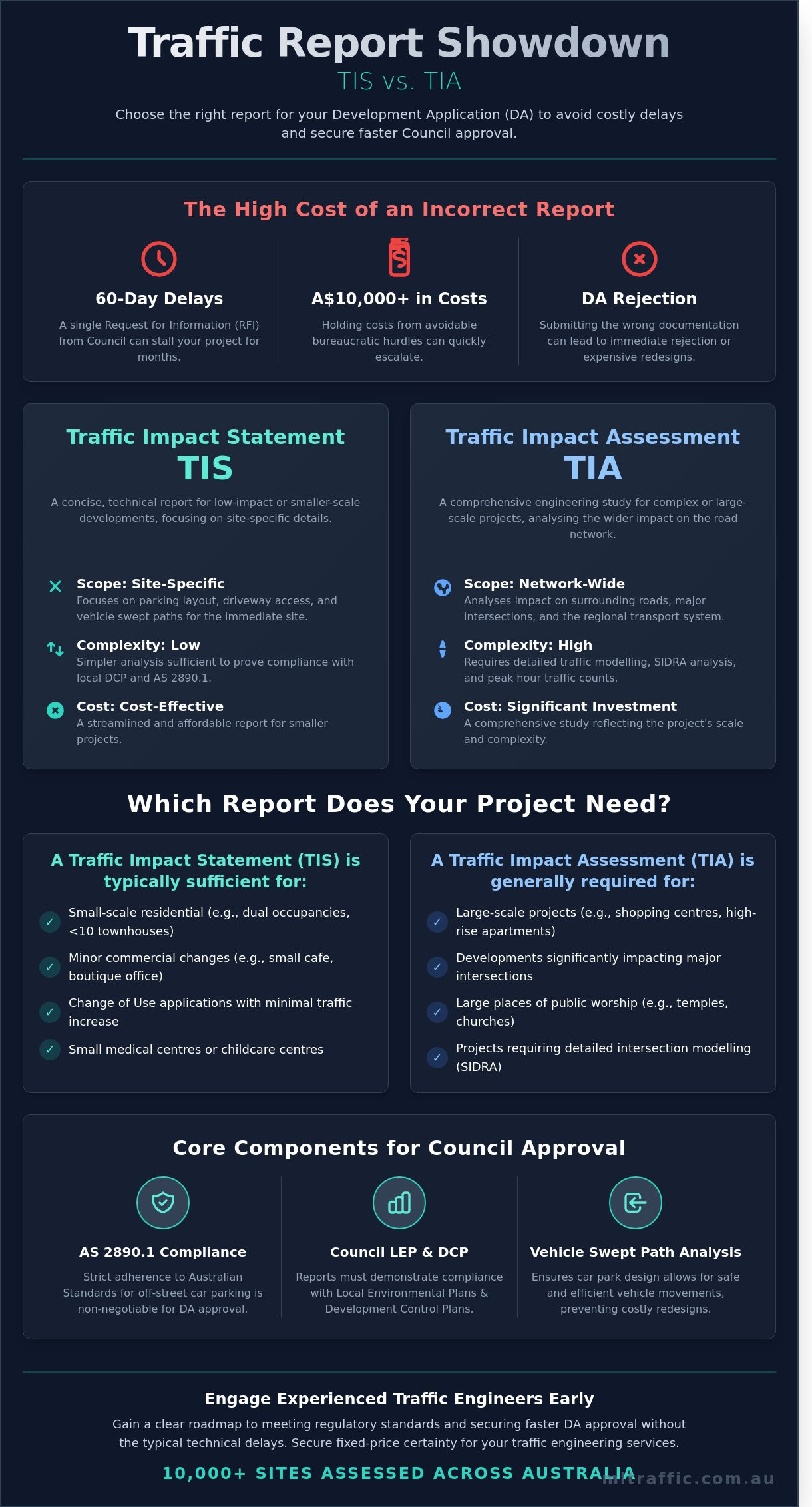
A single Request for Information (RFI) from Council can stall your development for 60 days and add over A$10,000 in holding costs. You shouldn’t have to guess which technical report satisfies local planning requirements or risk your Development Application (DA) being stalled by avoidable bureaucratic hurdles. Most developers find the technical jargon surrounding transport planning frustrating, and submitting the wrong documentation often leads to immediate DA rejection or expensive, last-minute redesigns.
This guide provides a professional comparison of a traffic statement vs traffic impact assessment to ensure you commission the correct report the first time. We’ve managed over 10,000 sites across Australia and understand exactly what Council planners require for different land-use scales. We’ll help you identify the specific triggers for each report type and how to secure fixed-price certainty for your traffic engineering services. You’ll gain a clear roadmap to meeting AS 2890.1 standards and securing faster DA approval without the typical technical delays that plague modern developments.
Key Takeaways
-
Determine whether your project requires a TIS or a TIA to meet Council expectations and avoid unnecessary delays in the DA process.
-
Identify the specific land-use thresholds where a Traffic Impact Statement provides sufficient evidence for parking demand and site access.
-
Understand the critical triggers for a comprehensive traffic statement vs traffic impact assessment, particularly when intersection modelling is required.
-
Learn how technical assessments like vehicle swept path analysis ensure compliance with AS 2890.1 and protect your car park design from refusal.
-
Gain insights into engaging experienced traffic engineers early to secure a compliant, cost-effective report that satisfies Australian regulatory standards.
Table of Contents
-
Defining Traffic Statements and Impact Assessments for Developers
-
Traffic Statement vs Traffic Impact Assessment: Comparison Table
Defining Traffic Statements and Impact Assessments for Developers
Securing approval for a Development Application (DA) in Australia requires clear evidence that a project won’t compromise the safety or efficiency of the local road network. Local Councils mandate technical reports to evaluate how a new build affects vehicle movements and pedestrian safety. Understanding the technical requirements of a traffic statement vs traffic impact assessment is essential for developers to avoid unnecessary delays and budget overruns during the planning phase.
Every report we produce at ML Traffic Engineers adheres strictly to Australian Standards, specifically AS 2890.1 for off-street car parking. Since 2005, we’ve completed over 10,000 site assessments, ranging from small residential subdivisions to massive industrial warehouses. The primary objective of these documents is to demonstrate that the proposed development complies with Council’s Local Environmental Plans (LEP) and Development Control Plans (DCP). We focus on delivering professional, fact-based reports that satisfy both the developer’s needs and the regulatory requirements of authorities.
To better understand this concept, watch this helpful video:
The core of any traffic report involves quantifying the expected increase in vehicle trips. For larger projects, engineers must calculate the Intersection Capacity Utilization to determine if existing infrastructure can absorb the added load. Our traffic engineering services ensure that every aspect of the site layout, including driveway ramp grades and sight-line assessments, meets the necessary safety benchmarks. At our firm, the traffic consultant who provides the quote, does the work, ensuring direct accountability for every DA submission.
What is a Traffic Impact Statement (TIS)?
A Traffic Impact Statement (TIS) is a concise, technical report designed for low-impact or smaller-scale developments. It focuses primarily on site-specific details such as parking layout, vehicle swept paths, and minor traffic generation. We typically prepare a TIS for change of use applications, small medical centres, or residential subdivisions with fewer than 10 lots. It’s a cost-effective way to prove that a small project won’t disrupt the immediate street environment or violate AS 2890.1 standards.
What is a Traffic Impact Assessment (TIA)?
A Traffic Impact Assessment (TIA) is a comprehensive engineering study required for complex or large-scale projects like shopping centres, high-rise apartments, or large temples. Unlike a TIS, a TIA analyses the broader impact on the surrounding road network and major intersections. It requires detailed traffic modelling, SIDRA analysis, and peak hour traffic counts. This report provides a deep dive into how a development influences the regional transport system, ensuring long-term efficiency and safety for all road users.
When is a Traffic Impact Statement (TIS) Sufficient?
Determining the appropriate level of documentation is the first step in any successful Development Application (DA). For many small-scale projects, a full-scale analysis is unnecessary. The decision between a traffic statement vs traffic impact assessment usually rests on the volume of additional vehicle trips generated. A TIS is a concise, professional report that confirms a proposal complies with local Council Development Control Plan (DCP) requirements and Australian Standards.
While specific triggers vary by local government area, the Caltrans traffic impact study guidelines provide a global benchmark for technical proportionality. They suggest studies can range from simple traffic counts to complex simulations. For most minor Australian developments, the simpler TIS provides enough evidence to satisfy a Council’s Statement of Environmental Effects (SEE). This streamlined approach reduces lead times and lowers consultancy costs for developers.
Typical TIS Land-Use Scenarios
A TIS is generally acceptable when the development’s impact on the surrounding road network is negligible. Common scenarios include:
-
Small-scale residential: This includes dual occupancies, secondary dwellings, or small townhouse clusters (typically under 10 units) that don’t trigger major intersection upgrades.
-
Minor commercial changes: Converting a small retail shop into a 40-square-metre cafe or a boutique office space often requires only a TIS.
-
Negligible traffic generation: Projects where the new use generates a similar or lower traffic volume than the existing, approved use.
-
Internal alterations: Fit-outs or mezzanine additions that increase floor area without significantly changing the building’s external footprint or parking demand.
Key Components of a TIS Report
A compliant TIS must be technical and data-driven to withstand Council scrutiny. Our reports focus on three primary pillars:
-
Site Analysis: We document existing conditions, including site frontage, road hierarchy, and current access points.
-
Parking Demand: We assess the proposed parking supply against the specific rates defined in the local Council DCP and AS 2890.1. If there’s a shortfall, we provide a technical justification based on empirical data.
-
Vehicle Swept Paths: Using specialised software, we simulate vehicle movements to prove that the largest expected vehicle, such as a B85 car or a small delivery van, can enter and exit the site in a forward direction.
Choosing a TIS for simple projects ensures you don’t over-invest in unnecessary data. You can review our full range of traffic engineering services to see which report fits your project scale. Our senior engineers personally handle these assessments to ensure every TIS is accurate and compliant with current transport regulations.
Triggers for a Full Traffic Impact Assessment (TIA)
A Traffic Impact Assessment (TIA) is necessary when a development’s operational footprint extends beyond the immediate site boundary. While a basic statement might suffice for low-impact changes, a TIA addresses the broader implications for the local road network. The decision regarding a traffic statement vs traffic impact assessment usually rests on whether the project will alter the performance of existing infrastructure. Professional engineers use TIAs to prove that the surrounding network can absorb the new traffic without compromising safety or efficiency.
Complex land uses often require this level of detail. For example, a childcare centre with 50 places or a 2,000sqm warehouse generates concentrated bursts of activity during peak periods. If your development moves more than 50 vehicles per hour through a single intersection, council will likely mandate a full TIA. This document serves as a technical justification for the project, often proposing mitigation strategies like dedicated turn lanes or new traffic signals to maintain network stability. Our traffic engineering services provide the technical depth needed to address these requirements.
Common TIA Trigger Points
Authorities use specific metrics to determine if a TIA is required for a Development Application (DA). These triggers ensure that significant projects undergo the necessary scrutiny before approval. Common triggers include:
-
Peak Hour Thresholds: Traffic generation exceeding 50 to 100 trips in a single peak hour, depending on local council guidelines.
-
Road Hierarchy: Direct access to, or proximity within 100 metres of, a state-controlled road or a major signalised intersection.
-
Heavy Vehicle Requirements: Sites requiring access for vehicles exceeding 12.5 metres, such as Articulated Vehicles (AVs) or B-doubles.
-
High-Intensity Land Use: Fast food outlets, service stations, and large-scale residential flat buildings with more than 50 dwellings.
Advanced Engineering Analysis in a TIA
A TIA involves technical depth that a standard statement lacks. It’s a data-driven document that relies on empirical evidence rather than qualitative descriptions. Key components include:
-
SIDRA Modelling: Detailed analysis of intersection delay, queue lengths, and Level of Service (LoS) ratings to ensure the network doesn’t fail.
-
Cumulative Impact: Assessing the combined effect of your project and other approved developments within a 500-metre radius.
-
Safety Audits: Evaluating sight distance and access points according to AS 2890.1 and AS 2890.2 standards.
-
Swept Path Analysis: Using software to ensure the largest expected vehicles can manoeuvre safely without encroaching on opposing lanes.
When comparing a traffic statement vs traffic impact assessment, the TIA is the definitive tool for resolving complex engineering objections from council or state road authorities like TfNSW or DTMR.
Traffic Statement vs Traffic Impact Assessment: Comparison Table
Selecting the correct report between a traffic statement vs traffic impact assessment is a critical technical decision for your development application. Choosing the simpler Traffic Impact Statement (TIS) for a project that warrants a full Traffic Impact Assessment (TIA) is a common cause of avoidable delays. Professional scoping ensures your submission matches Council expectations and specific land-use requirements.
| Feature | Traffic Impact Statement (TIS) | Traffic Impact Assessment (TIA) |
|---|---|---|
| Primary Scope | Site-specific; focuses on internal layout and immediate frontage. | Network-wide; evaluates multiple intersections and road capacity. |
| Typical Project Size | Small scale (e.g., 5-10 apartments, small childcare, boutique retail). | Large scale (e.g., 50+ apartments, shopping centres, industrial hubs). |
| Data Requirements | Desktop analysis, existing traffic counts, and AS 2890.1 compliance. | Live traffic surveys, SIDRA modelling, and 10-year growth projections. |
| Estimated Cost | A$1,500 – A$3,500+ | A$6,000 – A$15,000+ |
| Timeline | 1 – 2 weeks | 3 – 6 weeks |
Key Differences at a Glance
A TIS is a concise document. It proves your development won’t disrupt the immediate street and that your car park design is functional. We focus on vehicle swept paths and driveway safety. In contrast, a TIA is a deep dive into the local transport network. It requires sophisticated modelling to predict how your project affects peak hour congestion at nearby signalised intersections. Council risk is lowest when the report type matches the projected trip generation rates of your specific land use.
The Cost of Getting it Wrong
Submitting an inadequate TIS to save on initial costs is a high-risk strategy. If Council’s traffic engineer determines the trip generation exceeds thresholds, they’ll issue a formal Request for Further Information (RFI). This stops the clock on your DA. You’ll then have to commission a full TIA anyway, often paying more for an urgent turnaround. This mistake can add 8 to 12 weeks to your approval timeline and thousands in holding costs.
The cheapest quote often leads to the longest approval times because it lacks the technical depth to satisfy RPEQ standards or Council’s specific planning overlays. We recommend getting professional scoping advice early. You can review our full range of technical capabilities at ML Traffic Services to ensure your project starts with the right documentation. Expert advice prevents the "double-handling" of reports and keeps your DA moving toward a decision.
Need certainty on your report requirements?
Contact our senior engineers for a direct project assessment.
How to Secure Council Approval with a Compliant Report
Securing a Development Application (DA) approval requires a report that satisfies both Council planners and traffic engineers. Whether your project triggers a traffic statement vs traffic impact assessment, the quality of the technical data determines the outcome. Engaging an experienced traffic consultant during the initial design phase is the most effective way to avoid delays. If you wait until the design is finalised to consider traffic flow, you risk expensive revisions when Council identifies non-compliance with Australian Standards.
Our engineers focus on identifying potential "deal-breakers" before you lodge your application. We evaluate the site’s constraints against local government requirements and state-wide planning policies. This proactive approach ensures that the traffic statement vs traffic impact assessment you submit is robust, defensible, and fact-based. We don’t guess; we use industry-standard software and decades of experience to prove your development works.
Integrating Traffic Engineering into Your Design
A successful design balances yield with functionality. We use Swept Path Analysis to verify that the largest expected vehicles can safely navigate your site. This is critical for verifying driveway widths and ramp grades. For residential developments, we ensure every parking space and aisle complies with AS 2890.1. For commercial or industrial sites, we apply AS 2890.2 to manage heavy vehicle turn circles and loading bay requirements.
Our team also specialises in justifying departures from standard Council parking rates. We assess parking demand using empirical data and site-specific factors to show that your development won’t create an overspill onto local streets. We also prioritise safe pedestrian and vehicle interaction. This includes assessing sight-lines at property boundaries and ensuring internal walkways are clearly defined and safe for all users.
Why Choose ML Traffic Engineers?
ML Traffic Engineers has been trading since 2005, providing expert advice across 10,000+ sites nationally. Our firm is built on a "no-gatekeepers" philosophy. The traffic consultant who provides your quote is the senior engineer who does the work. This ensures accountability and technical accuracy from the first phone call to the final report. You’ll have direct access to senior principals Michael Lee and Benny Chen, who bring between 30 and 40 years of experience each to your project.
-
Direct principal involvement on every project, regardless of size.
-
Comprehensive experience across all land-use types, from childcare centres to industrial warehouses.
-
Fast turnaround times for RPEQ-certified reports that meet strict Council deadlines.
-
A reputation for no-nonsense, fact-based assessments that Council officers trust.
We understand the bureaucratic requirements of traffic engineering inside and out. Our reports are designed to answer Council’s questions before they’re even asked. Ready to start? Contact our team today to discuss your project requirements and receive a professional fee proposal.
Secure Your Development Approval with Technical Precision
Choosing between a traffic statement vs traffic impact assessment is a critical step in your planning process. Small-scale developments typically require a TIS to verify compliance with AS 2890.1. Larger projects trigger a full TIA to address broader road network impacts. Miscalculating these requirements results in avoidable Council delays and increased costs. Accurate reporting from the start protects your project’s timeline.
ML Traffic provides the certainty you need. We’ve assessed over 10,000 sites across Australia during our 15 years in operation. You’ll have direct access to senior RPEQ and NER engineers throughout the entire process. The consultant who quotes your job is the one who completes the work. This hands-on approach ensures every technical detail is handled with professional rigor. We don’t use junior staff or middle management to filter your project. You get direct expertise and reports that stand up to Council scrutiny.
Get a fixed-price quote for your Traffic Report from the experts at ML Traffic.
We look forward to helping you achieve a successful DA outcome.
Frequently Asked Questions
Is a Traffic Impact Statement the same as a Traffic Impact Assessment?
A Traffic Impact Statement (TIS) is not the same as a Traffic Impact Assessment (TIA). A TIS is a concise report for low-impact developments, such as a 4-unit townhouse project or a small medical clinic. A TIA is a comprehensive technical document required for high-density apartments or shopping centres. It involves detailed intersection modelling and traffic volume projections to satisfy Council requirements under Australian Standards.
How much does a Traffic Impact Statement cost compared to a TIA?
A Traffic Impact Statement generally costs between A$1,500 and A$3,500 depending on the project complexity. In contrast, a TIA often starts at A$5,000 and can exceed A$15,000 for major infrastructure projects. The price difference reflects the additional hours required for SIDRA intersection modelling and extensive data collection. At ML Traffic Engineers, the consultant who provides your quote performs the actual technical work.
Can I prepare my own Traffic Impact Statement for a small development?
You cannot prepare your own traffic report because Councils require certification from a qualified traffic engineer. Most Australian local government authorities insist on reports signed by an RPEQ or a professional with equivalent engineering qualifications. A self-prepared document lacks the technical authority of an AS 2890.1 compliance check. This often leads to the immediate rejection of your Development Application (DA).
What happens if the Council asks for a TIA after I’ve submitted a TIS?
If Council requests a TIA after you’ve submitted a TIS, you must commission a more detailed study. This usually occurs when a Council officer determines the 24-hour traffic generation exceeds their initial threshold for minor impact. You’ll need to pay for additional data collection and modelling. Choosing the correct traffic statement vs traffic impact assessment early saves 4 to 6 weeks in the DA process.
How long does it take for a traffic engineer to prepare these reports?
A Traffic Impact Statement typically takes 5 to 10 business days to complete from the site inspection date. A full TIA requires 3 to 5 weeks because it involves coordinating external traffic count contractors and performing complex software simulations. We focus on direct delivery to ensure your report meets the 14-day or 21-day deadlines often set by project managers or developers during the RFI stage.
What information do I need to provide to get a quote for a traffic report?
You must provide the site address, a full set of architectural floor plans, and the proposed land-use details. Include any Request for Further Information (RFI) letters from the Council if you’ve already filed your DA. We need the exact number of residential units, the Gross Floor Area (GFA) for commercial sites, and the number of proposed car parking spaces to calculate the fee accurately.
Does a TIA always require new traffic counts and surveys?
A TIA almost always requires fresh traffic surveys if existing data is more than 24 months old. Council planners rarely accept outdated figures from 2021 or earlier for high-impact developments. We typically commission 7-day pneumatic tube counts or peak-period intersection turning counts. This ensures the traffic statement vs traffic impact assessment accurately reflects current road network conditions and peak hour volumes.
Will a traffic report guarantee my DA approval?
A traffic report does not guarantee DA approval, but it eliminates technical grounds for refusal. Our reports demonstrate that your development complies with AS 2890.1 and local planning schemes. While the Council makes the final decision, a professional report signed by an experienced engineer provides the necessary evidence to overcome 90% of traffic-related objections from planning officers or community groups during the assessment period.
Which areas do you cover?
We are traffic engineers servicing Melbourne, Sydney, Brisbane, Gold Coast, Hobart, Perth, Adelaide, Darwin, Canberra and surrounding areas.

Disclaimer
The content on www.mltraffic.com.au, including all technical articles, guides, and resources, is provided for general informational and educational purposes only. It is not intended to constitute professional advice in traffic engineering, transportation planning, development approvals, or any other technical or legal field.
While ML Traffic Engineers makes every reasonable effort to ensure the accuracy, completeness, and timeliness of the information published, we do not provide any warranties or representations (express or implied) regarding its reliability, suitability, or availability for any particular purpose. Any reliance you place on the content is strictly at your own risk.
In no event shall ML Traffic Engineers, its directors, employees, authors, or affiliates be liable for any direct, indirect, incidental, special, consequential, or punitive damages (including, without limitation, loss of profits, data, or business opportunities) arising out of or in connection with the use of, or inability to use, any information provided on this website.
The articles and guides on this site are not a substitute for engaging a qualified, registered professional traffic engineer (such as an NPER or RPEQ engineer) to assess your specific project requirements. For tailored advice, compliance assessments, or traffic engineering services, please contact a competent professional.
This disclaimer may be updated from time to time without notice. By accessing or using this website, you agree to be bound by the most current version of this disclaimer.
