

What if a single week of data could shave three months off your Council approval timeline? For many developers, a precise Traffic Volume Survey is the only thing standing between a stalled project and a successful DA. You likely already know that Council officers are becoming more rigorous with their requirements. It’s frustrating to face delays because of technical jargon like ATC or MCC, especially when every week of waiting costs your project money.
At ML Traffic Engineers, we’ve seen how professional data can turn a skeptical planning officer into a supporter. We’ve completed over 10,000 site assessments since 2005, and we know that raw numbers alone aren’t enough. You need a report that translates those numbers into a compelling case for your site’s capacity. This guide explains how to secure fast-tracked approvals through cost-effective engineering solutions. We’ll show you exactly how to use professional surveys to clarify your site’s potential and satisfy Council requirements without the usual stress.
Key Takeaways
- Understand why Council demands specific data to assess safety and community impact, ensuring your DA meets strict Australian planning requirements.
- Learn how to select the most cost-effective Traffic Volume Survey method, from pneumatic tubes to AI video, to provide the precise data your report requires.
- Discover why the 8:00 AM and 5:00 PM peak hour windows are the critical data points needed to build a persuasive Traffic Impact Assessment (TIA).
- Avoid common planning pitfalls by mastering the “Golden Rule” of survey timing and identifying exactly which roads fall within your project’s Zone of Influence.
- See how 15+ years of specialist engineering experience can streamline your approval process with a hands-on approach where the consultant who quotes your project also delivers the work.
Table of Contents
- Traffic Volume Survey: The Secret Weapon for Your Development Application
- The 3 Most Common Methods for Collecting Traffic Data in Australia
- From Raw Numbers to DA Approval: The TIA Connection
- Planning Your Survey: Timing, Location, and Common Pitfalls
- Why ML Traffic Engineers is Your Best Bet for Council Approval
Traffic Volume Survey: The Secret Weapon for Your Development Application
A Traffic Volume Survey is a technical assessment used in 2026 Australian planning to quantify the number and type of vehicles using a specific road or intersection. In the current regulatory environment, it’s no longer a simple tally of cars passing a point. It’s a data-driven snapshot that includes heavy vehicle percentages, cyclist movements, and pedestrian interactions. This data allows us to model how your proposed development will integrate with the existing transport network. A standard Traffic count serves as the foundation for these reports, helping engineers calculate Average Annual Daily Traffic (AADT) and peak hour flow rates required for Council approval.
Council planners demand these surveys because they have a legal obligation to maintain road safety and network capacity. They look for compliance with Australian Standards, specifically AS 2890.1 for off-street parking and various Austroads guidelines for intersection performance. If your development adds 50 trips during the morning peak to an already congested intersection, Council needs to see the empirical evidence of how that impact will be managed. Without a professional survey, your application relies on guesswork, which leads to immediate rejection or costly delays.
To better understand the technical process of data collection in the field, watch this helpful video:
Distinguishing between counting cars and analyzing movement patterns is where professional expertise becomes vital. Raw numbers tell you how many vehicles are there, but movement analysis tells you where they’re going. We track turning movements at intersections to identify if a specific right-turn lane is failing. We also look at the “gap acceptance” for vehicles exiting your site. This level of detail is what separates a successful Traffic Volume Survey from a basic count. It provides the “why” behind the traffic behavior, not just the “how many.”
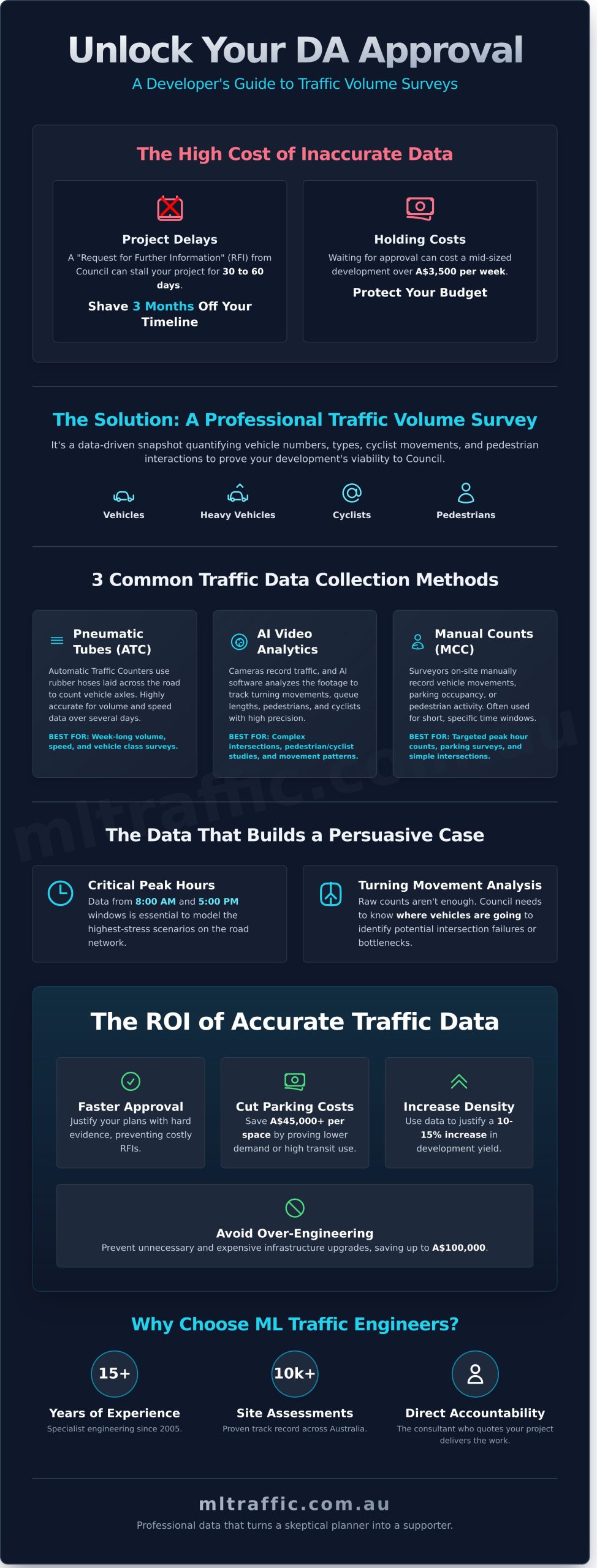
Missing or inaccurate data is the primary cause of the “Request for Further Information” (RFI) nightmare. When a Council officer spots a discrepancy in your traffic claims, they’ll issue an RFI that can stall your project for 30 to 60 days. In 2026, holding costs for a mid-sized development site can exceed A$3,500 per week. By submitting a report verified by a qualified engineer from the start, you eliminate these bureaucratic hurdles. At ML Traffic Engineers, the traffic consultant who provides the quote, does the work, ensuring that the person defending your data at Council is the same person who collected it.
Why Raw Data Isn’t Enough for Council
State government “Viewer” data or historical census figures are often too generic for a site-specific Development Application (DA). Most public data is 3 to 5 years old and doesn’t reflect 2026 local growth or recent nearby developments. Site-specific surveys prove your project won’t cause gridlock by using real-time, local conditions. Professional verification builds immediate trust with planning officers. They’re more likely to approve an application when the data is backed by an RPEQ-certified engineer who understands local traffic nuances.
The ROI of Accurate Traffic Data
Precision data can justify a 10% to 15% increase in development density or a reduction in on-site parking requirements. If we prove that local transit usage is high, you might avoid building an extra basement level, saving upwards of A$45,000 per parking space. Accurate surveys also prevent over-engineering. You shouldn’t be forced to pay for a A$100,000 intersection upgrade if the data shows the current infrastructure can handle your site’s load. A Traffic Volume Survey is the mandatory bridge between your initial site plan and final Council approval.
The 3 Most Common Methods for Collecting Traffic Data in Australia
Selecting the correct technology for your Traffic Volume Survey depends on your specific development goals. You don’t need a sledgehammer to crack a nut, but you do need enough data to satisfy Council and state road authorities. In Australia, we follow the Austroads Guide to Traffic Management (AGTM03) to ensure every count meets national standards. Modern “set and forget” technology has largely replaced the days of manual counters sitting on lawn chairs, providing higher accuracy and lower costs for developers.
The method you choose impacts both the upfront cost and the depth of the resulting report. A misaligned strategy can lead to data gaps, often resulting in a 3 to 6 month delay in the Development Application process. We’ve seen projects stall because a simple volume count was used where a detailed turning movement analysis was required. Our approach ensures the consultant who provides your quote is the one doing the work, maintaining accountability from the first sensor placement to the final report submission.
Automatic Traffic Counters (ATC)
Pneumatic tubes are the industry workhorse for 24/7 data collection. These rubber hoses stretch across the pavement and record a pulse every time a pair of axles passes over them. They’re ideal for capturing volume and speed profiles over a full 7 day period. This method provides the 85th percentile speed data essential for sight-line assessments. For broader context on how these systems integrate into larger networks, the Traffic Monitoring Guide provides a deep dive into standardized data collection procedures. While cost-effective at roughly A$450 per location, tubes can’t distinguish specific turning movements at busy junctions.
Manual Coordination Counts (MCC) and Video Surveys
When your project involves a busy intersection, you need to understand Intersection Turning Movements (ITM). Knowing that 800 vehicles passed a point is useless unless you know how many turned into your proposed site. We now use AI-powered video units that offer 99% accuracy in vehicle classification. These cameras don’t just count cars; they distinguish between heavy vehicles, cyclists, and pedestrians simultaneously. This level of detail is vital for complex Australian intersections where safety and multi-modal transport are priorities for local councils.
Matching Method to Compliance Requirements
Compliance with AGTM03 is non-negotiable for RPEQ-certified reports. Each method has a specific place in a Traffic Impact Assessment (TIA):
- Pneumatic Tubes: Best for mid-block counts, speed limit reviews, and 168-hour volume profiles.
- AI Video Surveys: Essential for peak hour (AM/PM) intersection analysis and pedestrian density studies.
- Manual Oversight: Necessary for highly complex sites where temporary roadworks or unusual lane configurations confuse automated systems.
A standard 12 hour video survey with AI analysis might cost A$1,200, but it provides the granular data needed for SIDRA modeling. If you’re unsure which method fits your project’s scope, you can request a technical review from our senior engineers. We’ve completed over 10,000 site assessments since 2005, ensuring that the data we collect is exactly what authorities need to see. Using the right tool the first time prevents the need for expensive re-surveys and keeps your development timeline on track.
From Raw Numbers to DA Approval: The TIA Connection
A Traffic Volume Survey provides the raw data, but the Traffic Impact Assessment (TIA) is what actually secures your Development Application (DA) approval. We don’t just hand you a spreadsheet of vehicle counts; we translate those figures into a technical narrative that satisfies Council requirements. This process begins by isolating the peak hour windows, specifically 8:00 AM and 5:00 PM. These periods represent the highest stress on the local road network. If we can prove your development functions efficiently during these windows, Council has little grounds to reject the proposal based on traffic grounds.
We compare your site’s predicted traffic against the existing background flow to determine the percentage of impact. This isn’t guesswork. We use Advanced Travel Modeling principles to simulate how your project’s 40 or 50 additional peak-hour trips interact with current queue lengths and delay times. Our engineers look at the saturation of nearby intersections to ensure your development doesn’t push a local street past its design capacity. To understand how this fits into a broader project scope, you can explore our full range of traffic engineering services.
Understanding Trip Generation Rates
Trip generation is the calculation of how many vehicles will enter and exit your site once it’s operational. We use specific rates from the Transport for NSW (TfNSW) Guide to Traffic Generating Developments or similar state-specific databases. It’s vital to use current 2026 growth projections and recent survey data. Relying on 2016 or 2021 census figures is a common mistake that leads to Council issuing a Request for Further Information (RFI).
Council planners want to see that your development “fits” within the current road hierarchy. If a proposed childcare centre adds 25 trips during the morning drop-off, we must demonstrate that the 25 cars won’t cause the existing queue at the nearest traffic light to spill back into your driveway. We use the Traffic Volume Survey data to provide this evidence, moving the conversation from subjective “concerns” to objective engineering facts.
Level of Service (LoS) Explained
Level of Service, or LoS, is the report card Council uses to grade your project. It’s a qualitative measure that describes operational conditions within a traffic stream. The grades range from LoS A to LoS F:
- LoS A: Free-flow conditions where drivers are virtually unaffected by others in the traffic stream.
- LoS B: Stable flow, but the presence of other users is noticeable.
- LoS C: Stable flow, but most drivers are restricted in their freedom to select speed.
- LoS D: High-density flow where speed and freedom to manoeuvre are severely restricted.
- LoS E: Operating conditions at or near capacity; any disruption will cause queues.
- LoS F: Forced or breakdown flow; the classic “car park” scenario.
A high-quality Traffic Volume Survey can often prove that a project is more viable than it looks on paper. For instance, we’ve managed projects where detailed modeling showed that adding a dedicated left-turn lane could move an intersection from LoS D to C, even with the new development traffic. Council generally expects an intersection to maintain its current LoS or, at the very least, not drop below LoS D in urban Australian environments. We provide the technical justification to show your project meets these benchmarks.
Planning Your Survey: Timing, Location, and Common Pitfalls
A Traffic Volume Survey is a precision tool, but its accuracy depends entirely on when and where you use it. If you collect data at the wrong time, you aren’t just getting bad numbers; you’re risking a direct rejection from Council. We’ve seen developers forced to repeat entire week-long studies because they overlooked a local public holiday or a minor roadwork project three blocks away. This isn’t just a delay. It’s a significant financial hit of A$3,000 or more that can stall your DA for months.
The “Golden Rule” in traffic engineering is simple: never conduct your count during school holidays. During these periods, traffic volumes in Australian metropolitan corridors often drop by 15% to 25%. Commuter patterns change, and school-run congestion disappears. If your data shows these lower volumes, Council will correctly argue that your assessment doesn’t reflect the “worst-case” or even the “average” scenario. You need representative data that shows the road network under its usual stress levels.
You also need to define the “Zone of Influence” correctly. Council isn’t just interested in the street directly in front of your site. They generally require data on any intersection or road segment where your development will increase traffic by more than 5% of the existing base flow. Identifying these specific locations early prevents the need for supplemental surveys later. We analyze the local network to ensure every road Council cares about is included in the initial scope of the Traffic Volume Survey.
External factors like weather and roadworks are the most common causes of data invalidation. A single day of heavy rain can reduce traffic counts by 12% as people stay home or change travel modes. Similarly, a two-day utility repair nearby can divert thousands of vehicles away from your sensors. We’ve seen A$4,500 survey budgets wasted because a developer didn’t check the local council’s works schedule. We handle the scheduling meticulously to avoid these pitfalls.
The Developer’s Survey Checklist
Success requires a clean window of observation. Use this checklist to ensure your data stands up to scrutiny:
- Verify there are no major roadworks or lane closures planned near your site during the survey window.
- Avoid all public holidays and major local events, such as regional festivals or sporting finals, which create artificial peaks.
- Ensure the survey captures “representative” traffic by avoiding the first and last weeks of the school term.
Dealing with “Atypical” Traffic
If your site is near a major school or an industrial hub, “standard” traffic patterns don’t apply. We adjust our collection methods to capture these unique peaks, ensuring the data reflects the reality of your specific location. We also apply seasonal variation factors to account for shifts in Australian traffic throughout the year. Learn more about our team’s 15+ years of experience in managing these complex variables.
A poorly timed survey is a complete waste of money. Don’t leave your data to chance. Contact ML Traffic Engineers to schedule your survey and ensure your application moves forward without costly recounts.
Why ML Traffic Engineers is Your Best Bet for Council Approval
Securing a Development Application (DA) shouldn’t feel like a gamble. When you commission a Traffic Volume Survey, you’re not just buying a spreadsheet of vehicle counts; you’re investing in the technical foundation of your project’s approval. At ML Traffic Engineers, we’ve refined a process that eliminates the friction between private developers and local government authorities. We understand that your timeline is critical, and our reports are designed to withstand the most rigorous Council scrutiny.
Our “ML Signature” is a promise of direct accountability. In many large, bureaucratic firms, a senior partner signs the quote while a junior graduate performs the actual analysis. We don’t operate that way. The consultant who provides your initial quote is the same engineer who conducts the work and stands behind the report. This hands-on approach ensures that nothing is lost in translation from the site visit to the final submission. It’s a transparent way of working that prioritizes your project’s success over corporate hierarchy.
Experience is our strongest asset. Since 2005, we have successfully managed over 10,000 sites across Australia. This isn’t just a high number; it represents a deep database of local Council requirements from Sydney to Perth. We’ve worked on every land-use type imaginable, including apartments, childcare centres, medical clinics, and industrial warehouses. We know exactly what a Council engineer looks for because we’ve answered their technical questions thousands of times before. This history allows us to anticipate issues before they become costly delays.
Data alone won’t get your DA over the line. We provide a comprehensive strategy that interprets the numbers. If a Traffic Volume Survey reveals a potential bottleneck, we don’t just report the problem. We provide the engineering solution, whether that involves a Vehicle Swept Path Assessment or a revised Car Parking Demand Assessment. By integrating technical data with practical site constraints, we ensure your project remains viable and compliant. We’ve seen projects stall because of poorly presented data; we make sure yours isn’t one of them.
Personal Accountability in Every Report
We take a no-nonsense approach to traffic engineering. Every report is backed by the authority of a registered engineer. Whether you need an RPEQ sign-off or a registered professional, we provide the credentials. Our reputation with local Councils is your biggest advantage; they trust our compliance with Australian Standards like AS 2890.1. This trust often results in faster turnaround times and fewer requests for further information.
Ready to Start Your Project?
Don’t navigate transport planning alone. We offer a direct line to senior principals Michael Lee and Benny Chen. There are no junior gatekeepers; you get professional advice immediately. We handle everything from the initial survey to the final submission across Australia. Contact Michael Lee or Benny Chen today for a direct quote and let’s get your development moving forward.
Secure Your Council Approval with Precision Data
Success for your development application hinges on the quality of your technical data. By choosing the right collection methods and timing your data capture correctly, you eliminate the guesswork that often leads to council RFI requests. A precise Traffic Volume Survey provides the objective evidence required to satisfy Australian Standards and move your project forward. It’s the difference between a stalled application and a successful site assessment.
ML Traffic Engineers offers the reliability you need for a seamless approval process. We’ve spent over 15 years assisting Australian developers and have completed more than 10,000 successful site assessments. You’ll work directly with our principals on every project. We don’t pass your work to juniors; the expert who quotes your job is the one who delivers the results. This hands-on approach ensures your Traffic Impact Assessment is robust, compliant, and ready for scrutiny.
Don’t let poor data stall your progress. Get started with a team that understands the technicalities of the Australian planning landscape and delivers results without the bureaucracy.
Get a Professional Traffic Survey Quote for Your DA
We’re ready to help you navigate the complexities of traffic engineering and get your project approved.
Frequently Asked Questions
How much does a traffic volume survey cost in Australia?
A standard pneumatic tube traffic volume survey in Australia typically costs between A$600 and A$1,200 per location. If your project requires complex intersection counts using video technology, prices usually range from A$1,500 to A$3,500 depending on the number of movements tracked. These figures cover equipment setup, data collection over 7 days, and the final technical report required for your application. Out of town locations incur travel disbursements.
How long do I need to conduct a traffic count for a DA?
Most Australian Councils require a traffic count to cover a minimum of 7 consecutive days to capture a full weekly profile. For intersection specific assessments, we conduct manual counts during the morning peak from 7:00 AM to 9:00 AM and the afternoon peak from 4:00 PM to 6:00 PM. It’s vital to collect this data during a standard school term to ensure the results aren’t skewed by holiday traffic patterns.
Can I use Transport for NSW (TfNSW) data instead of a new survey?
You can use TfNSW data only if the recording station is within 100 metres of your site and the data is less than 12 months old. Most existing government data is either outdated or located on major state roads rather than the local streets where your development access is proposed. If the available data is older than 2 years, Council will likely reject it and require a fresh Traffic Volume Survey.
What is the difference between an ATC and an MCC survey?
An Automatic Traffic Counter (ATC) uses pneumatic tubes to record vehicle volumes and speeds over a 24 hour period for several days. A Manual Classified Count (MCC) uses video or observers to record specific vehicle types and turning movements at an intersection during peak hours. ATCs provide broad volume trends, while MCCs provide the granular data we need for SIDRA intersection modelling and detailed capacity analysis.
Do I need a traffic volume survey for a small residential subdivision?
You’ll generally need a survey if your subdivision creates 3 or more additional lots or if the site access has restricted sight distance. Councils often require specific volume data to confirm the local road network can handle the 10 daily vehicle trips typically generated by each new dwelling. Even small scale developments must prove they comply with AS 2890.1 standards for safe property access and traffic flow.
What happens if the traffic survey shows the road is already at capacity?
If a road is at capacity, we use the survey data to perform a Level of Service (LoS) analysis to show your project’s impact is negligible. A development might only add 5 vehicles to a peak hour flow of 1,200, representing a tiny 0.4% increase. We use these specific numbers to argue that the development won’t worsen existing conditions, which helps you avoid high developer contributions for road upgrades.
How long is a traffic volume survey valid for in the eyes of Council?
A traffic survey is typically considered valid by Australian planning authorities for 12 to 24 months. If a major development has opened nearby or the road network has been modified since your count, Council will demand an update. We suggest scheduling your counts within 6 months of your DA submission. This ensures the data is current, defensible, and reflects the actual traffic environment during the assessment.
Can a traffic volume survey help me reduce my required parking spots?
A Traffic Volume Survey combined with a parking occupancy study can successfully justify a reduction in on-site parking requirements. If we demonstrate that local street parking stays below 85% capacity or that your land use generates less demand than standard Council rates, you can save on construction costs. This evidence-based approach is the most reliable way to negotiate a variation from rigid Development Control Plan requirements.
Which areas do you service?
We are traffic engineers covering Melbourne, Sydney, Brisbane, Gold Coast, Hobart, Perth, Adelaide, Darwin and surrounding areas. Out of town locations incur travel disbursements.
