

With boom gates previously down for up to 20 minutes every hour during peak periods, the $870 million Tram Grade Separation Projects Adelaide are fundamentally reshaping the city’s western and southern transport corridors. If you manage or develop property near Marion, Cross, or Morphett Roads, you’re likely feeling the pressure of these massive infrastructure shifts. It’s common to feel uncertain about site access and updated regulatory requirements while major intersection upgrades continue through late 2026. You need absolute certainty that your project remains compliant amidst shifting road geometries and complex construction phases.
This article provides the technical clarity required to navigate these changes, focusing on how the new infrastructure impacts your Traffic Impact Assessments and vehicle swept path requirements. We’ll examine the completed removals at Plympton and Morphettville, the South Road overpass reconstruction, and the essential steps for aligning private development plans with the new state network. You’ll gain expert insight into managing parking demand and driveway ramp grades to ensure your development meets the rigorous standards expected by the Department for Infrastructure and Transport.
Key Takeaways
- Identify the current 2026 operational status and final intersection configurations of the major Tram Grade Separation Projects Adelaide.
- Understand how the vertical alignment of new overpasses impacts heavy vehicle clearances and the specific engineering requirements for adjacent driveway ramp grades.
- Determine why surrounding developments require updated Traffic Impact Assessment (TIA) reports to account for altered road geometries and modified site access points.
- Learn how to utilise Vehicle Swept Path Analysis to maintain service vehicle functionality and parking compliance during complex construction phases.
- Access expert strategies for aligning private infrastructure with state-level transport upgrades to ensure regulatory approval and project continuity.
Understanding Tram Grade Separation Projects in Adelaide
Grade separation is a technical engineering term for the vertical alignment of different transport modes at varying heights. This process removes physical intersections between trams and road vehicles, ensuring that traffic flow remains uninterrupted. In the context of the Tram Grade Separation Projects Adelaide, this involves elevating the Glenelg tram line over major arterial roads via bridge structures. This transition from at-grade crossings to overpasses is a fundamental shift in the city’s transport architecture.
As of June 2026, the project has reached several major milestones. The structural removals of level crossings at Marion Road, Cross Road, and Morphett Road are finished. While tram services resumed in early 2026, the surrounding intersection upgrades at Anzac Highway are expected to conclude by late 2026. This initiative is strategically linked to the $15.4 billion North-South Corridor T2D project, forming a cohesive transport network designed for long-term growth.
To better understand the scale and engineering of this project, watch this helpful video:
The Scope of the Glenelg Tram Line Upgrades
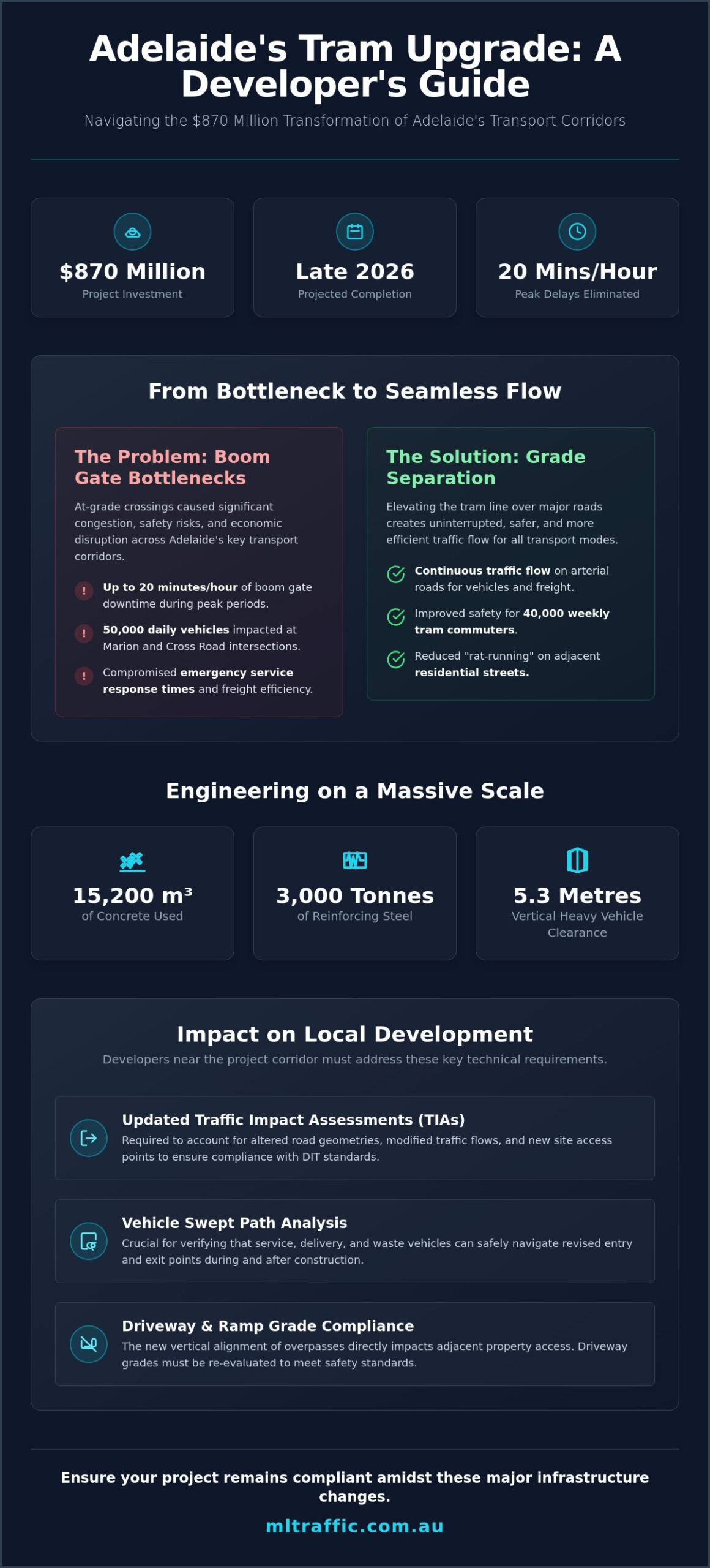
The $870 million infrastructure package addresses several critical points along the tram network. Major works included the removal of level crossings at Plympton and Morphettville, alongside the total reconstruction of the South Road tram overpass at Glandore. These upgrades are not isolated; they are part of a broader effort to modernise the Glenelg Tram Line History and its supporting infrastructure. The project utilised over 15,200 cubic metres of concrete and 3,000 tonnes of steel to create the new overpasses. This investment also includes the progressive opening of the Mike Turtur Bikeway across all project sites by July 2026.
Why Level Crossing Removal is a Priority
The primary driver for these works was the elimination of the “boom gate bottleneck”. Data indicated that boom gates were down for up to 20 minutes each hour during peak periods, causing significant congestion for 50,000 daily vehicles at the Marion and Cross Road intersections. This downtime compromised emergency service response times and freight efficiency. By removing these crossings, the government has improved safety for 40,000 weekly tram commuters and thousands of motorists. These changes effectively transform the local road hierarchy, prioritising continuous flow and reducing the risk of collisions at previous high-conflict zones. If you are planning a development nearby, you can find more information on how these changes affect local site access on our services page.
The Technical Engineering Behind Level Crossing Removals
Engineering for the Tram Grade Separation Projects Adelaide requires precise intersection analysis to determine overpass heights and ramp grades. Designers must balance the maximum allowable gradients for light rail vehicles against the 5.3-metre vertical clearance required for heavy vehicles on the arterial roads below. These calculations are critical to ensuring that the new structures don’t just clear the road, but also facilitate efficient tram acceleration and braking. As detailed in the Official Tram Grade Separation Project documentation, this vertical alignment is the cornerstone of network reliability.
A secondary but vital engineering goal is the reduction of “rat-running” in adjacent residential side streets. When boom gates previously blocked Marion and Cross Roads, motorists frequently diverted through local Plympton and Glandore streets to avoid delays. Removing these at-grade barriers encourages traffic to remain on the primary arterial network. This shift requires meticulous Sight Distance Assessment at newly created junctions and underpass areas to manage the increased flow and ensure pedestrian safety near the integrated Mike Turtur Bikeway.
Intersection Analysis and Traffic Flow Dynamics
Traffic engineers utilise SIDRA modelling to predict post-separation performance at signalised intersections. This modelling accounts for the removal of tram-induced interruptions, allowing for more consistent green-light cycles for road vehicles. For freight operators and airport-bound commuters, this translates to improved travel time reliability. The redistribution of traffic once the at-grade barriers are removed necessitates a review of local turn lanes and storage lengths. If your development is situated near these new structures, a professional Intersection Analysis can determine how these network shifts impact your specific site access.
Compliance with Australian Standards and Road Geometry
All structural designs must strictly adhere to Austroads guidelines for bridge clearances and roadside safety. The road geometries at the base of the overpasses are engineered to accommodate B-double vehicles, requiring specific horizontal curves and lane widths. This level of traffic engineering ensures that heavy vehicle swept paths don’t encroach on adjacent bicycle lanes or pedestrian refuges. Meticulous planning of these geometries is essential for maintaining the urban realm’s functionality while supporting the high-volume traffic demands of the North-South Corridor. Ensuring your private site entry aligns with these new public road geometries is a fundamental requirement for modern development applications in these zones.
Implications for Local Development and Traffic Impact Assessments
The physical footprint of the Tram Grade Separation Projects Adelaide necessitates a total re-evaluation of property access for adjacent landholders. If you’re managing a site near the new overpasses at Marion or Morphett Roads, your existing development application (DA) approvals might no longer be technically feasible. New embankments and extensive road widening often mean that previous entry points are now physically blocked or deemed unsafe by transport authorities. This shift requires a revised Traffic Impact Assessment (TIA) Report to ensure your site remains functional within the altered road environment.
Early coordination with the Department for Infrastructure and Transport (DIT) is essential for any project in these zones. Because the overpass structures involve permanent changes to road levels and the installation of new median strips, “left-in, left-out” access restrictions are frequently mandated. These restrictions are designed to prevent hazardous right-hand turns across multiple lanes of high-volume traffic. Developers must adapt their internal site circulation to accommodate these forced directional movements, which can significantly alter the commercial viability of certain land uses.
Preparing a Traffic Impact Assessment (TIA)
A TIA for a property affected by grade separation must reflect the updated road hierarchy. With at-grade tram crossings removed, traffic speeds and volumes on arterial roads have become more consistent, which changes the safety profile of every nearby intersection. Engineers must evaluate whether the increased traffic flow makes existing turning movements hazardous or if new deceleration lanes are required. All site access designs must strictly adhere to AS 2890.1 standards to ensure that internal ramps and parking layouts remain compliant despite the modified external road levels.
Managing Site Access and Parking Compliance
Driveway ramp grades represent a significant technical challenge when a site is situated near new overpass inclines. If the public road level has been raised to meet a bridge structure, your site’s connection point must be re-engineered to maintain safe gradients. Furthermore, the loss of local on-street parking due to road widening puts immense pressure on internal site capacity. To mitigate this, developers should conduct a Car Parking Demand Assessment. This technical document helps justify internal parking ratios to local councils, ensuring your development remains compliant even as public kerbside spaces are removed to facilitate better traffic flow.
Managing Construction Traffic and Vehicle Swept Paths
Construction phases for the Tram Grade Separation Projects Adelaide introduce significant logistical constraints that require precise engineering oversight. While the temporary 16-day closure of the Glenelg line in July 2026 allows for concentrated structural work, the ongoing intersection upgrades at Marion and Morphett Roads demand continuous management of temporary detours. For existing businesses and residential developments, maintaining service vehicle access is a regulatory necessity. This involves coordinating a Waste Management Plan that aligns with major construction timelines to ensure collection vehicles can operate without obstructing arterial traffic flow.
Safety for vulnerable road users is a critical component of the construction lifecycle. With the Mike Turtur Bikeway scheduled to open progressively across all sites in July 2026, engineers must manage the interface between active cyclists and heavy machinery. This requires clear physical separation and temporary path alignments that adhere to Australian safety standards. Meticulous planning ensures that the 1,115 jobs supported by this project can proceed without compromising the safety of the 40,000 weekly tram commuters or local pedestrians.
Swept Path Analysis for Temporary Access
Narrowed lanes and temporary diversions during overpass construction leave little margin for error. We utilise AutoTURN software to conduct a Vehicle Swept Path Analysis for every individual construction stage. This technical verification ensures that heavy delivery trucks and emergency vehicles can navigate modified road geometries safely. If a temporary lane is too narrow for a standard B-double, the construction alliance must adjust the site layout to prevent network gridlock. Ensuring these clearances is vital for maintaining the commercial functionality of surrounding precincts during the $870 million upgrade.
Developing Traffic Guidance Schemes (TGS)
A comprehensive TGS is essential for managing high-risk activities like crane lifts and bridge beam installations. These works often require short-term road closures, particularly when positioning the massive concrete components for the Marion and Cross Road overpasses. A professional TGS includes several technical layers:
- Precise placement of temporary signage and VMS boards to alert motorists.
- Strategic positioning of traffic controllers to facilitate local property access.
- Designated pedestrian detour routes that avoid active work zones.
- Coordination with public transport providers for bus bridge services during tram closures.
For expert assistance in maintaining site functionality and regulatory compliance during these major works, you should contact our senior principals for direct project guidance.
Navigating Infrastructure Changes with Expert Traffic Consultancy
The structural evolution resulting from the Tram Grade Separation Projects Adelaide creates a complex regulatory environment for property developers. Navigating these changes requires a traffic consultancy that offers more than just theoretical knowledge. We provide direct access to senior principals who manage your project from inception to approval. This personnel continuity promise ensures that the expert who understands your site’s unique challenges is the same one performing the technical analysis and defending the results to authorities. Our approach eliminates unnecessary bureaucracy and provides the reliability needed for high-stakes development applications.
Securing a project’s viability near major overpasses at Marion, Cross, or Morphett Roads depends on precise, data-driven advocacy. We apply national expertise to these local infrastructure zones, ensuring your site remains functional despite the modified road hierarchy. Proactive planning turns these infrastructure shifts into advantages by identifying optimal access points and parking configurations before they become points of contention with councils. Our firm is dedicated to providing meticulous, results-oriented planning that builds confidence with every regulatory body involved.
Professional Engineering and TIA Services
Our firm brings exhaustive experience in delivering TIA reports, car park design, and intersection analysis for a vast range of project environments. Engaging an expert traffic engineer who understands bureaucratic requirements is essential for securing development approvals near major infrastructure zones. A meticulously prepared traffic report does more than meet a requirement; it provides the empirical evidence needed to satisfy the rigorous standards of state planning bodies. Our technical capabilities include:
- Detailed Traffic Impact Assessment (TIA) Reports for new and existing developments.
- Vehicle Swept Path Analysis using industry-standard AutoTURN software.
- Car Parking Demand Assessments to justify variations in local planning schemes.
- Driveway Ramp Grade Assessments to ensure compliance with AS 2890.1.
- Intersection Analysis to determine the impact of new road geometries on site access.
Securing Your Development’s Future
Major infrastructure works like the Glenelg tram line upgrades shouldn’t derail your project’s timeline or commercial viability. By leveraging technical data, you can justify site access and parking variations that might otherwise be rejected under the new road conditions. We specialise in aligning private development goals with the permanent infrastructure changes scheduled for completion in late 2026. This ensures that your site remains compliant and accessible for the long term. You can request a technical quote for your traffic engineering needs to ensure your project remains on track and fully integrated with Adelaide’s modernised transport network.
Securing Development Success in a Modernised Transport Network
The Tram Grade Separation Projects Adelaide have permanently redefined the movement of people and freight through the city’s western and southern transport corridors. Successfully navigating this new road hierarchy requires more than just standard compliance; it demands a proactive approach to intersection dynamics and modified property access. Failing to adapt to these structural changes can result in significant regulatory hurdles and costly delays during the development assessment process.
ML Traffic Engineers Australia provides the high-level expertise necessary to overcome these technical challenges. With over 15 years of specialist experience, we offer direct access to senior principals who remain personally accountable for every project. Our personnel continuity promise ensures that the technical lead who understands your site’s specific constraints stays with you until the final approval is secured. This hands-on method builds trust with regulatory authorities and ensures your data is defended by those who performed the analysis.
Contact ML Traffic Engineers Australia for expert advice on your development to ensure your project integrates seamlessly with Adelaide’s upgraded infrastructure. We provide the technical certainty required to secure your development’s future in this evolving urban landscape.
Frequently Asked Questions
What is the main goal of the tram grade separation projects?
The primary objective is to eliminate the “boom gate bottleneck” where gates were previously down for up to 20 minutes every hour. This improves network reliability for 50,000 daily vehicles and 40,000 weekly tram commuters. By separating tram and road traffic, the projects significantly reduce the risk of collisions and improve travel times for motorists, buses, and freight operators.
How long will the Glenelg tram line be partially closed for these works?
The Glenelg tram line will be temporarily closed for 16 days from Saturday, 4 July 2026, to Sunday, 19 July 2026. Services are scheduled to resume on Monday, 20 July 2026. This window allows for critical structural works on the Tram Grade Separation Projects Adelaide that can’t be performed while trams are operational.
Do I need a new Traffic Impact Assessment if my site is near an overpass?
Yes, existing Traffic Impact Assessments often become obsolete when road geometries and traffic volumes change. If your site is near a new overpass, you must re-evaluate access points and turning movements to ensure they remain safe and compliant. A revised TIA identifies how the new road hierarchy affects your development’s traffic generation and site functionality.
What is the difference between a level crossing and a grade separation?
A level crossing occurs where a tram line and a road intersect at the same height, requiring boom gates to manage traffic conflict. Grade separation involves the vertical alignment of these modes at different heights, typically using an overpass bridge. This physical separation allows trams and vehicles to move independently without stopping for each other, which increases network capacity.
How does swept path analysis help during major road construction?
Swept path analysis verifies that heavy vehicles can navigate narrowed lanes and temporary detours during the construction phase. By using AutoTURN software, engineers ensure that B-doubles and emergency vehicles maintain sufficient clearance throughout all project stages. This technical check prevents network gridlock and ensures service vehicle access to adjacent businesses isn’t compromised during works.
Can an overpass affect the driveway access to my business?
An overpass can significantly impact driveway access through the installation of embankments or new median strips. These structures often result in “left-in, left-out” restrictions or the complete relocation of entry points to meet safety standards. It’s critical to assess driveway ramp grades if the public road level has been adjusted to meet the bridge structure.
What are the benefits of grade separation for pedestrians and cyclists?
Grade separation improves safety by removing conflict points between pedestrians, cyclists, and moving trams. The projects include the progressive opening of the Mike Turtur Bikeway across all sites by July 2026. Additionally, new community and green spaces are developed under the overpasses, providing safer and more accessible urban environments for active transport users throughout the corridor.
Who is responsible for the funding of the Adelaide tram projects?
The Tram Grade Separation Projects Adelaide are jointly funded by the Australian and South Australian Governments on a 50:50 basis. The total cost for the Marion, Cross, and Morphett Road removals is $870 million. The South Road overpass reconstruction is funded separately as part of the $15.4 billion North-South Corridor T2D Project.

Disclaimer
The content on www.mltraffic.com.au, including all technical articles, guides, and resources, is provided for general informational and educational purposes only. It is not intended to constitute professional advice in traffic engineering, transportation planning, development approvals, or any other technical or legal field. While ML Traffic Engineers makes every reasonable effort to ensure the accuracy, completeness, and timeliness of the information published, we do not provide any warranties or representations (express or implied) regarding its reliability, suitability, or availability for any particular purpose. Any reliance you place on the content is strictly at your own risk. In no event shall ML Traffic Engineers, its directors, employees, authors, or affiliates be liable for any direct, indirect, incidental, special, consequential, or punitive damages (including, without limitation, loss of profits, data, or business opportunities) arising out of or in connection with the use of, or inability to use, any information provided on this website. The articles and guides on this site are not a substitute for engaging a qualified, registered professional traffic engineer (such as an NPER or RPEQ engineer) to assess your specific project requirements. For tailored advice, compliance assessments, or traffic engineering services, please contact a competent professional. This disclaimer may be updated from time to time without notice. By accessing or using this website, you agree to be bound by the most current version of this disclaimer.
