

A single RFI regarding vehicle access or parking shortfalls can stall a multi-million dollar urban renewal project for months. You’re likely navigating the reality that high-density sites leave zero margin for error when it comes to vehicle swept paths and strict council compliance. Securing a successful planning approval requires more than just a basic report. It demands a precise transport assessment for urban renewal projects that balances intense land use with the constraints of existing public transport networks and limited site footprints.
This 2026 guide provides the technical roadmap to master these complexities and secure approvals with minimal friction. You’ll gain a clear understanding of transport modelling requirements and learn how to optimise car park designs to meet AS 2890.1 and AS 2890.2 standards. We will detail the essential components of Traffic Impact Assessments, vehicle swept path analysis, and car parking demand assessments. By the end of this guide, you’ll know exactly how to present a robust case to council that minimises delays and maximises the functional potential of your high-density development within the Australian urban landscape.
Key Takeaways
- Understand why a sophisticated transport assessment for urban renewal projects is the primary tool for managing high-density site complexities and meeting council expectations.
- Identify how intersection performance modelling using SIDRA provides the technical evidence required to support increased traffic generation in urban centres.
- Learn to optimise car park designs within constrained footprints to ensure full compliance with AS 2890.1 and AS 2890.2 standards.
- Differentiate between Traffic Management Plans and Traffic Guidance Schemes to effectively mitigate construction-phase risks and approval delays.
- Discover how direct involvement from senior traffic engineers reduces Request for Information (RFI) cycles and accelerates the development application process.
Understanding Transport Assessment for Urban Renewal Projects
A transport assessment for urban renewal projects is a strategic instrument used to manage the complexities of increasing urban density. These assessments differ significantly from standard site studies because they operate within a fixed geographical footprint with established constraints. Developers must prove that their project won’t just fit into the existing streetscape, but will also function without degrading the performance of the surrounding precinct.
Modern transportation planning in Australian cities requires a seamless link between land use and transit accessibility. This integrated approach is vital for urban renewal where the goal is often to reduce car dependency. Strategic modelling provides the high-level data on population growth, but the site-specific assessment provides the granular detail needed to justify a specific development application to a consent authority.
The Scope of Transport Assessments in 2026
In 2026, the technical scope includes a heavy emphasis on the “last mile” of the journey. This involves assessing the impact on existing road infrastructure and public transport capacity while simultaneously evaluating active transport links for pedestrians and cyclists. A Transport Impact Assessment (TIA) in the context of urban renewal is a specialised technical report that quantifies the movement demands of a new development and outlines the infrastructure required to support that growth safely.
Why Councils Require Detailed Transport Reports
Preparing a transport assessment for urban renewal projects is a mandatory step for any developer seeking to increase site density in an established precinct. Australian councils require these detailed reports to ensure that proposed density increases don’t lead to systemic network failure. When an old industrial site is rezoned for high-density residential use, the traffic generation profile changes entirely. Engineers must verify that local intersections can handle the peak hour load without creating excessive queuing that blocks through-traffic or emergency services.
To secure approval, developers must provide a Traffic Impact Assessment (TIA) Report that addresses both site-specific and precinct-wide issues. This documentation is essential for:
- Determining if the local road network can absorb additional trip generation.
- Identifying necessary upgrades to intersections or pedestrian crossings.
- Ensuring the development aligns with the council’s long-term transport strategy.
- Mitigating safety risks for pedestrians, cyclists, and motorists in high-traffic zones.
Core Components of a Successful Transport Impact Assessment
A robust transport assessment for urban renewal projects moves beyond basic traffic counts. It requires a detailed Reuse Assessment of the existing infrastructure to determine how a site’s previous utility can be repurposed for higher density. Unlike greenfield sites, urban renewal requires engineers to account for established traffic patterns and multi-modal transit interactions. This complexity necessitates a comprehensive Traffic Impact Assessment that satisfies both council planning schemes and state-level transport requirements.
Traffic Generation and Network Modelling
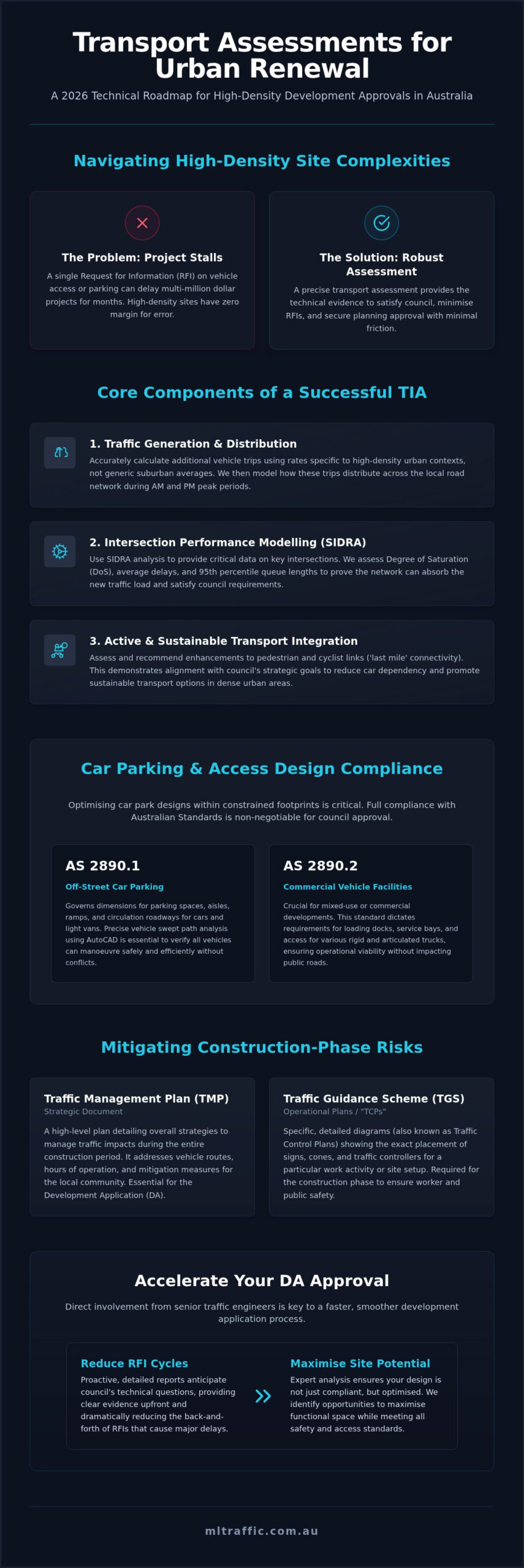
Accurate trip generation is the foundation of any technical report. For high-density residential and commercial developments, engineers must apply specific trip rates that reflect the urban context rather than generic suburban averages. We analyse how these trips distribute across the local network during morning and afternoon peak periods. Intersection performance modelling using SIDRA software provides critical data on Degree of Saturation (DoS), average delays, and 95th percentile queue lengths. In highly sensitive precincts, microsimulation is often used to visualise traffic flow and identify potential bottlenecks before they cause operational failure on the ground. This level of detail ensures that the proposed density aligns with the actual capacity of surrounding key intersections and provides the evidence council needs to approve higher-density land uses.
Active and Sustainable Transport Integration
Modern planning approvals in Australia are increasingly dependent on demonstrating a shift away from private vehicle reliance. A successful assessment must outline clear sustainable transport mode share targets. This involves developing Green Travel Plans that incentivise walking, cycling, and public transport use through specific infrastructure and policy commitments. We focus on “last-mile” connectivity, ensuring the site integrates perfectly with nearby transit hubs. Compliance with local council bicycle parking requirements and end-of-trip facilities is mandatory. Designing for pedestrian safety and cycling permeability isn’t just a regulatory hurdle; it’s a strategic method to reduce the required parking provision on constrained sites. If you need assistance with these technical requirements, you can contact our senior principals for direct expert advice on your development application.
By integrating these core components, developers can present a balanced case that acknowledges the constraints of the urban environment while proving the project’s long-term viability. This technical rigour is what differentiates a standard report from a strategic document that secures planning approval.
Navigating Car Parking and Access in Constrained Urban Sites
Urban renewal projects often face the physical impossibility of meeting standard council parking rates within a restricted site footprint. A transport assessment for urban renewal projects must bridge the gap between these rigid requirements and the spatial reality of the site. This involves a detailed Car Parking Demand Assessment to justify lower parking provisions based on proximity to high-frequency transit. We integrate principles from the EPA’s guide to smart growth and transportation to demonstrate how reduced parking correlates with the success of transit-oriented developments.
Every design must adhere to AS 2890.1 for off-street parking. In constrained environments, achieving this compliance requires technical precision. We frequently implement innovative parking solutions such as car stackers, car lifts, or shared parking arrangements between residential and commercial tenants. These systems maximise the yield of a site while ensuring each parking space remains functionally accessible and compliant with Australian Standards.
Vehicle Swept Path Analysis for Tight Access
Verifying that vehicles can enter, exit, and manoeuvre within the site is a critical hurdle for council approval. We use AutoTURN software to perform a rigorous Vehicle Swept Path Analysis for all proposed access points. This is particularly vital for loading docks where heavy rigid vehicles (HRVs) must navigate narrow urban lanes. Our assessments ensure that B99 design cars and service vehicles can operate without impacting the safety of other road users or damaging the building’s structural elements.
Driveway Design and Ramp Grade Compliance
Driveway design in urban renewal is complicated by significant changes in site levels and narrow frontages. We perform a Driveway Ramp Grade Assessment to ensure compliance with AS 2890.1, preventing vehicle scraping and ensuring smooth transitions. Sight distance assessments are equally critical; we verify that drivers have clear visibility of pedestrians at the site boundary before exiting. Our senior engineers provide the necessary certification for car park designs to satisfy council DA requirements, ensuring the technical work is performed by the same expert who manages your project from start to finish.
Managing Construction Traffic and Guidance Schemes
Managing construction traffic is a primary hurdle for urban renewal approvals. These projects typically occur in constrained environments where the surrounding road network is already operating near capacity. A robust transport assessment for urban renewal projects must include a detailed strategy for the construction phase to prevent systemic gridlock. Councils prioritise the safety of existing residents and the continuity of local businesses. Your construction logistics must be flawless to avoid stop-work orders or permit refusals. We ensure that every movement is accounted for before the first vehicle arrives on site.
Developers must understand the technical difference between a Traffic Management Plan (TMP) and a Traffic Guidance Scheme (TGS). The TMP serves as the high-level strategic framework. It details the project’s traffic impact, risk assessments, and mitigation measures. The TGS is the specific, scaled diagram used by on-site personnel to implement physical traffic control measures. In busy urban centres, managing pedestrian safety and diversions is a constant requirement. We design these schemes to ensure that foot traffic remains separated from heavy machinery at all times. This technical rigour reduces the likelihood of council RFIs during the planning phase.
Traffic Guidance Schemes (TGS) for Site Access
Safe entry and exit points for heavy construction vehicles are mandatory for site safety. We design TGS plans that account for narrow street frontages and limited vehicle swing room. This often involves planning for temporary road closures or lane diversions during critical phases, such as crane lifts or large-scale concrete pours. All TGS plans must be prepared by accredited professionals to ensure adherence to state-specific codes of practice. Our approach ensures that construction vehicles can access the site without causing dangerous queuing on public roads.
Construction Waste and Logistics Management
Coordinating waste removal is a logistical challenge in high-density precincts. We create specific loading zones that satisfy council requirements while minimising disruption to local traffic flow. This planning is integrated into the broader Traffic Engineering strategy. It ensures consistency between the construction phase and the final operational state of the development. A transport assessment for urban renewal projects is incomplete without a clear plan for demolition waste and material delivery. If you need a compliant TGS or TMP for your next project, contact our senior principals today for expert preparation and direct accountability.
Securing DA Approval with Specialist Traffic Engineering
Securing a Development Application (DA) approval in a high-density urban context requires more than just submitting a report. It involves a strategic defence of technical findings during council negotiations. A transport assessment for urban renewal projects serves as the primary evidence base for these discussions. When developers employ specialist traffic engineers, they gain an advocate who understands the specific bureaucratic requirements of local government authorities across Australia. This expertise is critical for navigating the inevitable Requests for Information (RFIs) that can otherwise stall a project for months.
Senior-level involvement in technical report preparation is a vital risk mitigation strategy. Junior engineers may follow standard checklists, but senior principals identify the nuanced conflicts between land use and transit capacity that often trigger council objections. Our approach at ML Traffic Engineers Australia eliminates the “gatekeeper” model found in larger firms. You deal directly with the expert performing the technical work. This ensures that every detail in the Traffic Impact Assessment or Swept Path Analysis is defensible under intense scrutiny from council planners and engineers.
The Value of Early Consultant Engagement
Engaging a traffic consultant during the preliminary design phase allows for the identification of potential “deal-breakers” before significant capital is committed to architectural plans. This proactive approach identifies issues like non-compliant driveway grades or inadequate loading dock clearances early. By integrating transport requirements into the initial site layout, developers can optimise site yields without compromising on regulatory compliance. Maintaining the same senior engineer throughout the project lifecycle ensures that technical nuances discussed during initial consultations are accurately reflected in final certifications and council rebuttals.
National Expertise for Local Council Success
With over 15 years of experience in the Australian market, we provide a results-oriented service that focuses on securing approvals. Our reports are meticulous and strictly adhere to AS 2890.1 and AS 2890.2 standards. This professional longevity has built a reputation for reliability with councils, which often leads to a smoother review process and fewer RFIs. We understand the specific local planning policies that govern urban renewal in different jurisdictions. Get started on your project by contacting ML Traffic Engineers Australia to speak directly with a senior principal about your development’s transport requirements.
Securing Your Development’s Future in Australian Urban Centres
Mastering the complexities of a transport assessment for urban renewal projects is the difference between a stalled application and a successful development. You must balance high-density mobility with strict adherence to Australian Standards in constrained environments. By prioritising technical accuracy in your TIA reports and vehicle swept path analysis, you eliminate the common pitfalls that lead to costly council delays and unnecessary RFIs. We ensure full compliance.
ML Traffic Engineers Australia provides over 15 years of Australian traffic engineering expertise to ensure adherence to AS 2890 and local council regulations. Every project benefits from our no-nonsense approach, where clients receive direct access to senior principals for all technical reports and design certifications. This continuity ensures your project remains functionally viable and regulatory compliant from the initial concept through to final approval. Our results-oriented methodology focuses entirely on securing your planning permits without the bureaucracy of larger firms.
Contact ML Traffic Engineers Australia for a Comprehensive Transport Assessment to streamline your next urban renewal project and secure a reliable planning outcome. We look forward to helping you deliver a high-performance development that meets the evolving needs of Australia’s urban landscape.
Frequently Asked Questions
What is the difference between a Transport Assessment and a Traffic Impact Assessment?
A Transport Assessment is a comprehensive study covering all modes of travel including walking, cycling, and public transport. A Traffic Impact Assessment (TIA) focuses specifically on the vehicle movements and intersection performance of a development. For a transport assessment for urban renewal projects, councils often require the broader study to ensure the site integrates with the existing urban fabric and high-frequency transit networks.
When is a Transport Assessment required for an urban renewal project?
Councils require these reports whenever a proposed development significantly changes the traffic generation profile of a site. This includes rezoning industrial land to residential, increasing floor area ratios, or introducing high-density commercial uses. If your project impacts the local road network or public transport capacity, a formal assessment is mandatory to secure planning approval and manage the resulting urban density.
Does my urban renewal project need a Swept Path Analysis for council approval?
Yes, a Vehicle Swept Path Analysis is essential for urban renewal sites where space is at a premium. It provides technical proof that service vehicles, waste trucks, and B99 design cars can safely enter and exit the site in a forward direction. Without this analysis, councils may refuse access designs that appear too tight or pose a risk to pedestrian safety at the property boundary.
How do Australian Standards like AS 2890.1 affect urban renewal parking design?
AS 2890.1 and AS 2890.2 dictate the mandatory physical dimensions for parking bays, aisle widths, and driveway ramp grades. In urban renewal, these standards are the baseline for compliance. Failure to meet these requirements can lead to vehicle scraping or operational failure. Professional engineers ensure every centimetre of a constrained basement or car park layout is optimised to meet these national regulatory standards.
Can a Green Travel Plan reduce the number of parking spaces council requires?
A Green Travel Plan can justify a reduction in the standard council parking rates by demonstrating a shift toward sustainable transport. By providing superior end-of-trip facilities, bicycle parking, and proximity to transit, developers can argue for a lower car parking demand. This is a strategic way to increase building yield on sites where providing full parking provisions is physically or commercially unviable.
What is a Traffic Guidance Scheme (TGS) and do I need one for construction?
A Traffic Guidance Scheme (TGS) is a technical diagram showing the exact placement of signs and barriers for construction-related traffic control. You need one whenever construction activities, such as crane lifts or material deliveries, impact the public road or footpath. These plans must be prepared by accredited professionals to ensure the safety of road users and to satisfy council’s construction permit requirements.
How long does it typically take to prepare a transport assessment report?
Preparation times vary, but a standard report typically takes between two and four weeks. This timeframe accounts for traffic counts, SIDRA intersection modelling, and internal senior review. More complex urban renewal precincts requiring microsimulation or extensive council liaison may take longer. Engaging a traffic engineer early prevents the transport assessment from becoming a bottleneck in your overall development application timeline.
Can a traffic engineer help negotiate with council if our site has access constraints?
Specialist traffic engineers act as technical advocates during the council negotiation process. If your site has significant access constraints, we use SIDRA modelling and swept path data to prove that your proposed solution is safe and functional. Our senior principals deal directly with council engineers to resolve technical objections, often finding compliant workarounds that junior consultants might overlook.

Disclaimer
The content on www.mltraffic.com.au, including all technical articles, guides, and resources, is provided for general informational and educational purposes only. It is not intended to constitute professional advice in traffic engineering, transportation planning, development approvals, or any other technical or legal field.
While ML Traffic Engineers makes every reasonable effort to ensure the accuracy, completeness, and timeliness of the information published, we do not provide any warranties or representations (express or implied) regarding its reliability, suitability, or availability for any particular purpose. Any reliance you place on the content is strictly at your own risk.
In no event shall ML Traffic Engineers, its directors, employees, authors, or affiliates be liable for any direct, indirect, incidental, special, consequential, or punitive damages (including, without limitation, loss of profits, data, or business opportunities) arising out of or in connection with the use of, or inability to use, any information provided on this website.
The articles and guides on this site are not a substitute for engaging a qualified, registered professional traffic engineer (such as an NPER or RPEQ engineer) to assess your specific project requirements. For tailored advice, compliance assessments, or traffic engineering services, please contact a competent professional.
This disclaimer may be updated from time to time without notice. By accessing or using this website, you agree to be bound by the most current version of this disclaimer.
