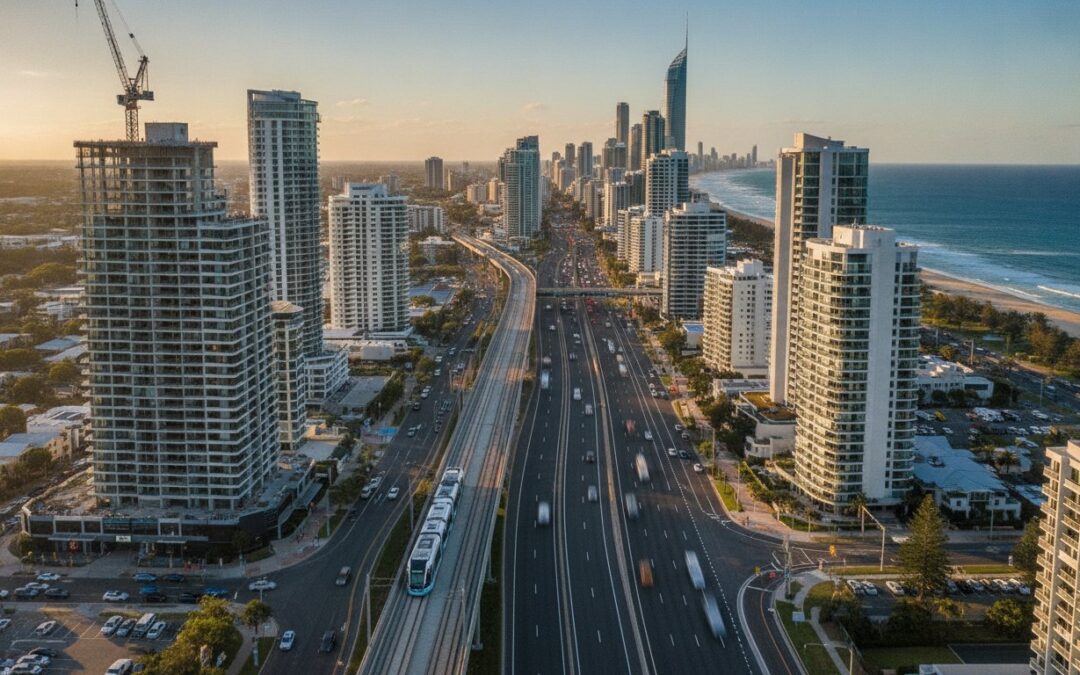
Could a minor technical oversight in your traffic report be the only thing standing between your project and a successful Council approval? As the Gold Coast allocates $543 million toward infrastructure in the 2026-27 budget, the regulatory goalposts for developers are shifting rapidly. We recognise the uncertainty you feel regarding changing Council requirements and the complexity of integrating private access with major public corridors. Understanding the Transport Connectivity Gold Coast Foundation of Growth Light Rail Stage 3, Coomera Connector, Coomera Rail Upgrades, Bus Network Expansion framework is now essential for any developer looking to avoid costly DA delays.
You’ll discover exactly how these major projects are reshaping development requirements and how to secure your approvals with technical precision. This article provides a clear roadmap for navigating the infrastructure landscape, covering everything from the impact of the new Hope Island and Pimpama stations to ensuring your site design meets strict AS 2890 standards. We’ll show you how to leverage this connectivity to move your project forward with confidence and authority.
Key Takeaways
- Understand how major projects such as the Transport Connectivity Gold Coast Foundation of Growth Light Rail Stage 3, Coomera Connector, Coomera Rail Upgrades, Bus Network Expansion are driving regional density and increasing the “connectivity premium” for nearby land.
- Learn why proximity to new light rail or rail stations often leads to more complex Traffic Impact Assessment (TIA) requirements for private developments rather than simpler ones.
- Identify the technical necessity of Vehicle Swept Path Analysis and AS 2890.1 compliance to ensure site access remains functional within constrained urban corridors.
- Discover how to mitigate the risk of DA delays by proactively addressing Council’s traffic and parking demand expectations early in the planning phase.
- Gain insights into the benefits of a “no-gatekeepers” consultancy model where senior principals provide direct oversight on every technical report and design to ensure regulatory compliance.
Major Infrastructure Projects Shaping Future Connectivity
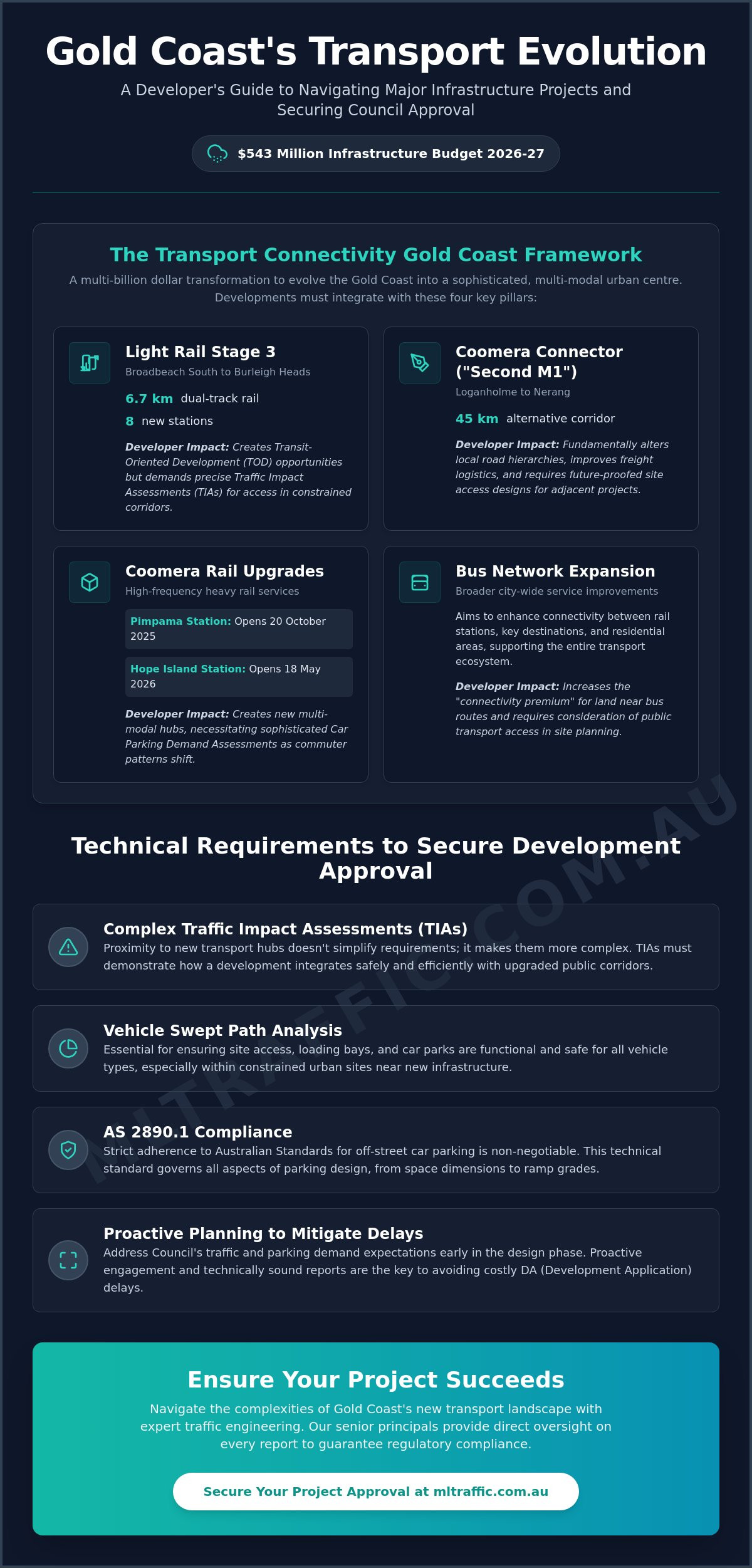
The Gold Coast is currently undergoing a multi-billion dollar transformation of its movement corridors. This investment represents a fundamental shift in how the region manages population growth and commuter efficiency. The primary framework for this evolution is the Transport Connectivity Gold Coast Foundation of Growth Light Rail Stage 3, Coomera Connector, Coomera Rail Upgrades, Bus Network Expansion. These projects are not isolated improvements; they are integrated systems designed to transition the city from a car-dependent coastal strip to a sophisticated, multi-modal urban centre. Understanding the historical context and current state of Transport on the Gold Coast is vital for developers who must coordinate site access with these heavy rail, light rail, and road networks.
To better understand how these metro-style services are evolving to support regional growth, watch this recent news update:
Light Rail Stage 3 and Urban Transformation
The Stage 3 extension involves 6.7 kilometres of dual-track rail connecting Broadbeach South to Burleigh Heads, featuring eight new stations. This project introduces significant Transit-Oriented Development (TOD) opportunities within high-connectivity zones. For developers, this transformation requires careful consideration of altered road lane configurations and modified signalised intersections along the Gold Coast Highway. Integrating a new development’s access point into these constrained corridors demands a precise Traffic Impact Assessment (TIA) Report to satisfy Council’s evolving requirements for safety and efficiency.
The Coomera Connector and Regional Flow
The Coomera Connector, often referred to as the “Second M1,” is a 45-kilometre corridor designed to relieve regional traffic congestion by providing an alternative route between Loganholme and Nerang. This project fundamentally alters the hierarchy of local road networks, particularly in the northern growth corridor. Key implications for the development sector include:
- Diversion of local and regional trips away from the M1 to improve precinct-level circulation.
- Improved freight and logistics movements near major interchanges, supporting industrial growth.
- A requirement for developers to future-proof site access for projects adjacent to the new motorway.
- Increased complexity in Intersection Analysis for developments within the Coomera and Hope Island catchments.
Complementing these road and light rail projects are the Coomera Rail Upgrades and a broader Bus Network Expansion. The introduction of high-frequency heavy rail services, including the opening of Pimpama Station on 20 October 2025 and Hope Island Station on 18 May 2026, creates a multi-modal foundation for urban growth. These upgrades necessitate sophisticated Car Parking Demand Assessments as commuter patterns shift away from private vehicle reliance toward integrated public transport hubs.
As these commuter patterns evolve, many employees are also looking at more efficient ways to manage vehicle costs through novated leasing; to compare quotes from multiple providers, click here.
How Transport Upgrades Drive Urban Development and Growth
The integration of high-frequency infrastructure into the urban fabric creates a measurable “connectivity premium” for nearby land parcels. This value uplift is a direct result of the strategic Transport Connectivity Gold Coast Foundation of Growth Light Rail Stage 3, Coomera Connector, Coomera Rail Upgrades, Bus Network Expansion framework. As public transport accessibility increases, local planning schemes often shift to support higher density and diversification of land use. This transition allows developers to maximise site potential, provided they can demonstrate that the transport network can support the increased intensity. It’s a technical balance between public investment and private development feasibility.
A critical factor in this growth is the shifting nature of parking requirements. Increased proximity to transport hubs allows for a more nuanced approach to on-site parking provision. In many cases, developers can justify a reduction in standard parking rates by conducting a professional Car Parking Demand Assessment. This technical report uses empirical data to prove that the site’s proximity to public transport reduces private vehicle reliance. It is an essential tool for justifying development intensity during the DA process and ensuring that site layouts remain functional without over-investing in redundant car spaces.
Leveraging Multi-Modal Connectivity
Supporting higher-density residential and commercial use requires more than just a single rail line. It requires a seamless combination of bus network expansion and rail upgrades to create a truly multi-modal environment. Case studies of successful commercial hubs show that pedestrian flow is the primary driver of retail success. Optimising site layouts to encourage direct access from transport interchanges is a technical requirement that must be addressed early in the design phase. If you are planning a high-density project, our team can provide a Car Parking Demand Assessment to support your submission.
Economic Foundations of Transport-Led Growth
Infrastructure delivery directly impacts the timing and viability of DA submissions. Reduced commuter times significantly expand the catchment area for commercial developments, making previously peripheral sites more attractive for investment. The Coomera Connector project serves as a prime example of how new corridors create economic opportunities in high-growth regions. Aligning your project with these long-term regional strategies ensures that your development remains viable as the city evolves. Technical compliance with national standards remains the foundation of this growth, ensuring that increased connectivity translates into approved, functional developments.
Navigating Traffic Impact Challenges in High-Growth Corridors
Many developers assume that the Transport Connectivity Gold Coast Foundation of Growth Light Rail Stage 3, Coomera Connector, Coomera Rail Upgrades, Bus Network Expansion framework automatically simplifies their planning obligations. In reality, Council scrutiny often increases as these major projects alter the functional hierarchy of the road network. These infrastructure shifts necessitate a detailed Traffic Impact Assessment (TIA) Report to ensure private access doesn’t conflict with new public corridors. Precision in these reports is the difference between a swift approval and a costly request for information.
Developers often ask why a traffic report is necessary when a new light rail station sits on their doorstep. The presence of a station fundamentally alters pedestrian volumes, signal timings, and local traffic distributions. Additionally, the construction phases of projects like the Gold Coast Light Rail Stage 3 can temporarily impact site visibility and existing access. A TIA manages these risks by providing empirical evidence of a development’s long-term compatibility with the evolving network.
The Complexity of Modern TIA Reports
Modern reports must use SIDRA modelling to analyse intersection performance when new light rail priority signals are introduced. This analysis isn’t just about current conditions; it’s about accounting for “induced demand” as the network matures. To satisfy Council, a TIA must account for future-year background traffic growth by applying a specific annual percentage increase to current traffic counts to forecast road network conditions at the time of development completion. This ensures the project remains functional a decade after the doors open.
Overcoming Common DA Hurdles
Council frequently raises concerns regarding “rat-running” through residential streets to avoid new signalised intersections or congested corridors. Justifying access points located in high-frequency bus zones or near major interchanges requires a high level of technical expertise. Common hurdles we address include:
- Mitigating the loss of on-street parking due to road widening or rail corridors.
- Proving sight distance compliance in constrained urban environments where new street furniture is installed.
- Managing vehicle swept paths for waste and delivery vehicles amidst modified kerb alignments.
- Addressing the impact of changed traffic distributions post-infrastructure completion.
Securing an approval requires more than just acknowledging new transport options. It requires a meticulous demonstration that your site can handle the specific traffic pressures of a high-growth zone. Our senior principals oversee every assessment to ensure your project meets the rigorous standards expected by the City of Gold Coast and the Department of Transport and Main Roads.
Technical Requirements for Developments Near Major Transport Hubs
Building near major infrastructure requires more than just a proximity analysis. It requires strict adherence to physical design constraints defined by Australian Standards. The Transport Connectivity Gold Coast Foundation of Growth Light Rail Stage 3, Coomera Connector, Coomera Rail Upgrades, Bus Network Expansion projects often result in modified road levels and narrowed kerb alignments. These changes directly impact how a private driveway integrates with the public road. If your project sits adjacent to a new light rail corridor or a bus high-frequency zone, your driveway ramp grades must be meticulously calculated. This prevents vehicle scraping and ensures a smooth transition between the site and the modified streetscape.
Swept Path Analysis and Access Compliance
In high-density zones, every square metre of land is valuable. This often leads to tight basement entries and complex internal circulation paths. We use specialised software to perform Vehicle Swept Path Analysis, simulating the exact movements of garbage trucks, delivery vans, and B99 vehicles. This simulation is critical for commercial sites near bus network expansions where large vehicle movements must be managed without disrupting high-frequency transit flow. Ensuring your site can accommodate these movements without encroaching on pedestrian zones or public infrastructure is a non-negotiable requirement for DA approval. We provide the technical evidence Council requires to prove your site is functional for all vehicle classes.
Car Park Design in the New Connectivity Era
Maximising yield on expensive, well-connected land requires an efficient car park layout that doesn’t sacrifice compliance. Our approach to Car Park Design focuses on meeting the strict requirements of AS 2890.1 and AS 2890.2. This includes verifying aisle widths, bay dimensions, and column placements to ensure functionality. Sight distance requirements are particularly stringent for driveways near new light rail crossings. Council will not approve a development if the exit point creates a safety risk for pedestrians or light rail vehicles. We provide the technical certification needed to prove your design adheres to these national standards, even in the most constrained urban environments.
Integrating your site with the region’s growth infrastructure requires technical precision and deep-seated expertise. If you’re managing a project in a high-growth corridor, contact our senior principals today to secure your technical site assessment and ensure your design is compliant from the outset.
Securing Planning Approval with Expert Traffic Engineering
Success in the development sector requires more than just a vision; it requires technical certainty. ML Traffic Engineers Australia provides the professional foundation needed to navigate the Transport Connectivity Gold Coast Foundation of Growth Light Rail Stage 3, Coomera Connector, Coomera Rail Upgrades, Bus Network Expansion framework. With over 15 years of professional tenure, we understand the specific technical requirements of the City of Gold Coast and the Department of Transport and Main Roads. Our firm specialises in translating complex infrastructure impacts into approved development applications. We provide the technical reports that bridge the gap between public investment and private growth.
Our firm operates with a strict “no-gatekeepers” approach. You gain direct access to senior principals for every project. We don’t believe in handing work off to junior staff once a contract is signed. Our personnel continuity promise ensures that the expert who initiates your project performs the technical work from inception to approval. This accountability is a core signature of our consultancy. It builds trust with both our clients and the regulatory authorities who review our assessments. You’ll always have a direct line to the expert responsible for your site’s compliance.
Our National Expertise in Local Contexts
We prepare comprehensive Traffic Impact Assessment (TIA) Reports designed to withstand intense scrutiny. Our technical capabilities are broad and meticulously applied. We offer specialised services including Intersection Analysis, Sight Distance Assessments, and Driveway Ramp Grade Assessments. Our professional resume includes success across an exhaustive range of land-use categories, such as residential flat buildings, mixed-use developments, commercial retail centres, bulky goods showrooms, industrial warehouses, freight logistics hubs, childcare centres, medical clinics, aged care facilities, service stations, fast-food outlets with drive-throughs, taverns, hotels, schools, and community centres.
Take the Next Step for Your Development
Early involvement of a traffic engineer is a strategic necessity. Engaging our team during the initial design phase prevents costly redesigns later in the DA process. We identify potential access conflicts and parking shortfalls before they become roadblocks. Our goal is to simplify the transport planning process for our clients. We handle the technical simulations and regulatory compliance so you can focus on project delivery. If your site is located within a high-growth corridor, you need a partner who understands the local infrastructure landscape inside and out. Contact ML Traffic Engineers Australia today to discuss your specific project requirements and secure your traffic and parking approvals.
Future-Proofing Your Gold Coast Development
The transformation of the region into a sophisticated, multi-modal transport hub is well underway. Success for developers now depends on a precise understanding of the Transport Connectivity Gold Coast Foundation of Growth Light Rail Stage 3, Coomera Connector, Coomera Rail Upgrades, Bus Network Expansion framework. You’ve seen how these projects redefine land value and how strict technical compliance with AS 2890.1 remains the bedrock of a successful DA. Navigating these shifting Council requirements requires a partner who understands the technicalities and bureaucratic demands of the field inside and out.
ML Traffic Engineers Australia offers 15+ years of national experience and a proven track record with both Council and State approvals. We provide direct principal involvement in every report to ensure your project receives the senior oversight it deserves. Early involvement prevents costly redesigns and ensures your site access is optimised for the new infrastructure landscape. Get Expert Traffic Engineering Support for Your Development from ML Traffic Engineers Australia today. We look forward to helping you translate these major transport investments into a functional and approved project.
Frequently Asked Questions
How does Light Rail Stage 3 affect the parking requirements for my development?
Proximity to Light Rail Stage 3 often allows for a reduction in standard on-site parking rates. Council typically supports lower parking provision for developments within walking distance of a station, provided a professional Car Parking Demand Assessment justifies the reduction based on decreased private vehicle reliance. This assessment uses empirical data to prove the site’s accessibility supports a lower modal split for cars.
Will the Coomera Connector change the way my site access is assessed by Council?
The Coomera Connector alters the functional hierarchy of the local road network, which directly impacts site access assessments. Council will scrutinise new access points to ensure they don’t conflict with modified traffic flows or interchange operations. Developers must provide a detailed Intersection Analysis to demonstrate that their site entry remains safe and functional as regional traffic patterns shift toward this new corridor.
Do I need a Swept Path Analysis if my development is near a new bus interchange?
Yes. New bus interchanges often result in modified kerb alignments and higher pedestrian volumes. A Vehicle Swept Path Analysis is essential to prove that delivery vans and waste collection trucks can enter and exit your site without encroaching on bus lanes or pedestrian zones. This simulation ensures your site remains functional within the increasingly constrained urban environments created by expanded transport hubs.
What is a Traffic Impact Assessment (TIA) and when is it mandatory in Australia?
A Traffic Impact Assessment (TIA) Report is a technical document evaluating a development’s effect on the surrounding transport network. It’s mandatory in Australia whenever a project exceeds trip generation thresholds defined in a local planning scheme or state planning policy. This report is a critical component for any project within the Transport Connectivity Gold Coast Foundation of Growth Light Rail Stage 3, Coomera Connector, Coomera Rail Upgrades, Bus Network Expansion framework to ensure long-term road network performance.
Can I reduce my on-site parking if my project is close to the Coomera Rail Upgrades?
Proximity to high-frequency heavy rail services often justifies a reduction in on-site parking requirements. To secure this reduction, you must submit a Car Parking Demand Assessment that demonstrates how the Transport Connectivity Gold Coast Foundation of Growth Light Rail Stage 3, Coomera Connector, Coomera Rail Upgrades, Bus Network Expansion network facilitates commuter travel. This technical evidence allows you to maximise your development yield by reducing the space allocated to redundant car parks.
How much does a professional traffic report cost for a standard DA?
The cost of a traffic report is determined by the technical scope and complexity of the project rather than a fixed price. Key factors include the number of intersections requiring SIDRA modelling, the class of vehicles needing swept path simulations, and the level of scrutiny from state authorities. A high-density residential project near a major interchange requires a more exhaustive assessment than a small commercial change of use.
What happens if my development access conflicts with a new light rail station?
Conflict with a light rail station usually requires a redesign of the site access or a detailed Sight Distance Assessment. Council prioritises the safety and efficiency of the light rail corridor over private vehicle access. We provide the technical expertise to negotiate access solutions that satisfy both the Department of Transport and Main Roads and your project’s operational requirements.
How do I ensure my car park design complies with AS 2890.1?
Compliance with AS 2890.1 requires meticulous verification of bay dimensions, aisle widths, and driveway ramp grades. Our team performs a detailed Car Park Design review to identify non-compliant elements such as blind aisles or inadequate column offsets early in the design phase. Correcting these technical issues before submission prevents costly DA delays and ensures the facility is functional for all users.

Disclaimer
The content on www.mltraffic.com.au, including all technical articles, guides, and resources, is provided for general informational and educational purposes only. It is not intended to constitute professional advice in traffic engineering, transportation planning, development approvals, or any other technical or legal field. While ML Traffic Engineers makes every reasonable effort to ensure the accuracy, completeness, and timeliness of the information published, we do not provide any warranties or representations (express or implied) regarding its reliability, suitability, or availability for any particular purpose. Any reliance you place on the content is strictly at your own risk. In no event shall ML Traffic Engineers, its directors, employees, authors, or affiliates be liable for any direct, indirect, incidental, special, consequential, or punitive damages (including, without limitation, loss of profits, data, or business opportunities) arising out of or in connection with the use of, or inability to use, any information provided on this website. The articles and guides on this site are not a substitute for engaging a qualified, registered professional traffic engineer (such as an NPER or RPEQ engineer) to assess your specific project requirements. For tailored advice, compliance assessments, or traffic engineering services, please contact a competent professional. This disclaimer may be updated from time to time without notice. By accessing or using this website, you agree to be bound by the most current version of this disclaimer.
