

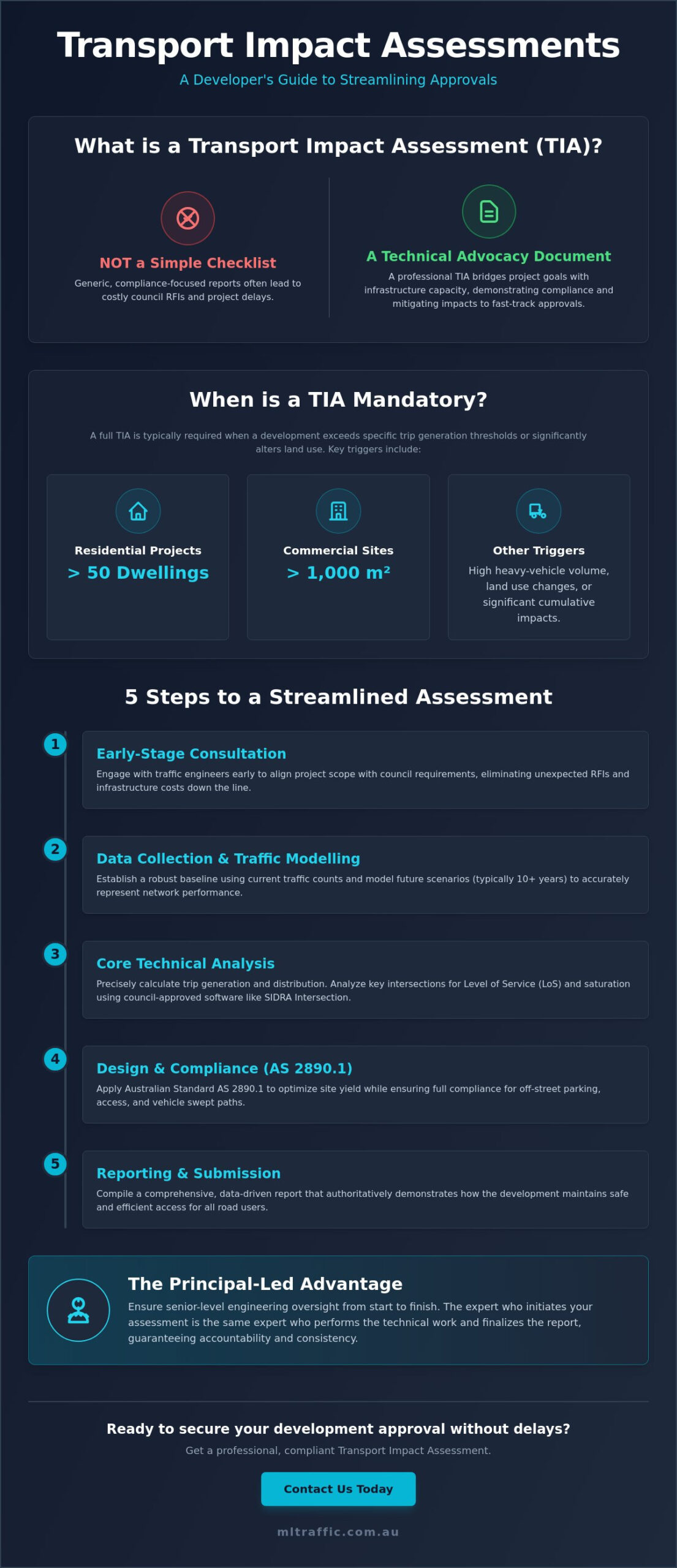
A Transport Impact Assessment is a technical advocacy document, not a simple compliance checklist. For developers, submitting a generic report often leads to expensive council RFIs and significant infrastructure delays. Securing a professional transport impact assessment brisbane is the primary method to align your development goals with current infrastructure capacity while satisfying rigorous local planning schemes.
It’s common to feel frustrated by the bureaucratic delays and complex technical standards like AS 2890.1 that frequently stall the DA process. You need a reporting strategy that bypasses these hurdles through meticulous data and direct senior-level engineering oversight. This article details the specific regulatory frameworks and technical requirements necessary to produce a compliant TIA report. We’ll examine how expert analysis and precise vehicle swept path assessments can fast-track your planning approval and eliminate the risk of unexpected infrastructure costs.
Key Takeaways
- Understand how a professional transport impact assessment brisbane serves as a technical advocacy document to bridge the gap between project goals and council infrastructure requirements.
- Learn how to calculate precise trip generation and distribution metrics to ensure your development application withstands rigorous network capacity scrutiny.
- Master the application of AS 2890.1 to optimize site yield while maintaining full compliance with off-street car parking and design standards.
- Identify the five critical steps for streamlining your assessment, starting with early-stage consultation to eliminate unexpected RFIs and infrastructure costs.
- Discover the benefits of principal-led project management, where the senior expert who initiates your assessment performs the technical work from start to finish.
Understanding the Role of a Transport Impact Assessment (TIA) Report
A Transport Impact Assessment functions as a technical instrument used to quantify the effects of a specific development on the existing road network. It provides local councils with the data necessary to ensure that new projects don’t compromise safety or operational efficiency. Conducting a transport impact assessment brisbane ensures that your project aligns with the Brisbane City Council’s City Plan and the Department of Transport and Main Roads (TMR) requirements. This assessment methodology often draws from broader multi-criteria frameworks, such as the New Approach to Appraisal (NATA), which helps engineers evaluate the wider economic and environmental implications of transport infrastructure.
To better understand this concept, watch this helpful video:
The distinction between a Traffic Impact Statement (TIS) and a full Assessment is critical for project budgeting and timelines. A TIS is generally sufficient for low-impact developments where traffic generation is minimal. In contrast, a full TIA is mandatory when a project significantly alters land use or exceeds specific trip generation thresholds. Our team provides these specialized technical services with a focus on principal-led accountability, ensuring the expert who starts your project is the one performing the technical work.
Objectives of an Authoritative Traffic Assessment
The primary objective of a professional assessment is to demonstrate that the proposed development maintains safe and efficient access for all road users. We use intersection analysis and site-specific data to mitigate potential impacts on existing traffic flow. This process confirms compliance with national and state-specific planning schemes, protecting the developer from future liability and ensuring the long-term viability of the site access points.
When is a Traffic Report Mandatory for Your DA?
Determining whether a report is mandatory depends on specific development thresholds. For example, residential projects exceeding 50 dwellings or commercial sites over 1,000 square meters typically trigger a requirement. Other triggers include land use changes that result in “notifiable road use” or high heavy-vehicle volumes. We also evaluate cumulative impacts from neighboring projects, a common requirement in high-growth corridors where multiple developments share the same infrastructure capacity.
Technical Components of a Compliant Transport Assessment
Technical rigour is the foundation of any successful transport impact assessment brisbane. Precision in calculating trip generation is essential for determining the exact volume of traffic a proposed development will produce. We use established empirical data to predict these volumes, ensuring the project’s impact is neither underestimated nor over-engineered. Trip distribution follows, where we predict the specific paths vehicles take through the existing network. This directional flow analysis identifies which intersections require detailed scrutiny to prevent localized congestion.
Intersection analysis remains the most scrutinized component of a TIA. We evaluate the Level of Service (LoS) and the degree of saturation to measure current and future performance. Our engineers utilize SIDRA Intersection software to provide the verified data that councils demand. This software allows us to model complex signalized and unsignalized intersections with high accuracy. All technical methodologies align with the Australian Transport Assessment and Planning (ATAP) Guidelines to ensure national consistency and regulatory acceptance.
Traffic Modelling and Data Collection
Accurate data collection establishes the baseline for all traffic modelling. We utilize current traffic counts to build a realistic representation of the network before adding development traffic. We simulate future scenarios, typically looking ten years ahead, to account for regional growth. This includes analyzing peak hour demands when the network is under the most stress. If you require a detailed intersection analysis or parking assessment, our senior principals provide the necessary oversight to ensure accuracy.
Vehicle Swept Path and Access Assessment
Vehicle swept path analysis is a mandatory requirement for modern site design. We use AutoTURN software to simulate the movements of specific vehicles, such as waste collection trucks and delivery vans. This ensures that on-site maneuvers are safe and don’t require illegal or dangerous reversing into public roads. We also perform rigorous sight distance assessments at all property access points. These assessments confirm that entering and exiting vehicles have sufficient visibility to interact safely with through-traffic, satisfying both council safety standards and AS 2890.1 requirements.
Navigating Australian Standards for Car Parking and Design
Compliance with Australian Standards is non-negotiable for development approval. AS 2890.1 governs off-street car parking and provides the technical framework for bay dimensions, aisle widths, and circulation patterns. Applying these standards correctly allows developers to optimize site yield without compromising safety or functionality. While councils set minimum parking rates, a professional transport impact assessment brisbane can justify a reduction if the land-use characteristics support lower demand.
Commercial and industrial projects must also adhere to AS 2890.2. This standard specifies the requirements for loading facilities and heavy vehicle maneuvering. Failure to account for these dimensions during the design phase often leads to costly redesigns after a council RFI. Additionally, driveway ramp grades require precise calculation. We design ramps to prevent vehicle scraping by following strict longitudinal grade limits and transition requirements. This ensures that every entry and exit point remains accessible for all standard vehicle types.
Car Parking Demand vs. Supply Assessments
We provide technical justifications for parking relaxations when council-mandated minimums are impractical. This process involves conducting empirical parking surveys at similar developments to demonstrate actual peak demand. We also integrate active transport provisions and green travel plans to further reduce reliance on private vehicles. These data-driven arguments are essential for securing approvals in high-density areas where space is at a premium.
Compliance with AS 2890.6: Disabled Parking Requirements
AS 2890.6 dictates the specific dimensions and access paths required for mobility-impaired users. These spaces must integrate seamlessly with the overall car park layout and provide a continuous accessible path of travel to the building entrance. Our senior principals provide the necessary certification of parking designs to ensure full compliance with these critical accessibility standards. This accountability prevents delays during the operational works phase and ensures the development is inclusive for all users.
5 Steps to Streamlining Your Transport Assessment for Approval
A streamlined approval process is not accidental; it’s the result of technical precision and proactive advocacy. Securing a transport impact assessment brisbane requires a structured approach that prioritizes council requirements from the initial site plan. Our methodology eliminates the guesswork that often leads to project stalls and bureaucratic friction. Following these five steps ensures your development application remains on track for a seamless approval.
- Step 1: Early Consultation. Engaging with traffic engineers during the site planning phase is the most effective way to prevent fundamental design errors. We identify potential access issues before the site layout is finalized.
- Step 2: Site Inspection and Data Collection. Desktop audits are insufficient. We conduct physical site inspections to identify existing constraints, such as street furniture or sightline obstructions, that impact traffic flow.
- Step 3: Technical Report Preparation. We develop a comprehensive report featuring SIDRA intersection modelling and AutoTURN swept path simulations. This data provides the technical proof councils require.
- Step 4: Planning Code Audit. Every report undergoes a rigorous review against the Brisbane City Plan 2014 and relevant state planning codes. We ensure every performance outcome is addressed with technical evidence.
- Step 5: Proactive RFI Management. If the council issues a Request for Further Information, we manage the technical response directly. This “no-gatekeepers” approach ensures senior experts resolve queries without delay.
Mitigating the Risk of Council RFIs
Council RFIs often stem from unclear diagrams or insufficient technical justification for code variations. We mitigate this risk by producing professional, high-resolution technical drawings that leave no room for interpretation. If your project requires a relaxation of standard parking rates, we provide the empirical data and survey results to support the deviation. It’s about presenting a report that is difficult to challenge on technical grounds. To ensure your project meets these standards from the outset, contact our senior principals for a direct consultation.
Integration with Other Engineering Disciplines
A transport impact assessment brisbane does not exist in a vacuum. It must align with civil engineering designs, specifically drainage and pavement requirements. We coordinate closely with your civil team to ensure driveway grades and site access points are technically feasible. Furthermore, we work with town planners to ensure our traffic data supports the broader Statement of Environmental Effects. This multi-disciplinary alignment prevents conflicting data from reaching the council and ensures a unified project narrative.
ML Traffic Engineers: Principal-Led Expertise for National Projects
ML Traffic Engineers operates on a model of absolute accountability and technical excellence. Clients receive direct access to senior principals who possess over 15 years of specific industry experience. This ensures that every transport impact assessment brisbane is handled with the depth of knowledge required for complex urban environments. Unlike larger firms that delegate technical tasks to junior staff, we guarantee personnel continuity. The expert who initiates the relationship performs the actual technical work from inception to approval.
Our track record includes securing approvals for a wide range of land-use categories. We apply a meticulous approach to compliance that minimizes bureaucratic friction and prevents project stalls. We’ve successfully delivered technical reports for:
- High-density residential developments and mixed-use towers.
- Commercial retail centers and bulky goods outlets.
- Industrial warehouse facilities and logistics hubs.
- Childcare centers, schools, and educational institutions.
- Medical precincts and specialized health service buildings.
- Service stations and fast-food drive-through facilities.
Why Senior Involvement Matters in Traffic Engineering
Senior involvement is critical when negotiating with council officers or providing expert witness testimony. Our principals bring technical precision to SIDRA modelling and vehicle swept path analysis. This level of expertise allows for the fast-tracked delivery of reports without sacrificing quality. We understand the bureaucratic requirements of the planning process and apply a results-oriented approach to every transport impact assessment brisbane. There are no gatekeepers; you’ll have a direct line to the professional performing your technical work.
Comprehensive Services for Every Development Phase
We provide technical support from initial feasibility studies through to final car park design and certification. Our specialized assessments cover the following technical requirements:
- Traffic Impact Assessment (TIA) Reports
- Vehicle Swept Path Analysis using AutoTURN
- Car Parking Demand Assessments
- Traffic Guidance Schemes (TGS)
- Driveway Ramp Grade Assessments
- Intersection Analysis and SIDRA modelling
- Sight Distance Assessments
- Car Park Design and certification
- Waste Management Plans
This comprehensive approach ensures that all traffic-related requirements of a development application are met under one professional banner. Explore our full range of traffic engineering services to see how our expertise supports your project goals. We remain committed to delivering compliant, professional reports that withstand the highest levels of regulatory scrutiny.
Securing Your Project’s Infrastructure Approval
A successful development application relies on technical precision and strategic advocacy. You now understand that a professional transport impact assessment brisbane is more than a regulatory requirement; it’s a tool to align your site goals with existing council capacity. By mastering AS 2890 design standards and utilizing verified SIDRA modelling, you eliminate the technical ambiguities that cause project delays. Principal-led oversight ensures that the expert who begins your project is the one who delivers the final report, providing a level of accountability and continuity that larger firms often lack.
With over 15 years of industry experience and a comprehensive history of national planning approvals, we provide direct access to senior leadership on every project. Our meticulous approach to technical reporting and RFI management minimizes bureaucratic friction and fast-tracks your path to construction. Contact ML Traffic Engineers today for a principal-led traffic assessment report. We look forward to helping you achieve a seamless and compliant planning outcome for your next development.
Frequently Asked Questions
What is the difference between a Traffic Impact Assessment and a Traffic Impact Statement?
A Traffic Impact Assessment (TIA) is a comprehensive technical study, whereas a Traffic Impact Statement (TIS) is a simplified report for low-impact developments. A TIS usually addresses basic access and parking compliance. A full transport impact assessment brisbane is required when the development exceeds specific trip generation thresholds or significantly impacts the existing road network capacity.
How long does it typically take to prepare a professional TIA report?
Preparation timelines typically range from two to four weeks. This duration depends on the availability of current traffic count data and the complexity of the required modelling. Simple parking assessments may be completed faster; however, projects requiring detailed intersection analysis and multi-scenario simulations require more extensive technical review to ensure council acceptance.
Will my development need a SIDRA intersection analysis?
SIDRA analysis is mandatory if your development significantly increases traffic volumes at nearby intersections. Councils use this data to verify that the Level of Service (LoS) remains within acceptable limits. If your project impacts a signalized or high-volume unsignalized intersection, verified SIDRA modelling is the only way to prove your site won’t cause unacceptable congestion.
What happens if my project doesn’t meet council parking requirements?
You must submit a Car Parking Demand Assessment to justify a relaxation of council-mandated minimums. We conduct surveys at similar developments to provide empirical proof that your specific land use requires fewer spaces. This data-driven approach allows you to optimize site yield while still satisfying the performance outcomes of the local planning scheme.
Can a traffic engineer help reduce my infrastructure contribution costs?
Yes, traffic engineers can often reduce infrastructure contribution costs by providing accurate trip generation data. If your development’s actual impact is lower than the generic rates used by the council, we can negotiate a more favorable outcome. This requires a professional transport impact assessment brisbane that uses site-specific evidence to challenge standard infrastructure charge assumptions.
Is a Swept Path Analysis required for all commercial developments?
Swept Path Analysis is required for any commercial site involving heavy vehicle movements. This includes waste collection, loading bay access, and emergency vehicle entry. We use AutoTURN software to simulate these movements, ensuring vehicles can enter and exit in a forward gear. This analysis is essential for proving compliance with AS 2890.2 and local safety standards.
What information should I provide my traffic consultant to get started?
You should provide a current site plan, the proposed Gross Floor Area (GFA), and the specific number of residential or commercial units. Any correspondence from the council, such as an RFI or pre-lodgement minutes, is also critical. This information allows us to identify technical hurdles early and tailor the assessment to your project’s specific needs.
How current does traffic count data need to be for council acceptance?
Traffic count data generally needs to be less than two years old to be accepted by the council. If there have been major infrastructure changes or significant new developments in the immediate area, the council may require counts from the last 12 months. Establishing an accurate baseline is vital for the integrity of your technical modelling.

Disclaimer
The content on www.mltraffic.com.au, including all technical articles, guides, and resources, is provided for general informational and educational purposes only. It is not intended to constitute professional advice in traffic engineering, transportation planning, development approvals, or any other technical or legal field.
While ML Traffic Engineers makes every reasonable effort to ensure the accuracy, completeness, and timeliness of the information published, we do not provide any warranties or representations (express or implied) regarding its reliability, suitability, or availability for any particular purpose. Any reliance you place on the content is strictly at your own risk.
In no event shall ML Traffic Engineers, its directors, employees, authors, or affiliates be liable for any direct, indirect, incidental, special, consequential, or punitive damages (including, without limitation, loss of profits, data, or business opportunities) arising out of or in connection with the use of, or inability to use, any information provided on this website.
The articles and guides on this site are not a substitute for engaging a qualified, registered professional traffic engineer (such as an NPER or RPEQ engineer) to assess your specific project requirements. For tailored advice, compliance assessments, or traffic engineering services, please contact a competent professional.
This disclaimer may be updated from time to time without notice. By accessing or using this website, you agree to be bound by the most current version of this disclaimer.
