
What if the most effective way to lower your project’s capital expenditure wasn’t through cheaper materials, but through a smarter approach to transport? For many developers, the requirement for a travel demand management plan for new developments feels like another layer of red tape designed to stall progress. You’re likely tired of Council demanding costly road capacity upgrades or excessive car parking spaces that eat into your floor area ratio. It’s a common frustration to see a development application (DA) languish because of transport concerns that seem disconnected from modern urban realities.
A strategic Travel Demand Management (TDM) plan is actually a powerful financial lever that swaps expensive concrete for intelligent transport solutions. This guide demonstrates how these plans reduce infrastructure costs and fast-track your approvals by addressing Council concerns before they become roadblocks. We’ll examine the shift towards performance-based transport systems now being adopted across Australian metropolitan centres, where quantifiable mode-shift targets are replacing prescriptive parking minimums. You’ll learn how to navigate evolving regulatory landscapes to deliver a sustainable, future-proof development that satisfies both the balance sheet and the planning authorities.
Key Takeaways
- Understand how a travel demand management plan for new developments prioritises mode shift targets to reduce total vehicle kilometres travelled (VKT) and single-occupancy vehicle trips.
- Learn how to leverage TDM strategies to justify a reduction in mandatory car parking rates under AS 2890.1, significantly lowering basement excavation costs.
- Identify why the pre-DA meeting is the critical moment to introduce your transport strategy and ensure it aligns seamlessly with your Traffic Impact Assessment (TIA).
- Discover the core components of a compliant plan, including site-specific analysis of existing public transport, walking, and cycling infrastructure.
- Gain insights into a results-oriented approach to transport planning that focuses on what Councils actually approve to avoid unnecessary bureaucratic delays.
What is a Travel Demand Management Plan for New Developments?
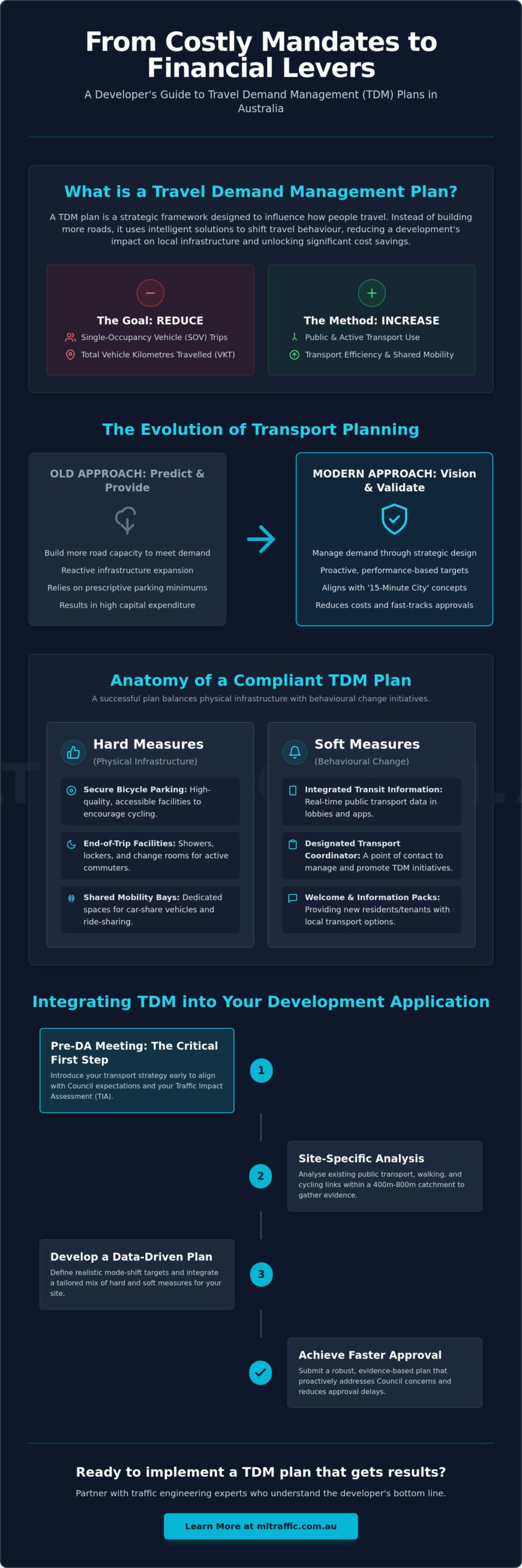
In Australian urban planning, a travel demand management plan for new developments is a technical framework designed to influence how people travel to and from a site. It moves beyond traditional traffic engineering by prioritising transport efficiency over road capacity. The primary objective is a quantifiable reduction in single-occupancy vehicle (SOV) trips and total vehicle kilometres travelled (VKT). Instead of simply assuming every resident or worker will drive, a TDM plan implements measures like car-sharing, improved end-of-trip facilities, and integrated transit information to shift behaviour.
This shift is now a mandatory component of modern Traffic Impact Assessments (TIA). Planners can no longer rely on road expansion to mitigate development impacts. A travel demand management plan for new developments differs significantly based on site context. For infill developments, the strategy focuses on leveraging high-frequency rail or bus networks and reducing car parking provision. Conversely, greenfield projects require a proactive design of internal street networks to prioritise active transport and transit connectivity from the outset.
To better understand this concept, watch this helpful video:
The Evolution of Transport Planning in Australia
Transport planning has moved away from the “predict and provide” model, which historically focused on building more road capacity to meet projected demand. Today, the industry follows a “vision and validate” approach. This manages demand through strategic design rather than just reactive infrastructure. These plans align with “Healthy Streets” and “15-minute city” philosophies, creating walkable, self-contained precincts. A robust TDM plan also serves as a critical pathway for achieving Green Star sustainability certifications, increasing the project’s overall market value and appeal to institutional investors.
Why Councils Require a TDM Plan in 2026
Councils require these plans to manage density without widening lanes. In established urban centres, road expansion is often impossible. TDM plans address the “first-mile, last-mile” problem, ensuring commuters can reach transit hubs effectively. These strategies ensure developments remain functional as car ownership patterns shift toward shared mobility. By reducing the reliance on private vehicles, developers can often negotiate lower car parking rates, directly improving the project’s feasibility. This proactive approach reduces the burden on local infrastructure while maintaining site accessibility.
Core Components of a Compliant Travel Demand Management Plan
A compliant travel demand management plan for new developments starts with a granular, site-specific transport analysis. This involves identifying all existing public transport, walking, and cycling links within a 400m to 800m catchment. We don’t just list these assets; we evaluate their capacity and quality to ensure they can support the development’s projected population. This data informs evidence-based mode shift targets. These targets must be realistic and tailored to the specific land use, whether it’s a high-density residential tower or a commercial business park.
Success requires a balanced integration of “hard” and “soft” measures. Hard measures involve physical infrastructure built into the site design. Soft measures focus on behavioural change and ongoing management. Both categories require clear implementation timelines and designated accountability, usually managed by a transport coordinator. This structured approach ensures the transport strategy remains functional long after the initial occupancy certificate is issued.
Sustainable Transport Infrastructure (Hard Measures)
Infrastructure provides the physical foundation for transport mode shifts. High-quality end-of-trip facilities are essential. These must include secure bicycle parking, lockers, and change rooms that exceed the minimum requirements of local planning schemes or AS 2890.3. We also specify electric vehicle (EV) charging infrastructure and dedicated car-share pods located in accessible areas of the car park. Smart parcel lockers and delivery hubs are increasingly vital. These reduce the frequency of courier vehicle movements and dwell times on-site, further lowering the development’s traffic footprint.
Behavioural Change Strategies (Soft Measures)
Physical assets alone don’t change habits. “Travel Welcome Packs” for new residents or employees provide immediate information on local transit routes and may include initial subsidies for public transport. One of the most effective soft measures is unbundling car parking from property titles. By separating the cost of a parking space from the unit price, developers encourage lower car ownership rates. For larger or more isolated sites, we often recommend development-wide carpooling apps or private shuttle bus services to bridge the gap to major transit hubs.
Monitoring, Reporting, and Remediation
Councils now demand long-term accountability. A travel demand management plan for new developments must include a monitoring framework. This typically involves annual travel surveys to track actual performance against the original mode shift targets. A Travel Plan Coordinator is often required to oversee these surveys and manage the TDM programme’s success. If a development fails to meet its transport goals, contingency plans must be in place. These might include additional funding for transit subsidies or physical modifications to the site’s transport facilities.
Ensuring these components align with Council expectations is critical for a smooth approval process. You can view our full range of technical transport services to see how we integrate these measures into successful DAs.
TDM vs. Traditional Infrastructure: The ROI for Developers
A travel demand management plan for new developments is a strategic financial tool, not just a compliance document. It allows developers to justify a significant reduction in mandatory car parking rates under Australian Standard AS 2890.1. By demonstrating that a site can function effectively with fewer private vehicles, you can pivot away from the traditional “predict and provide” model. This shift directly addresses the requirement for road capacity upgrades often demanded by local Councils. Instead of funding expensive off-site lane widenings, resources are directed toward on-site transport efficiency.
Implementing a robust TDM strategy also impacts infrastructure contributions. A professional plan can mitigate the projected traffic impact on the local network, providing the evidence needed to negotiate lower Section 7.11 (formerly Section 94) contributions or equivalent local government levies. You’re essentially swapping high-cost, low-yield concrete infrastructure for lower-cost, high-value transport programmes. This approach preserves capital while ensuring the development meets its regulatory obligations. It turns a bureaucratic requirement into a mechanism for protecting your project’s margins.
Reducing Capital Expenditure on Parking
Basement excavation often represents the most significant financial risk in a project’s budget. Underground parking is notoriously expensive, especially on sites with difficult access, high water tables, or limited footprints. Reducing parking requirements by even 10% to 20% can eliminate entire basement levels, saving millions in construction costs. On “unsolvable” sites where traditional parking quotas are physically impossible to meet, a travel demand management plan for new developments makes the project viable. The cost-benefit ratio is clear. A comprehensive bike-share programme and transit subsidies cost a fraction of the price of five car parking spots.
Optimising Site Yield and Floor Space
Reducing parking provision isn’t just about saving on excavation. It’s about reclaiming valuable site area. By removing internal ramps, driveways, and excess parking bays, you can increase the residential or commercial Gross Floor Area (GFA). In transit-oriented development (TOD) zones, Councils are increasingly receptive to higher-density DAs when they’re supported by professional TDM strategies. This reclaimed space directly increases the project’s total yield. Additionally, sustainable transport amenities like high-quality end-of-trip facilities and car-share pods improve the site’s marketability. Modern, eco-conscious tenants and buyers increasingly value these features over traditional car ownership, future-proofing your asset in a shifting market.
Integrating TDM with the Development Application Process
Successful integration of a travel demand management plan for new developments requires early engagement with planning authorities. The pre-DA meeting is the most critical moment for your transport strategy. This is where you present the managed-case scenario to Council officers before they solidify their expectations for parking and road upgrades. Waiting until the formal lodgement often leads to friction and expensive redesigns if the Council’s transport team hasn’t been briefed on your TDM objectives. Establishing this transport narrative early prevents the project from being assessed against outdated “predict and provide” metrics.
Your TDM plan must speak the same language as your Traffic Impact Assessment (TIA). While the TIA identifies potential network impacts, the TDM plan provides the mitigation framework. These documents must be perfectly aligned to avoid conflicting data. Similarly, TDM measures such as centralised delivery hubs or car-share pods directly influence your Swept Path Analysis. If your TDM strategy successfully reduces courier vehicle dwell times through smart lockers, this should be reflected in your service vehicle manoeuvring designs. This cohesive approach demonstrates a sophisticated understanding of site logistics.
Councils frequently object to TDM measures based on fears of “overspill” parking in local streets. We counter these concerns with expert data and empirical evidence. By showing that each TDM measure correlates with a measurable reduction in vehicle kilometres travelled, we provide the technical assurance Councils need. We use site-specific transport analysis to prove that the proposed parking rates are sufficient for the managed demand of the development.
Aligning with Council Local Transport Plans
Every Council area in Australia operates under an Integrated Transport Strategy (ITS) or a similar local transport plan. We meticulously research these documents to identify the Council’s specific goals for cycling, walking, and transit. If your development proactively supports these goals, the approval path becomes much clearer. This alignment is particularly useful when negotiating Voluntary Planning Agreements (VPAs). You can often trade TDM commitments, such as funding a local bike-share hub or improving off-site pedestrian links, for offsets in other infrastructure levies.
Navigating the Technical Review
The technical review phase often triggers a “Request for Further Information” (RFI) regarding transport demand. Councils may question the validity of your mode shift targets. Having a qualified traffic engineer certify the plan provides the necessary professional weight to these targets. We ensure that every TDM condition of consent is achievable. If the conditions are overly prescriptive, they become a burden for the future building manager. Practicality is the key to long-term compliance and successful project handover.
To ensure your transport strategy is robust enough to withstand Council scrutiny, contact our senior leadership team to discuss your specific site requirements.
Strategic TDM Planning with ML Traffic Engineers Australia
ML Traffic Engineers Australia provides over 15 years of technical expertise in transport planning and traffic engineering across Australia. We adopt a no-nonsense approach to every travel demand management plan for new developments. Our focus remains strictly on what Council will actually approve. This results-oriented philosophy ensures your project avoids unnecessary bureaucratic delays. We understand the technicalities of the DA process inside and out. Our comprehensive service suite covers every stage of the development lifecycle. We handle everything from initial TDM plans and Car Parking Demand Assessments to detailed car park design and construction traffic management.
Our methodology is built on technical precision and qualification. We don’t provide generic advice; we provide defensible engineering solutions. This includes a heavy reliance on technical assessments that satisfy the specific land-use categories of your project. We ensure that every strategy proposed is grounded in current regulatory standards and practical site constraints.
Our Proven Methodology for TDM Success
Our process relies on data-driven demand forecasting. We produce reports that stand up to rigorous Council scrutiny and independent peer reviews. We maintain deep expertise in AS 2890.1 and AS 2890.2 compliance. This ensures all parking and access solutions are both regulatory-compliant and physically functional. We specialise in identifying the specific transport requirements of diverse project environments, including:
- High-density residential towers and mixed-use precincts
- Commercial office developments and business parks
- Retail centres and industrial logistics hubs
- Childcare centres, medical clinics, and educational facilities
- Aged care and retirement living developments
We tailor our strategies to balance strict planning requirements with developer profitability. This ensures transport commitments don’t compromise the project’s commercial viability or total yield. Our methodology is designed to provide clear, defensible evidence that supports your preferred development outcomes.
Secure Your DA Approval Today
Early involvement of a traffic consultant is the most effective way to prevent project delays. ML Traffic Engineers Australia provides direct access to our senior principals. The expert who starts your project will be the one who finishes it. There are no gatekeepers. We do not hand technical work off to junior staff once the contract is signed. This personnel continuity ensures accountability and technical precision throughout the DA process. It distinguishes our consultancy from larger, more impersonal firms where project knowledge is often lost during personnel hand-overs.
We invite you to contact us for a preliminary review of your site’s transport demand needs. We get straight to the point. We provide the technical assurance you need to secure your approval and minimise infrastructure costs. Enquire about a Travel Demand Management Plan for your next project.
Accelerate Your DA Approval with Strategic Transport Planning
A travel demand management plan for new developments represents more than a compliance obligation; it’s a strategic asset that preserves your project’s margins. By shifting the transport narrative from “predict and provide” to “vision and validate”, you can justify reduced car parking rates and eliminate high-cost basement levels. This approach directly increases your Gross Floor Area while satisfying Council’s sustainability and network capacity requirements. Early engagement with qualified professionals ensures your transport strategy aligns with local Integrated Transport Strategies and national standards like AS 2890.
ML Traffic Engineers Australia brings over 15 years of specialised transport planning experience to your project. We ensure direct principal involvement in every assessment, providing you with a reliable technical partner who understands the bureaucratic nuances of local government. Our no-nonsense methodology focuses on delivering results that stand up to rigorous technical review. We’re ready to help you navigate the complexities of the DA process and future-proof your development’s accessibility.
Contact our senior traffic engineers to discuss your TDM requirements.
Frequently Asked Questions
What is the difference between a TDM plan and a Traffic Impact Assessment (TIA)?
A Traffic Impact Assessment (TIA) evaluates the development’s physical effect on the surrounding road network and intersection performance. In contrast, a TDM plan focuses on reducing the total number of vehicle trips generated by the site. While the TIA identifies the potential traffic impact, the TDM plan provides the strategic solution to mitigate that growth through sustainable transport alternatives and behavioural change.
Is a Travel Demand Management plan mandatory for all new developments in Australia?
Requirements for a travel demand management plan for new developments vary between local government areas. Many metropolitan Councils now mandate these plans for large-scale residential, commercial, or mixed-use projects to manage urban density and network congestion. You should consult your local planning scheme or a traffic engineer early in the pre-DA phase to determine if your specific site triggers this requirement.
Can a TDM plan really help me reduce the number of car parking spaces required by Council?
Yes, a robust TDM strategy provides the technical justification to reduce car parking provision below standard planning scheme rates. By implementing “soft” and “hard” measures that encourage a verifiable mode shift, developers can demonstrate that the actual parking demand will be lower than traditional models suggest. This frequently leads to significant savings in basement excavation costs and improved site yield.
How much does it cost to implement a Travel Demand Management programme?
Implementation costs depend on the scale of the development and the specific measures selected. Low-cost strategies include transit maps and travel welcome packs, while higher-expenditure items include dedicated car-share pods or private shuttle services. These costs should be weighed against the substantial capital savings achieved through reduced parking requirements and lower infrastructure contributions often negotiated with local Councils during the DA process.
Who is responsible for managing the TDM plan once the development is completed?
The responsibility for ongoing management typically falls to the Building Manager or a designated Travel Plan Coordinator. This role involves overseeing the maintenance of end-of-trip facilities, coordinating car-share arrangements, and distributing transit information to new tenants or employees. In many cases, Councils include these management duties as a formal condition of the development’s operational consent to ensure long-term compliance.
What are the most effective TDM measures for residential developments?
Effective residential measures include unbundling car parking from unit titles and providing high-quality, secure bicycle storage that exceeds Australian Standard AS 2890.3. On-site car-share pods and “Travel Welcome Packs” that include pre-loaded transit cards are also highly successful. These initiatives directly lower car ownership rates among residents, particularly in transit-oriented development zones with high-frequency rail or bus connectivity.
How do Councils monitor whether a TDM plan is actually working?
Councils monitor effectiveness through mandatory reporting periods, often requiring annual travel surveys for the first three to five years of occupancy. These surveys track actual transport behaviour against the original mode shift targets set in the travel demand management plan for new developments. Failure to meet these targets may trigger remediation clauses or the implementation of additional contingency measures to reduce site-generated traffic.
Can I use a TDM plan to justify a higher density on my site?
Yes, TDM is often used to support higher-density development applications by proving that the site’s traffic generation will remain within the capacity of the existing road network. When a developer can demonstrate a significant reduction in vehicle kilometres travelled, planning authorities are more likely to approve increased floor space or residential density in well-connected urban centres where road widening is not a viable option.

Disclaimer
The content on www.mltraffic.com.au, including all technical articles, guides, and resources, is provided for general informational and educational purposes only. It is not intended to constitute professional advice in traffic engineering, transportation planning, development approvals, or any other technical or legal field. While ML Traffic Engineers makes every reasonable effort to ensure the accuracy, completeness, and timeliness of the information published, we do not provide any warranties or representations (express or implied) regarding its reliability, suitability, or availability for any particular purpose. Any reliance you place on the content is strictly at your own risk. In no event shall ML Traffic Engineers, its directors, employees, authors, or affiliates be liable for any direct, indirect, incidental, special, consequential, or punitive damages (including, without limitation, loss of profits, data, or business opportunities) arising out of or in connection with the use of, or inability to use, any information provided on this website. The articles and guides on this site are not a substitute for engaging a qualified, registered professional traffic engineer (such as an NPER or RPEQ engineer) to assess your specific project requirements. For tailored advice, compliance assessments, or traffic engineering services, please contact a competent professional. This disclaimer may be updated from time to time without notice. By accessing or using this website, you agree to be bound by the most current version of this disclaimer.
