
A 1:4 ramp grade without proper transitions is a guaranteed way to trigger a Council Development Application (DA) rejection and cause permanent damage to every vehicle that enters your site. You likely know that failing to meet the rigid requirements of Australian Standard AS 2890.1 doesn’t just stall your project; it creates long-term liabilities such as vehicles scraping on steep gradients or poor visibility at exit points. These technical hurdles are common in modern developments, but they’re also entirely avoidable with the right engineering oversight.
We understand the frustration of receiving a Council RFI due to inadequate service vehicle access or unsafe sight-lines. This guide focuses on troubleshooting driveway access issues to help you identify, diagnose, and resolve complex manoeuvrability problems before they become permanent design flaws. You’ll learn how to ensure safe vehicle transitions and achieve the compliance necessary to secure your DA approval. We’ll examine the specific technical adjustments needed for steep sites, swept path requirements for service vehicles, and the precise sight-line assessments required by Australian authorities.
Key Takeaways
- Understand how to apply AS 2890.1 standards to correct ramp grades and prevent vehicle “bottoming out” on steep transitions.
- Discover why Swept Path Analysis is the industry-standard tool for identifying conflict points and ensuring seamless vehicle manoeuvrability.
- Learn a systematic approach to troubleshooting driveway access issues by distinguishing between minor physical defects and fundamental design non-compliance.
- Navigate local council LEP and DCP requirements effectively to ensure your site survey data leads to successful DA approval.
- Identify the value of senior engineering oversight to ensure accountability and technical precision throughout the driveway design process.
Table of Contents
Identifying Common Driveway Access and Manoeuvrability Issues
Australian driveway design is governed by strict technical requirements, primarily Australian Standard AS 2890.1:2004. This standard dictates the specific geometry required for safe vehicle movement between the public road and private property. Identifying and troubleshooting driveway access issues early in the design phase prevents costly rework during the construction stage. While Driveway basics involve simple material selection and location, professional compliance involves calculating ramp grades, transition lengths, and vertical clearances to prevent vehicle undercarriage damage.
Many "standard" designs fail because they don’t account for the unique topography of sloped Australian sites. A design that works on a flat 600sqm block will likely fail on a site with a gradient exceeding 15%. These failures lead to vehicles "bottoming out" or "scraping" where the wheelbase cannot clear the transition between the road crossover and the internal ramp. Professional traffic engineering ensures these physical constraints are addressed before the first pour of concrete.
To better understand the financial implications of these design errors, watch this helpful video:
Functional vs. Regulatory Access Problems
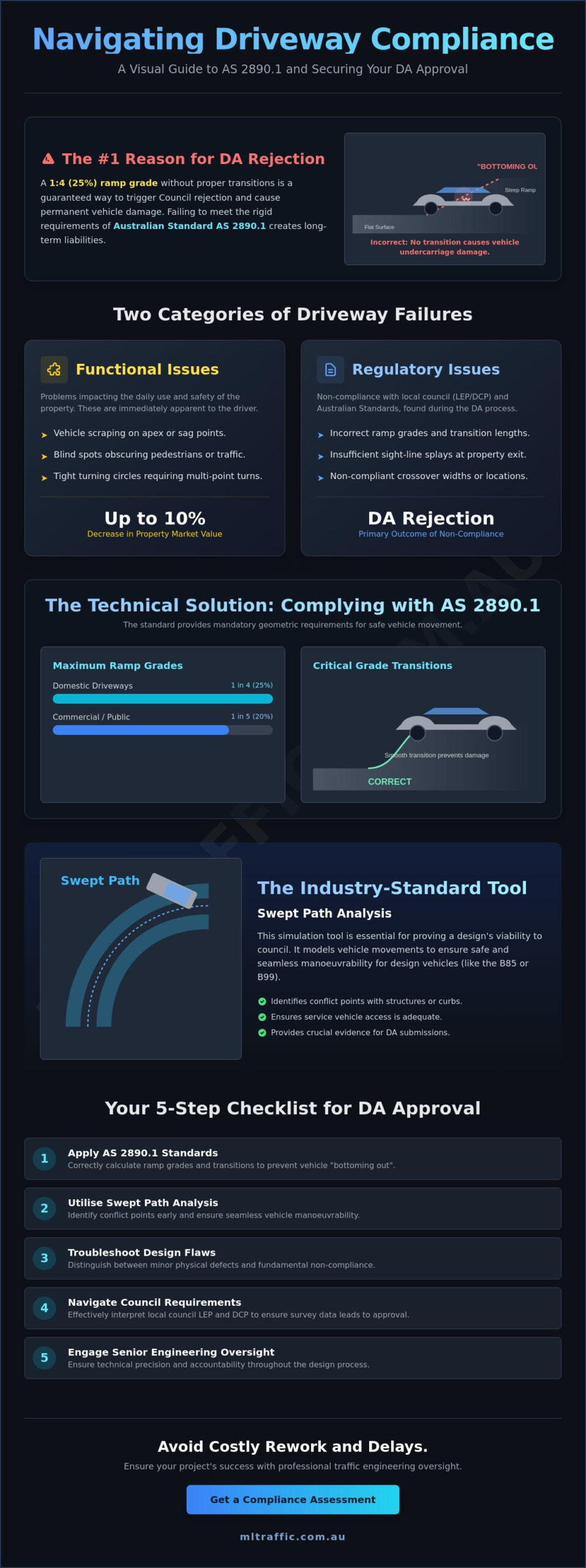
Functional issues are immediately apparent to the driver and impact the daily utility of the property. These include vehicle scraping on the driveway "apex" or "sag," blind spots that obscure pedestrians on the footpath, and tight turning circles that require three-point turns to enter a garage. These problems make a property difficult to use and can decrease market value by up to 10% in premium suburbs.
Regulatory issues are often discovered during the Development Application (DA) process or a final council inspection. Local councils require adherence to specific crossover widths and sightline splays. When functional failures overlap with regulatory non-compliance, the project faces significant hurdles. A professional Vehicle Swept Path Assessment is frequently required to prove a design’s viability to the council and ensure the proposed layout actually works for the B85 or B99 design vehicle.
The Consequences of Ignoring Access Conflicts
Ignoring access conflicts creates long-term liability for the property owner. Poor visibility at the property boundary increases the risk of collisions with pedestrians or cyclists, which can lead to significant legal exposure. If a driveway fails a final council inspection, the costs to rectify the slope or width can exceed A$15,000. These expenses cover demolition, re-excavation, and new concrete pours. Beyond the direct costs, a failed inspection will delay the issuance of a Certificate of Occupancy. This delay prevents owners from moving in or settling a property sale, causing cascading financial stress for developers and homeowners alike.
Technical Root Causes: Compliance with AS 2890.1
AS 2890.1 serves as the mandatory benchmark for off-street car parking in Australia. When troubleshooting driveway access issues, the first step is a technical audit against this standard to identify why vehicles are scraping or why councils are rejecting development applications. Most failures occur because the design overlooks the relationship between vehicle wheelbase and the rate of change in the pavement grade.
The standard ensures that a B85 vehicle, representing 85% of the vehicle fleet, can navigate a facility without damage. If your driveway doesn’t meet these geometric requirements, you risk structural damage to vehicles and potential liability for non-compliant infrastructure. Professional assessments often reveal that minor deviations in width or curvature are the root cause of poor site performance.
Understanding Ramp Grades and Transitions
AS 2890.1 specifies a maximum grade of 1 in 4 (25%) for domestic driveways. For commercial or public car parks, this limit is 1 in 5 (20%). If a ramp transitions from a flat surface to a 20% grade without a transition curve, the vehicle’s bumper or chassis will likely hit the ground. Vertical curves are mandatory when the change in grade exceeds 12.5% to maintain a minimum 100mm ground clearance.
Steep sites present the most significant challenges. When a standard ramp isn’t enough, engineers must use longitudinal sections to design complex transitions. These transitions prevent the "bottoming out" effect at the "apex" or "sag" of the ramp. If you’re struggling with a steep entry, our professional traffic engineering services can provide a compliant redesign that solves these elevation hurdles.
Sight Distance and Pedestrian Safety
Safety at the property boundary depends on the sight triangle. AS 2890.1 requires a clear area of 2.0 metres by 2.5 metres where the driveway meets the footpath. This ensures drivers see pedestrians before the vehicle nose enters the public walkway. Common obstructions like 1.8m high masonry fences, letterboxes, or overgrown hedges are frequent causes of council compliance failure.
Designers should consult this AS 2890.1 explained guide to verify boundary clearances before construction begins. While local councils enforce these rules, the FHWA Access Management Guidelines also highlight how proper sight-line management reduces collision rates by up to 30% in urban environments. Troubleshooting driveway access issues at the boundary often requires modifying fence heights or relocating utilities to restore these vital sight-lines. Every millimetre matters when trying to achieve a compliant and safe exit point.
-
Domestic Max Grade: 1 in 4 (25%).
-
Commercial Max Grade: 1 in 5 (20%).
-
Transition Requirement: Necessary if grade change is > 12.5%.
-
Sight Triangle: 2.0m x 2.5m at the boundary.
Troubleshooting Manoeuvrability with Swept Path Analysis
Swept Path Analysis (SPA) is the technical simulation of a vehicle’s movement to determine the exact envelope of space required for turning. It’s the industry standard for troubleshooting driveway access issues because it provides a 99% accuracy rate in predicting vehicle behaviour. By mapping the path of the wheels and the body swing of the vehicle, engineers identify conflict points where the chassis or bumper would strike structural elements like pillars, walls, or fences.
Professional assessments involve simulating specific vehicle classes defined by Australian Standard AS 2890.1. These include:
-
B85 and B99 Vehicles: Standard passenger cars representing the 85th and 99th percentile of vehicles on Australian roads.
-
Small Rigid Vehicles (SRV): Common for courier deliveries in residential or mixed-use zones.
-
Heavy Rigid Vehicles (HRV): Essential for waste collection and large-scale logistics.
Using software modelling prevents expensive construction errors. It’s significantly cheaper to adjust a CAD drawing than to jackhammer a reinforced concrete ramp that a garbage truck cannot navigate. Since 2005, we’ve used these simulations to resolve geometry issues before they reach the construction phase.
When Swept Path Analysis is Mandatory
Council requirements often dictate when a formal SPA is necessary for a Development Application (DA). This is common for sites with basement parking, steep gradients, or narrow corridors where clearance is minimal. If your site requires on-site waste collection or heavy vehicle deliveries, an SPA is vital to ensure these vehicles can enter and exit in a forward direction. For technical specifications, see our Swept Path Analysis guide for Australian developments.
Software vs. Manual Calculation
Manual turning templates are outdated and often lead to inaccuracies in modern design. They don’t account for the complex steering geometry of different vehicle models or the impact of vertical grades on horizontal clearance. We utilize AutoTURN and similar engineering software to provide visual proof to councils that a design is functional. This software allows us to:
-
Test multiple "what-if" scenarios for different vehicle types.
-
Identify the exact point where a driveway width is insufficient.
-
Provide high-resolution overlays for DA reports.
-
Ensure compliance with AS 2890.1 and local council codes.
Visual simulations remove the guesswork, providing a clear path for approval and construction. This methodology is essential when troubleshooting driveway access issues for complex urban sites where every millimetre of clearance counts.
A Step-by-Step Guide to Resolving Driveway Access Conflicts
Troubleshooting driveway access issues requires a methodical approach to satisfy both engineering safety and municipal regulations. When a design fails to meet initial council scrutiny, developers must follow a structured technical path to achieve compliance. This process ensures that every geometric detail aligns with Australian Standards while addressing site-specific constraints.
-
Step 1: Conduct a site survey. Commission a registered land surveyor to establish accurate Reduced Levels (RLs) and property boundaries. You can’t calculate ramp grades or transition zones without precise topographical data.
-
Step 2: Review local council LEP and DCP requirements. Every Local Government Area (LGA) has specific Development Control Plans. These documents define the allowable width, location, and number of crossovers for a single site.
-
Step 3: Perform a technical audit against Australian Standards. Compare the proposed layout against AS 2890.1:2004. This standard is the baseline for off-street car parking and driveway gradients in Australia.
-
Step 4: Engage a traffic engineer for a formal assessment. A qualified professional will identify non-compliance risks and provide the technical justification required for the Statement of Environmental Effects.
-
Step 5: Revise design drawings. Integrate engineering recommendations into the architectural set. This often involves adjusting floor levels or internal ramp configurations to meet sightline requirements.
Reviewing Council Requirements
Local government access codes vary significantly between municipalities. A design that passes in one council area might be rejected 10 kilometres away due to different DCP interpretations. Identifying "non-negotiable" requirements early is vital. These often include minimum distances from street trees, power poles, or intersections. If the council issues a Request for Further Information (RFI), don’t respond with vague promises. Provide technical proof, such as B85 vehicle swept path diagrams, to address their specific concerns regarding vehicle manoeuvrability and safety.
The Role of the Traffic Impact Assessment
A Traffic Impact Assessment serves as a professional tool to justify design variations. When a site’s steep topography or narrow frontage makes strict compliance with AS 2890.1 difficult, the assessment documents necessary safety mitigations. This might include installing convex mirrors or electronic warning systems for exiting vehicles. By providing a data-led report, you build a persuasive case for planning officers. It demonstrates that the proposed driveway, while non-standard, remains safe for both motorists and pedestrians. This technical evidence is often the difference between a refusal and a successful development consent.
Secure your development approval by consulting with experts who understand the technicalities of access design. Contact ML Traffic Engineers for a professional assessment of your site.
Professional Traffic Engineering: Ensuring DA Approval
Securing a Development Application (DA) approval often hinges on the technical feasibility of your site access. Troubleshooting driveway access issues is a complex task that requires specific engineering knowledge to meet Australian Standards. At ML Traffic Engineers, we operate on a clear principle: the traffic consultant who provides your quote is the one who performs the work. This direct accountability prevents the communication breakdowns that often occur in larger, impersonal firms where junior staff might handle the technical heavy lifting without adequate supervision.
Senior engineering oversight is vital for driveway design. Our principals bring between 30 and 40 years of experience to every project. We’ve assisted with over 10,000 sites across Australia, covering everything from residential apartments and childcare centres to large-scale industrial warehouses and temples. This depth of experience allows us to identify potential council objections before they lead to formal requests for further information (RFI).
Expert Assessment Services
Steep or difficult terrain often leads to non-compliance with AS 2890.1. We provide detailed driveway ramp grade assessments to ensure vehicles don’t scrape or lose traction. Our car park design certification guarantees that your layout is functional, safe, and compliant with all relevant regulations. You can view our full range of Traffic Engineering Services to see how we address site-specific constraints for private developers.
Streamlining the Approval Process
Redesigns and construction delays are expensive. Engaging an RPEQ (Registered Professional Engineer of Queensland) or equivalent registered engineer ensures your report carries the necessary professional weight for council submission. We focus on reducing the risk of costly errors by providing accurate Vehicle Swept Path Assessments and Sight-Line Assessments from the outset. For a direct consultation regarding your project, you can reach our principals directly via their mobile numbers.
Final Checklist Before Council Submission:
-
Verify the driveway ramp grade against AS 2890.1 standards to prevent vehicle scraping.
-
Confirm sight-line requirements are met for both pedestrian and vehicle safety at the property boundary.
-
Ensure the vehicle swept path assessment accounts for the largest expected vehicle, such as a heavy rigid vehicle (HRV) for industrial sites.
-
Check that the engineering report is signed and certified by a registered professional (RPEQ or equivalent).
-
Validate that all car park dimensions, including aisle widths and blind aisle extensions, meet local council Development Control Plan (DCP) requirements.
-
Confirm that any proposed traffic control devices are clearly marked on the design plans.
Secure Your DA Approval with Precise Driveway Design
Successful development applications depend on precise geometry and strict adherence to AS 2890.1. Identifying manoeuvrability constraints early prevents expensive redesigns during the construction phase. Using technical tools like Swept Path Analysis ensures every vehicle can enter and exit your site safely. Effective troubleshooting driveway access issues requires this level of technical rigour to satisfy strict council requirements. ML Traffic Engineers brings over 15 years of industry experience to your project. We’ve successfully completed assessments for more than 10,000 sites across Australia. You’ll have direct access to our senior principals, Michael Lee and Benny Chen, throughout the process. This direct accountability means the consultant who provides your quote is the expert who performs the technical work. Don’t risk your DA approval with generic plans that fail to meet Australian Standards. Professional traffic engineering provides the data-backed assurance you need for a seamless and compliant approval process.
Get an expert Traffic Engineering Assessment for your driveway today
Expert guidance ensures your project moves from the drawing board to reality without unnecessary delays.
Frequently Asked Questions
Why is my car scraping when I drive up my driveway ramp?
Scraping occurs because the vertical transitions or ramp grades exceed the clearance limits of your vehicle. This usually happens at the breakover point or the toe of the ramp where the angle changes too abruptly. Troubleshooting driveway access issues often involves measuring these specific angles against the B85 or B99 vehicle templates defined in Australian Standards. If your driveway lacks the required 1 in 8 transitions, even standard sedans will bottom out.
Does every driveway need to comply with AS 2890.1?
Yes, all residential and commercial off-street parking facilities in Australia must adhere to AS 2890.1:2004. While local councils have their own Development Control Plans, they almost universally reference this Australian Standard for technical requirements. Compliance ensures vehicles can safely enter and exit without damage or creating traffic hazards. Failure to comply can lead to rejected occupancy certificates or legal liability in the event of a property damage claim.
What happens if my driveway doesn’t meet council sight distance requirements?
Council will likely refuse your development application or require a formal Risk Assessment from a qualified traffic engineer. Sight distance is critical for pedestrian and motorist safety. If the required 2.0m by 2.5m clear zones aren’t met, you might need to relocate fences or remove vegetation. In some cases, an engineer can provide a merit-based justification to council if the shortfall is minor and safety is maintained through other measures.
Can I fix a driveway access issue without completely rebuilding it?
You can often resolve scraping issues through minor modifications like installing transition slabs or grinding down high concrete points. You don’t always need a full reconstruction. Applying a concrete topping to create a more gradual vertical curve can bridge the gap between steep grades effectively. However, any modification must still maintain compliance with AS 2890.1. A professional assessment will determine if a localized fix is viable or if the crossover requires a full adjustment.
What is a Swept Path Analysis and do I need one for a single dwelling?
A Swept Path Analysis is a computer-generated simulation showing the exact path a vehicle’s body and wheels take during a turn. You need one for a single dwelling if your driveway has tight turns, narrow widths, or complex entry angles. Councils often request this to prove a B85 or B99 vehicle can enter and exit in a single forward motion. It removes guesswork by providing technical proof that the design works for standard Australian vehicles.
How much does a traffic engineering report for a driveway cost?
A basic traffic engineering report for a residential driveway typically costs between A$1,200 and A$2,500 depending on the complexity of the site. Prices vary based on whether you need a simple sight-line assessment or a full swept path analysis. More complex projects involving multiple dwellings or steep terrain require more detailed modelling. Always ensure your consultant is an RPEQ or equivalent registered professional to ensure council acceptance of the report.
What is the maximum allowable grade for a residential driveway in Australia?
The maximum allowable grade for a domestic driveway under AS 2890.1 is 1 in 4, which equals 25%. However, this maximum grade cannot be used for the entire length of the ramp. You must include transition grades at the top and bottom to prevent vehicle scraping. For example, a 1 in 8 transition is required for at least 2.0 metres where the change in grade exceeds 12.5% to 15%.
Why did council reject my driveway crossover application?
Rejections usually stem from non-compliance with the local Council’s Standard Drawings or safety concerns regarding sight lines. Common reasons include the crossover being too close to an intersection, interference with utility pits, or excessive steepness. If you’re troubleshooting driveway access issues after a rejection, check if your design matches the specific 2024 council guidelines. A traffic engineer can often negotiate a solution through a formal Traffic Impact Statement or design amendment.
Which areas do you cover?
We are traffic engineers servicing Melbourne, Sydney, Brisbane, Gold Coast, Hobart, Perth, Adelaide, Darwin, Canberra and surrounding areas.

Disclaimer
The content on www.mltraffic.com.au, including all technical articles, guides, and resources, is provided for general informational and educational purposes only. It is not intended to constitute professional advice in traffic engineering, transportation planning, development approvals, or any other technical or legal field.
While ML Traffic Engineers makes every reasonable effort to ensure the accuracy, completeness, and timeliness of the information published, we do not provide any warranties or representations (express or implied) regarding its reliability, suitability, or availability for any particular purpose. Any reliance you place on the content is strictly at your own risk.
In no event shall ML Traffic Engineers, its directors, employees, authors, or affiliates be liable for any direct, indirect, incidental, special, consequential, or punitive damages (including, without limitation, loss of profits, data, or business opportunities) arising out of or in connection with the use of, or inability to use, any information provided on this website.
The articles and guides on this site are not a substitute for engaging a qualified, registered professional traffic engineer (such as an NPER or RPEQ engineer) to assess your specific project requirements. For tailored advice, compliance assessments, or traffic engineering services, please contact a competent professional.
This disclaimer may be updated from time to time without notice. By accessing or using this website, you agree to be bound by the most current version of this disclaimer.
