
A single oversight in your truck loading dock swept path analysis can trigger a Council Request for Information (RFI) that stalls your development for months and necessitates a A$30,000 structural redesign. You know that Australian local councils demand absolute precision in vehicle maneuvering to prevent traffic hazards and operational failures. Miscalculating the spatial requirements for a Heavy Rigid Vehicle (HRV) versus a Medium Rigid Vehicle (MRV) is a primary reason for DA rejections in industrial and commercial projects. Relying on guesswork rather than technical data often leads to costly, late-stage modifications that eat into your profit margins.
You need a design that satisfies AS 2890.2 standards while ensuring efficient operational flow for your future tenants. This article provides the technical expertise required to master loading dock requirements and secure rapid council approval. We’ll examine the specific clearance margins, turning circle dimensions, and documentation standards necessary to produce a compliant and functional development plan.
Key Takeaways
-
Understand how AS 2890.2 dictates minimum bay dimensions and manoeuvring areas to ensure your commercial development remains compliant with Australian Standards.
-
Learn to distinguish between the ‘Design Vehicle’ and ‘Check Vehicle’ to accurately size your loading facilities for the largest expected traffic.
-
Identify and mitigate ‘invisible’ danger zones, such as vertical clearance heights and structural pillar placement, through a precise truck loading dock swept path assessment.
-
Secure rapid council approval by integrating professional traffic engineering insights into your Development Application (DA) to prevent expensive post-submission redesigns.
Table of Contents
-
Identifying and Mitigating Common Swept Path Conflict Points
-
Securing Council Approval with Professional Traffic Engineering Reports
Understanding Truck Loading Dock Swept Path Requirements
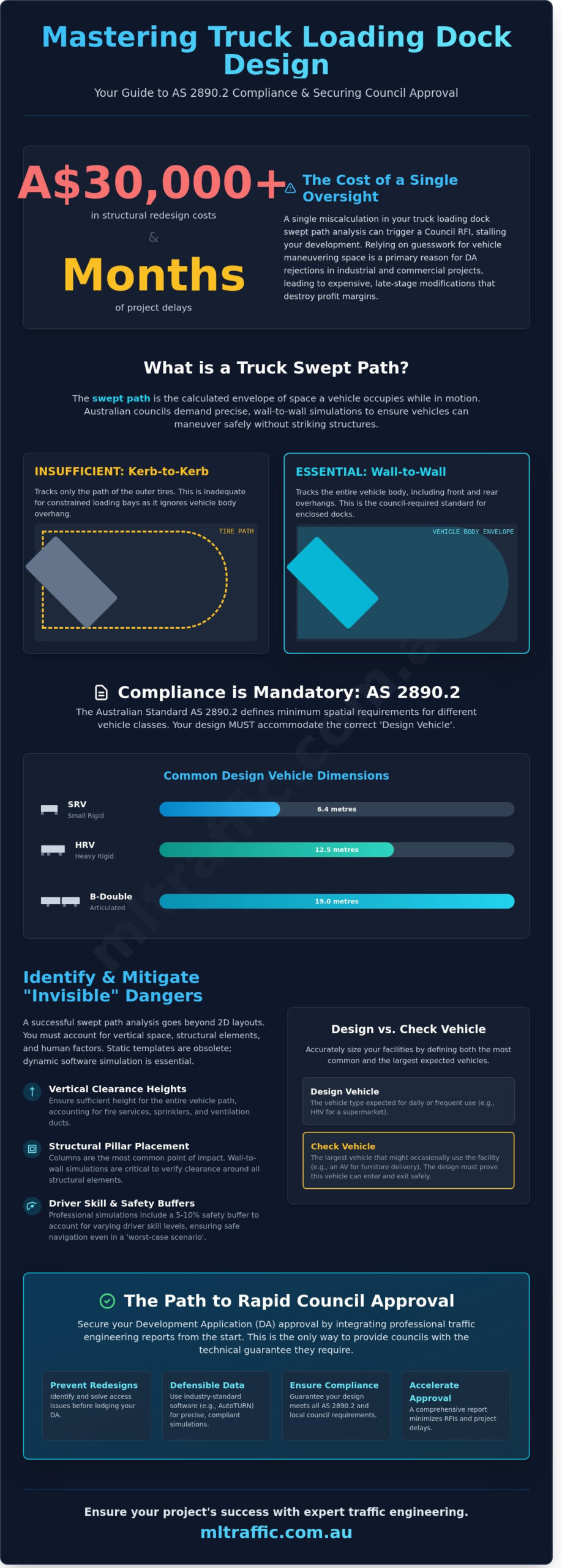
A truck loading dock swept path is the calculated envelope of space a vehicle occupies while in motion. It’s the most scrutinized element of a commercial Development Application (DA) in Australia. Councils focus on this because a failure in dock access creates immediate safety risks and operational bottlenecks. If a heavy vehicle cannot enter or exit in a single forward or reverse motion, it creates traffic congestion on public roads and increases the risk of property damage.
The financial risk of ‘near-miss’ designs is substantial. A 500mm error in the turn radius of a 19m semi-trailer isn’t a minor oversight; it’s a structural failure. Such errors often lead to site-wide redesigns after the DA has been lodged, costing developers thousands in A$ and delaying project timelines by several months. Precision in swept path analysis is the only way to mitigate these risks early in the design phase.
Modern engineering relies on these simulations to validate that the loading dock infrastructure is compatible with the intended vehicle fleet. Whether you are designing for a Small Rigid Vehicle (SRV) or a B-Double, the simulation must account for every millimetre of the vehicle’s movement. This ensures the truck loading dock swept path complies with AS 2890.2 and local council requirements for heavy vehicle access.
The Difference Between Kerb-to-Kerb and Wall-to-Wall
Kerb-to-kerb measurements define the path of the outer tyre during a manoeuvre. While this is useful for road design, it’s insufficient for constrained loading bays. Wall-to-wall simulations track the path of the entire vehicle body, including front and rear overhangs. Australian councils insist on wall-to-wall simulations for enclosed or basement docks. This ensures that the vehicle body doesn’t strike structural columns, fire services, or overhead clearances during tight turns.
Why Standard Templates Often Fail in 2026
Static turning templates are no longer sufficient for complex site layouts. Dynamic software provides a level of precision that plastic overlays cannot match. These simulations factor in variable steering speeds and the 5% to 10% safety buffer required to account for varying driver skill levels. Designing for the ‘worst-case scenario’ is now a necessity for council approval. It ensures that even a less experienced driver can navigate the dock safely without multiple-point turns or hitting site boundaries.
Technical Compliance: AS 2890.2 and Vehicle Manoeuvrability
AS 2890.2:2018 is the primary Australian Standard governing the design and operation of off-street commercial vehicle facilities. This standard establishes the mandatory framework for bay dimensions, height clearances, and manoeuvring areas. Compliance is not optional for developers. It ensures that a specific truck loading dock swept path is achievable within the physical constraints of a site. Failure to adhere to these benchmarks often results in refused Development Applications (DAs) or dangerous operational environments where vehicles cannot safely enter or exit in a forward direction.
The standard categorises vehicles into specific classes, each with distinct spatial requirements. A Small Rigid Vehicle (SRV) typically measures 6.4 metres in length, while a Heavy Rigid Vehicle (HRV) extends to 12.5 metres. The required turning radii increase significantly as the vehicle class scales up. For example, an Articulated Vehicle (AV) requires a much larger swept area than an SRV to avoid mounting kerbs or striking structural columns. We utilise AutoTURN software to generate precise, defensible diagrams that simulate these movements. This software accounts for steering lock angles and tail swing, providing a technical guarantee that the loading dock functional design meets all safety and regulatory benchmarks.
Interpreting AS 2890.2 for Different Land Uses
Loading dock requirements vary based on the intended land use of the development. Industrial warehouses frequently accommodate 19-metre B-doubles, requiring expansive hardstand areas and deep loading bays. In contrast, retail centres in urban environments often focus on SRV or Medium Rigid Vehicle (MRV) access. On mixed-use sites, the design must manage the interaction between commercial vehicles and passenger cars. This requires a seamless integration between AS 2890.1, which covers car parking, and AS 2890.2. Key considerations for different land uses include:
-
Industrial: Provision for Articulated Vehicles and B-doubles with 15.4 metre turning radii.
-
Retail: Frequent turnover of MRVs and SRVs with specific requirements for service lift proximity.
-
Residential Mixed-Use: Strict separation of waste collection vehicles from resident parking entries to ensure safety.
The Role of the Traffic Engineer
A professional certification from a qualified traffic engineer is a standard requirement for most Australian DAs. This expertise is essential to bridge the gap between architectural intent and local council approval. Traffic engineering involves more than just drawing lines; it requires a deep understanding of how different councils interpret the Australian Standards. At ML Traffic Engineers, we operate with a Principal-led advantage. The traffic consultant who provides the quote, does the work. This ensures senior oversight on every truck loading dock swept path assessment, providing our clients with a direct line to experts with decades of experience. If you need a compliant assessment for your next project, you can view our full range of traffic engineering services online.
Selecting the Correct Design Vehicle for Your Loading Dock
Choosing the appropriate Design Vehicle is the most critical step in any traffic assessment. This vehicle represents the largest truck expected to service the site on a regular basis. If you select a vehicle that is too small, the truck loading dock swept path will not reflect real-world conditions. This oversight causes operational failure, leading to structural damage, blocked public roads, and safety hazards. At ML Traffic Engineers Australia, we’ve seen 15% of site revisions occur because the initial design didn’t account for the actual fleet used by tenants.
You must distinguish between the Design Vehicle and the Check Vehicle. The Design Vehicle is the standard for everyday use and requires a 300mm clearance on both sides during all manoeuvres. The Check Vehicle is a larger, infrequent visitor, such as a maintenance truck or a heavy articulated unit. For this vehicle, we allow for tighter tolerances and minimal clearances, provided the driver can complete the turn without hitting infrastructure. Balancing these requirements ensures the site remains functional without wasting valuable floor space on oversized aprons.
Common Design Vehicles in Australia
Australian Standards, specifically AS 2890.2, define the dimensions for commercial vehicles. We use these standards to ensure compliance with local councils and state road authorities. Common categories include:
-
Small Rigid Vehicle (SRV): At 6.4 metres long, these are standard for small retail shops and residential waste collection.
-
Medium Rigid Vehicle (MRV): Measuring 8.8 metres, this is the benchmark for most commercial loading docks and urban delivery zones.
-
Heavy Rigid Vehicle (HRV): These 12.5-metre trucks are essential for larger warehouses and industrial developments.
-
Articulated Vehicles (AV): Ranging from 19.0-metre semi-trailers to B-doubles, these are required for major logistics hubs and distribution centres.
Operational Efficiency and Bay Design
The efficiency of a dock depends on the apron space. This is the area required for a truck to straighten its trailer before backing into the bay. For an MRV, you’ll typically need an apron depth of at least 15 metres to ensure a smooth entry. If the truck loading dock swept path shows the vehicle crossing into oncoming traffic lanes, you’ll likely face objections during the development application process.
Directional flow also dictates complexity. One-way access systems simplify the swept path and reduce the risk of head-on conflicts. We always prioritise driver-side reversing, where the driver looks out their own window to monitor the trailer. Blind-side reversing, where the driver relies on mirrors or a spotter, increases the risk of collisions by roughly 40% in tight industrial environments. Designing for the driver’s natural line of sight is a hallmark of a professional traffic layout.
Identifying and Mitigating Common Swept Path Conflict Points
Swept path analysis often focuses on the horizontal footprint, but vertical constraints cause significant risk in industrial environments. A truck loading dock swept path must account for the full 3D volume of the vehicle to prevent structural collisions. Structural pillars located within the turning envelope force drivers into wider arcs; this often leads to encroachment on pedestrian zones or opposing traffic lanes. Identifying these conflict points early prevents expensive retrofitting after the concrete is poured.
Ensuring that all specialized equipment is also calibrated to standard is another key part of industrial site readiness; for concrete facilities, check out Independent Scale Service to learn about AS 1379 requirements.
Vertical Clearances and Overhead Obstructions
Standard heavy vehicle clearances in Australia typically require a minimum of 4.5 metres. Designers must account for fire sprinklers, signage, and overhead awnings that sit below the structural slab. A 3D swept path assessment identifies these hazards before construction begins. For Medium Rigid Vehicles (MRV), AS 2890.2:2018 specifies minimum overhead clearances that must be maintained throughout the entire travel path. Projections like drainage pipes or HVAC ducting often reduce effective height by 300mm to 500mm. We ensure every overhead element is mapped against the vehicle’s maximum reach to maintain compliance.
Managing Tight Urban Sites
In CBD environments with limited frontage, achieving a compliant truck loading dock swept path requires technical precision. When standard 12.5m Heavy Rigid Vehicle (HRV) paths cannot be met, we implement solutions like vehicle turntables or designated shunt areas. These tools allow trucks to enter and exit in a forward direction on sites where a traditional 3-point turn is physically impossible. At ML Traffic Engineers, the consultant who provides your quote also performs the technical work. This ensures that the justification provided to local council is based on direct project knowledge rather than a hand-off to junior staff. This evidence-based approach has helped over 10,000 sites achieve development approval by demonstrating safety despite space constraints.
Pedestrian safety remains a priority in shared spaces. Separating heavy vehicle movements from foot traffic using physical barriers or 1.2 metre wide dedicated walkways reduces the risk of collisions. We use swept path data to justify driveway crossover widths. This ensures they’re wide enough for the design vehicle while maintaining pedestrian priority as required by local planning schemes. Accurate modelling proves to council that the proposed crossover is the minimum width necessary for safe operation.
Contact our team for a professional Vehicle Swept Path Assessment to ensure your site meets all Australian Standards.
Securing Council Approval with Professional Traffic Engineering Reports
Australian councils maintain strict standards for commercial and industrial developments. They don’t just look for a line on a map; they require technical proof that your truck loading dock swept path complies with AS 2890.2. Assessment officers scrutinize these reports to ensure that heavy vehicles can enter and exit the site in a forward direction without mounting kerbs or encroaching on opposing traffic lanes. They specifically look for the 300mm clearance margins required for maneuvering and the use of the correct design vehicle, whether it’s a 12.5m Heavy Rigid Vehicle (HRV) or a 19m Articulated Vehicle.
We integrate these swept paths into a comprehensive Traffic Impact Assessment to provide a holistic view of site operations. This document connects the physical movement of trucks to the broader road network, addressing traffic generation and safety. To satisfy council requirements, we use high-resolution CAD overlays. These digital blueprints show the precise body swing and wheel paths of the vehicle over your site survey. Clear, professional overlays reduce the risk of Request for Further Information (RFI) letters, which can delay a Development Application (DA) by several months.
The ML Traffic Advantage
ML Traffic Engineers has been trading since 2005, providing expert consultancy for over 10,000 sites across Australia. We operate on a ‘Senior Only’ model. This means the principal engineer who quotes your job is the same expert who performs the truck loading dock swept path analysis and signs off on the report. You won’t deal with junior staff or graduates. With over 15 years of experience, we provide direct access to our principals for rapid troubleshooting. If a council officer raises an objection, you have a seasoned expert ready to negotiate the technicalities on your behalf immediately.
Next Steps for Your Development
Timing is critical in the DA process. You should engage a traffic engineer during the initial concept design phase. Identifying a tight turning circle early prevents expensive architectural redesigns after you’ve already lodged your plans. To begin a technical assessment, we require your site plans in DWG format and details regarding the largest vehicle expected on-site. Once we have these files, we can typically provide a response within a few business days. You can contact ML Traffic Engineers today for a technical fee proposal to ensure your loading dock design meets all Australian Standards and council expectations.
Secure Your Development Approval with Precise Engineering
Achieving council approval for a commercial or industrial development requires more than a basic layout. It demands strict adherence to AS 2890.2 standards and a technical understanding of heavy vehicle manoeuvrability. Selecting the correct design vehicle and identifying potential conflict points early prevents costly redesigns during the construction phase. A professional truck loading dock swept path analysis ensures your site functions safely while meeting the specific regulatory requirements necessary for a successful Traffic Impact Statement.
ML Traffic Engineers have assessed over 10,000 sites across Australia since 2005. We provide direct access to senior traffic engineers who handle your project from the initial quote to the final signed report. Our team specializes in AS 2890.2 compliance to ensure your design is both functional and ready for immediate council submission. You’ll work directly with seasoned experts who understand the technicalities of traffic engineering and transport planning. The traffic consultant who provides your quote is the same professional who completes the work.
Get a Compliant Swept Path Analysis for Your Project
We’re ready to help you move your project forward today.
Frequently Asked Questions
What is the minimum width for a truck loading dock swept path?
The minimum width for a truck loading dock swept path depends on the design vehicle specified by AS 2890.2. For an 8.8 metre Medium Rigid Vehicle (MRV), a minimum width of 3.5 metres is standard for straight sections. However, this width must increase on curves to accommodate the vehicle’s off-tracking and steering characteristics. A 12.5 metre Heavy Rigid Vehicle (HRV) often requires a path wider than 5.0 metres during tight turns to maintain safe clearances.
Do I need a swept path analysis for a small residential development?
You need an assessment if the development requires on-site waste collection or deliveries by heavy vehicles. Australian councils typically mandate a truck loading dock swept path for any residential site where a vehicle larger than a B99 car must enter and exit in a forward direction. This ensures that 100% of service vehicles can navigate the site without mounting kerbs or damaging property structures.
What is the difference between an MRV and an HRV in swept path terms?
An MRV is a Medium Rigid Vehicle with a length of 8.8 metres, while an HRV is a Heavy Rigid Vehicle measuring 12.5 metres. In terms of a truck loading dock swept path, the HRV requires a significantly larger turning circle and produces more tail swing. These dimensions are strictly defined by AS 2890.2. Designing a dock for an MRV when an HRV is the required service vehicle will lead to operational failure and potential structural damage.
Can I use standard turning templates for my DA submission?
No, standard static templates are generally insufficient for modern Development Application (DA) submissions. Most Australian local government authorities require dynamic, computer-generated simulations using software like AutoTURN. These digital assessments account for specific steering locks and vehicle speeds. We provide these precise simulations to ensure your application meets the technical requirements of the assessing officer without delays.
How does AS 2890.2 impact the design of my loading dock?
AS 2890.2 is the Australian Standard for off-street commercial vehicle facilities and dictates every design aspect of your loading area. It sets the benchmarks for vehicle dimensions, turning radii, and ramp gradients. Compliance with this standard is mandatory for most commercial developments. Our engineers use these standards to verify that your dock design is functionally sound and legally compliant before construction begins.
What happens if my swept path analysis shows a conflict with a structural pillar?
You must either relocate the pillar or redesign the vehicle’s approach path to eliminate the conflict. A conflict indicates a physical strike will occur during vehicle operation. We identify these spatial constraints during the design phase to prevent expensive rectifications during the build. Our team provides clear, data-driven feedback to architects to ensure the structural grid accommodates the necessary vehicle movements.
How long does a professional swept path assessment take to complete?
A standard assessment for a single development site usually takes between 2 and 5 business days. This timeframe includes the technical simulation, verification against AS 2890.2, and the production of a professional report for council submission. Complex industrial sites with multiple loading bays or articulated vehicles may require additional time to ensure every movement is accurately mapped and verified.
Is vertical clearance included in a standard swept path analysis?
Vertical clearance is a separate assessment that we perform alongside the horizontal swept path analysis. AS 2890.2 requires specific headrooms, such as 3.5 metres for an MRV and 4.5 metres for an HRV. We check these heights against your architectural sections to ensure vehicles don’t strike overhead services like fire sprinklers or structural beams. It’s a critical step for any basement or covered loading dock design.
Which areas do you cover?
We are traffic engineers servicing Melbourne, Sydney, Brisbane, Gold Coast, Hobart, Perth, Adelaide, Darwin, Canberra and surrounding areas.
Disclaimer
The content on www.mltraffic.com.au, including all technical articles, guides, and resources, is provided for general informational and educational purposes only. It is not intended to constitute professional advice in traffic engineering, transportation planning, development approvals, or any other technical or legal field.
While ML Traffic Engineers makes every reasonable effort to ensure the accuracy, completeness, and timeliness of the information published, we do not provide any warranties or representations (express or implied) regarding its reliability, suitability, or availability for any particular purpose. Any reliance you place on the content is strictly at your own risk.
In no event shall ML Traffic Engineers, its directors, employees, authors, or affiliates be liable for any direct, indirect, incidental, special, consequential, or punitive damages (including, without limitation, loss of profits, data, or business opportunities) arising out of or in connection with the use of, or inability to use, any information provided on this website.
The articles and guides on this site are not a substitute for engaging a qualified, registered professional traffic engineer (such as an NPER or RPEQ engineer) to assess your specific project requirements. For tailored advice, compliance assessments, or traffic engineering services, please contact a competent professional.
This disclaimer may be updated from time to time without notice. By accessing or using this website, you agree to be bound by the most current version of this disclaimer.
