
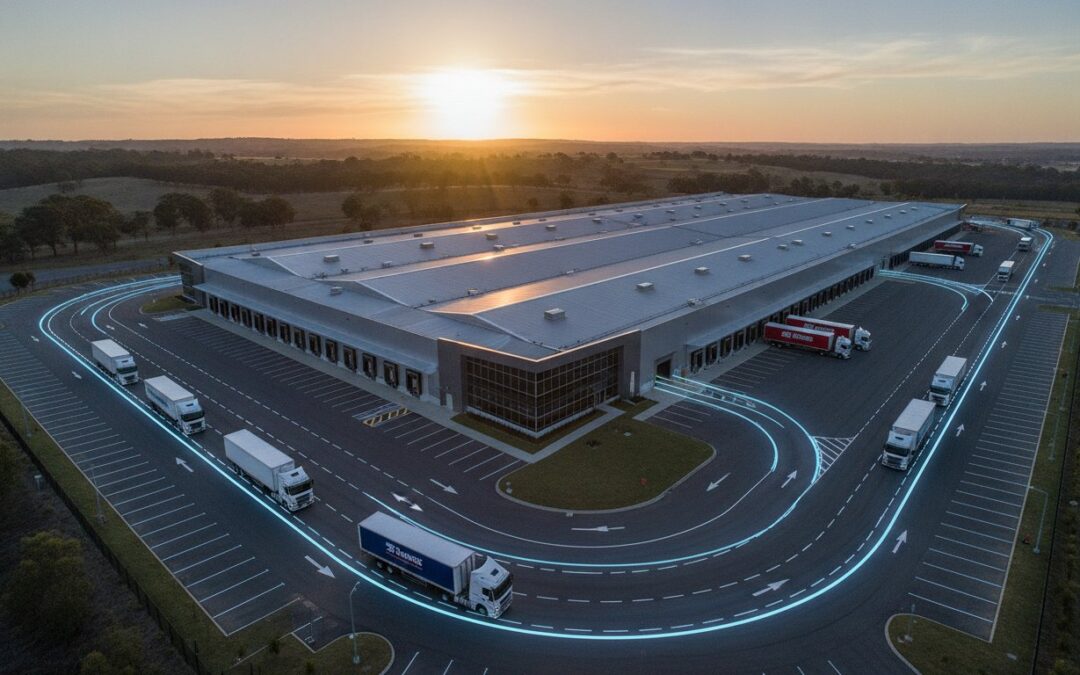
A single miscalculation in your heavy vehicle arrival rate can be the difference between a seamless Development Application (DA) approval and a costly council rejection. You likely understand that managing a high-volume facility requires more than just floor space. It demands a precise, data-driven understanding of how vehicles move, wait, and interact with the public road network. When trucks begin to spill out onto external verges, you face more than just operational bottlenecks; you risk significant traffic fines and severe road safety issues.
We’ve seen how insufficient traffic data leads to months of unnecessary council delays. This article demonstrates how professional truck queuing analysis for distribution centres ensures regulatory compliance and long-term operational efficiency. By leveraging over 15 years of consultancy experience and specialised tools like AutoTURN, you can justify your site layout and satisfy strict council requirements. We will cover the essential components of a Traffic Impact Assessment (TIA), the application of AS 2890.2 standards, and why direct access to senior principal engineers is vital for securing a successful DA outcome.
Key Takeaways
- Understand the technical role of queuing assessments in preventing heavy vehicle spillover onto public road networks.
- Learn how truck queuing analysis for distribution centres utilises AS 2890.2 standards to calculate precise space for B-Doubles and semi-trailers.
- Discover strategies to optimise site layout by separating staff vehicle movements from heavy vehicle loading dock queues.
- Identify the specific queue percentile data required by council planners to ensure a successful Traffic Impact Assessment (TIA) outcome.
- Recognise the importance of direct senior principal involvement in ensuring technical accuracy and meeting rigorous regulatory compliance.
What is Truck Queuing Analysis for Distribution Centres?
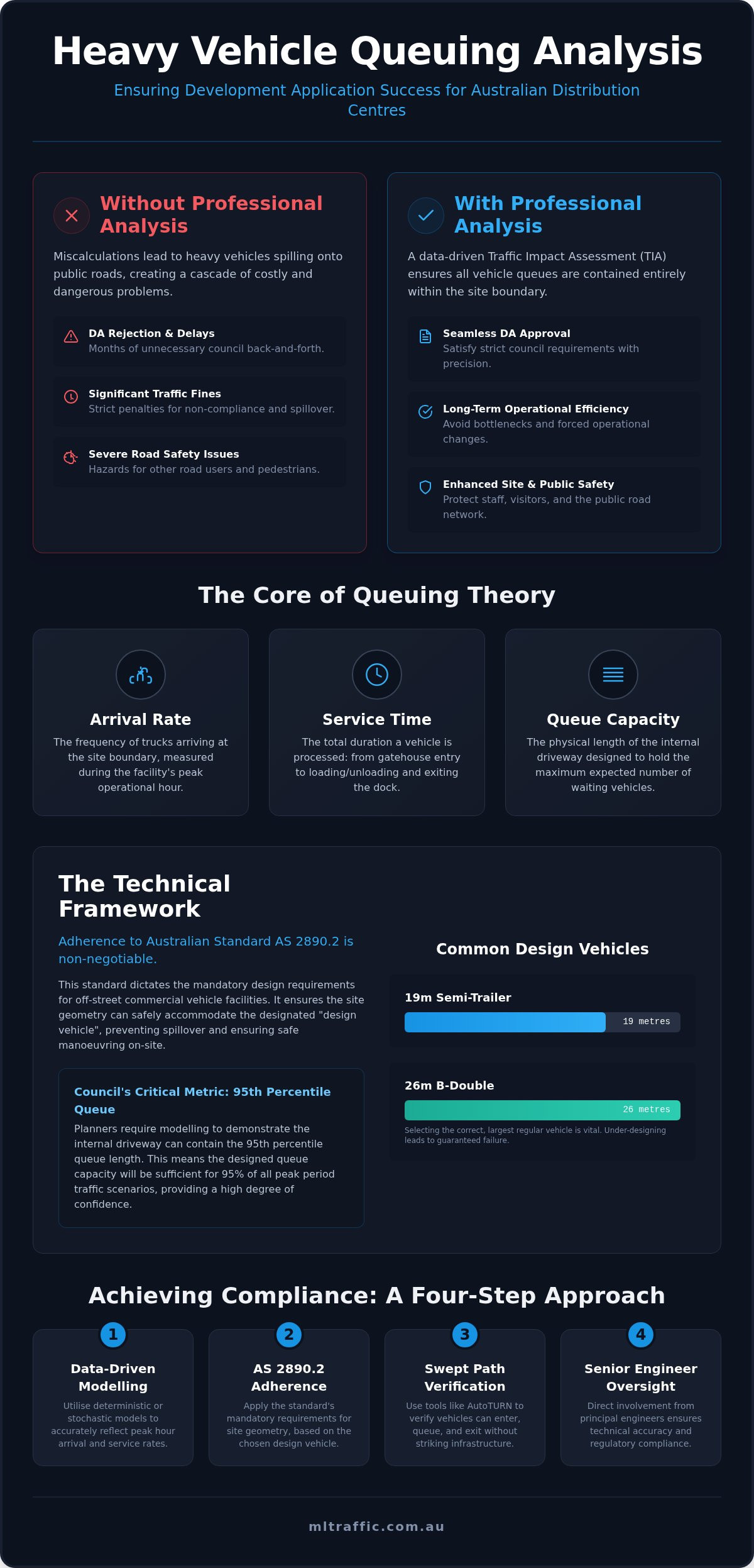
Truck queuing analysis for distribution centres is a technical assessment used to determine the physical space required for heavy vehicles waiting to access loading docks. It’s a mandatory component of most industrial Traffic Impact Assessment (TIA) reports. The fundamental objective is to ensure that the maximum expected queue remains entirely within the site boundary. This prevents heavy vehicles from spilling over onto public road networks, which is a primary concern for local councils and road authorities.
The analysis relies on the principles of Queuing Theory to model the interaction between arrival rates and service times. If trucks arrive faster than they can be processed at the gatehouse or loading dock, a queue forms. Engineers must calculate whether the designated internal driveway has the capacity to hold these vehicles during peak operational periods. This is not a matter of guesswork; it requires rigorous mathematical modelling to satisfy regulatory bodies.
The Consequences of Poor Queuing Design
Inadequate site planning leads to significant road safety risks. When heavy vehicles are forced to idle on public verges or block travel lanes, it creates hazards for other road users and pedestrians. Councils often impose strict fines for such non-compliance. In severe cases, they may mandate forced operational changes post-occupancy, which can cripple a distribution centre’s throughput. Persistent queuing issues also damage relationships with neighbouring businesses and contribute to general traffic congestion in industrial precincts.
Key Terminology in Heavy Vehicle Modelling
To understand how these assessments function, we use several specific technical metrics:
- Arrival Rate: This is the frequency at which trucks reach the site boundary. It’s typically measured during the facility’s peak hour of operation.
- Service Time: The total duration a vehicle spends being processed. This includes time at the gatehouse, manoeuvring into the dock, and the loading or unloading process.
- Queue Capacity: The physical length of the internal driveway specifically designated for waiting vehicles. It must be long enough to accommodate the “design vehicle”, such as a B-Double or semi-trailer, as specified in AS 2890.2.
Professional modelling ensures these variables are balanced. It’s not just about meeting a minimum requirement. It’s about site safety and operational longevity. Our senior principals involve themselves in every project to ensure these technicalities are handled with precision, providing a direct line of accountability for your DA submission.
The Technical Framework: AS 2890.2 and Queuing Theory
AS 2890.2 is the primary Australian Standard governing the design of off-street commercial vehicle facilities. It provides the mandatory requirements for parking and loading areas, ensuring that the site geometry can safely accommodate the designated vehicles. A robust truck queuing analysis for distribution centres must adhere strictly to these benchmarks to pass council scrutiny. Engineers use this framework to establish the spatial requirements for the “design vehicle”, which is typically the largest vehicle expected to access the site on a regular basis.
Determining the right design vehicle, whether it’s a 19-metre semi-trailer or a 26-metre B-Double, is the first step in modelling. This choice dictates the minimum radius of turns and the length of individual queue slots. Applying these models within a truck queuing analysis for distribution centres allows us to predict the 95th percentile queue length with high confidence. We also apply peak hour analysis to ensure the model reflects the facility’s busiest operational windows. This involves choosing between deterministic models, which use fixed arrival rates, and stochastic models, which account for the random nature of truck arrivals using probability distributions. Stochastic modelling is often required for high-volume facilities to provide a more realistic representation of potential “clumping” in arrivals.
Design Vehicles and Site Geometry
Selecting the correct design vehicle is vital for site safety. If a site is designed for semi-trailers but eventually services B-Doubles, the queuing lanes will be physically too short, leading to spillover. We integrate swept path analysis to verify that these large vehicles can enter, queue, and exit without striking kerbs or infrastructure. This technical verification ensures that the queuing lane is not just long enough, but also accessible and functional for the drivers.
Data Collection and Input Variables
Accurate modelling requires high-quality input data. We often use historical arrival patterns from similar industrial facilities to predict how trucks will enter the site. It’s essential to account for seasonal peaks, such as the lead-up to Christmas, when logistics volumes can increase significantly. Most models employ “first-in, first-out” (FIFO) logic, assuming that vehicles are processed in the order they arrive. If your project involves complex gatehouse operations or multiple dock types, you may need a more detailed Traffic Impact Assessment (TIA) to justify your operational assumptions to the council.
Our senior principals remain directly involved in these technical calculations, ensuring that the data used in your submission is both accurate and defensible during the DA process.
Optimising Loading Dock Efficiency and Site Safety
Effective site design requires strict segregation. Mixing staff car parking with heavy vehicle queuing lanes creates avoidable conflict points and increases the likelihood of on-site incidents. A professional truck queuing analysis for distribution centres identifies these risks during the design phase, allowing for a layout that prioritises safety. By providing a dedicated queuing “reservoir” space, you ensure that the arrival of multiple semi-trailers doesn’t obstruct staff access or egress. This separation is a key requirement for modern industrial developments seeking council approval.
Balancing dock turnaround times with available space is critical for maintaining high throughput. If loading docks are occupied, the internal driveway must function as an efficient storage area. We often recommend implementing a formal Traffic Guidance Scheme (TGS) to manage this internal flow. This ensures drivers know exactly where to wait without interfering with active loading operations. A well-organised queue reduces driver frustration and minimises the time spent manoeuvring, which directly improves overall site efficiency.
Gatehouse and Security Checks
Entry points are the primary source of initial queuing. If your security protocol involves manual logbooks or physical inspections, the resulting “gatehouse lag” can quickly push a queue toward the public road. Reducing this bottleneck often involves digital pre-clearance systems or automated number plate recognition (ANPR). We also advise incorporating bypass lanes into the design. These allow emergency vehicles or non-delivery traffic to move past stationary queues, maintaining essential site access at all times.
Internal Circulation and Manoeuvring
Queuing trucks must never impede the swept paths of departing vehicles. If a waiting B-Double blocks the exit trajectory of another truck, the entire site grinds to a halt. Clear line marking and high-visibility signage are essential for organising these heavy vehicle queues and preventing drivers from parking in unauthorised areas. Pedestrian safety is another non-negotiable factor. Designated crossings within the loading precinct must be clearly separated from heavy vehicle manoeuvring zones to mitigate the risk of accidents. Our truck queuing analysis for distribution centres accounts for these internal dynamics to ensure your site remains safe and compliant post-occupancy.
Meeting Council Requirements for a Traffic Impact Assessment
Council planners prioritise the protection of public infrastructure and the safety of the local road network. When reviewing a Development Application (DA), they scrutinise the truck queuing analysis for distribution centres to ensure the proposal doesn’t externalise operational costs onto the community. This means proving that your internal driveway can handle peak arrivals without vehicles idling on the street or blocking intersections. A professional Traffic Impact Assessment provides the technical justification required to mitigate these risks and secure a successful approval. Planners also look for evidence that the cumulative impact of your facility, combined with existing industrial traffic, won’t degrade the level of service on surrounding arterial roads.
The report must demonstrate that the site can accommodate its own demand. If the modelling shows that even one B-Double might hang over the property line, the DA is likely to face a Request for Information (RFI) or an outright refusal. We use 15 years of consultancy experience to ensure that the queuing calculations are defensible and aligned with the specific expectations of the relevant local authority.
The 95th Percentile Rule
Councils generally mandate modelling for the 95th percentile peak queue. This metric represents the queue length that will not be exceeded during 95% of the peak operational period. For high-intensity hubs or sites near sensitive intersections, some authorities may even request 98th percentile data. Proving this requires detailed technical documentation, including arrival rate distributions and service time calculations based on AS 2890.2. If a site has low-frequency movements, we can sometimes justify a lower percentile to save on pavement area, but this requires robust historical data and a clear engineering rationale to satisfy planning officers.
Mitigation Strategies for Constrained Sites
Not every development site has the luxury of a 100-metre internal driveway. When physical space is limited, we develop an Operational Management Plan (OMP) as a formal solution. This document outlines how the facility will manage flow through mandatory time-slotting for deliveries. By flattening the arrival peak, you prevent the clumping of heavy vehicles that leads to spillover. For large-scale logistics hubs, off-site staging areas can act as a critical buffer, holding vehicles until a dock becomes available. These strategies allow developers to maximise floor space while still meeting the safety requirements of a truck queuing analysis for distribution centres.
We provide direct access to senior principals who handle the technical work personally to ensure your project meets council standards. Request a Traffic Impact Assessment to discuss your site requirements.
Why Professional Traffic Engineering is Essential
Professional traffic engineering is the foundation of a viable distribution centre design. While basic site planning might identify general space requirements, it often lacks the technical depth needed to survive a rigorous council review. With over 15 years of consultancy experience, ML Traffic Engineers Australia understands the nuances of Australian planning laws and the specific data sets required to satisfy road authorities. A comprehensive truck queuing analysis for distribution centres is only as strong as the methodology behind it. We utilise industry-standard software, including AutoTURN for swept path assessments and SIDRA for intersection modelling, to generate defensible, data-driven reports.
The value of expert traffic engineering lies in the ability to anticipate council concerns before they become formal objections. Our approach ensures that technical accuracy is maintained from the initial concept through to the final DA submission. By having senior principals directly involved in the technical work, we provide a level of accountability that larger, more impersonal firms cannot match. This continuity ensures that the engineer who understands your site’s unique constraints is the one performing the complex calculations.
Defending the Analysis at Council
When a council issues a Request for Further Information (RFI), the response must be technically sound and authoritative. We specialise in providing high-level technical justifications that address specific concerns regarding heavy vehicle movements and queuing capacity. Our reports are certified and backed by professional indemnity, providing the legal and technical weight required for major industrial developments. In complex cases, we offer expert witness services to defend our analysis, ensuring your project remains on track despite bureaucratic hurdles.
Engaging ML Traffic Engineers Australia
We operate with a “no-gatekeepers” philosophy. This means you have direct access to the senior engineers responsible for your truck queuing analysis for distribution centres. There are no junior staff or intermediaries to dilute the technical message. This direct line of communication streamlines the project timeline and ensures your facility is both compliant with Australian Standards and operationally efficient. Our focus is on delivering results that facilitate successful DA outcomes without unnecessary delays. To begin your assessment, Contact our senior team for a fee proposal and ensure your project is backed by seasoned expertise.
Securing Your DA Approval with Precise Modelling
Achieving a successful DA outcome for industrial developments requires a rigorous approach to site geometry and traffic flow. A technical truck queuing analysis for distribution centres acts as the definitive proof that your facility won’t negatively impact the public road network. By adhering to AS 2890.2 standards and utilising 95th percentile modelling, you demonstrate a commitment to both regulatory compliance and operational safety. This data-driven approach is essential for mitigating the risk of council delays or post-occupancy traffic fines.
ML Traffic Engineers Australia brings over 15 years of traffic engineering experience to every project. We ensure national expertise in AS 2890.2 compliance is applied to your specific site constraints. Our approach guarantees that a Senior Principal is directly involved in the preparation of every report, providing the technical accountability and precision that councils demand for high-volume logistics sites. This ensures your development is both defensible at the planning stage and functional once operational.
Don’t let avoidable queuing bottlenecks or data gaps delay your project timeline. Contact ML Traffic Engineers Australia for an expert Traffic Impact Assessment today. We look forward to helping you deliver a compliant and highly efficient distribution hub.
Frequently Asked Questions
How much queuing space do I need for a B-Double?
A single B-Double slot requires a minimum length of 26 metres under AS 2890.2. Total capacity depends on peak arrival modelling, which ML Traffic Engineers Australia calculates during the TIA process. You must include additional clearance for vehicle separation and manoeuvring. These dimensions ensure that the largest design vehicle can queue safely within the site boundary without obstructing internal thoroughfares or public road access.
What is the 95th percentile queue length?
The 95th percentile queue length is a technical benchmark representing the maximum queue expected during 95% of the busiest hour. Councils require this data to ensure the site can handle high-intensity arrival “clumps” without spillover. ML Traffic Engineers Australia uses stochastic modelling to determine this figure, providing a defensible buffer that satisfies planning authorities. It’s a critical component in proving that your distribution centre will not degrade local traffic safety.
Do I need a truck queuing analysis for a small warehouse expansion?
Yes, because any expansion likely changes the operational intensity or vehicle arrival patterns. Councils scrutinise warehouse modifications to ensure the existing queuing reservoir remains sufficient for the increased load. Even if the building footprint grows slightly, the change in traffic volume or vehicle type necessitates a fresh truck queuing analysis for distribution centres to confirm ongoing regulatory compliance and safety.
What Australian Standards govern truck queuing?
AS 2890.2 is the primary Australian Standard governing off-street commercial vehicle facilities. It provides the mandatory dimensions and swept path requirements for heavy vehicles like B-Doubles and semi-trailers. While AS 2890.1 covers light vehicles, part 2 focuses specifically on the spatial needs of logistics and freight operations. ML Traffic Engineers Australia ensures every assessment adheres to these standards to facilitate a smooth DA approval process for industrial clients.
Can an Operational Management Plan replace physical queuing space?
An Operational Management Plan (OMP) can supplement physical space on constrained sites but rarely replaces it entirely. An OMP might detail delivery time-slotting or mandatory arrival windows to flatten peak demand. However, councils still require technical proof that these management strategies will prevent vehicles from queuing on public roads. ML Traffic Engineers Australia develops these plans to justify layout decisions when physical site dimensions are limited by existing infrastructure.
How does a gatehouse affect my truck queuing requirements?
A gatehouse acts as a service point that introduces processing lag into the arrival sequence. If the time taken to check documents or perform security inspections exceeds the arrival rate, a queue forms immediately. Professional modelling identifies this bottleneck, allowing us to recommend bypass lanes or digital pre-clearance systems. This ensures that the gatehouse operation doesn’t push the queue length beyond the designated internal storage capacity during peak periods.
What software is used for truck queuing analysis?
Engineers utilise specialised tools like SIDRA for intersection and queuing modelling and AutoTURN for swept path analysis. These tools allow ML Traffic Engineers Australia to simulate real-world scenarios and provide data-driven justifications for site layouts. Using these programs ensures that your truck queuing analysis for distribution centres is technically accurate and meets the rigorous documentation standards expected by council planners and state road authorities across Australia.
Will Council accept a queuing report if I don’t have a gatehouse?
Councils will accept a queuing report without a gatehouse, provided the analysis identifies the next bottleneck, such as the loading docks themselves. The modelling then focuses on dock turnaround times and the time taken for a vehicle to manoeuvre into position. ML Traffic Engineers Australia evaluates these variables to ensure the internal driveway provides enough reservoir space to hold incoming trucks while active loading or unloading processes are underway.

Disclaimer
The content on www.mltraffic.com.au, including all technical articles, guides, and resources, is provided for general informational and educational purposes only. It is not intended to constitute professional advice in traffic engineering, transportation planning, development approvals, or any other technical or legal field.
While ML Traffic Engineers makes every reasonable effort to ensure the accuracy, completeness, and timeliness of the information published, we do not provide any warranties or representations (express or implied) regarding its reliability, suitability, or availability for any particular purpose. Any reliance you place on the content is strictly at your own risk.
In no event shall ML Traffic Engineers, its directors, employees, authors, or affiliates be liable for any direct, indirect, incidental, special, consequential, or punitive damages (including, without limitation, loss of profits, data, or business opportunities) arising out of or in connection with the use of, or inability to use, any information provided on this website.
The articles and guides on this site are not a substitute for engaging a qualified, registered professional traffic engineer (such as an NPER or RPEQ engineer) to assess your specific project requirements. For tailored advice, compliance assessments, or traffic engineering services, please contact a competent professional.
This disclaimer may be updated from time to time without notice. By accessing or using this website, you agree to be bound by the most current version of this disclaimer.
