

A single hour of poorly timed data collection can invalidate months of planning work and lead to an immediate council rejection of your development application. You likely recognise that accurate data is the backbone of any Traffic Impact Assessment, yet the persistent confusion between manual and automated counting methods often creates unnecessary risk for developers. Mastering the turning movement count survey methodology isn’t just about counting cars; it’s about establishing a forensic foundation that survives the most rigorous technical scrutiny.
We understand the pressure to deliver data that’s both defensible and high-quality. This guide provides a clear breakdown of the TMC process, helping you choose the most reliable survey methodology for your specific site requirements. You’ll learn how to translate raw counts into sophisticated traffic models, ensuring your data integrates seamlessly into your TIA. By the end of this article, you’ll have the confidence to manage these technical requirements and secure the planning approvals your project depends on.
Key Takeaways
- Understand how Turning Movement Counts (TMC) establish the essential baseline for quantifying existing traffic demand at an intersection.
- Identify the most appropriate turning movement count survey methodology for your site by evaluating the accuracy of manual tallies against automated AI video analytics.
- Learn to select a “representative day” for data collection to ensure your results are not skewed by school holidays, roadworks, or public events.
- Discover the quality control protocols that senior engineers use to verify raw data and eliminate anomalies before they reach the council.
- See how to integrate survey data into SIDRA modelling to justify driveway locations and intersection performance within your Traffic Impact Assessment.
Understanding Turning Movement Counts (TMC) in Traffic Engineering
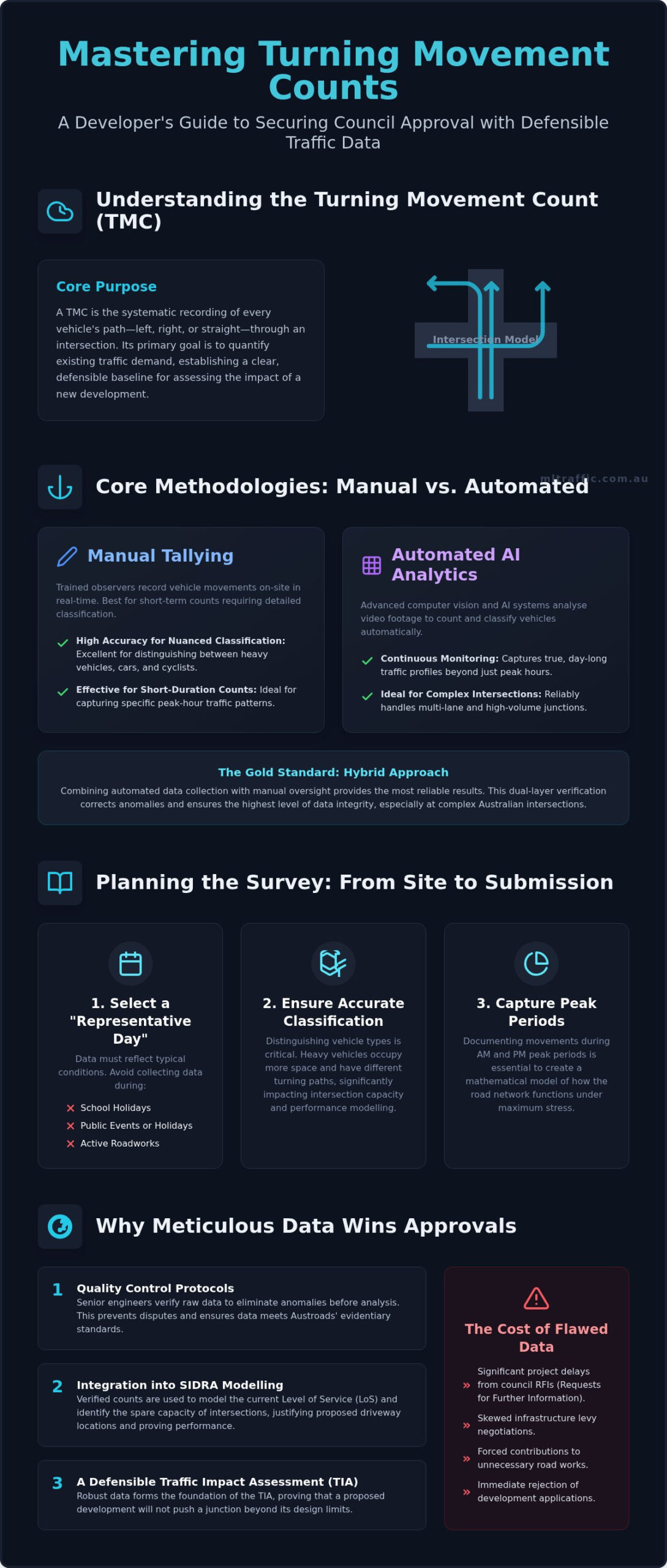
A Traffic count focused specifically on intersections is technically defined as a Turning Movement Count (TMC). It is the systematic recording of every vehicle movement, including left turns, right turns, and through movements, across all arms of a junction. For developers, the primary purpose of this data is to quantify existing traffic demand and establish a clear baseline for future developments. In the broader context of traffic engineering, TMCs are the most critical data component. They provide the empirical evidence needed to understand how current intersection geometry influences driver behaviour and queueing patterns.
This process isn’t merely about counting cars. It requires a sophisticated turning movement count survey methodology that accounts for vehicle classification, such as distinguishing between heavy vehicles and passenger cars. This distinction is vital because heavy vehicles occupy more road space and have different turning paths, which significantly impacts intersection capacity. By documenting these movements during peak periods, engineers can create a mathematical model of how the road network actually functions under stress. This creates a defensible foundation for any proposed site access or road modification.
The Role of TMC in Traffic Impact Assessments
Survey data serves as the primary input for any Traffic Impact Assessment (TIA). Engineers use these counts to establish the current Level of Service (LoS) for the road network surrounding a site. By applying a rigorous turning movement count survey methodology, we can identify the specific spare capacity available at an intersection. This allows us to prove whether a proposed development will push a junction beyond its design limits. Without precise baseline data, performance modelling becomes guesswork, often leading to rejected applications or excessive demands for road upgrades from authorities.
Why Accuracy Matters for Council Planning Approvals
Meticulous data is a prerequisite for securing council planning approval. Poorly executed surveys often lead to “under-counting,” which can result in skewed infrastructure levy negotiations or forced contributions to road works that aren’t actually required. If the data is flawed, councils will likely issue a Request for Further Information (RFI), causing significant project delays. Robust methodology ensures the survey meets the evidentiary standards required by state and local planning panels. We align our data collection with Austroads standards to ensure every count is technically defensible. This level of detail prevents disputes over traffic generation figures and ensures your development application moves through the assessment phase without unnecessary technical hurdles.
Core Methodologies: Manual vs. Automated Counting Techniques
The evolution of traffic data collection has transitioned from rudimentary paper tallies to advanced computer vision systems. Selecting the appropriate turning movement count survey methodology requires a balanced assessment of site complexity, project budget, and required survey duration. While simple four-way stops might only require a focused peak-hour count, complex multi-lane intersections often demand continuous monitoring to capture true traffic profiles. Our range of professional services ensures that the methodology aligns with the specific evidentiary requirements of your local council or state planning authority.
Hybrid approaches frequently yield the most reliable results for complex Australian intersections. By combining automated sensors with manual oversight, engineers can verify anomalies that automated systems might misinterpret. This dual-layer verification is particularly important when dealing with high volumes of heavy vehicles or irregular pedestrian movements. Adhering to rigorous standards, such as those detailed in the Caltrans Count Methodology Guide, ensures that even non-motorised traffic data is recorded with high precision.
Manual Intersection Surveys and Tallying
Manual surveys involve deploying trained observers to record vehicle movements in real-time. This method remains highly effective for short-duration counts where nuanced classification is essential. Observers can accurately distinguish between different vehicle classes and identify specific local driver behaviours, such as illegal U-turns or lane-splitting, that sensors might miss. However, the limitations are clear. High labour costs and the inherent risk of human fatigue during extended shifts can impact data integrity. Manual counts are best suited for snapshot assessments rather than multi-day data collection.
Video-Based AI and Sensor-Driven Methodology
Modern surveys increasingly utilise elevated cameras paired with deep learning software to track vehicle paths. This methodology allows for 24/7 monitoring without the overhead of on-site staff. A significant advantage is the ability to re-audit footage if the data is questioned by council during the assessment phase. Despite these benefits, technology has limitations. Occlusion remains a challenge, where a large heavy vehicle may physically block the camera’s view of a smaller passenger car in an adjacent lane. Weather conditions like heavy fog or torrential rain can also degrade sensor accuracy. If you are unsure which method suits your site, you can speak with our senior engineers to determine the most defensible approach.
Planning the Survey: Timing, Location, and Classification
Strategic planning is the most critical phase of data collection. Selecting a “Representative Day” ensures the data reflects typical traffic conditions rather than anomalies. This requires a strict avoidance of public holidays, school holidays, and periods with active roadworks that might divert traffic or artificially suppress demand. A robust turning movement count survey methodology must also account for the development’s predicted trip distribution. We select survey locations by identifying which intersections will carry the bulk of the new site traffic. Beyond simple tallies, we record queuing patterns and latent demand. Latent demand refers to traffic that would be present if not for existing congestion; identifying this is essential for accurate performance modelling. All our survey procedures adhere to the Austroads Guide to Traffic Management to maintain technical consistency across Australian jurisdictions.
Identifying Peak Periods and Representative Intervals
Standard surveys focus on the AM commuter peak (7:00 to 9:00) and the PM peak (16:00 to 18:00). However, for residential, retail, or educational developments, “School Peaks” (8:00 to 9:30 and 14:30 to 16:00) are often the most critical periods for council assessment. These windows capture the specific surges associated with school zones and 40km/h speed restrictions. We record data in 15-minute intervals as a standard requirement. This level of granularity is essential for calculating the Peak Hour Factor (PHF), which identifies the maximum flow rate within the peak hour. Relying on hourly totals alone often obscures the short-term surges that cause temporary saturation and queuing at site access points. Precise interval data allows for more accurate SIDRA modelling during the assessment phase.
Vehicle Classification Standards in Australia
Accurate classification is vital for determining intersection capacity and pavement wear. Our turning movement count survey methodology distinguishes between light vehicles, heavy vehicles (including articulated trucks and buses), and vulnerable road users such as cyclists. While some smaller projects only require a binary light/heavy split, complex industrial or commercial developments necessitate the full Austroads 12-class vehicle system. This detailed classification is essential for swept path analysis and heavy vehicle turn requirements. We also capture pedestrian movements at both signalised and unsignalised crossings. Documenting these movements ensures that the final Traffic Impact Assessment accounts for the safety and delay impacts of all road users, satisfying the multi-modal requirements of modern transport planning.
Data Analysis and Quality Control Procedures
Raw data collected from the field represents only the first stage of the turning movement count survey methodology. To be useful for a Traffic Impact Assessment, these tallies must undergo rigorous technical processing to ensure they accurately reflect real-world conditions. At ML Traffic Engineers Australia, we prioritise personnel continuity. The same senior engineer who designs the survey will oversee the analysis and final reporting. This hands-on approach eliminates the data degradation that frequently occurs in larger firms where field teams and office staff operate in isolation. We also document environmental factors such as inclement weather or local traffic incidents. These events can artificially suppress or inflate peak volumes; identifying them is crucial for maintaining data validity during council reviews.
Processing Raw Intersection Data into PCUs
Traffic engineers do not work with simple vehicle tallies. We convert heavy vehicles into Passenger Car Units (PCUs) to account for their disproportionate impact on intersection capacity. An articulated truck occupies significantly more road space and requires more time to complete a turn than a standard passenger car. Failing to apply these conversion factors results in an inaccurate Level of Service (LoS) calculation. We also determine the Peak Hour Factor (PHF) to identify short-term traffic surges within the peak hour. Another vital check involves balancing counts between adjacent intersections. If the volume of traffic exiting one junction does not align with the volume entering the next, we investigate the discrepancy immediately. This ensures network consistency and prevents technical challenges from planning authorities.
Rigorous QA/QC to Minimise Survey Error
Our quality control protocols include the “Spot Check” method. We cross-reference specific segments of video footage against manual tallies to verify the accuracy of the turning movement count survey methodology. This is particularly important for identifying and correcting “Double Counting” at closely spaced roundabouts or complex signalised junctions. We also review pedestrian and cyclist data for common-sense anomalies that might indicate observer error. Every dataset undergoes a final review by our senior principals who bring over 15 years of consultancy experience to the process. This results in a signed data certification that provides a defensible foundation for your development application. For data you can trust, contact our senior principals to discuss your survey requirements.
Applying TMC Data to Your Development Application
Turning movement counts are the primary evidentiary tool used to secure planning approval for new developments. Once the fieldwork is complete, we apply the results to justify specific site access points, driveway locations, and car park designs. This data allows us to prove that the proposed entry and exit points will function safely without compromising the surrounding road network. In many cases, comparing current data with historical traffic records allows us to demonstrate long-term trends, which can be pivotal when arguing for a development’s viability in a growing corridor. Presenting this information in a structured, technical format is essential for satisfying the rigorous requirements of council engineering departments.
From Intersection Counts to SIDRA Modelling
The transition from raw tallies to performance modelling is where the technical turning movement count survey methodology proves its value. We integrate the processed counts into SIDRA INTERSECTION software to determine key metrics like the Degree of Saturation (DoS) and Average Delay. These metrics provide a mathematical snapshot of current intersection performance. We then model the “With Development” scenario by adding the predicted site-generated traffic to the surveyed baseline. If the model shows a significant drop in Level of Service, we use the data to justify specific intersection upgrades or signal timing changes. This evidence-based approach ensures that any required infrastructure contributions are proportionate to the development’s actual impact.
Securing Council Approval with Defensible Data
Council planning officers frequently scrutinise traffic data for inconsistencies. We address potential objections by providing a transparent turning movement count survey methodology that details every step of the collection and verification process. Having a senior engineer who performed the technical work available to defend the data during council meetings or planning panels is a significant advantage. It ensures that technical questions are answered with authority and precision, reducing the risk of project delays. If you require high-quality, defensible traffic data for your next project, contact our senior principals to organise your site-specific survey and ensure your application is backed by 15 plus years of consultancy expertise.
Secure Your Planning Approval with Technical Precision
Accurate data collection is more than a regulatory box to tick; it’s the technical foundation of your entire development application. Implementing a rigorous turning movement count survey methodology eliminates the guesswork that often leads to council RFIs and costly redesigns. You now understand how precise vehicle classification and peak-hour analysis translate directly into defensible traffic models. This evidence-based approach ensures your site access and intersection designs are backed by empirical truth.
With over 15 years of traffic consultancy experience, ML Traffic Engineers Australia ensures your data is compliant with all Australian Standards and local council requirements. Meticulous data is essential. Our senior principals remain involved in every technical assessment, providing a level of accountability and personnel continuity that larger firms often lack. We understand the bureaucratic hurdles of the planning process and provide the forensic data needed to clear them.
Request a Defensible Traffic Survey for Your Project
We look forward to helping you move your development application toward a successful approval.
Frequently Asked Questions
What is a turning movement count survey?
A turning movement count (TMC) survey is the systematic recording of all vehicle movements through an intersection, typically categorised by direction and vehicle class. It provides the empirical baseline for quantifying existing traffic demand before a development is introduced. This data is essential for calculating the current Level of Service at a junction.
How long does a typical TMC survey take to complete?
Survey duration depends on the specific project scope and council requirements. Most surveys focus on the commuter peak periods, typically lasting two to three hours for both the AM and PM windows. Some high-impact developments may require 12-hour or 24-hour continuous monitoring to capture a full daily traffic profile.
Why can’t I use traffic data from a few years ago for my DA?
Councils generally reject traffic data that is more than 12 to 24 months old. Traffic patterns change rapidly due to new nearby developments, road network upgrades, or shifts in local land use. Using current turning movement count survey methodology ensures your data reflects the existing network capacity accurately and survives technical scrutiny.
Is manual counting more accurate than AI video counting?
Both methods have specific technical advantages. Manual counting allows for nuanced observations of driver behaviour and illegal movements in real-time. AI video counting provides a verifiable record that can be re-audited if the council questions the results. A hybrid approach often yields the highest precision for complex Australian junctions.
What are the standard peak periods for traffic surveys in Australia?
Commuter peak periods in Australia are typically 7:00 to 9:00 and 16:00 to 18:00. Residential or school-related developments also require monitoring during school peaks, usually 8:00 to 9:30 and 14:30 to 16:00. These windows capture the maximum stress points on the local road network during a representative day.
Does the survey include pedestrians and cyclists?
Yes, pedestrian and cyclist movements are included if they are relevant to the development’s impact area. Capturing these movements is essential for identifying potential safety conflicts and determining signal phase requirements. Modern turning movement count survey methodology prioritises these vulnerable road users to satisfy multi-modal planning standards.
What happens if it rains during the scheduled survey day?
Surveys are typically rescheduled if heavy rain or extreme weather occurs. Inclement weather alters driver behaviour, increases headways, and reduces overall traffic volumes, which leads to non-representative data. Light rain is generally acceptable, provided it doesn’t impact visibility for observers or automated video equipment.
How much does a turning movement count survey cost?
The cost of a traffic survey is influenced by the number of intersection arms, the required duration, and the complexity of vehicle classification. Automated video surveys often provide a more cost-effective solution for long-duration counts. Detailed quotes are provided after reviewing the specific site location and the council’s technical requirements.

Disclaimer
The content on www.mltraffic.com.au, including all technical articles, guides, and resources, is provided for general informational and educational purposes only. It is not intended to constitute professional advice in traffic engineering, transportation planning, development approvals, or any other technical or legal field.
While ML Traffic Engineers makes every reasonable effort to ensure the accuracy, completeness, and timeliness of the information published, we do not provide any warranties or representations (express or implied) regarding its reliability, suitability, or availability for any particular purpose. Any reliance you place on the content is strictly at your own risk.
In no event shall ML Traffic Engineers, its directors, employees, authors, or affiliates be liable for any direct, indirect, incidental, special, consequential, or punitive damages (including, without limitation, loss of profits, data, or business opportunities) arising out of or in connection with the use of, or inability to use, any information provided on this website.
The articles and guides on this site are not a substitute for engaging a qualified, registered professional traffic engineer (such as an NPER or RPEQ engineer) to assess your specific project requirements. For tailored advice, compliance assessments, or traffic engineering services, please contact a competent professional.
This disclaimer may be updated from time to time without notice. By accessing or using this website, you agree to be bound by the most current version of this disclaimer.
