

A single week of poorly timed traffic data collection can stall your entire Development Application for 30 days or more. It’s a common reality for developers who underestimate the technical logistics required for transport planning. Understanding the typical timeline for a traffic impact report is essential to avoid these costly project delays. You’ve likely felt the frustration of waiting on consultants while council deadlines loom, often without a clear explanation for the hold up.
We understand that certainty is your most valuable asset during the planning process. This guide provides a professional breakdown of the stages required to produce a council-ready Traffic Impact Assessment. We’ll outline the specific timeframes for traffic counting, technical analysis, and certified engineering review. You’ll gain the knowledge needed to manage your project schedule with confidence and identify the hidden factors that frequently disrupt delivery dates.
Key Takeaways
- Learn why most standard assessments require a 2 to 4-week window and how the typical timeline for a traffic impact report shifts based on your development’s scale and land-use type.
- Understand the four critical stages of the reporting process, from initial site inspections and data collection to technical modelling and analysis.
- Identify the key variables, such as project complexity and traffic data availability, that can influence your report delivery date and council submission.
- Discover proactive strategies to streamline your engineering approval, including the early provision of scaled CAD plans and council pre-lodgement correspondence.
- See how direct principal involvement and the “Quote-to-Work” model at ML Traffic Engineers Australia eliminate the “middle-man” delays often found in larger multidisciplinary firms.
Table of Contents
- Understanding the Standard Duration for a Traffic Impact Assessment
- The 4 Critical Stages of the Traffic Impact Report Process
- Key Variables That Influence Your Report Delivery Date
- Proactive Strategies to Streamline Your Traffic Engineering Approval
- Why Direct Principal Involvement at ML Traffic Minimises Project Delays
Understanding the Standard Duration for a Traffic Impact Assessment
The typical timeline for a traffic impact report generally spans 2 to 4 weeks for standard developments. This duration accounts for the technical assessment, data analysis, and report drafting required to meet regulatory standards. While 14 to 28 days is the baseline, the schedule fluctuates based on the scale of the project and the specific land-use type. A 20-unit residential flat building requires less intensive modelling than a large-scale industrial warehouse or a high-traffic retail centre. You must align the report delivery with your broader DA submission schedule to prevent avoidable delays in the planning process.
The scope of the report also dictates the speed of delivery. There is a distinct difference between a short-form Traffic Impact Statement (TIS) and a full Traffic Impact Assessment (TIA):
- Traffic Impact Statement (TIS): Usually prepared for low-impact developments where the traffic generation is minimal. These can often be completed toward the faster end of the 2-week window.
- Traffic Impact Assessment (TIA): A comprehensive document required for larger sites. It involves detailed intersection analysis and SIDRA modelling, which typically takes the full 4 weeks or longer for complex intersections.
Defining the Traffic Impact Report
A TIA is a technical analysis of a development’s effect on the existing road network. Australian Councils require this evidence-based documentation to ensure that a new project doesn’t compromise road safety or traffic flow. It’s a mandatory component of the planning phase where Traffic Engineering expertise is used to justify the proposed parking provision and access arrangements. Without this technical data, Councils cannot make informed decisions regarding infrastructure capacity or developer contributions.
Initial Engagement and Scope Confirmation
The first 48 hours of the process are critical for setting the project trajectory. During this period, we review the architectural plans and any specific Council pre-lodgement notes provided by the client. We identify the exact requirements of Australian Standards, specifically AS 2890.1, to ensure the site layout for off-street car parking is compliant from the outset. This initial review prevents mid-project redesigns that could blow out the typical timeline for a traffic impact report.
The formal start date is triggered once the fee proposal is finalised and the engagement is confirmed. At ML Traffic Engineers, we follow a direct approach: the traffic consultant who provides the quote is the one who performs the work. This eliminates bureaucratic layers and ensures technical accuracy from day one. The engagement phase includes:
- Reviewing site-specific constraints and driveway ramp grades.
- Confirming the required number of swept path assessments for waste and delivery vehicles.
- Establishing the study area for traffic counts if required by the local road authority.
The 4 Critical Stages of the Traffic Impact Report Process
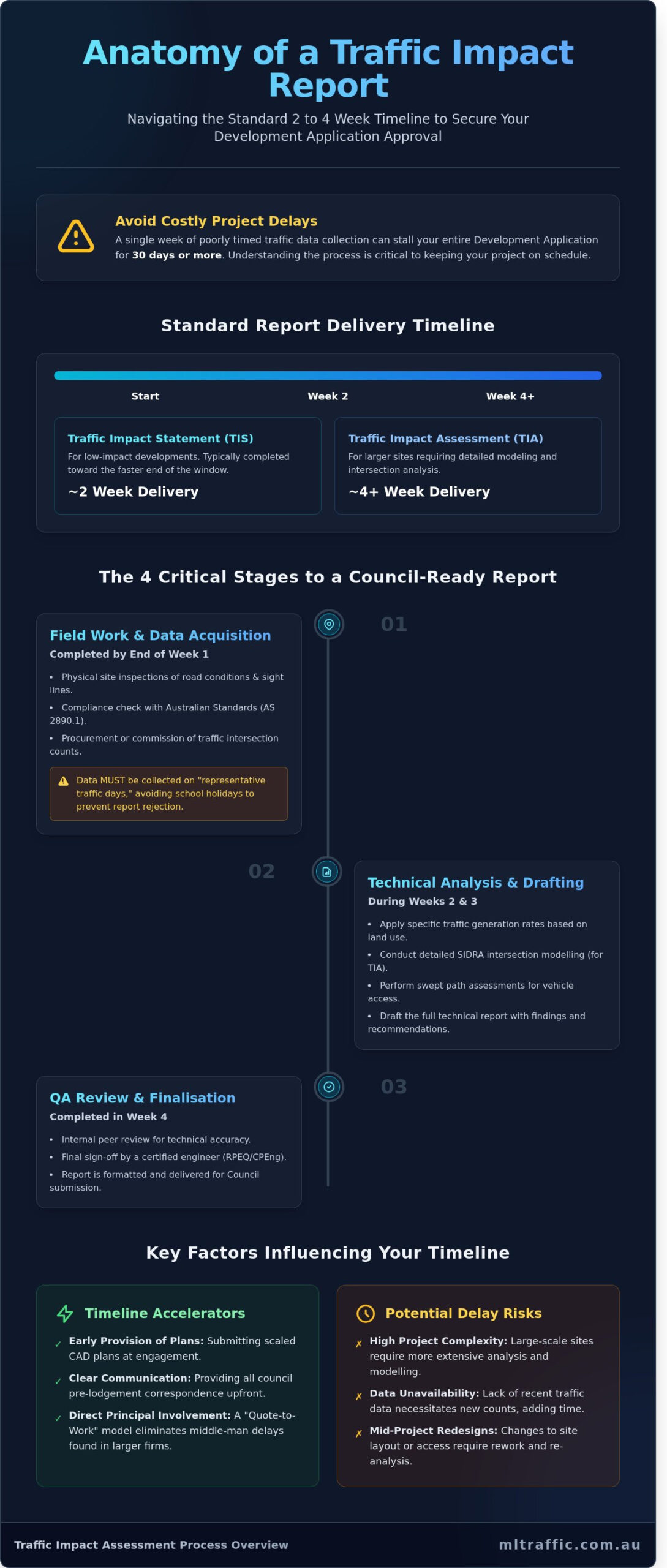
A professional traffic assessment follows a rigorous four-stage workflow to ensure the final document withstands council scrutiny. Understanding the typical timeline for a traffic impact report requires a breakdown of these technical milestones. Most projects reach completion within three to four weeks, provided there are no delays in data procurement.
Stage 1: Field Work and Data Acquisition
The first week focuses on gathering raw data. We conduct physical site inspections to evaluate existing road conditions, driveway ramp grades, and sight distances. Compliance with Australian Standards (AS 2890.1) is assessed on-site to identify potential design conflicts early. We procure historical traffic data from state authorities or commission new intersection counts where current data is unavailable.
Timing is critical during this phase. We must collect data on “representative traffic days.” This means avoiding public holidays, school holidays, and local events that might skew the results. If counts are taken during a non-representative period, the council will likely reject the report, forcing a restart of the data collection process. This stage typically concludes by the end of Week 1.
Stage 2 & 3: From Analysis to Draft
During Weeks 2 and 3, we transition into technical modelling and report drafting. We apply specific traffic generation rates based on the proposed land use. For example, a childcare centre creates concentrated peak-hour movements during drop-off and pick-up times, whereas an industrial warehouse generates consistent heavy vehicle movements throughout the day. We use these variables to assess intersection performance and car parking demand.
A vital component of this stage is the Swept Path Analysis. This simulation ensures that the largest anticipated vehicles can enter, manoeuvre, and exit the site in a forward direction. We also address:
- Queue length analysis at site entry points.
- Internal circulation and pedestrian safety.
- Compliance with the relevant local environmental plan (LEP) and development control plan (DCP).
- Potential impacts on the surrounding road network capacity.
By the end of Week 3, a comprehensive draft is produced that addresses all technical requirements of the Development Application (DA).
Stage 4: Quality Assurance and Final Review
The final week is dedicated to quality assurance. At ML Traffic Engineers, the consultant who provides the quote does the work, ensuring accountability throughout the process. Every report undergoes a final review to verify that all sight-line assessments and technical calculations are accurate. We ensure the document is ready for submission to the council or Transport for NSW (TfNSW). If you are planning a new development, you can view our full range of traffic engineering services to see how we manage these requirements. The typical timeline for a traffic impact report concludes here with the delivery of a professional, defensible document.
Key Variables That Influence Your Report Delivery Date
The typical timeline for a traffic impact report depends on the scale of the proposed development. A single-use project, such as a small childcare centre or a 10-unit apartment block, requires less data processing than a large-scale mixed-use precinct. Complex sites involving retail, residential, and commercial components increase the analytical workload. We must assess how these different uses interact during peak hours, which naturally extends the delivery schedule.
Council-specific requirements also play a major role in the process. Every local government area in Australia has its own Development Control Plan (DCP) and specific overlays. Some councils require a 10-year growth forecast, while others focus on immediate intersection capacity. Addressing these unique local planning instruments is essential to avoid a Request for Further Information (RFI) later in the application process. Our team ensures that every specific local requirement is met before the report is finalised.
Data Collection Bottlenecks
Accurate reporting relies on data that reflects “normal” traffic conditions. We can’t perform traffic counts during school holiday periods or on weeks containing public holidays because the volumes don’t represent typical peak demand. This factor alone can delay a project by 14 days if the timing coincides with term breaks. Weather events also cause delays. Heavy rain or flooding can skew vehicle speeds and volumes, making the data unusable for a compliant assessment. Once we collect the raw data, our team needs 3 to 5 business days to process it into usable modelling inputs.
Technical Complexity and Modelling
When a project impacts a major road or a busy intersection, councils often mandate SIDRA modelling. This technical software simulates traffic flow and calculates the Degree of Saturation (DoS) and Level of Service (LoS). These models take time to build and calibrate against current conditions. Detailed Car Park Design assessments and ramp grade calculations are also necessary to ensure compliance with AS 2890.1. If our site inspection identifies sight-line constraints or safety risks, we must perform additional safety audits. These technical requirements are necessary to ensure the typical timeline for a traffic impact report accounts for all regulatory hurdles and safety standards.
- Site Complexity: Large-scale developments require longer analysis periods.
- Data Type: Using existing databases is faster than commissioning new manual counts.
- Regulatory Standards: Adherence to AS 2890.1 and local council overlays is mandatory.
- Software Requirements: SIDRA modelling adds technical depth and time to the final delivery.
Proactive Strategies to Streamline Your Traffic Engineering Approval
Project delays often stem from administrative gaps rather than technical complexities. Efficiency in the approval process depends on the quality of documentation provided at the start. To maintain the typical timeline for a traffic impact report, you must provide high-quality architectural plans in both PDF and CAD formats immediately. CAD files allow for precise Vehicle Swept Path Assessments without the need for manual scaling; this reduces technical errors and saves hours of drafting time.
Sharing all correspondence from council pre-lodgement meetings is equally critical. These documents outline specific concerns raised by council officers, such as sight-line requirements or intersection capacity. If the traffic consultant has these minutes from day one, they’ll address every requirement in the first draft. You must also ensure the site is physically accessible for inspections. Locked gates or restricted access can delay the initial site visit by 48 to 72 hours, pushing back the entire reporting schedule.
The Value of Early Involvement
Engaging a traffic consultant during the concept design stage prevents late-stage redesigns that compromise project viability. Early feedback on car park layouts ensures compliance with AS 2890.1 before the plans are locked in. Identifying “deal-breaker” traffic issues, such as inadequate driveway widths or non-compliant ramp grades, allows for adjustments before the formal timeline begins. You can view early-stage consulting options to see how this technical oversight improves development outcomes.
Documentation Readiness Checklist
A complete data set is the only way to avoid frustrating Requests for Information (RFIs) from council. Providing the correct council reference numbers and a draft Statement of Environmental Effects (SEE) helps the traffic engineer align their report with the overall project narrative. This consistency is vital for a smooth assessment. Ensure your documentation package includes:
- Scaled site plans and floor plans showing all proposed uses.
- Expected staff and visitor numbers based on maximum occupancy.
- Delivery schedules including the largest vehicle type expected (e.g., 8.8m MRV or 12.5m HRV).
- Operational hours and peak periods for the specific land use.
A proactive approach ensures that the typical timeline for a traffic impact report isn’t extended by avoidable administrative hurdles. Providing these details upfront allows the engineer to focus on the technical assessment rather than chasing missing data.
Contact us today to discuss your project requirements with an experienced traffic consultant.
Why Direct Principal Involvement at ML Traffic Minimises Project Delays
The typical timeline for a traffic impact report is often extended by internal bureaucracy within large, multidisciplinary firms. At ML Traffic Engineers, we operate on a “Quote-to-Work” model. This means the senior engineer who reviews your site and provides the initial fee proposal is the same expert who performs the technical analysis. It’s a direct approach that eliminates the communication gap between sales teams and technical staff, ensuring your project doesn’t sit in an administrative queue.
In many corporate environments, projects move through layers of junior engineers, CAD drafters, and project managers. Each hand-off introduces a delay of several days. We’ve removed these middle-man bottlenecks. Since we began trading in 2005, we’ve prioritised a lean structure where clients have a direct line to the experts. When you call to discuss your TIS or car parking demand assessment, you speak to the professional actually calculating your swept paths or driveway ramp grades.
Our experience spans over 19 years of navigating specific Australian council requirements and state-based regulations. This deep local knowledge allows us to bypass common pitfalls that usually trigger a “Request for Further Information” (RFI). We understand what council engineers look for in a TIA, whether the project is a small residential subdivision or a large-scale industrial warehouse.
Accountability and Technical Precision
Senior oversight from day one reduces the need for extensive revisions. We draw upon a database of over 10,000 sites to solve complex access and parking issues quickly. This massive data set allows us to find precedents for almost any land use, including:
- Childcare centres and medical clinics
- Service stations and fast food outlets
- High-density residential apartments
- Specialised industrial facilities and temples
You have direct access to our senior principals, Michael Lee and Benny Chen, for rapid decision-making. They each bring between 30 and 40 years of experience to every project. There are no gatekeepers here. This hands-on involvement ensures the typical timeline for a traffic impact report remains as short as possible. You can read more about ML Traffic and our commitment to technical precision.
Fast-Track Your Development Application
The right traffic consultant turns a potential council hurdle into a smooth approval process. By ensuring every assessment complies with AS 2890.1 from the first draft, we prevent the back-and-forth cycles that stall developments for months. Our goal is to provide a report that’s both compliant and defensible during the DA process. We focus on private clients who need reliable, professional results to keep their projects moving forward.
If you’re facing tight deadlines or complex RPEQ requirements, don’t leave your project in a large firm’s backlog. Quick turnaround times are a result of our focused expertise and lack of corporate red tape. Contact ML Traffic Engineers for a direct quote and a specific timeline estimate for your development site today.
Accelerate Your Development Approval Process
Navigating the four stages of a traffic assessment requires precision and technical foresight. While the typical timeline for a traffic impact report varies based on site variables and council requirements, proactive planning reduces the risk of costly delays. You need a partner who understands Australian Standards and local government expectations to keep your project on track. ML Traffic Engineers brings a track record of over 10,000 successfully completed projects to your development application.
We eliminate the middleman. The traffic consultant who quotes your work also performs the work. This ensures accountability and technical accuracy from the first day. You’ll work directly with principals who hold over 30 years of industry experience. This hands-on approach streamlines the traffic engineering approval and keeps your project moving forward. Don’t let bureaucratic hurdles or inexperienced juniors stall your progress. Secure expert guidance to meet your deadlines and satisfy all regulatory demands. It’s the most reliable way to ensure your report is professional, compliant, and delivered on time.
Get a direct quote and timeline for your project from our senior engineers
Frequently Asked Questions
How long does a standard Traffic Impact Assessment take?
A standard Traffic Impact Assessment typically takes between 14 and 28 days to complete from the date of engagement. This typical timeline for a traffic impact report accounts for site inspections, data analysis, and technical drafting. If the project requires complex intersection modelling using SIDRA software, the timeframe often extends toward the 28-day mark to ensure all RPEQ standards are met.
Can I get a traffic report in less than a week for an urgent DA?
Obtaining a comprehensive traffic report in less than 7 days isn’t feasible for a valid Development Application. High-quality assessments require accurate field data and rigorous compliance checks against AS 2890.1. Rushing this process increases the risk of Council refusal. We focus on providing reliable reports that withstand scrutiny, which requires a minimum of 10 to 14 business days for even minor developments.
Why do traffic counts take so long to organise?
Traffic counts require specific timing to ensure data represents normal conditions. We avoid school holidays and public holidays because these periods skew results. Most counts occur on a Tuesday, Wednesday, or Thursday to capture average weekday peaks. Organising equipment and personnel for a 12-hour or 7-day tube count requires at least 5 business days of lead time to ensure technical accuracy.
Does the size of my development change the reporting timeline?
Project scale directly impacts the assessment duration. A small residential 4-unit development might take 10 business days. Conversely, a large commercial warehouse or a 50-apartment complex requires 4 to 6 weeks. Larger sites involve more complex Vehicle Swept Path Assessments and detailed Car Parking Demand Assessments to satisfy Council requirements and State Government transport regulations.
What happens if council asks for more information after the report is submitted?
If a Council issues a Request for Further Information (RFI), it adds approximately 7 to 14 days to the project schedule. This phase involves addressing specific technical concerns or providing additional Sight-Line Assessments. The traffic consultant who provides the quote, does the work; this ensures RFI responses are handled by the senior engineer who understands the original site data and local planning schemes.
Are there certain times of the year when traffic reports take longer?
Timelines extend during the Christmas and New Year period, specifically from mid-December to late January. Many Councils and data collection firms close for 14 days during this window. Additionally, traffic data collected during school holidays is often rejected by authorities. We recommend initiating the typical timeline for a traffic impact report by October to avoid these seasonal delays and ensure data validity.
How much does the complexity of car park design affect the timeline?
Complex car park designs involving steep driveway ramp grades or tight circulation spaces add 3 to 5 business days to the reporting process. Each bay and access point must be checked against AS 2890.1 standards. If the design requires multiple iterations of Vehicle Swept Path Assessments to prove functionality, the extra drafting time is necessary to ensure the final report supports a successful DA outcome.
Disclaimer
The content on www.mltraffic.com.au, including all technical articles, guides, and resources, is provided for general informational and educational purposes only. It is not intended to constitute professional advice in traffic engineering, transportation planning, development approvals, or any other technical or legal field.
While ML Traffic Engineers makes every reasonable effort to ensure the accuracy, completeness, and timeliness of the information published, we do not provide any warranties or representations (express or implied) regarding its reliability, suitability, or availability for any particular purpose. Any reliance you place on the content is strictly at your own risk.
In no event shall ML Traffic Engineers, its directors, employees, authors, or affiliates be liable for any direct, indirect, incidental, special, consequential, or punitive damages (including, without limitation, loss of profits, data, or business opportunities) arising out of or in connection with the use of, or inability to use, any information provided on this website.
The articles and guides on this site are not a substitute for engaging a qualified, registered professional traffic engineer (such as an NPER or RPEQ engineer) to assess your specific project requirements. For tailored advice, compliance assessments, or traffic engineering services, please contact a competent professional.
This disclaimer may be updated from time to time without notice. By accessing or using this website, you agree to be bound by the most current version of this disclaimer.
