

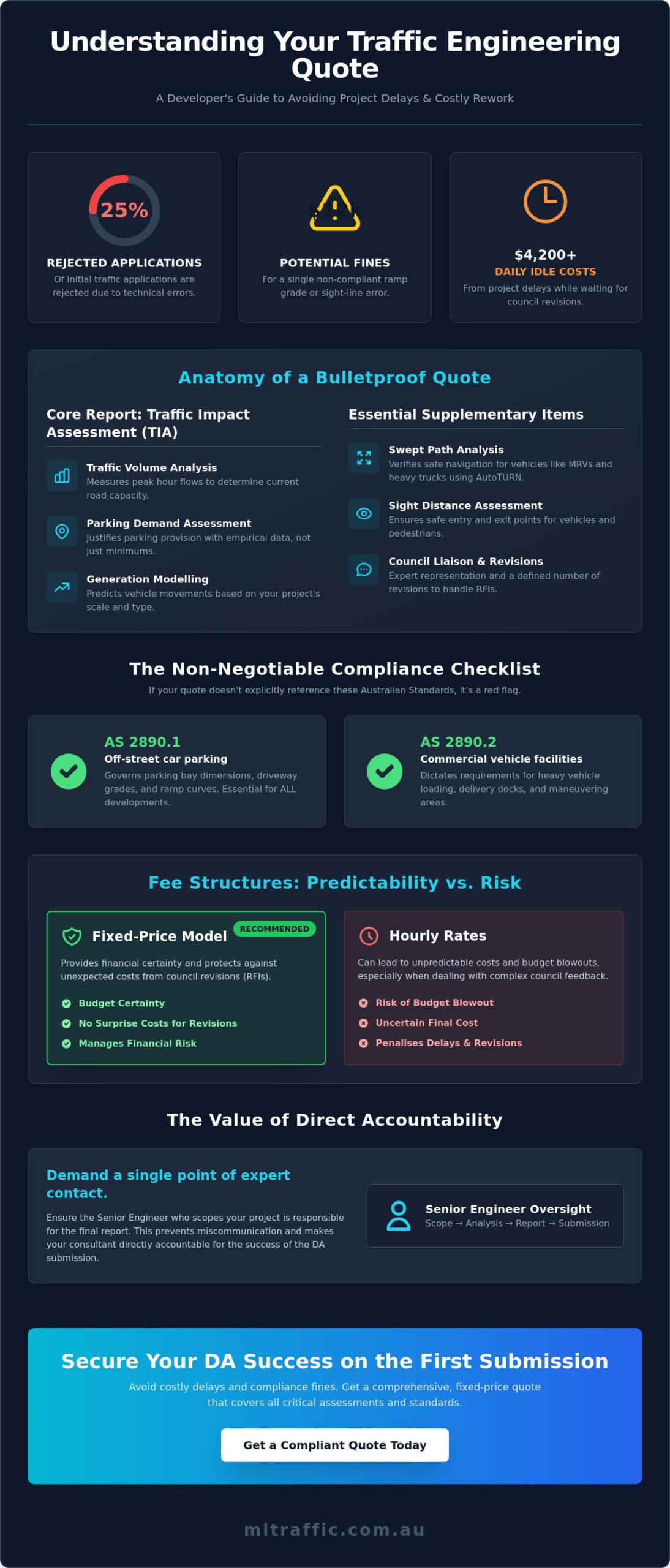
Approximately 25% of initial traffic management applications in Sydney are rejected due to technical inaccuracies. For a developer, this is more than a minor delay. It’s a direct threat to your project timeline and bottom line. Understanding a traffic engineering quote is the only way to ensure your proposal is a compliance roadmap rather than a liability. A single error in a driveway ramp grade or sight-line assessment can lead to a $12,000 fine for non-compliance. You need to know exactly what you’re paying for before the council sends a Request for Information (RFI).
It’s frustrating to decipher technical jargon while fearing hidden costs that might appear later. We agree that a quote should provide financial certainty, not a list of vague exclusions. This guide explains how to identify essential compliance items and compare proposals with confidence. You’ll learn to spot the difference between a basic TIA and a comprehensive assessment that handles council revisions. We’ll provide the clarity you need to avoid $4,200 in daily idle machinery costs and ensure your DA succeeds on the first submission.
Key Takeaways
- Learn to distinguish between the core Traffic Impact Assessment (TIA) and supplementary line items like Parking Demand Assessments to ensure full project coverage.
- Success in understanding a traffic engineering quote depends on verifying that Australian Standards AS 2890.1 and AS 2890.2 are included as non-negotiable compliance benchmarks.
- Compare fee structures to identify the benefits of fixed-price models over hourly rates when managing the financial risks of council revisions.
- Identify the value of including Council Liaison as a specific service to ensure your consultant provides expert representation during the DA approval process.
- Recognize the importance of direct accountability by ensuring the senior engineer who scopes your project is the one responsible for the final technical report.
Table of Contents
-
Decoding the Technical Components of a Traffic Engineering Quote
-
Compliance Check: Australian Standards and Essential Inclusions
-
Beyond the Report: Council Liaison and Expert Representation
Decoding the Technical Components of a Traffic Engineering Quote
A traffic engineering proposal serves as the technical foundation for your development application. Understanding a traffic engineering quote requires a granular look at the specific reports and assessments required by the local road authority. While the price is often the focus, the scope of work determines if the document will actually pass a planner’s desk. Essential components like Sight Distance Assessments are frequently separated from the main report because they involve site-specific safety measurements. A comprehensive quote should also explicitly state the number of revisions included. This protects you from unexpected fees when the council requests minor adjustments to the site layout after the initial submission.
To better understand the technical fundamentals involved in these assessments, watch this helpful video:
The Traffic Impact Assessment (TIA) Scope
The TIA is the primary document used to evaluate how a new development interacts with the existing road network. At ML Traffic Engineers Australia, our quotes detail the exact data collection methods used, such as intersection turning counts or queue length surveys. We analyze existing traffic volumes against the proposed generation rates specific to your land-use. This data-driven approach ensures the report is defensible during the RFI process. A professional scope will typically include:
-
Traffic volume analysis: Measuring peak hour flows to determine current road capacity.
-
Parking Demand Assessment: Justifying parking provision based on empirical data rather than just minimum code requirements.
-
Generation modeling: Predicting vehicle movements based on the scale and type of the proposed project.
Specialised Vehicle Maneuvering and Swept Paths
Modern site design requires proof that vehicles can navigate the property safely. A Swept Path Analysis uses AutoTURN software to simulate vehicle movements. This is a non-negotiable item for commercial or industrial developments where heavy vehicles are expected. A quote from ML Traffic Engineers Australia ensures that these simulations account for the largest vehicle expected on-site, such as an 8.8m Medium Rigid Vehicle (MRV) or a heavy articulated truck. We provide detailed assessments rather than basic diagrams. This ensures that driveway widths and internal circulation areas are fully functional and compliant with state-specific road authority guidelines from the start.
Compliance Check: Australian Standards and Essential Inclusions
A traffic engineering proposal is a technical commitment to regulatory compliance. Understanding a traffic engineering quote requires a checklist of mandatory Australian Standards that form the basis of a successful DA. If a quote does not explicitly reference AS 2890, it’s incomplete. This standard governs everything from the width of a parking bay to the curve of a driveway. For developers, ignoring these details leads to costly redesigns during the construction phase. A single error in a driveway ramp grade assessment can result in a $12,000 fine for non-compliance or necessitate the complete demolition of a poured slab. Your quote must include these assessments to ensure the physical reality of the site matches the approved plans.
Beyond the parking layout, the quote should detail contributions to the Statement of Environmental Effects (SEE). Traffic engineers provide the data-driven evidence required for the SEE, justifying how the development fits within the local context. For commercial or industrial projects, AS 2890.2 is equally critical. It dictates the requirements for heavy vehicle loading and maneuvering. If your project involves delivery docks or service vehicles, ensure AS 2890.2 compliance is a dedicated line item. You can contact our senior engineers to discuss which specific standards apply to your site’s land-use type.
The Role of AS 2890 in Your Quote
Compliance with AS 2890.1 is the primary reason for parking-related Requests for Information (RFIs) from council. A quote that lacks "Compliance Certification" leaves the developer vulnerable. Our engineers verify every technical dimension, including aisle widths, bay lengths, and the treatment of blind aisles. We ensure that columns are positioned correctly so they don’t obstruct car doors. Without this level of detail in the initial quote, you risk hiring a firm that provides a report council will immediately reject for technical non-compliance.
Sight-Line and Safety Assessments
Council planners prioritize safety, which makes Sight Distance Assessments a requirement for all new driveway entries. There is a significant difference between a desktop study and a physical site inspection. A desktop study uses maps, but a physical inspection accounts for real-world obstructions like power poles, existing trees, or neighboring structures. These assessments protect developers from future liability by proving the entry point meets the safe intersection sight distance (SISD) requirements. Ensuring this is scoped correctly in your quote prevents the council from demanding expensive safety audits later in the process.
Evaluating Fee Structures: Fixed Price vs. Hourly Rates
Fee structures in traffic engineering vary significantly between firms. Understanding a traffic engineering quote requires a clear-eyed look at how the consultant bills for their time and expertise. Most developers prefer fixed-price quotes for DA reports because they offer budget certainty. Hourly rates, while sometimes lower initially, often become a financial liability when dealing with unpredictable council feedback. A senior traffic engineer in NSW typically bills at A$200 to A$300 per hour. If the council issues multiple RFIs, those hours accumulate rapidly. A fixed-price model forces the consultant to scope the project accurately from day one, covering the necessary analysis without surprise invoices.
Variations are the most common source of friction in engineering contracts. These "out-of-scope" items typically include additional traffic counts requested by the council or major changes to the site masterplan after the report is drafted. A professional quote will clearly define what triggers a variation. It is essential to identify "box-ticking" quotes that provide the bare minimum. These reports often lack the depth required to survive council scrutiny. They might meet the letter of the law but fail to defend the project’s specific traffic generation or parking deviations. This leads to a cycle of rejections that eventually costs more than a comprehensive initial proposal.
The Fixed-Price Security Model
A professional traffic engineering firm should provide a lump sum for the standard DA package. This security model protects your project from the "daily rate" trap, where engineering consultants bill between $500 and $2,000 per day regardless of progress. Your quote must include a "reimburseables" section. This covers external costs like purchasing historical traffic data from state road authorities. Ensure the quote explicitly covers the final report delivery and the initial round of council responses. This prevents the consultant from charging extra for the very first conversation they have with a council planner.
Red Flags in Low-Ball Quotes
Low-ball quotes often hide "Vague Scoping." If a proposal doesn’t mention specific items like Swept Path Analysis or AS 2890 compliance, it’s likely they’ll charge for these as extras later. Another major risk is the "Junior Engineer" bait-and-switch. Larger firms often have a senior principal sign the quote, but a junior staff member with limited experience performs the actual work. This increases the likelihood of technical errors. At ML Traffic Engineers Australia, the consultant who provides the quote does the work. This direct accountability eliminates the risk of technical inaccuracies that lead to $4,200 in daily idle machinery costs due to non-compliance delays.
Beyond the Report: Council Liaison and Expert Representation
A traffic report is a static document. Its value depends on the author’s ability to defend its conclusions under pressure. Understanding a traffic engineering quote means checking if "Council Liaison" is included as a distinct line item. Many developers overlook this, assuming the report is the final deliverable. However, the period after submission is where projects often stall. You need a consultant who doesn’t just write but also advocates. This representation ensures that technical jargon doesn’t become a barrier to your DA approval. Post-submission support is a specialized skill set. It requires an engineer who can translate technical data into terms a council planner accepts.
Handling Council RFIs and Revisions
A Request for Further Information (RFI) is a formal query from the council regarding technical aspects of your application. It happens when a planner needs clarification on data like vehicle swept paths or parking demand. Approximately 25% of initial applications in Sydney face these rejections. Your quote should explicitly state if it includes responses to the first round of RFIs. If it doesn’t, you’ll face unbudgeted hourly charges. We recommend ensuring your proposal includes a set number of hours for council negotiation. Direct access to the senior engineer is vital here. You shouldn’t be relayed through a project manager who didn’t perform the original analysis.
Expert Witness and Professional Advocacy
Some projects encounter significant opposition or complex legal hurdles. In these cases, your quote might need to account for Land and Environment Court support. Professional advocacy requires deep-seated expertise. Planners respect engineers with decades of experience who understand the bureaucratic requirements of traffic engineering. Between 30 and 40 years of experience per senior staff member allows a firm to speak with authority. A deep understanding a traffic engineering quote involves knowing if your engineer has the experience to act as an expert witness if required. This level of advocacy is a core part of our ML Traffic Services. We don’t just provide a document; we provide a defensible technical position. Senior representation ensures your project isn’t sidelined by junior-level errors.
If you need a consultant who will stand by their work at a council meeting, get a comprehensive quote from our senior engineers today.
The ML Traffic Difference: Direct Accountability
The primary risk in hiring a large consultancy is the disconnect between the salesperson and the technician. Understanding a traffic engineering quote requires knowing exactly whose hands will be on your data. In many corporate firms, the senior principal signs the proposal, but the actual analysis is delegated to a graduate with limited field experience. This creates a knowledge gap when the council asks for technical justifications. At ML Traffic Engineers Australia, we operate on a principle of total transparency. The traffic consultant who provides the quote is the same expert who performs the work, ensuring that every calculation is backed by senior-level judgment.
Our firm has assessed over 10,000 sites nationally, ranging from residential apartments and bars to temples and warehouses. This immense breadth of experience informs our scoping process, allowing us to anticipate council requirements that a less experienced firm might miss. Whether your project is in a high-density urban center or a regional industrial hub, our national coverage ensures compliance with specific state road authority codes. This direct accountability minimizes the risk of technical inaccuracies and provides the reliability needed for a successful DA submission.
Direct Principal Involvement
We eliminate bureaucratic delays by providing direct access to our senior engineers, Michael Lee and Benny Chen. You won’t be relayed through junior project managers or administrative gatekeepers. Each principal brings between 30 and 40 years of experience to your project, and their direct mobile numbers are included on every proposal. This "no-gatekeepers" approach means technical questions regarding driveway ramp grades or intersection analysis are answered immediately by the professional responsible for the report. At ML Traffic Engineers Australia, we believe that senior involvement at every stage is the only way to guarantee a defensible technical position.
Requesting Your Comprehensive Proposal
Generating an accurate, fixed-price quote requires a few key pieces of information. We need the current site masterplan, a description of the proposed land-use, and any relevant council correspondence or pre-DA minutes. Our typical turnaround time for a professional proposal is between 24 and 48 hours. This efficiency allows you to finalize your project team and move toward submission without unnecessary downtime. If you are ready to secure a principal-led assessment for your development, contact ML Traffic Engineers Australia for a comprehensive, fixed-price quote today.
Secure Your Project with Technical Precision
Successful development applications depend on technical accuracy and expert advocacy. Understanding a traffic engineering quote requires a focus on fixed pricing and specific compliance with Australian Standards. A vague proposal leads to unbudgeted hourly costs and council rejections. You need a consultant who provides direct accountability from the initial quote to the final council meeting. This ensures that the technical scope matches the physical reality of your site and survives the scrutiny of planning authorities.
We have assessed over 10,000 sites nationally and bring over 20 years of experience to every project. This extensive history ensures your project meets all bureaucratic requirements without unneeded delays. You gain direct access to our senior engineers, Michael Lee and Benny Chen, who handle every technical detail of your assessment. They don’t just write reports; they defend them. Your DA success is within reach when backed by decades of engineering expertise.
Get a Fixed-Price Traffic Engineering Quote from our Principals
Frequently Asked Questions
How much does a traffic engineering report cost for a standard DA?
A standard Traffic Impact Assessment (TIA) typically costs between $3,000 and $8,500 for a private development. For complex commercial sites, the cost can exceed $15,000 according to May 2026 industry benchmarks. Understanding a traffic engineering quote requires checking if these fees include all necessary technical assessments or if they are limited to the base report writing without data collection.
What is the difference between a Traffic Impact Statement and a Traffic Impact Assessment?
A Traffic Impact Statement (TIS) is a concise document for small-scale projects with minimal traffic generation. A Traffic Impact Assessment (TIA) is a comprehensive strategic document for larger developments that significantly alter road or footpath conditions. Councils specify which report is required based on the development’s intensity and the potential impact on the surrounding road network.
Does my quote include the cost of traffic counts and data collection?
Traffic counts and data collection are often listed as separate line items or "reimbursables" within a proposal. This occurs because historical data costs from road authorities vary significantly by jurisdiction. You must verify if your quote includes physical intersection counts or if these will be billed as additional out-of-pocket expenses during the assessment phase.
What happens if the council asks for changes after the report is submitted?
Council revisions are handled through a formal Request for Further Information (RFI). A professional quote should explicitly state if it includes responses to the first round of council queries. Approximately 25% of applications in Sydney face initial rejections due to technical inaccuracies. Including liaison time in your initial quote prevents unbudgeted hourly charges later in the project.
Why do some quotes include Swept Path Analysis while others do not?
Swept Path Analysis is included when a development requires heavy vehicle access or has tight maneuvering areas. Industrial and commercial sites must prove that delivery trucks can enter and exit in a forward direction using specialized software like AutoTURN. If your site is a simple residential driveway, this analysis might be omitted unless specific council codes require it for safety.
How long is a traffic engineering quote valid for?
Most traffic engineering quotes are valid for a period of 30 to 60 days. This timeframe accounts for potential changes in data collection costs or shifts in state road authority regulations. If you delay signing the proposal beyond this window, the consultant may need to reassess the scope based on updated council guidelines or current engineering consultant daily rates.
Is AS 2890 compliance mandatory for all residential developments?
Compliance with AS 2890.1 is mandatory for all off-street car parking in Australia. This standard dictates bay dimensions, aisle widths, and driveway ramp grades for residential developments. Understanding a traffic engineering quote involves ensuring the engineer will certify the design against these standards to avoid $12,000 fines for non-compliance or expensive construction-phase rectifications.
Can I use a general civil engineer instead of a specialist traffic engineer?
Councils generally require reports from accredited traffic engineering specialists rather than general civil engineers. Traffic engineering is a distinct field focused on vehicle dynamics, transport planning, and specific Australian Standards. Specialist engineers have the expertise and professional accreditation required to certify traffic impact and safety assessments that a generalist firm may not possess.
Which areas do you cover?
We are traffic engineers servicing Melbourne, Sydney, Brisbane, Gold Coast, Hobart, Perth, Adelaide, Darwin, Canberra and surrounding areas.

Disclaimer
The content on www.mltraffic.com.au, including all technical articles, guides, and resources, is provided for general informational and educational purposes only. It is not intended to constitute professional advice in traffic engineering, transportation planning, development approvals, or any other technical or legal field.
While ML Traffic Engineers makes every reasonable effort to ensure the accuracy, completeness, and timeliness of the information published, we do not provide any warranties or representations (express or implied) regarding its reliability, suitability, or availability for any particular purpose. Any reliance you place on the content is strictly at your own risk.
In no event shall ML Traffic Engineers, its directors, employees, authors, or affiliates be liable for any direct, indirect, incidental, special, consequential, or punitive damages (including, without limitation, loss of profits, data, or business opportunities) arising out of or in connection with the use of, or inability to use, any information provided on this website.
The articles and guides on this site are not a substitute for engaging a qualified, registered professional traffic engineer (such as an NPER or RPEQ engineer) to assess your specific project requirements. For tailored advice, compliance assessments, or traffic engineering services, please contact a competent professional.
This disclaimer may be updated from time to time without notice. By accessing or using this website, you agree to be bound by the most current version of this disclaimer.
