

What if the traffic data Council uses to evaluate your project is based on outdated metrics that no longer reflect real-world behavior? Relying on generic rates can lead to unnecessary project delays or rejection due to perceived congestion. Understanding trip generation survey data is essential for any developer looking to challenge standard assumptions with site-specific, empirical evidence.
It’s understandable to feel uncertain when interpreting complex traffic engineering reports or worrying about how authorities calculate your project’s impact. You want a clear path to approval, not a technical roadblock. This guide provides a professional breakdown of how data is collected and analyzed under the latest standards, including the Guide to Transport Impact Assessment (TS 00085) that became effective on November 4, 2024. You’ll gain the confidence to present traffic data to authorities by learning about the transition to the national TRIPS database and modern survey methodologies.
We’ll examine how leveraging the 73,627 hours of data now available in the TRIPS database can transform your Traffic Impact Assessment from a compliance hurdle into a strategic advantage. This article previews the technical requirements for site-specific surveys and explains how to use current data to secure your planning approvals.
Key Takeaways
- Define a ‘trip’ as a single-direction vehicle movement and understand its foundational role in the broader Traffic Impact Assessment (TIA) framework.
- Evaluate the technical differences between manual turning movement counts and automatic traffic counters to select the appropriate data collection methodology.
- Gain a technical advantage by understanding trip generation survey data and how site-specific empirical surveys can challenge generic or outdated Council rates.
- Learn to interpret raw survey results by calculating precise trip rates and directional splits during critical peak hours to ensure planning compliance.
- Recognize why professional engineering oversight and direct access to senior principals are essential for producing legally defensible traffic data analysis.
What is Trip Generation Survey Data in Traffic Engineering?
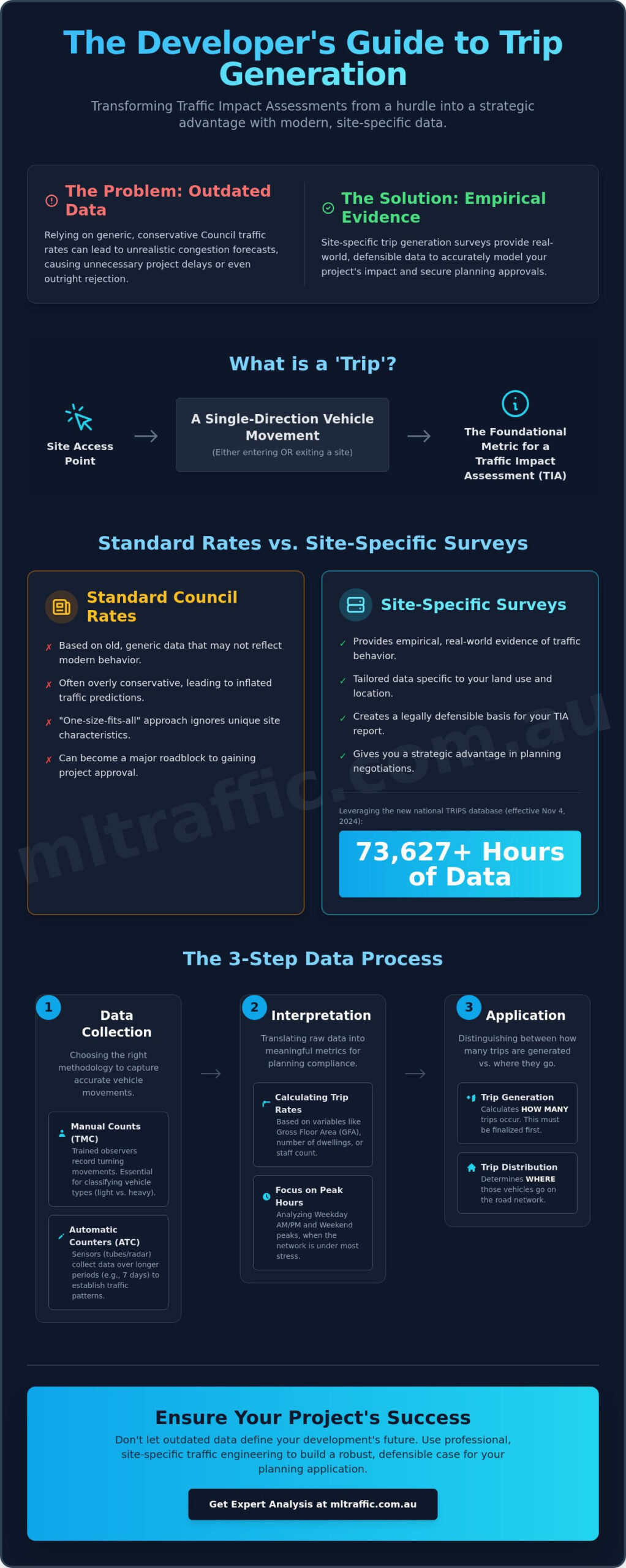
Trip generation is the process of estimating the number of vehicle movements a specific land use will produce. In traffic engineering, a “trip” refers to a single-direction vehicle movement either entering or exiting a site. It’s the foundational metric used within a Traffic Impact Assessment (TIA) Report to quantify the demand a new development places on the surrounding transport network. Without accurate generation figures, the entire assessment lacks a reliable basis for predicting future traffic conditions.
Understanding trip generation survey data is critical because it dictates the scale of required infrastructure. Accurate data informs road capacity requirements, intersection performance, and car parking demand assessments. While daily totals provide a broad overview, traffic engineers focus heavily on peak hour vehicle movements. These peak periods represent the highest stress on the network and determine whether an intersection will maintain acceptable levels of service or require significant upgrades.
To gain a deeper technical perspective on these foundational concepts, watch this lecture:
This component is often the most scrutinized element of a development application. Councils and road authorities, such as Transport for NSW (TfNSW), examine these figures to predict congestion. Professionals prioritize understanding trip generation survey data to ensure that site-specific nuances aren’t ignored in favor of generic, conservative averages that could jeopardize a project’s feasibility.
The Core Variables of Trip Generation
Several factors influence the volume of traffic a site generates. Land use categories are the primary drivers; a high-density residential flat building operates differently than a regional distribution center. Engineers use independent variables to scale these rates, including Gross Floor Area (GFA), the number of dwellings, or staff counts. Temporal factors also play a role, as assessments must account for weekday AM/PM peaks and weekend peak periods.
Trip Generation vs. Trip Distribution
It’s vital to distinguish between generation and distribution. While generation calculates how many trips occur, trip distribution determines where those vehicles go. Generation data must be finalized before distribution analysis begins. Once the volume is established, engineers use existing traffic patterns and census data to assign those trips to specific routes. These combined metrics define the Zone of Influence, identifying which intersections require detailed Intersection Analysis to ensure the project doesn’t adversely impact the local community.
Methodologies for Collecting Empirical Trip Data
Collecting defensible traffic data requires a blend of traditional observation and modern sensor technology. While generic rates offer a baseline, authorities often demand empirical evidence from comparable sites to justify a development’s projected impact. Understanding trip generation survey data involves recognizing which methodology produces the most accurate reflection of vehicle behavior for a specific land use. Professionals must ensure that the chosen method accounts for both volume and vehicle classification to meet regulatory standards.
Standard methodologies for data collection include:
- Manual Turning Movement Counts (TMC): Trained observers record vehicle movements at site access points. This is essential for complex Intersection Analysis where distinguishing between light and heavy vehicles is critical for capacity modeling.
- Automatic Traffic Counters (ATC): Pneumatic tubes or radar sensors collect data over extended periods, typically seven days. This method establishes Average Daily Traffic (ADT) volumes and identifies fluctuations across the week.
- Video-Based Surveys: High-definition cameras capture footage that is processed via AI-enhanced recognition software. This provides a permanent record for auditing and eliminates human error in high-volume environments.
- Interview-Based Surveys: Specialized sites like hospitals or large educational campuses often require intercept interviews. These surveys help engineers understand the split between staff, visitors, and service vehicle movements, which generic rates often overlook.
Data validity depends on more than just the equipment used. Sample sizes must be statistically significant to withstand Council scrutiny. Additionally, weather conditions must be monitored; surveys conducted during heavy rain or extreme weather are usually discarded as they don’t represent typical travel behavior. If you are unsure which methodology suits your project, contact our senior principals for a technical consultation.
Technological Advances in Traffic Surveys
The shift from manual clicking to high-definition video processing has revolutionized data reliability. Modern sensors now utilize Bluetooth and Wi-Fi sniffing to track anonymous device IDs. This technology allows engineers to understand dwell times and origin-destination patterns without manual intervention. While traditional pneumatic tubes remain a staple, radar-based counters offer higher accuracy in high-volume environments where tube strikes may be inconsistent or hazardous to install.
Selecting the Right Survey Period
Timing is critical for data validity. Surveys must be conducted during “typical” traffic conditions, generally a Tuesday, Wednesday, or Thursday. Engineers must avoid school holidays, public holidays, and periods with atypical road events that could skew the results. For high-density residential developments, multi-day surveys are necessary to capture the variance between weekday and weekend peak periods. This rigorous approach ensures the data is legally defensible during the DA process.
Standard Rates vs. Site-Specific Empirical Surveys
Australian road authorities rely on established databases to predict the traffic impact of new developments. The primary references include the NSW Guide to Transport Impact Assessment (TS 00085) and the national TRIPS database, which currently contains 73,627 hours of survey data across 32 land use types. While these resources provide a standardized starting point, they represent broad averages. Understanding trip generation survey data is necessary to determine when these generic rates fail to reflect the reality of a specific site. Relying solely on database averages can lead to inflated traffic projections that don’t account for unique local conditions.
The risk of using outdated or generalized data is significant in a rapidly evolving transport environment. Many older databases were compiled before the widespread adoption of car-sharing, remote work, and multimodal transport shifts. If a development is located near high-frequency public transport or features restricted parking, standard rates will likely overestimate its vehicle output. Professionals often employ a “first principles” approach for novel land uses where no standard rate exists, building a custom model based on staff numbers, delivery schedules, and customer turnover.
The Pitfalls of Over-Reliance on Database Averages
Standard rates are often conservative, designed to cover a worst-case scenario. This can lead to Council demanding unnecessary infrastructure contributions or expensive upgrades to local intersections. To avoid these costs, developers must account for local factors such as walkability and proximity to transit hubs. For example, a residential tower in a metropolitan CBD will generate significantly fewer vehicle trips than an identical building in a car-dependent suburb. Failing to distinguish between these contexts results in skewed data that can stall the approval process.
Case for Custom Surveys in Development Applications
When a project faces resistance due to perceived traffic congestion, site-specific empirical surveys provide a technical solution. By surveying “proxy” sites, which are existing developments with similar characteristics and land uses, engineers can provide Council with hard evidence of actual performance. This data is then integrated into a Traffic Impact Assessment to prove that the proposed development’s impact is lower than standard models suggest.
Challenging Council objections requires more than just an opinion; it requires legally defensible data. Custom surveys allow you to present a site-specific narrative that accounts for modern travel behaviors. Understanding trip generation survey data and its practical application ensures that your development is assessed on its actual merits rather than a theoretical average that may no longer be relevant.
Interpreting Survey Results for Planning Compliance
Converting raw vehicle counts into standardized trip rates is the first step in translating field observations into planning compliance. For a residential development, this involves dividing the total peak hour vehicle movements by the number of dwellings. For commercial sites, Gross Floor Area (GFA) is the standard divisor. Understanding trip generation survey data allows engineers to move beyond simple totals to analyze the directional split. This inbound versus outbound ratio is critical during peak hours; a morning peak for a residential site is predominantly outbound, while an evening peak is inbound.
These ratios directly impact the Level of Service (LoS) at nearby intersections. If the directional split is incorrectly modeled, the resulting intersection analysis will fail to reflect actual congestion points. Engineers also distinguish between “new” trips and “pass-by” or “diverted” trips. For retail developments, a significant portion of traffic may already be on the road network, simply stopping at the site while traveling elsewhere. Accounting for these prevents the double-counting of traffic and provides a more realistic view of the project’s impact.
Survey data is also used to justify a Car Parking Demand Assessment. If empirical data proves that the peak parking demand is lower than Council’s statutory requirements, developers can argue for a reduction in on-site spaces. This can significantly lower construction costs, particularly in projects requiring basement excavation. The results are clear. Accurate data saves money.
Accounting for Multi-Modal Shifts
Modern transport assessments must account for pedestrian and cyclist activity. If a site is located within a high-walkability zone, the vehicle trip rate should be adjusted downward. Documenting the mode share provides a holistic view of site access that satisfies the requirements of the latest Guide to Transport Impact Assessment (TS 00085). Implementing a Green Travel Plan can further reduce projected vehicle trips, proving to authorities that the development prioritizes sustainable transport. This shift is essential for inner-city projects.
Addressing Council Objections to Data
Authorities often reject survey data due to insufficient sample sizes, poor timing, or incorrect vehicle classification. To minimize Requests for Further Information (RFI), data must be presented transparently with clear documentation of the survey methodology. It’s essential to have a qualified Traffic Engineer certify the results. This ensures the data is technically sound and legally defensible during the planning process. Professional certification carries weight.
If you need a professional assessment of your site’s traffic data, request a Traffic Impact Assessment from our senior team today.
Professional Traffic Engineering for Accurate Data Analysis
Defensible traffic data is the backbone of a successful development application. Professional oversight is mandatory because raw vehicle counts lack the context required for a planning authority’s review. Understanding trip generation survey data involves applying rigorous engineering principles to ensure the results are legally robust and compliant with Australian Standards. Authorities typically reject data that lacks professional certification or fails to meet the specific requirements of the local road authority. Expert analysis transforms these counts into a technical narrative that proves a site’s actual performance.
ML Traffic Engineers Australia brings a 15-year history of delivering compliant traffic reports for a diverse range of project environments. We ensure every survey adheres to the latest regulatory frameworks, including the Guide to Transport Impact Assessment (TS 00085). Our senior team specializes in converting complex empirical data into clear, evidence-based arguments that address Council’s concerns regarding congestion and safety. We provide a comprehensive range of technical services to support your application, including:
- Traffic Impact Assessment (TIA) Report
- Vehicle Swept Path Analysis
- Car Parking Demand Assessment
- Traffic Guidance Scheme (TGS)
- Driveway Ramp Grade Assessment
- Intersection Analysis
- Sight Distance Assessment
- Car Park Design
The ML Traffic Engineers Australia Approach to Data Integrity
We operate on a philosophy of personnel continuity. The engineer who initiates your site survey is the same expert who performs the technical analysis and completes the final report. This “no-gatekeepers” approach distinguishes ML Traffic Engineers Australia from larger firms where data collection is often outsourced to junior staff. You gain direct access to senior principals who provide strategic advice based on decades of practical experience. This meticulous attention to detail ensures your data is accurate and your project remains on schedule.
Next Steps for Your Development Application
Securing an approval starts with a precise understanding of your site’s traffic requirements. You can request a fee proposal for a comprehensive survey tailored to your specific land use and location. Our team integrates this trip data into a complete Traffic Impact Assessment, providing the authoritative backing your project needs to withstand scrutiny. Don’t leave your project’s success to generic database averages when site-specific evidence is available. Contact the senior leadership at ML Traffic Engineers Australia today to ensure your application is backed by reliable, professional engineering.
Securing Your Project’s Approval with Empirical Evidence
Establishing a defensible traffic profile is the most critical step in overcoming Council objections. Understanding trip generation survey data ensures that your development is evaluated on its actual performance rather than conservative, theoretical estimates. By leveraging site-specific empirical counts, you can often justify lower infrastructure contributions and optimized car parking demand. This technical approach removes the uncertainty that often leads to project delays or rejection.
Professional oversight remains the standard for legally robust applications. ML Traffic Engineers Australia provides over 15 years of consultancy experience to ensure every report meets national regulatory requirements. You receive direct access to senior principals who oversee every stage of data collection and analysis. Our comprehensive national coverage ensures your project is backed by authoritative engineering wherever your site is located. This expertise transforms raw data into a strategic advantage for your development application.
Contact our senior engineers for a project-specific traffic assessment to begin your application process. We look forward to helping you secure a successful planning outcome.
Frequently Asked Questions
What is the difference between trip generation and traffic volume?
Trip generation measures the vehicle movements directly attributed to a specific site access point, focusing on vehicles entering or exiting the property. Traffic volume refers to the total number of vehicles passing a specific point on a public road link. Engineers use generation data to calculate the net impact a new development adds to the existing background traffic volume already present on the network.
How long does a typical trip generation survey take to complete?
Physical data collection usually occurs over a 24-hour period for a single typical weekday, though equipment setup and extraction extend the process. The full cycle, including professional analysis and vehicle classification, typically takes one to two weeks. Understanding trip generation survey data requires this timeframe to ensure all counts are verified and formatted for inclusion in a Traffic Impact Assessment.
Can I use trip generation data from a similar project in another state?
Interstate data is generally discouraged unless it is justified as a direct proxy for a novel land use. Australian road authorities prefer data from the national TRIPS database or local sites within the same jurisdiction to account for regional differences in public transport and driver behavior. Using interstate figures without professional justification often leads to a Request for Further Information from Council.
Why does Council care more about peak hour trips than daily totals?
Peak hour trips dictate the maximum stress placed on the road network and determine if an intersection maintains an acceptable Level of Service. While daily totals show overall site activity, they don’t reflect the capacity constraints that cause congestion. Infrastructure upgrades and intersection designs are based on these critical peak periods to ensure the network can handle the highest expected demand.
What happens if my site-specific survey shows higher rates than the standard?
If a survey reveals higher rates, the developer must propose mitigation strategies within the Traffic Impact Assessment to manage the increased load. This may involve modifying site access, upgrading nearby intersections, or implementing travel demand management plans. Submitting accurate, higher rates is more defensible than using generic averages that Council’s technical reviewers will likely challenge as being unrealistic.
How many days of data collection are required for a valid survey?
A valid survey requires at least one typical weekday, specifically a Tuesday, Wednesday, or Thursday, to avoid weekend or Friday anomalies. High-density residential and retail projects often require a full seven-day count to capture the variance between weekday and weekend peaks. This ensures the data sample is statistically significant and reflects the full operational cycle of the land use.
Does trip generation data include pedestrian and bicycle movements?
Modern surveys must include multimodal movements to comply with the 2024 Guide to Transport Impact Assessment (TS 00085). Recording pedestrians and cyclists provides a holistic view of site access and is often used to justify lower vehicle trip rates in metropolitan areas. This multimodal data is essential for projects aiming to meet modern sustainability and “Safe System” planning requirements.
How often should trip generation databases be updated?
Databases require continuous updates to reflect shifts in travel behavior caused by remote work and car-sharing adoption. The TRIPS database, officially launched on December 10, 2025, is the current national benchmark for evidence-based planning in Australia. Relying on superseded documents, such as the 2002 NSW guide, is no longer acceptable for applications lodged after the November 4, 2024, effective date of the new standards.

Article by
Michael Lee
Practising traffic engineer with over 35 years experience.
Disclaimer
The content on www.mltraffic.com.au, including all technical articles, guides, and resources, is provided for general informational and educational purposes only. It is not intended to constitute professional advice in traffic engineering, transportation planning, development approvals, or any other technical or legal field.
While ML Traffic Engineers makes every reasonable effort to ensure the accuracy, completeness, and timeliness of the information published, we do not provide any warranties or representations (express or implied) regarding its reliability, suitability, or availability for any particular purpose. Any reliance you place on the content is strictly at your own risk.
In no event shall ML Traffic Engineers, its directors, employees, authors, or affiliates be liable for any direct, indirect, incidental, special, consequential, or punitive damages (including, without limitation, loss of profits, data, or business opportunities) arising out of or in connection with the use of, or inability to use, any information provided on this website.
The articles and guides on this site are not a substitute for engaging a qualified, registered professional traffic engineer (such as an NPER or RPEQ engineer) to assess your specific project requirements. For tailored advice, compliance assessments, or traffic engineering services, please contact a competent professional.
This disclaimer may be updated from time to time without notice. By accessing or using this website, you agree to be bound by the most current version of this disclaimer.
