

Last Tuesday, a developer in Sydney spent four hours staring at a SIDRA intersection table, convinced that a Level of Service (LOS) D rating meant his 15-unit townhouse project was headed for a council refusal. It’s a common source of anxiety. You receive a 45-page document filled with technical jargon and complex charts, yet you’re still left wondering if the data actually backs your goals. Understanding your traffic assessment report shouldn’t feel like learning a second language just to get your development application approved.
We know how frustrating it is to feel sidelined by engineering terminology when your capital is on the line. This guide changes that by showing you exactly how to interpret the technical tables and charts that determine your project’s fate. You’ll learn to identify the specific win points that prove your site is viable, ensuring you move forward without unnecessary council objections. We are going to break down the essential metrics, from vehicle swept paths to required mitigations, so you can walk into your next planning meeting with the confidence of a seasoned expert.
Key Takeaways
-
Learn why the Executive Summary is your most powerful tool for persuading council planners and how a well-structured report acts as your project’s "transportation resume."
-
Gain confidence in understanding your traffic assessment report by decoding technical grades like Level of Service (LOS) to anticipate how your project impacts local intersections.
-
Discover how to prove parking sufficiency without sacrificing floor space and use Swept Path Analysis as visual evidence that your site remains functional for all vehicles.
-
Identify hidden "Mitigation Measures" and subjective engineer comments early to protect your construction budget from unexpected council-mandated costs.
-
Understand why your traffic report is a living document and the critical importance of having a Principal Engineer present your case during council meetings.
Table of Contents
-
The Anatomy of a Traffic Assessment Report: Why the Structure Matters
-
Decoding the Data: Traffic Generation and Level of Service (LOS)
-
Reading Between the Lines: Spotting Red Flags and Opportunities
The Anatomy of a Traffic Assessment Report: Why the Structure Matters
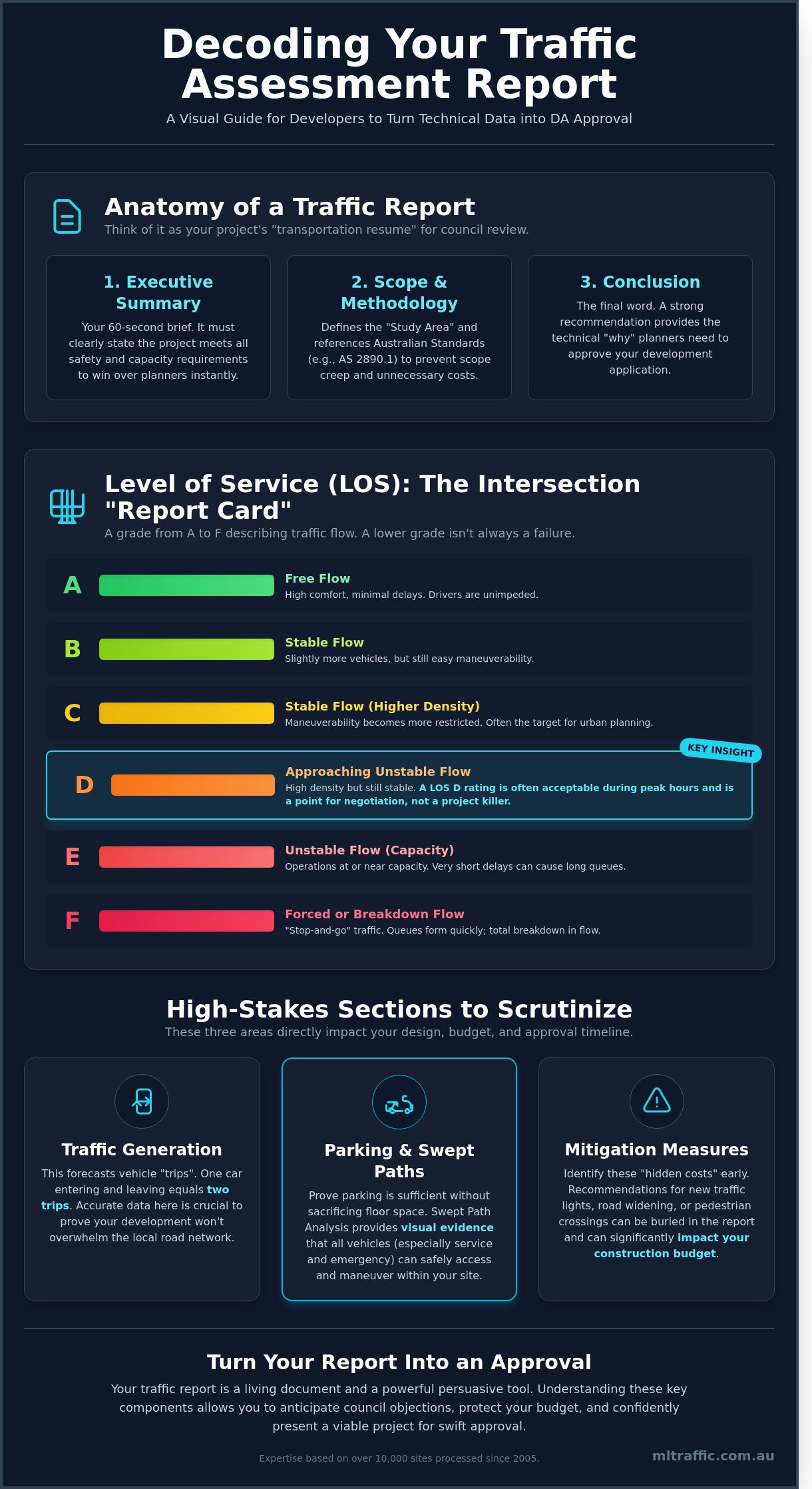
A Traffic Impact Assessment (TIA) is a technical bridge between your design and council’s infrastructure requirements. Think of it as your project’s transportation resume for council review. Understanding your traffic assessment report starts with recognizing that it isn’t just a stack of data. It’s a persuasive tool. Since 2005, ML Traffic Engineers has processed over 10,000 sites. We’ve seen how a well-structured report can bypass months of council delays.
To better understand this concept, watch this helpful video:
The Executive Summary: Your 60-Second Brief
Planners often review dozens of applications weekly. They usually read the summary first. If it doesn’t align with your primary development goals within 60 seconds, you’ve lost the room. This section must be punchy. It should highlight that the development meets all safety and capacity requirements. We ensure every summary we write provides a clear path to approval by focusing on the outcomes planners care about most.
Scope and Methodology: Setting the Ground Rules
Precision prevents scope creep. We define a "Study Area" to ensure council doesn’t ask for unnecessary upgrades three blocks away. This involves referencing Australian Standards like AS 2890.1 for parking and access. For developers, getting this right early is vital. You can find more about how we define these parameters on the ML Traffic’s services page. We use specific data to justify why certain intersections are included while others are omitted.
Every report establishes a baseline by analyzing existing conditions. We look at current traffic volumes and the Level of Service (LOS) of nearby intersections. If an intersection currently operates at LOS B, our job is to prove your 40-unit warehouse or 15-story apartment complex won’t degrade it to a failing grade. We compare this baseline against the proposed impact to show exactly how much "room" the local network has for your project.
The conclusion is where we silence objections. A strong recommendation section states that the proposal is supported on traffic engineering grounds. It provides the technical "why" that planners need for their own internal reports. This structure ensures your project moves from the desk to the construction site without unnecessary friction or expensive redesigns.
Decoding the Data: Traffic Generation and Level of Service (LOS)
Understanding your traffic assessment report starts with recognizing that engineers don’t just guess how many cars will enter your site. We use empirical data to forecast "trips." A trip is defined as a single one-way directional movement. If a customer drives into your retail center and later leaves, that counts as two trips. Since 2005, ML Traffic Engineers has analyzed over 10,000 sites, and we’ve found that precision in these early calculations saves developers significant capital on infrastructure contributions.
Level of Service: The "Report Card" for Roads
The Level of Service (LOS) is a qualitative measure used to describe operational conditions within a traffic stream. It’s graded from A to F. LOS A represents free-flow conditions where drivers have high physical and psychological comfort. Conversely, LOS F represents a total breakdown in flow, characterized by "stop-and-go" waves and extreme delays. While a "C" might seem mediocre in school, it’s often the target for urban planning.
In many jurisdictions, a LOS D is perfectly acceptable during peak hours. It indicates a high-density flow that’s still stable. If your report shows a local intersection moving from LOS C to LOS D because of your project, it’s a signal for negotiation rather than a project killer. We use this data to prove that while your development adds volume, it doesn’t "break" the existing network. You can see how these standards are applied by reviewing the official TIS manual for foundational analysis requirements.
Trip Generation: Quality Over Quantity
Distinguishing between daily trips and peak hour trips is vital for understanding your traffic assessment report. Council engineers care most about the "worst-case" peak hour, usually between 8:00 AM and 9:00 AM or 5:00 PM and 6:00 PM. Using the correct land-use code is the difference between a project being approved or stalled. For example, a 500sqm "Medical Centre" generates significantly more morning peak trips than a 500sqm "General Office."
-
Daily Trips: Total volume over 24 hours, used for noise and pavement wear assessments.
-
Peak Hour Trips: The highest volume of traffic in a 60-minute period, used for intersection capacity.
-
SIDRA Modelling: This software is our industry standard. It allows us to input your specific trip data to simulate how an intersection will perform five or ten years into the future.
Accurate trip generation prevents over-engineered road upgrades. If we can demonstrate that your specific business model generates 20% fewer trips than the standard RTA or Austroads averages, we can often reduce the scope of required roadworks. If you’re unsure about the land-use codes applied to your project, you can review our traffic consultancy services to see how we refine these estimates for council submissions.
Parking and Access: The High-Stakes Sections of Your Report
Parking and access are the two areas where a development application is most likely to hit a wall. When you are understanding your traffic assessment report, these sections dictate your project’s physical footprint and its ultimate profitability. You must prove you have enough spots to satisfy demand without sacrificing floor space that could be used for extra units or retail area. Mistakes here don’t just cause delays; they lead to expensive structural redesigns.
The Art of the Parking Justification
Your report includes a parking table comparing three specific figures: your proposed supply, the expected demand, and the Council’s requirement. If your supply is lower than the Council code, we use empirical evidence to bridge the gap. This involves using real-world data from similar land uses to prove that the rigid code doesn’t apply to your site. You can check ML Traffic’s about page to see how their 15+ years of parking expertise helps developers win these technical arguments through data-backed justification.
Swept Paths: When Diagrams Save Projects
Swept path analysis uses software like AutoTURN to provide visual proof that vehicles can move through your site. Whether it’s a B99 car or a Small Rigid Vehicle (SRV), these diagrams show the exact "envelope" the vehicle occupies while turning. If a diagram shows a "tight fit" with minimal clearance, expect a Request for Further Information (RFI) from the Council. High-quality swept paths act as proof of design excellence, showing the assessor that your layout works in reality, not just on a flat CAD drawing.
Beyond the parking spots, two technical details often trigger design revisions:
-
Driveway Gradients: These are checked against AS 2890.1 standards. If your ramp is too steep or lacks proper transitions, such as a 1:20 grade at the property line, cars will scrape their undersides. This is the most common reason developers are forced to redraw basement levels mid-assessment.
-
Sight Distance: This ensures drivers can see pedestrians before crossing the property line. We look for specific clear sight triangles, usually 2.0m by 2.5m, at the exit. Correcting this early is essential for understanding your traffic assessment report and mitigating future developer liability.
A well-prepared report doesn’t just list these numbers. It uses them to build a persuasive case that your development is safe, functional, and compliant with Australian Standards.
Reading Between the Lines: Spotting Red Flags and Opportunities
Don’t just flip to the final page of your traffic report to check for a "supported" conclusion. Success in development requires a deeper look at the technical nuances. When understanding your traffic assessment report, you’re looking for hidden costs and potential planning hurdles that could stall your project for months. Our experience across 10,000 sites shows that the most expensive mistakes are often buried in the fine print of the mitigation and impact sections.
Mitigation: The Cost of Approval
You must distinguish between "essential" upgrades and "negotiable" suggestions. Essential measures usually involve core safety or compliance with Australian Standards like AS 2890.1 for parking facilities. Negotiable items are often "wish-list" improvements, such as a council wanting you to upgrade a 50-metre stretch of footpath that isn’t directly impacted by your site. Every mitigation measure is a potential negotiation point with council. Read your Statement of Environmental Effects (SEE) alongside the traffic data. If the traffic report suggests a $60,000 intersection treatment but the SEE claims minimal impact, council planners will exploit that inconsistency to demand the higher spend.
The RFI Pre-emptor
A proactive report answers council’s questions before they’re asked. We’ve seen projects delayed by 45 to 90 days because a report lacked a simple Vehicle Swept Path Assessment for an 8.8m Medium Rigid Vehicle (MRV). Identifying these data gaps early prevents a Request for Information (RFI). Remember that a heavy report isn’t always a better report. A 20-page document with precise SIDRA modelling is far more effective than a 100-page report filled with generic census data. Quality technical analysis beats "fluff" every time when you’re understanding your traffic assessment report and its role in the approval process.
The "Cumulative Impact" trap is another common red flag. If three other developments are planned within a 400-metre radius, council may hold you responsible for the combined traffic increase. Your report needs to address these external factors head-on to ensure you aren’t footing the bill for someone else’s traffic volume.
Checklist: 5 things to look for before you submit:
-
Data Currency: Are the traffic counts less than 12 months old?
-
Vehicle Clearance: Does the swept path analysis use the correct vehicle size for your land use?
-
Sight-Lines: Is there a clear "Sight-Line Assessment" for the driveway exit?
-
Compliance: Does the report explicitly cite AS 2890.1 and the RTA Guide?
-
Warrants: Are proposed upgrades backed by data or just "suggested" by the engineer?
If your current report feels vague or identifies too many "necessary" upgrades, you need a second opinion from a seasoned expert. Review our full range of traffic engineering services to see how we streamline the approval process.
Conclusion: Turning Your Report into a DA Approval
Receiving your final draft is a major milestone, but it isn’t the finish line. A traffic report functions as a technical foundation that often evolves during the assessment process. Data from local planning authorities suggests that roughly 70% of medium-to-high impact developments receive at least one Request for Further Information (RFI) regarding transport and access. Because of this, understanding your traffic assessment report is about more than just reading the pages. It’s about knowing how those findings will be defended when a council officer scrutinizes the parking numbers or the vehicle swept paths.
At ML Traffic Engineers, we eliminate the communication gaps found in larger, bureaucratic firms. Our "the consultant who quotes, does the work" policy ensures that the engineer who analyzed your site is the same one who signs the report. This prevents the "knowledge loss" that occurs when a junior staffer writes the document and a senior director simply skims it before signing. When Michael Lee or Benny Chen handles your project, they own every data point. This accountability is what transforms a standard document into a successful DA approval.
The Value of Expert Advocacy
You need an engineer who acts as an advocate, not just a technical writer. If your project goes to a planning hearing or a council meeting, the report must hold up under intense pressure. Our principals bring over 35 years of individual experience to the table. This seniority allows us to challenge council interpretations of AS 2890.1 or local planning schemes with authority. We’ve worked on over 10,000 sites since 2005, which gives us the perspective needed to navigate even the most stubborn bureaucratic hurdles. A well-understood report, backed by a senior expert, is your strongest asset in any planning dispute.
Ready to Move Forward?
Review your current draft against the criteria we’ve covered in this guide. If you’re understanding your traffic assessment report but find the technical defense lacking, you might need a more robust approach. We provide direct access to our principals, ensuring your project isn’t handed off to an inexperienced graduate. Whether you’re developing a boutique apartment block, a new childcare center, or a large-scale industrial warehouse, our results-oriented approach gets projects moving.
If you require a second opinion on a current draft or need a comprehensive new assessment for a pending submission, we’re available to talk. Contact ML Traffic Engineers to discuss your project requirements with a principal engineer today.
Secure Your DA Approval with Expert Engineering
You now have the tools for understanding your traffic assessment report and its role in your project’s success. You’ve seen how report structure impacts clarity. You know why LOS data is the heartbeat of your submission. Accurate parking and access sections aren’t just technical details; they’re the difference between a smooth approval and a costly delay. Navigating these technicalities requires a partner who stays in the trenches with you. At ML Traffic Engineers, we’ve assessed over 10,000 sites across Australia since 2005. You won’t be handed off to a junior staffer here. When you call, you get direct access to senior engineers Michael Lee and Benny Chen. Our promise is simple: the consultant who provides your quote is the one who does the work. This hands-on approach ensures your specific site constraints are handled with over 30 years of technical expertise. Let’s get your development moving forward with total confidence. Get a Professional Traffic Assessment for Your DA. We’re ready to help you clear the final hurdle.
Frequently Asked Questions
What is the difference between a Traffic Impact Statement (TIS) and a Traffic Impact Assessment (TIA)?
A Traffic Impact Statement (TIS) is a concise report for minor developments, while a Traffic Impact Assessment (TIA) is a comprehensive study for large-scale projects. You’ll need a TIS for a small 8-unit apartment block. A TIA is mandatory for a 60-unit complex or a 3,000 square meter warehouse. The TIA uses SIDRA software to model intersection delays, providing the deep data councils demand for high-traffic sites.
How long is a traffic assessment report usually valid for council?
Most traffic reports remain valid for 12 months before councils consider the data outdated. Traffic patterns in Sydney and Melbourne shift by 3% to 5% annually, making old counts unreliable. If your report was finished in 2022, you’ll need a 2024 update. This usually involves a fresh site inspection and a "Letter of Reliance" to confirm the original traffic generation figures still hold true today.
Can I use a traffic report from a previous DA for a new application on the same site?
You can’t usually reuse a previous report because a new application changes the development’s intensity or land use. Even a small 10% increase in floor area changes the trip generation numbers. Understanding your traffic assessment report involves recognizing that 2024 planning codes are stricter than those from 2019. We recommend a technical review to align your old data with the current council development control plans.
What happens if my traffic report shows a "Level of Service F" for my intersection?
Level of Service (LoS) F means an intersection has failed and is operating at 100% capacity with delays over 70 seconds. It’s a red flag for council planners. If your report shows LoS F, you must propose mitigation like adding a 30-meter left-turn slip lane. We’ve helped developers navigate these "failed" grades by proving the development’s specific contribution to the delay is less than 5% of total volume.
Do I really need a swept path analysis for a small residential development?
You definitely need a swept path analysis for small residential projects to prove a B99 vehicle can turn safely. Council won’t approve a 3-unit site if the driveway doesn’t allow a car to enter and exit in a forward direction. We use AutoTURN software to simulate these movements. It’s better to spend $600 on an analysis now than to face a $15,000 driveway reconstruction later.
How much does a standard traffic assessment report cost in Australia?
A standard traffic assessment report in Australia generally costs between $2,800 and $5,200 for most private developments. Costs increase if you need 24-hour tube counts or complex SIDRA modeling for signalized intersections. At ML Traffic Engineers, the consultant who provides your quote is the senior engineer who does the work. This direct approach saves you from the 20% overhead markups charged by larger, multi-disciplinary firms.
What is AS 2890.1 and why is it mentioned in almost every traffic report?
AS 2890.1 is the mandatory Australian Standard for off-street car parking that defines every dimension of your parking layout. It specifies the 2.4-meter width for a standard space and the 1:20 maximum gradient for a disabled parking bay. Every report we write references this standard because it’s the legal benchmark for safety. If your ramp grade is 26% instead of the allowed 25%, council will reject your plans.
Can a traffic engineer help negotiate lower parking requirements with council?
Our traffic engineers regularly negotiate lower parking requirements by performing a Car Parking Demand Assessment. If your site is within 400 meters of a major bus interchange, we can argue for a 25% reduction in visitor spots. We’ve successfully lowered parking counts for over 1,000 projects by using empirical data. This saves you roughly $40,000 per basement spot that you no longer have to excavate.
Which areas do you cover?
We are traffic engineers servicing Melbourne, Sydney, Brisbane, Gold Coast, Hobart, Perth, Adelaide, Darwin, Canberra and surrounding areas.
Disclaimer
The content on www.mltraffic.com.au, including all technical articles, guides, and resources, is provided for general informational and educational purposes only. It is not intended to constitute professional advice in traffic engineering, transportation planning, development approvals, or any other technical or legal field.
While ML Traffic Engineers makes every reasonable effort to ensure the accuracy, completeness, and timeliness of the information published, we do not provide any warranties or representations (express or implied) regarding its reliability, suitability, or availability for any particular purpose. Any reliance you place on the content is strictly at your own risk.
In no event shall ML Traffic Engineers, its directors, employees, authors, or affiliates be liable for any direct, indirect, incidental, special, consequential, or punitive damages (including, without limitation, loss of profits, data, or business opportunities) arising out of or in connection with the use of, or inability to use, any information provided on this website.
The articles and guides on this site are not a substitute for engaging a qualified, registered professional traffic engineer (such as an NPER or RPEQ engineer) to assess your specific project requirements. For tailored advice, compliance assessments, or traffic engineering services, please contact a competent professional.
This disclaimer may be updated from time to time without notice. By accessing or using this website, you agree to be bound by the most current version of this disclaimer.
