

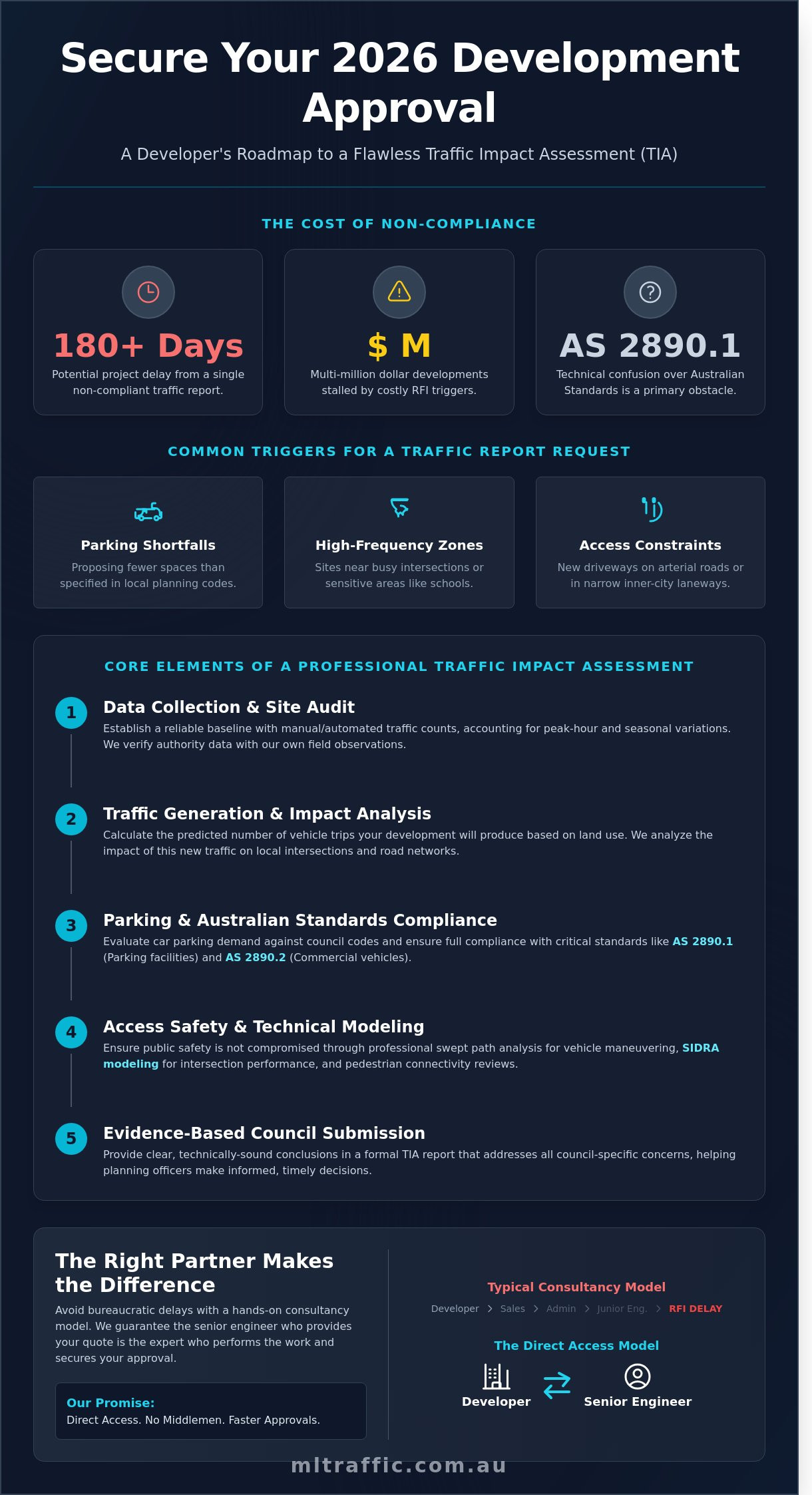
A single non-compliant traffic report can stall a multi-million dollar development application for over 180 days. When you are Undertaking Traffic and Car Parking Impact Assessments for council approval across Australia, even a minor deviation from AS 2890.1 or the relevant jurisdictional planning codes can trigger a costly Request for Information (RFI). Most developers agree that council delays and technical confusion over Australian Standards are the primary obstacles to breaking ground on time. It’s frustrating to see your project timeline slip because of a report that fails to address specific bureaucratic requirements.
This guide provides a comprehensive technical roadmap for developers to secure DA approval without traffic-related setbacks in 2026. You will gain a clear understanding of the TIA process and learn how to avoid the unexpected costs associated with non-compliant documentation. We’ll examine the critical steps for successful council responses and explain why direct access to the senior engineer who performs the work is the most reliable path to a successful outcome. By following this professional framework, you can ensure your submission meets every regulatory hurdle the first time.
Key Takeaways
-
Learn how to navigate the Request for Further Information (RFI) process by defining the specific technical requirements of a formal Traffic Impact Assessment (TIA).
-
Identify core TIA components, such as calculating traffic generation rates and analyzing existing road conditions to meet Australian planning authority requirements.
-
Master the complexities of Undertaking Traffic and Car Parking Impact Assessments in Adelaide City Council while ensuring full compliance with Australian Standards (AS 2890.1).
-
Follow a practical step-by-step guide to preparing your engineering submission, from initial site audits to addressing specific council technical objections.
-
Understand the advantage of a hands-on consultancy model where senior engineers personally manage your project from the initial quote to final approval.
Table of Contents
-
What to Do When Your Local Council Requests a Traffic Report
-
Core Elements of a Professional Traffic Impact Assessment (TIA)
-
Evaluating Car Parking Demand and Australian Standards Compliance
-
A Step-by-Step Guide to Preparing Your Traffic Engineering Submission
-
Securing Planning Approval with Expert Traffic Engineering Consultants
What to Do When Your Local Council Requests a Traffic Report
Receiving a Request for Further Information (RFI) is a standard part of the Development Application (DA) process in South Australia. It shouldn’t cause alarm. It simply means the planning authority requires more technical data to make an informed decision. A Traffic Impact Assessment (TIA) is the formal document used to provide this data. It’s a technical report that evaluates how your proposal affects the local transport network. Undertaking Traffic and Car Parking Impact Assessments in Adelaide City Council ensures that your project complies with the Planning and Design Code and relevant Australian Standards like AS 2890.1.
Adelaide City Council prioritizes traffic safety and parking availability due to increasing urban density. They won’t approve projects that risk pedestrian safety or create unmanageable congestion. Submitting a self-prepared statement or an inadequate report is a significant risk. These documents often lack the required technical depth, such as SIDRA intersection modeling or professional swept path analysis. Planning officers will likely reject informal letters, leading to immediate delays. Undertaking Traffic and Car Parking Impact Assessments in Adelaide City Council is a specialized task that requires local expertise to ensure all council-specific concerns are addressed.
Common Triggers for a Traffic Assessment Request
Certain factors almost always trigger a demand for professional traffic engineering services. Land-use changes are a primary driver. For example, converting a 500-square-meter warehouse into a high-intensity gym significantly increases trip generation. Other common triggers include:
-
Parking Shortfalls: Proposing fewer parking spaces than the minimum rates specified in the local planning scheme.
-
High-Frequency Zones: Sites located near busy intersections or within 50 meters of sensitive areas like school crossings.
-
Access Constraints: New driveway crossovers on major arterial roads or narrow inner-city laneways.
The Consequences of Non-Compliant Submissions
Submitting a report that doesn’t meet council standards leads to project stagnation. Each round of RFI responses can add 4 to 8 weeks to your timeline. This delay impacts your holding costs and construction schedules. You might also face increased expenses if you’re forced to redesign basement access or ramp grades late in the planning stage. In the worst cases, the council may refuse the application entirely based on unresolved safety or congestion concerns. Professional consultants mitigate these risks by providing compliant documentation the first time. We ensure the consultant who provides your quote is the one who does the work.
Core Elements of a Professional Traffic Impact Assessment (TIA)
A professional TIA provides a technical blueprint for how a proposed development interacts with the existing transport network. When Undertaking Traffic and Car Parking Impact Assessments in Adelaide City Council, we first analyze existing road conditions and identify current traffic volume data. This baseline is essential for calculating traffic generation based on established industry rates and specific land-use types. Every assessment ensures all data aligns with current Australian Standards for traffic engineering, specifically AS 2890.1 for parking facilities and AS 2890.2 for commercial vehicles.
Our process involves determining traffic distribution and how new trips impact local intersections. We evaluate site access safety and pedestrian connectivity requirements to ensure the proposal doesn’t compromise public safety. We provide clear, evidence-based conclusions that help council planning officers make informed decisions.
Data Collection and Traffic Surveys
Accurate assessments rely on robust data. We use a combination of manual and automated traffic counts to establish a reliable baseline. These surveys account for peak-hour fluctuations and seasonal traffic variations to ensure the model reflects real-world conditions. Traffic generation is the predicted number of vehicle trips a site will produce. We verify the accuracy of historical data provided by local authorities against our own field observations to eliminate discrepancies. This meticulous approach ensures the foundation of the report is technically sound.
Intersection and Network Analysis
We utilize SIDRA software to model intersection performance and determine the Level of Service (LoS). This analysis identifies the spare capacity of the surrounding road network and predicts how the development will alter delay times and queue lengths. By following the Austroads Guide to Traffic Management Part 12, we ensure the assessment meets national engineering benchmarks. If the modeling shows a significant drop in performance, we identify necessary infrastructure upgrades to mitigate the development’s impact on the community.
Vehicle Swept Path Analysis
Ensuring functional site access is a primary concern for council reviewers. We use AutoTURN software to perform vehicle swept path analysis, demonstrating that vehicles can maneuver safely within the site. This is particularly important for ensuring waste collection and delivery vehicles can access loading bays without mounting kerbs or requiring multi-point turns in dangerous locations. We address specific council concerns regarding tight turns or narrow access ways through precise digital simulations. You can learn more about our swept path analysis services to see how we resolve complex access issues. If you need a reliable assessment for your project, speak with our principals today for a direct technical consultation.
Evaluating Car Parking Demand and Australian Standards Compliance
Undertaking Traffic and Car Parking Impact Assessments in Adelaide City Council requires a precise calculation of statutory parking requirements defined by the South Australian Planning and Design Code. Each land use, from high-density residential towers to boutique retail spaces, carries a specific parking rate. We calculate the minimum number of spaces required by law before evaluating if the site’s unique characteristics justify a reduction. Our traffic engineering services ensure that every assessment remains grounded in technical accuracy and local policy requirements.
Parking Demand vs. Statutory Requirements
Statutory rates don’t always reflect real-world usage. A medical centre in North Adelaide has different peak accumulation patterns than a retail outlet in the CBD. We analyse peak parking demand by looking at the specific operational hours and user profiles of the development. If a site is within 200 metres of a high-frequency public transport corridor, such as the O-Bahn or the Glenelg tram line, the Code often permits a reduction in car parking provision. We provide empirical evidence from similar sites to support parking waivers, ensuring the council receives a data-backed justification rather than an estimate.
Technical Design and Ramp Grades
Physical car park layouts must strictly comply with AS 2890.1:2004 standards to ensure safety and functionality. Our assessments scrutinise every technical detail, including:
-
Aisle Widths: Ensuring sufficient space for two-way traffic and B85 vehicle manoeuvring.
-
Blind-Aisle Extensions: Providing the mandatory 1-metre extension to allow vehicles to turn around safely.
-
Ramp Grades: Assessing driveway gradients to prevent vehicle scraping. This typically involves a maximum 1:20 grade for the first 6 metres at the property boundary to maintain sight-lines.
-
Sight-Line Requirements: Verifying that exiting drivers have a clear view of pedestrians and oncoming traffic at the property line.
Beyond standard vehicle bays, we address the specific needs of accessible parking under AS 2890.6. This includes calculating the required number of disabled bays and ensuring the vertical clearance meets the 2.5-metre minimum. Bicycle facilities are also a core component of Undertaking Traffic and Car Parking Impact Assessments in Adelaide City Council. We calculate the necessary secure bike storage and end-of-trip facilities based on the total floor area or staff numbers, promoting sustainable transport options within the urban core. Our focus is on providing a compliant, efficient design that eliminates the risk of costly redesigns during the council’s RFI (Request for Further Information) stage.
A Step-by-Step Guide to Preparing Your Traffic Engineering Submission
Successful development applications in South Australia require a methodical approach to technical documentation. When Undertaking Traffic and Car Parking Impact Assessments in Adelaide City Council, you must follow a structured workflow to satisfy both local planners and the Department for Infrastructure and Transport. This process ensures your project meets the safety and capacity requirements of the Adelaide (City) Development Plan.
-
Step 1: Review the Council RFI. Carefully examine the Request for Further Information to identify specific technical concerns. Council often flags issues regarding intersection capacity or parking shortfalls that require immediate attention.
-
Step 2: Site Audit. Engage a qualified traffic engineer to conduct a preliminary site audit. This involves checking sight-line compliance and existing road conditions to identify potential constraints early.
-
Step 3: Data and Modelling. Perform required traffic counts and swept path simulations. Use industry-standard software to demonstrate that delivery vehicles and residents can enter and exit the site in a forward direction.
-
Step 4: Draft the TIA Report. Prepare the Traffic Impact Assessment by addressing each council point with technical evidence. Ensure all designs adhere to Australian Standard AS 2890.1 for parking facilities.
-
Step 5: Final Submission. Submit the certified report as part of your amended DA. A professional report reduces the likelihood of secondary RFIs and speeds up the approval timeline.
Engaging the Right Traffic Consultant
Prioritise consultants who offer direct access to the principal engineer rather than junior staff. It’s vital to verify the consultant’s experience with your specific land-use category, as a medical centre has different parking requirements than a warehouse. Ensure your quote includes all necessary SIDRA modelling and ongoing council liaison. The traffic consultant who provides the quote should be the one performing the technical work.
Liaising with Council Planning Officers
Pre-lodgement meetings are a valuable tool for clarifying traffic expectations before you commit to a final design. These discussions allow you to negotiate realistic mitigation measures for identified impacts, such as modified driveway placements or specific signage. If community objections arise regarding parking, your engineer must provide data-driven responses to address local concerns. Reports should be formatted for easy review by council engineers, featuring clear diagrams and concise summaries of compliance with the Planning and Design Code. This professional transparency builds trust with decision-makers and facilitates a smoother assessment process.
If you need expert assistance Undertaking Traffic and Car Parking Impact Assessments in Adelaide City Council, our principals are ready to help. Contact our senior engineers to discuss your project requirements today.
Securing Planning Approval with Expert Traffic Engineering Consultants
Securing development approval in a high-density environment like Adelaide requires technical precision and deep regulatory knowledge. ML Traffic Engineers Australia has been trading since 2005, providing the high-level expertise necessary for complex urban projects. This 19-year history is critical when Undertaking Traffic and Car Parking Impact Assessments in Adelaide City Council, as senior engineers understand the specific nuances of the local Planning and Design Code. Experience allows a consultant to anticipate council concerns before they become formal objections, saving developers time and capital.
We operate with a hands-on philosophy: the traffic consultant who provides your quote is the same senior engineer who performs the technical work. This direct accountability ensures that complex data, such as Vehicle Swept Path Assessments or driveway ramp grades, is handled by experts rather than junior staff. Professional, data-backed reports are the best defense against project delays. They significantly reduce the risk of costly Land and Environment Court appeals by ensuring every design element meets Australian Standards, specifically AS 2890.1 for off-street car parking. We ensure your development meets all national safety and compliance benchmarks from the initial submission.
The ML Traffic Engineers Australia Advantage
-
Direct Accountability: You maintain a direct line to senior engineers Michael Lee or Benny Chen. There are no gatekeepers or middle management.
-
Proven Track Record: Our firm has completed over 10,000 successful site assessments across a vast range of land uses, including apartments, medical centres, childcare facilities, and industrial warehouses.
-
Comprehensive Technical Services: We provide everything from Traffic Impact Statement (TIS) reports and Car Parking Demand Assessments to detailed Construction Traffic Management Plans (CTMP).
Next Steps for Your Development
If you have received a Request for Further Information (RFI) from the council, you need a fast, technical response to keep your project on schedule. We specialize in providing clear, authoritative documentation that addresses council queries directly. To begin the process, prepare your site plans and any council correspondence for a seamless engineering review. You can Contact our senior traffic engineers to discuss your council RFI and obtain a formal quote. Undertaking Traffic and Car Parking Impact Assessments in Adelaide City Council doesn’t have to be a bottleneck in your development timeline when you have senior experts managing the technical requirements.
Secure Your Development Approval with Technical Precision
Navigating the 2026 planning landscape requires technical precision and a firm understanding of Australian Standards. Successful development applications depend on accurate data and professional reporting that meets the specific expectations of local authorities. When Undertaking Traffic and Car Parking Impact Assessments in Adelaide City Council, you need a partner who understands the nuances of AS 2890.1 compliance and parking demand evaluations. ML Traffic Engineers brings the experience of over 10,000 site assessments across Australia to your project. We’ve been trading since 2005 and understand the technical requirements of every major council. You won’t deal with junior staff or gatekeepers. Every report involves senior staff; you’ll have direct access to our principal engineers, Michael Lee and Benny Chen. We operate on a simple principle: the consultant who provides your quote is the one who performs the work. This ensures accountability and technical accuracy for your submission. Secure the expert support your project requires to move forward without unnecessary delays. We’re ready to help you meet your deadlines and achieve a positive planning outcome.
Get a Professional Quote for Your Council Traffic Report
Frequently Asked Questions
What is the difference between a Traffic Impact Statement and a full TIA?
A Traffic Impact Statement (TIS) is a concise report for smaller developments with low traffic generation, whereas a full Traffic Impact Assessment (TIA) is a comprehensive study for larger projects. TIS focuses on basic access and parking. TIA involves detailed intersection modeling using SIDRA software and long-term network impact analysis. Adelaide City Council typically requires a TIA for developments exceeding 50 daily vehicle trips or significant floor area increases.
How much does a council-requested traffic report typically cost?
Professional fees for a traffic report in South Australia vary based on project complexity, but basic assessments often start from A$2,000 for simple residential subdivisions. More complex commercial TIAs involving extensive data collection and SIDRA analysis can exceed A$10,000. These costs represent the technical engineering time required to ensure compliance with the Planning and Design Code and Australian Standard AS 2890.1.
Can I use a traffic report from a previous application for a new project?
You cannot typically reuse an old report because traffic data and planning regulations change frequently. Adelaide City Council generally requires traffic counts to be less than 2 years old to be considered valid. If the development scope or the local road network has changed since the original report, a new assessment is mandatory. Undertaking Traffic and Car Parking Impact Assessments in Adelaide City Council requires current data to reflect existing site conditions accurately.
What happens if my development cannot meet the council’s parking requirements?
You must provide a Car Parking Demand Assessment to justify a parking shortfall. This involves using empirical data from similar land uses or the ITE Trip Generation Manual to prove that actual demand is lower than the Planning and Design Code rates. If the shortfall is justified, the council may accept a lower provision or require a financial contribution to the Off-street Car Parking Development Fund, currently applied to specific zones within the City of Adelaide.
How long does it take to prepare a compliant Traffic Impact Assessment?
A compliant TIA usually takes 2 to 4 weeks to complete from the date of engagement. This timeframe accounts for 7 days of traffic data collection, engineering analysis, and report drafting. Complex projects requiring consultation with the Department for Infrastructure and Transport (DIT) or detailed swept path analysis for heavy vehicles can extend this period to 6 weeks or more.
Is a swept path analysis always required for a multi-deck car park?
Yes, a swept path analysis is mandatory for all multi-deck car park designs to verify compliance with AS 2890.1. We use CAD-based software like AutoTURN to simulate the movement of a B85 or B99 design vehicle through ramps, tight turns, and parking bays. This ensures that vehicles can navigate the structure without colliding with columns or walls, which is a critical requirement for council approval.
What are the most common reasons councils reject a traffic report?
Rejections often stem from using outdated traffic data or failing to address the specific requirements of the Planning and Design Code. Other common issues include non-compliant driveway gradients, insufficient sight distances at access points, or incorrect vehicle turn simulations. Undertaking Traffic and Car Parking Impact Assessments in Adelaide City Council requires meticulous attention to detail to ensure every technical parameter meets current South Australian transport standards.
Which areas do you cover?
We are traffic engineers servicing Adelaide City Centre and North Adelaide.
Disclaimer
The content on www.mltraffic.com.au, including all technical articles, guides, and resources, is provided for general informational and educational purposes only. It is not intended to constitute professional advice in traffic engineering, transportation planning, development approvals, or any other technical or legal field.
While ML Traffic Engineers makes every reasonable effort to ensure the accuracy, completeness, and timeliness of the information published, we do not provide any warranties or representations (express or implied) regarding its reliability, suitability, or availability for any particular purpose. Any reliance you place on the content is strictly at your own risk.
In no event shall ML Traffic Engineers, its directors, employees, authors, or affiliates be liable for any direct, indirect, incidental, special, consequential, or punitive damages (including, without limitation, loss of profits, data, or business opportunities) arising out of or in connection with the use of, or inability to use, any information provided on this website.
The articles and guides on this site are not a substitute for engaging a qualified, registered professional traffic engineer (such as an NPER or RPEQ engineer) to assess your specific project requirements. For tailored advice, compliance assessments, or traffic engineering services, please contact a competent professional.
This disclaimer may be updated from time to time without notice. By accessing or using this website, you agree to be bound by the most current version of this disclaimer.
