

A single Request for Further Information (RFI) from your local planning authority can stall your development for 60 days or more, often due to avoidable technical oversights in site access or parking design. You likely recognize that navigating the intersection of local planning schemes and Australian Standards is the most frequent bottleneck in the Development Application (DA) process. Undertaking Traffic and Car Parking Impact Assessments requires more than just a basic layout; it demands technical precision to meet AS 2890.1 requirements from the start.
This guide explains how to leverage professional traffic engineering to mitigate project risks, ensure full compliance, and streamline your approval timeline. You’ll learn how to determine whether your project requires a comprehensive Traffic Impact Assessment (TIA) or a simpler Traffic Impact Statement (TIS). We provide a clear roadmap for your planning approval, including strategies to minimize construction costs through optimized car park design and site access. At ML Traffic Engineers Australia, we ensure the expert who provides your quote is the one doing the work, giving you direct access to decades of technical expertise and a reliable path to project commencement.
Key Takeaways
-
Learn how a Traffic Impact Assessment (TIA) acts as a strategic de-risking tool by identifying access and parking constraints before they become permanent structural issues.
-
Understand the specific triggers and local planning controls required when Undertaking Traffic and Car Parking Impact Assessments in Adelaide Hills Council to streamline your approval.
-
Discover how technical compliance with AS 2890 and software-led Swept Path Analysis can eliminate design errors and ensure site safety for all vehicle types.
-
Follow a professional step-by-step methodology for scoping and data collection that aligns with council expectations and Australian Standards.
-
Benefit from the ML Traffic Engineers Australia promise: work directly with a senior consultant who manages your project from the initial quote to final technical delivery.
Table of Contents
-
The Strategic Role of Traffic and Car Parking Impact Assessments in Property Development
-
Undertaking Traffic and Car Parking Impact Assessments in Adelaide Hills Council: Key Requirements
-
De-risking Through Compliance: AS 2890 and Swept Path Analysis
-
The Step-by-Step Process for a Successful Traffic Assessment
The Strategic Role of Traffic and Car Parking Impact Assessments in Property Development
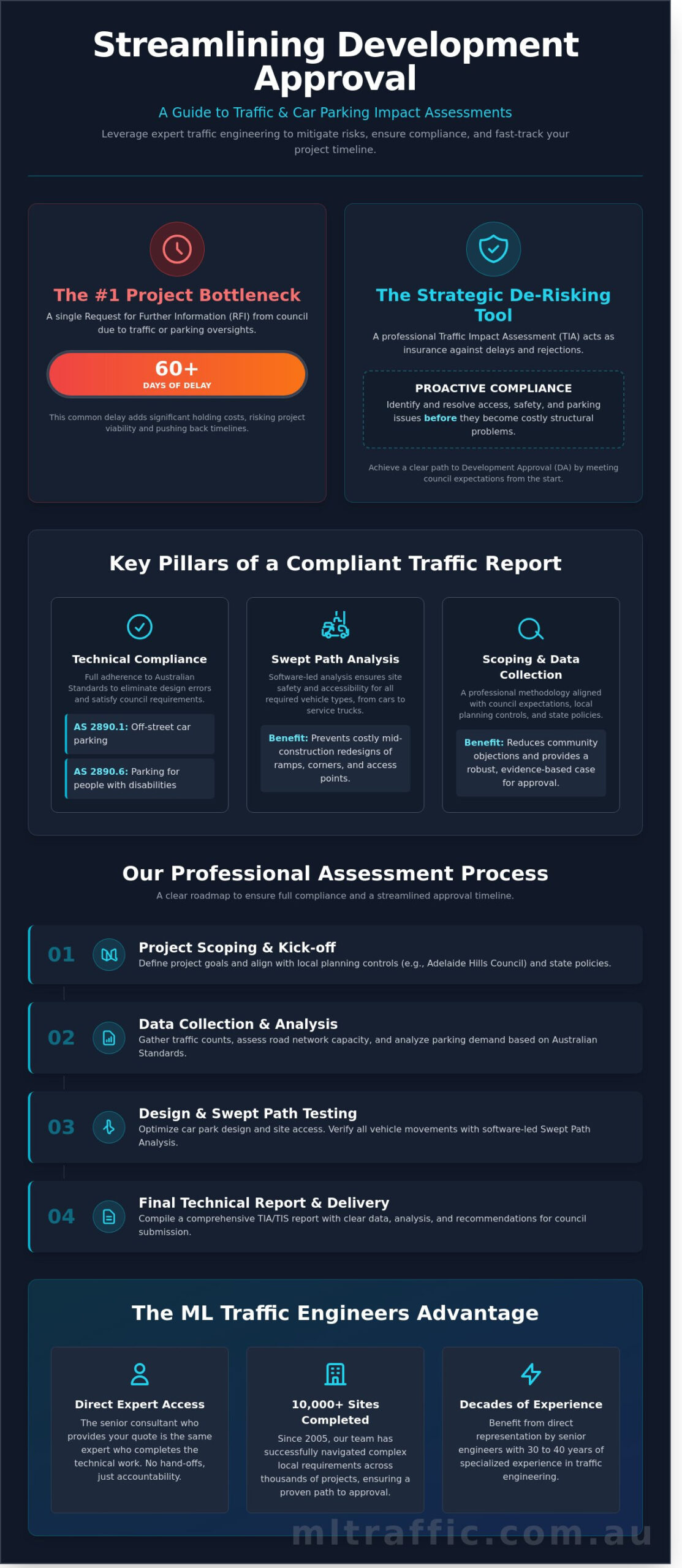
A Traffic Impact Assessment (TIA) is a technical analysis that evaluates how a proposed development influences the surrounding transport network. It’s a critical component for any developer undertaking Traffic and Car Parking Impact Assessments in Adelaide Hills Council. The primary objective is de-risking the project. By identifying access, safety, and parking issues before they become permanent structural constraints, developers avoid costly mid-construction redesigns. An inadequate report often triggers a Request for Further Information (RFI) from the council. In the South Australian planning system, these delays frequently stall projects for 30 to 60 days, adding significant holding costs. At ML Traffic Engineers, every project benefits from direct access to senior principals. This ensures that the consultant who provides your quote is the same expert performing the technical work, maintaining accountability throughout the application process.
Moving Beyond Compliance: Why Traffic Reports Matter
Traffic engineering is the application of scientific principles to move people and goods safely. It’s not just a box-ticking exercise for council approval. Professional traffic engineering directly influences site yield and commercial viability. If parking layouts are inefficient, you lose valuable floor area. If traffic flow is congested, it degrades the user experience for future tenants and customers. When undertaking Traffic and Car Parking Impact Assessments in Adelaide Hills Council, specific attention must be paid to the region’s unique topography and road geometry. We analyze vehicle swept paths and sight-line requirements to ensure the design works in practice, not just on paper. This level of detail protects the long-term value of the asset.
The Financial Risk of DA Rejection
Holding costs in the current Australian market are a major threat to project margins. With interest rates remaining high, a three-month delay on a multi-million dollar development can cost tens of thousands of dollars in interest alone. A professional Traffic Impact Assessment acts as insurance against council refusals and protracted appeals. Engaging a consultant during the concept phase is a strategic move. It allows for the adjustment of driveway ramp grades and parking numbers before the plans are finalized, saving money on architectural revisions. Our team has completed over 10,000 sites since 2005, providing the experience needed to navigate complex local requirements. Using data-driven reports reduces the likelihood of community objections and provides a clear path to Development Approval (DA).
-
Site Yield: Optimizing parking layouts to maximize usable development space.
-
RFI Prevention: Providing comprehensive data to stop council delays before they start.
-
Safety Compliance: Ensuring all access points meet Australian Standards (AS 2890.1).
-
Expert Advocacy: Direct representation from senior engineers with 30 to 40 years of experience.
Undertaking Traffic and Car Parking Impact Assessments in Adelaide Hills Council: Key Requirements
Undertaking Traffic and Car Parking Impact Assessments in Adelaide Hills Council requires a dual focus on the South Australian Planning and Design Code and the specific geographical constraints of the region. All development applications must align with the Adelaide Hills Council development requirements to ensure that new infrastructure doesn’t compromise road safety or local amenity. Our assessments are anchored in national engineering standards, specifically AS 2890.1 for off-street car parking and AS 2890.6 for off-street parking for people with disabilities.
Planning controls follow a clear hierarchy. State-level policies provide the baseline for parking ratios and traffic volumes, but local overlays often dictate stricter requirements for bushfire access and steep driveway gradients. We address both on-site parking supply and off-site traffic generation. It’s not enough to simply provide enough bays; the development must also demonstrate that the surrounding road network can absorb the additional trip load without dropping the Level of Service (LoS) at key intersections.
Common Triggers for a Formal Traffic Report
Council planners trigger the requirement for a formal traffic report based on the intensity of the proposed land use. Common developments requiring detailed documentation include:
-
Child Care Centres: Typically those with 40 or more places or located on collector roads.
-
Medical and Allied Health: Facilities with 3 or more practitioners operating simultaneously.
-
Multi-Deck and High-Density Housing: Residential projects exceeding 5 dwellings on a single title.
-
Commercial Expansions: Any change of use that increases the floor area by more than 15% in high-traffic zones.
The "Threshold" concept is the primary determinant for the depth of the study. If a project is estimated to generate fewer than 30 peak-hour vehicle trips, a Traffic Impact Statement (TIS) usually suffices. This is a concise document focusing on parking provision and basic access. If the 30-trip threshold is exceeded, a full Traffic Impact Assessment (TIA) is mandatory. This requires detailed intersection analysis, often using SIDRA modelling, to prove the local network can handle the surge.
Navigating Local Council Expectations
Council engineers review private submissions with a focus on long-term public liability and road safety. Generic reports that use standard trip generation rates without local context often face immediate rejection. In the Adelaide Hills, factors like narrow carriage-ways and limited sight-lines due to topography mean that "average" data doesn’t apply. We use site-specific data collection to ensure the analysis reflects real-world conditions.
A compliant traffic report must bridge the gap between developer goals and the public interest of road safety.
When preparing your application, it’s vital to consider vehicle swept path analysis. Council staff look for evidence that waste collection vehicles and emergency services can enter and exit the site in a forward direction. If your project involves complex access points, our team can assist with professional traffic engineering services to ensure your design meets all regulatory hurdles before submission.
De-risking Through Compliance: AS 2890 and Swept Path Analysis
Compliance with Australian Standards isn’t a suggestion; it’s a legal and functional safeguard. When Undertaking Traffic and Car Parking Impact Assessments in Adelaide Hills Council, we strictly adhere to AS 2890.1 for off-street car parking and AS 2890.2 for commercial vehicle facilities. These standards dictate everything from bay dimensions to ramp grades. Failing to meet these specifications creates "static design" risks. This occurs when a parking layout looks functional on a 2D plan but proves unusable in the real world. A bay might meet the minimum width, but if a structural pillar obstructs the door opening or the aisle is too narrow for a three-point turn, the design is flawed. Ensuring AS 2890.1 compliance protects developers from post-construction litigation and costly retrofits.
Our engineers use AutoTURN software to eliminate guesswork. This software simulates the physical movement of vehicles to ensure they can navigate the site safely. Without this digital verification, developers risk building driveways that scrape the undercarriage of standard cars or loading docks that heavy rigid vehicles (HRVs) cannot access. In the Adelaide Hills, where topography is often steep and roads are narrow, these simulations are vital for project viability.
The Critical Nature of Swept Path Analysis
The "swept path" is the total envelope of space a vehicle occupies while negotiating a turn. It’s wider than the vehicle itself. Adelaide Hills Council frequently demands swept path diagrams to prove that waste collection trucks and emergency vehicles can enter and exit the site in a forward direction. Tight turns are the primary cause of site failure. If a 12.5-metre heavy rigid vehicle cannot clear a corner without mounting a kerb or hitting a wall, the site’s logistics are compromised. We provide detailed diagrams showing the wheel paths and body overhangs for the largest expected vehicles. This transparency speeds up the RFI (Request for Further Information) process during the development application.
Car Parking Demand vs. Council Requirements
There is often a gap between statutory requirements and actual demand. The Planning and Design Code sets a baseline for the number of spots required based on land use. However, Undertaking Traffic and Car Parking Impact Assessments in Adelaide Hills Council often involves justifying a reduction in these numbers. We use empirical data and local surveys to argue for departures from standard rates. Key factors include:
-
Proximity to high-frequency public transport corridors.
-
Shared parking arrangements between businesses with different peak operating hours.
-
Specific business models that generate lower visitor rates than the generic code assumes.
-
Availability of on-street parking within a 200-metre walking distance.
Our consultants provide the technical justification needed to convince council planners that a project won’t cause overspill parking issues in the surrounding neighborhood. This evidence-based approach prevents projects from being burdened by the high costs of unnecessary basement excavation or excessive hardstand areas.
The Step-by-Step Process for a Successful Traffic Assessment
Undertaking Traffic and Car Parking Impact Assessments in Adelaide Hills Council requires a methodical approach to satisfy both the Planning and Design Code and local engineering requirements. The process is broken down into five critical stages to ensure a seamless Development Application (DA) submission. It’s a technical workflow that leaves no room for guesswork.
-
Step 1: Scoping and Consultation. We define the study parameters with the client and council staff. This ensures the assessment focuses on the correct intersections and timeframes before the work begins.
-
Step 2: Data Collection. Our team conducts physical traffic counts, parking occupancy surveys, and site observations to gather real-world evidence.
-
Step 3: Technical Analysis. We calculate trip generation based on established rates, determine trip distribution across the local network, and model intersection performance.
-
Step 4: Design Review. We verify that driveway grades, sight lines, and internal parking layouts comply with Australian Standards, specifically AS 2890.1.
-
Step 5: Reporting. We consolidate all findings into a professional document ready for council review.
Data Collection and Site Investigation
Desktop studies are rarely sufficient for a robust traffic report. Relying solely on historical maps or digital data misses critical site-specific factors like local topography, vegetation affecting sight lines, or recent changes in local road usage. We prioritize peak-hour analysis because it identifies the worst-case scenario for traffic impact. This is essential for developments near high-traffic areas like Mount Barker Road or Stirling’s main street. We blend historical data from the Department for Infrastructure and Transport (DIT) with our own current counts. This allows us to project traffic volumes 10 years into the future with high precision. It’s this level of detail that ensures Undertaking Traffic and Car Parking Impact Assessments in Adelaide Hills Council stands up to rigorous scrutiny.
Technical Analysis and Reporting Standards
Our engineers utilize SIDRA Intersection software to perform detailed capacity analysis. This tool measures delay, queue lengths, and the level of service (LoS) at critical junctions. A professional report follows a structured format, starting with an executive summary and concluding with technical appendices. Every technical claim in a traffic report must be supported by verifiable data or recognized industry guidelines. This level of detail is what differentiates a successful application from one that faces delays or requests for further information (RFI). We don’t just provide opinions; we provide data-driven solutions that meet the specific needs of the Adelaide Hills region.
If you need expert assistance with your project, contact our senior traffic engineers for a direct quote and professional advice.
Why Expert Engineering is the Ultimate De-risking Strategy
Undertaking Traffic and Car Parking Impact Assessments in Adelaide Hills Council shouldn’t be a gamble. At ML Traffic Engineers, we operate on a foundational promise: the traffic consultant who provides the quote, does the work. This eliminates the disconnect often found in larger, junior-heavy firms where the person you meet isn’t the one performing the technical analysis. When the principal engineer is the one drafting the report, the risk of technical oversight drops significantly.
Our track record spans 15 years and over 10,000 sites across Australia. This volume of experience translates directly into faster approvals. We understand the specific nuances of the Adelaide Hills Council’s requirements, from steep driveway gradients to bushfire access constraints. By leveraging this deep-seated expertise, we identify potential roadblocks before they become costly delays. Developers should view their traffic engineer as a partner in project viability. We don’t just provide data; we provide the technical justification needed to secure your development’s future.
-
Direct accountability from start to finish.
-
Meticulous compliance with Australian Standards like AS 2890.1.
-
Proactive identification of Council concerns.
-
Technical reports designed to withstand rigorous scrutiny.
The Value of Hands-On Accountability
Technical errors and communication breakdowns frequently occur when projects are handed off to inexperienced graduates. We avoid this by ensuring senior staff involvement in every project phase. Clients get direct access to principals Michael Lee and Benny Chen. This "no-gatekeepers" approach ensures project continuity and technical precision. For specialized engineering needs, view our comprehensive list of services. We cover everything from Vehicle Swept Path Assessments to Sight-Line Assessments with senior-level oversight.
Secure Your Project Approval Today
Don’t leave your DA to chance with a generic traffic report. Getting it right the first time is essential to avoid the "RFI cycle" where the Council requests further information, stalling your timeline by months. Undertaking Traffic and Car Parking Impact Assessments in Adelaide Hills Council requires a meticulous approach that aligns with local planning schemes. Contact ML Traffic Engineers for a direct quote and expert consultation. We provide the technical certainty needed to move your development forward without unnecessary delays.
Accelerate Your Adelaide Hills Development Approval
Navigating the planning requirements for the Adelaide Hills region requires technical precision and a deep understanding of local council expectations. Successful projects depend on rigorous compliance with AS 2890 standards and accurate swept path analysis to prove vehicle accessibility. Undertaking Traffic and Car Parking Impact Assessments in Adelaide Hills Council isn’t just a regulatory hurdle; it’s a strategic move to de-risk your investment and prevent expensive design revisions. Technical accuracy at the start of the process prevents costly delays during the RFI stage.
ML Traffic Engineers brings over 15 years of industry experience to your project. We’ve assessed over 10,000 sites across Australia, ensuring every development application meets strict engineering criteria. You’ll work directly with a principal engineer on every project. The traffic consultant who provides your quote is the one performing the technical work. This direct accountability eliminates communication gaps and ensures your assessment is handled with professional meticulousness and authoritative expertise.
Get a professional quote for your Traffic Impact Assessment today
Your development deserves the certainty that comes from seasoned expertise and a proven track record of success.
Frequently Asked Questions
Is a Traffic Impact Assessment mandatory for all developments?
It isn’t mandatory for every project. Adelaide Hills Council triggers this requirement based on land use, scale, and the potential impact on the existing road network. Small residential additions often bypass this step. Most commercial, industrial, or high-density residential developments must submit a report to demonstrate compliance with the Planning and Design Code. We determine the necessity of a report by reviewing your specific site plans.
Can I use a general civil engineer for my traffic report?
You can, but it’s not recommended for complex applications. Council planners prefer reports from specialist traffic engineers who possess deep knowledge of AS 2890.1 and specific modelling software. Generalists often lack the equipment for precise Vehicle Swept Path Assessments. At ML Traffic Engineers, the consultant who provides your quote is the expert who performs the work, ensuring technical accountability throughout the process.
How much does a Traffic and Car Parking Impact Assessment cost?
Fees for these assessments depend on the development’s scale and the technical requirements set by the Adelaide Hills Council. A small change of use application requires less data than a multi-storey mixed-use development. Costs are calculated based on the need for traffic counts, intersection modelling, and the complexity of the land-use types involved. We provide fixed-fee quotes after reviewing your specific project requirements.
What happens if the council rejects my traffic report?
You’ll receive a Request for Further Information (RFI) or a direct refusal if the report is insufficient. This happens when a document lacks technical data or fails to address safety concerns like sight distance. You must then engage a specialist to provide an amended report or additional evidence. Data shows that 35 percent of development application delays stem from inadequate technical documentation in the initial submission.
How long does it take to prepare a compliant traffic assessment?
Preparing a compliant report typically takes 10 to 15 business days. This timeframe includes site inspections, data analysis, and drafting the technical document. Undertaking Traffic and Car Parking Impact Assessments in Adelaide Hills Council requires extra time if 24-hour traffic counts or complex intersection modelling are necessary for the specific site. We focus on accuracy to ensure the report passes council scrutiny on the first attempt.
What is the difference between a TIA and a TIS?
A Traffic Impact Statement (TIS) is a concise document for low-impact developments with minimal traffic generation. A Traffic Impact Assessment (TIA) is a comprehensive report for larger projects with potential network-wide effects. TIAs involve detailed data like SIDRA modelling and long-term volume projections. Choosing the wrong format often leads to immediate requests for more information from council planners, which stalls your application.
Can a traffic engineer help justify a reduction in required parking spaces?
Yes, we use empirical data and Car Parking Demand Assessments to justify lower parking rates. By analyzing peak demand and local transport options, we prove that a development doesn’t need the full quota required by the Planning and Design Code. This process involves referencing AS 2890.1 and conducting parking surveys at 5 comparable sites. Our goal is to maximize your developable area while maintaining functional access.
What are the most common reasons for traffic-related DA delays?
Incomplete sight-line data and non-compliant driveway ramp grades cause the most delays. Data shows that 40 percent of traffic-related holdups stem from plans failing to meet Australian Standards for vehicle movements. Undertaking Traffic and Car Parking Impact Assessments in Adelaide Hills Council identifies these issues early. This prevents the council from issuing an RFI and keeps your application on schedule by ensuring all technical details are correct before submission.
Which areas do you cover?
We are traffic engineers servicing Aldgate, Ashton, Balhannah, Basket Range, Belair, Birdwood, Bradbury, Bridgewater, Carey Gully, Castambul, Chain Of Ponds, Charleston, Cherryville, Cleland, Crafers, Crafers West, Cromer, Cudlee Creek, Forest Range, Forreston, Greenhill, Gumeracha, Hahndorf, Hay Valley, Heathfield, Horsnell Gully, Houghton, Humbug Scrub, Inglewood, Ironbank, Kenton Valley, Kersbrook, Lenswood, Lobethal, Longwood, Lower Hermitage, Marble Hill, Millbrook, Montacute, Mount Crawford, Mount George, Mount Torrens, Mylor, Norton Summit, Oakbank, Paracombe, Piccadilly, Rostrevor, Scott Creek, Stirling, Summertown, Teringie, Upper Hermitage, Upper Sturt, Uraidla, Verdun, Waterfall Gully, Woodforde, Woodside.
Disclaimer
The content on www.mltraffic.com.au, including all technical articles, guides, and resources, is provided for general informational and educational purposes only. It is not intended to constitute professional advice in traffic engineering, transportation planning, development approvals, or any other technical or legal field.
While ML Traffic Engineers makes every reasonable effort to ensure the accuracy, completeness, and timeliness of the information published, we do not provide any warranties or representations (express or implied) regarding its reliability, suitability, or availability for any particular purpose. Any reliance you place on the content is strictly at your own risk.
In no event shall ML Traffic Engineers, its directors, employees, authors, or affiliates be liable for any direct, indirect, incidental, special, consequential, or punitive damages (including, without limitation, loss of profits, data, or business opportunities) arising out of or in connection with the use of, or inability to use, any information provided on this website.
The articles and guides on this site are not a substitute for engaging a qualified, registered professional traffic engineer (such as an NPER or RPEQ engineer) to assess your specific project requirements. For tailored advice, compliance assessments, or traffic engineering services, please contact a competent professional.
This disclaimer may be updated from time to time without notice. By accessing or using this website, you agree to be bound by the most current version of this disclaimer.
