
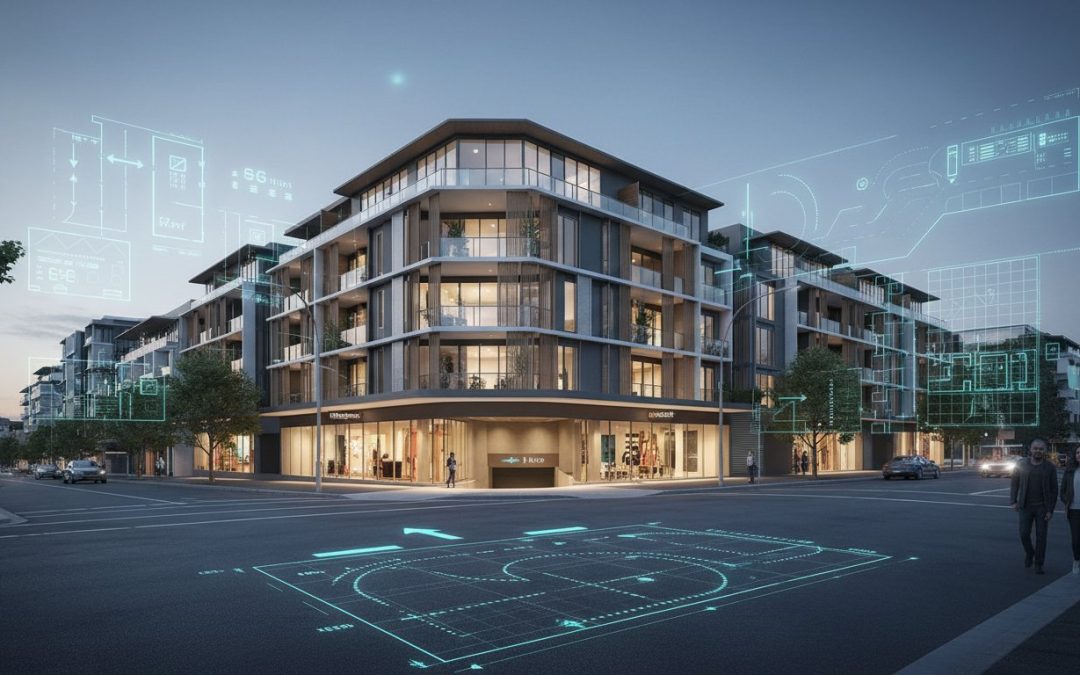
We are traffic engineers servicing Burwood, Burwood Heights, Croydon, Croydon Park, Enfield. A non-compliant traffic and parking report is a primary cause of costly delays and rejections for Development Applications (DAs) in the Burwood Local Government Area. Successfully undertaking Traffic and Car Parking Impact Assessments in Burwood Council of Sydney demands a precise understanding of the Council’s specific Development Control Plans (DCPs), local engineering standards, and on-the-ground traffic conditions. Any oversight or misinterpretation of these requirements can jeopardise your project timeline and budget before construction even begins.
This definitive guide eliminates that uncertainty. We provide a direct, technical breakdown of Burwood Council’s expectations for your traffic and parking report. Inside, you will find a checklist of the essential components required for a compliant submission-from traffic generation analysis and swept path diagrams to car park design compliance with Australian Standards (AS 2890.1). Our objective is to equip you with the detailed knowledge required to submit a robust assessment, ensuring your DA proceeds without unnecessary traffic-related obstacles.
Key Takeaways
-
A compliant Traffic and Parking Impact Assessment is a non-negotiable component of your DA, directly addressing Burwood Council’s objectives for safety, network efficiency, and residential amenity.
-
Successfully undertaking Traffic and Car Parking Impact Assessments in Burwood Council of Sydney requires a detailed understanding of key planning documents, primarily the Burwood Local Environmental Plan (LEP) and Development Control Plan (DCP).
-
Know the essential components of a compliant report, including traffic generation analysis and parking design against AS 2890.1, to ensure your submission meets Council’s technical standards.
-
Engaging a specialist traffic engineer with demonstrated experience in the Burwood LGA is the most effective strategy to pre-empt council objections and secure a timely approval.
Table of Contents
-
Why Your Burwood DA Needs a Traffic and Parking Impact Assessment
-
Engaging the Right Traffic Engineer for Your Burwood Project
Why Your Burwood DA Needs a Traffic and Parking Impact Assessment
The core purpose of a Traffic and Parking Impact Assessment is to provide Burwood Council with a detailed analysis of how a proposed development will affect the local road network and parking availability. Council’s primary objectives are to maintain road safety, ensure network efficiency, and protect residential amenity. A professional assessment demonstrates that your project has been designed to meet these critical standards from the outset.
To better understand the on-the-ground parking conditions in Burwood, the following video provides a practical overview.
Submitting a Development Application (DA) without a compliant report, or with an inadequate one, presents a significant risk. It is a common cause for DA delays, requests for further information (RFIs), or outright rejection. Properly undertaking Traffic and Car Parking Impact Assessments in Burwood Council of Sydney is not a procedural formality but a critical step to ensure a smooth and successful application process.
Understanding the Scope: Traffic vs. Parking
A comprehensive report integrates two key components. The Traffic Impact Assessment evaluates the development’s effect on vehicle movements, intersection performance, and road network capacity, based on established Traffic engineering principles. The Parking Impact Assessment focuses specifically on the on-site parking supply, analysing whether it meets the anticipated demand generated by the new land use, in accordance with Council’s controls and Australian Standards.
When is a Report Required by Burwood Council?
While specific requirements vary, a traffic and parking report is generally triggered by developments that significantly alter traffic patterns or parking demand. Common examples include:
-
New commercial or retail buildings
-
Multi-dwelling residential housing (e.g., apartment blocks, townhouses)
-
Childcare centres and educational establishments
-
Places of public worship or function centres
-
Any project that proposes a substantial increase in traffic generation or changes to existing access arrangements.
For smaller projects or changes of use, the requirement may be less clear. It is always advisable to confirm with Burwood Council or engage a professional traffic consultant to determine the specific assessment needs for your DA.
Decoding Burwood Council’s Key Planning Documents
A successful development application hinges on a thorough understanding of Council’s regulatory framework. For anyone undertaking Traffic and Car Parking Impact Assessments in Burwood Council of Sydney, two documents are paramount: the Burwood Local Environmental Plan (LEP) and the Burwood Development Control Plan (DCP). These documents form a clear hierarchy. The LEP establishes the high-level rules, such as land use zoning and what is permissible, while the DCP provides the detailed technical and design guidelines that your proposal must meet.
A compliant traffic and parking report must directly reference and address the specific controls within these key documents. Failure to do so is a common reason for delays or rejection of a Development Application.
Navigating the Burwood Development Control Plan (DCP) 2012
The Burwood DCP 2012 contains the granular detail required for assessment. Specifically, Part C1 – Transport, Access, Parking and Servicing is the primary reference for traffic engineers. This section outlines non-negotiable requirements that your report must satisfy, including:
-
Car Parking Rates: Minimum parking provision rates are specified for various land uses, such as residential flat buildings, commercial premises, and retail developments. Your assessment must justify the proposed parking supply against these rates.
-
Bicycle Parking & Facilities: The DCP mandates the provision of secure bicycle parking and associated end-of-trip facilities (showers, lockers) for specific development types to encourage active transport.
-
Vehicle Access & Sight Lines: Strict controls apply to the design of driveways, ramps, and vehicular crossings to ensure safe sight lines for pedestrians and other road users.
Key Considerations from the Burwood Local Environmental Plan (LEP) 2012
The Burwood LEP 2012 sets the strategic foundation for all development. Its land use zones-such as B4 Mixed Use in the town centre or R1 General Residential-directly influence the expected traffic generation and parking demand of a site. The LEP’s objectives for these zones guide Council’s assessment of whether a development’s traffic impact is appropriate for the location. For instance, a proposal in a commercial core will be assessed against different traffic objectives than one in a low-density residential street.
Referencing Australian Standards (AS 2890 series)
Compliance does not end with Council’s documents. The Burwood DCP explicitly requires that the geometric design of all parking and access facilities adheres to the relevant Australian Standards. Your traffic report must demonstrate full compliance with these technical benchmarks. The key standards include:
-
AS 2890.1:2004: For the design of off-street car parking facilities.
-
AS 2890.2:2018: For commercial vehicle facilities.
-
AS 2890.6:2022: For off-street parking for people with disabilities.
Core Components of a Compliant Report for Burwood Council
A well-structured and evidenced-based report is critical for a timely and positive assessment by Burwood Council’s traffic engineers. When undertaking Traffic and Car Parking Impact Assessments in Burwood Council of Sydney, the document must be clear, logical, and defensible. This section serves as a checklist for developers to review their consultant’s work, ensuring every mandatory component is addressed with the required level of detail.
A comprehensive report demonstrates due diligence and simplifies the review process, directly addressing Council’s key concerns from the outset. The report must be broken down into distinct, analytical sections.
Site Description and Existing Conditions Analysis
This foundational section establishes the context for the entire assessment. It is not merely a description but a detailed technical audit of the current environment. A compliant analysis must document:
-
The specifics of the proposed development, including land use, scale, and operational hours.
-
The surrounding road network, including street hierarchy, intersection controls (signals, roundabouts, stop/give way signs), and any existing access points.
-
Baseline traffic volumes on adjacent roads, established through professionally conducted traffic surveys during typical weekday and weekend peak periods.
Traffic Generation and Parking Demand Assessment
This component quantifies the development’s impact. The analysis must be based on established methodologies and local planning controls. Key calculations include:
-
Traffic Generation: Projections of additional vehicle trips during peak hours, calculated using the latest TfNSW (formerly RMS) technical guides and trip generation rates.
-
Parking Demand: The required number of car parking spaces must be determined strictly in accordance with the rates specified in the Burwood Development Control Plan (DCP).
-
Justification for Deviations: Any proposal to provide parking at a rate different from the DCP requirements must be supported by a robust, first-principles justification.
Proposed Site Access and Internal Layout Review
This section assesses the safety and functionality of the proposed design. It confirms that the development can safely accommodate vehicle movements in compliance with national standards. This involves assessing the driveway location for adequate sight lines and its design for compliance. Furthermore, the internal layout requires rigorous analysis to ensure all vehicles can manoeuvre safely and efficiently. Learn about our detailed traffic engineering services that cover these critical analyses, including:
-
Swept Path Analysis: Computer-aided assessment confirming that design vehicles, from standard cars to service and waste collection vehicles, can enter, circulate, and exit the site without conflict.
-
Standards Compliance: Verification that all car parking spaces, aisle widths, ramp grades, and clearances meet the strict requirements of Australian Standards AS 2890.1, AS 2890.2, and AS 2890.6.
The Assessment Process: A Step-by-Step Walkthrough
For clients unfamiliar with the Development Application (DA) process, commissioning a traffic and parking report can seem complex. However, it is a structured, systematic procedure designed to satisfy Council requirements and ensure a development functions safely and efficiently. Engaging an experienced traffic consultant early in the design phase is critical; it prevents costly redesigns and streamlines the path to approval.
The following steps outline the typical project lifecycle, from initial contact through to the final report submission for your Burwood development.
Step 1: Initial Consultation and Scoping
This foundational stage establishes the project’s specific needs. A senior traffic engineer will work directly with you to define the scope required by Burwood Council. The process involves:
-
A detailed discussion of your proposed development, its intended use, and scale.
-
Review of preliminary architectural plans and any initial feedback or requirements from Council.
-
Issuing a comprehensive fee proposal that clearly outlines the scope of work, methodology, and deliverables.
Step 2: Data Collection and Site Investigation
With the scope defined, we proceed to the evidence-gathering phase. This involves a thorough assessment of the existing environment to establish a baseline for our analysis. Key activities include:
-
Organising traffic surveys to count vehicle and pedestrian movements at key nearby intersections, typically during weekday AM and PM peak periods.
-
Conducting a detailed site visit to observe and document existing traffic operations, on-street parking availability, and pedestrian infrastructure.
-
Photographing site access points, road geometry, relevant traffic control devices, and signage.
Step 3: Analysis, Reporting, and Submission
This final stage synthesizes all collected data into a professional, compliant report. Our analysis models the net traffic impact of the development and provides clear recommendations to mitigate any issues. The successful completion of this phase is essential when undertaking Traffic and Car Parking Impact Assessments in Burwood Council of Sydney. This includes:
-
Analysing traffic count data and applying relevant trip generation rates to model the future traffic scenario.
-
Drafting the Traffic and Parking Impact Assessment report, detailing all findings, compliance with Australian Standards (e.g., AS 2890.1), and practical recommendations.
-
Finalising the report for inclusion in your DA submission package to Council.
You can review our past projects and articles for examples of our detailed reporting. For expert guidance on your Burwood project, contact ML Traffic Engineers directly.
Engaging the Right Traffic Engineer for Your Burwood Project
Navigating Burwood Council’s traffic and parking requirements is a highly specialised discipline. A generic report that fails to address the specific nuances of the Burwood Development Control Plan (DCP) can lead to significant delays, costly redesigns, and potential DA rejection. Engaging a qualified and experienced traffic engineering consultant from the outset is the most critical step to ensure a smooth and successful application process.
The right expert not only produces a compliant report but also provides strategic advice that can save you time and money by pre-empting council objections and streamlining your design.
What to Look For in a Traffic Consultant
When selecting a consultant, technical competence and local experience are paramount. The success of undertaking Traffic and Car Parking Impact Assessments in Burwood Council of Sydney depends directly on your consultant’s ability to interpret and apply local planning controls. Look for a firm that provides:
-
Demonstrated Burwood LGA Experience: A portfolio of recently approved projects within Burwood Council is essential. The consultant must be intimately familiar with the Burwood DCP and LEP.
-
Technical Proficiency: A strong, working knowledge of Transport for NSW (TfNSW) guidelines, the Roads Act 1993, and all relevant Australian Standards (e.g., AS 2890.1 for parking facilities) is non-negotiable.
-
Direct Senior Engineer Access: You should have a direct line to the senior, qualified engineer who is personally handling your assessment, not a junior graduate or account manager.
-
A Proven Track Record: Ask for testimonials and case studies of approved developments similar to yours across Sydney.
Why Choose ML Traffic Engineers?
ML Traffic Engineers offers the specialised expertise required for a successful development outcome in Burwood. Our approach is defined by direct accountability and a singular focus on achieving DA approval for our clients.
-
With over 15 years of experience, we have a deep understanding of the traffic and transport planning landscape across Sydney.
-
Our unique service model guarantees that the senior engineer who prepares your quote is the same expert who completes the technical analysis and signs off on your final report.
-
We possess a proven and extensive track record of securing DA approvals for residential, commercial, and mixed-use developments within the Burwood Council area.
-
You can read more about our experienced team and our client-focused, no-nonsense methodology.
Next Steps for Your Development
To receive an accurate, obligation-free quote for your traffic assessment, please prepare the following information. Having these details ready will help us provide a fast and comprehensive proposal.
-
Your preliminary architectural plans (site plan, floor plans, and elevations).
-
A brief summary of your proposed development, including the land use type and scale (e.g., number of dwellings, gross floor area).
-
Any relevant correspondence you have received from Burwood Council.
Contact us today to discuss your project requirements with a senior traffic engineer and secure a quote for your Burwood development.
Secure Your Burwood DA Approval with an Expert Traffic Assessment
Navigating the development application process in Burwood requires precision and a deep understanding of local council requirements. As this guide has shown, a compliant assessment is a critical component for DA success, and it hinges on a thorough interpretation of key planning documents. Successfully undertaking Traffic and Car Parking Impact Assessments in Burwood Council of Sydney is not merely about ticking a box; it is about presenting a robust case that mitigates risk and satisfies council expectations from the outset.
At ML Traffic Engineers, our principal engineers leverage over 15 years of specialised experience in NSW to deliver assessments that achieve compliance. We have a proven track record with Burwood Council and other Sydney LGAs, providing you with direct access to the senior expert who will personally manage your project from quote to completion. Don’t let traffic and parking complexities create unnecessary delays for your development.
Ensure your project proceeds with confidence. Request an obligation-free quote for your Burwood DA today.
Frequently Asked Questions
How long does it take to prepare a Traffic and Parking Impact Assessment for Burwood Council?
A standard Traffic and Parking Impact Assessment for a development in Burwood is typically completed within 1 to 2 weeks. This period allows for a comprehensive review of architectural plans, a site inspection, and detailed analysis against the Burwood DCP and relevant Australian Standards. Projects with greater complexity, such as those requiring on-site traffic surveys or detailed intersection modelling, may necessitate a longer timeframe to ensure a thorough and compliant submission for your development application.
What are the specific car parking rates in the Burwood DCP?
Car parking rates are mandated within the Burwood Development Control Plan (DCP), specifically in Part B – General Controls. The rates vary by land use; for instance, residential flat buildings generally require 1 space per 1-2 bedroom dwelling and 1.5 spaces for dwellings with 3 or more bedrooms, plus visitor parking. It is critical to reference the most current version of the Burwood DCP, as these figures are strictly enforced by Council assessment officers.
Can a previous traffic report for a similar nearby site be used for my application?
No, a report prepared for a different site is not acceptable. Burwood Council requires that every Traffic and Parking Impact Assessment be site-specific, addressing the unique context of your proposal, including its access design, parking layout, and the current local traffic network. Submitting a generic or recycled report will lead to Council requesting further information, causing significant delays to your development application approval process. Each assessment must be a bespoke analysis of the proposed development.
What is the most common reason for Burwood Council to question a traffic report?
The most frequent issue raised by Burwood Council relates to non-compliance with technical design requirements, particularly Australian Standard AS 2890.1 for Off-Street Car Parking. Common errors include incorrect driveway gradients, inadequate sight lines for pedestrian safety at the property boundary, or vehicle swept path diagrams that fail to demonstrate safe and efficient access to parking spaces. A meticulous assessment of these technical details is essential for a smooth assessment process.
Does a small extension or change of use require a full traffic assessment?
The need for a traffic assessment depends on the nature of the change. A minor extension with no impact on parking or access may not require a report. However, a change of use (e.g., from an office to a medical centre) or any development that alters parking demand, modifies a driveway, or intensifies site activity will almost certainly require a Traffic and Parking Impact Statement to demonstrate compliance with Council’s planning controls and address potential impacts.
How much does a Traffic and Parking Impact Assessment typically cost for a project in Burwood?
The cost for undertaking Traffic and Car Parking Impact Assessments in Burwood Council of Sydney is determined by project complexity. A straightforward report for a small-scale project, such as a dual occupancy or a simple change of use, typically starts from A$2,000. Larger developments like apartment buildings or commercial centres that demand more detailed analysis and traffic surveys can range from A$3,500 to A$5,000+. We provide a fixed-fee quote outlining the full scope of works required.
