

We are traffic engineers servicing Avonsleigh, Bayles, Beaconsfield, Beaconsfield Upper, Bunyip, Bunyip North, Caldermeade, Cardinia, Catani, Clematis, Cockatoo, Cora Lynn, Dalmore, Dewhurst, Emerald, Garfield, Garfield North, Gembrook, Guys Hill, Heath Hill, Iona, Koo Wee Rup, Koo Wee Rup North, Lang Lang, Lang Lang East, Longwarry, Maryknoll, Menzies Creek, Modella, Monomeith, Mount Burnett, Nangana, Nar Nar Goon, Nar Nar Goon North, Nyora, Officer, Officer South, Pakenham, Pakenham South, Pakenham Upper, Rythdale, Tenby Point, Tonimbuk, Tooradin, Tynong, Tynong North, Vervale, Yannathan.
Submitting a Development Application (DA) in the Cardinia Shire presents unique challenges, and a common point of failure is an incorrect or incomplete traffic report. The process of undertaking Traffic and Car Parking Impact Assessments in Cardinia Council is governed by specific local requirements that, if overlooked, can lead to significant project delays and potential rejection. Uncertainty regarding whether your project requires a report, or what that report must contain, is a critical risk to your development timeline and budget.
This comprehensive guide provides developers with a definitive resource for navigating these requirements. We will detail the specific triggers that mandate a Traffic Impact Assessment (TIA), provide a clear checklist of essential components for your submission, and outline the process to ensure a smooth progression through the council’s review. Gain the clarity needed to avoid common pitfalls, understand your obligations, and confidently prepare a report that supports a successful DA approval for your project in the Cardinia Shire.
Key Takeaways
-
Identify the specific triggers within the Cardinia Planning Scheme that mandate a formal Traffic and Parking Impact Assessment for your Development Application.
-
Ensure your submission meets council expectations by including all key report components, from parking demand rates to swept path diagrams, to prevent common delays.
-
Understand the complete process for undertaking Traffic and Car Parking Impact Assessments in Cardinia Council, from initial preparation to final council liaison.
-
Learn how to avoid costly pitfalls and frequent mistakes that can lead to application rejections, ensuring a more efficient approval pathway for your project.
Table of Contents
-
When is a Traffic and Parking Assessment Required in Cardinia?
-
Key Components of a Compliant Cardinia Traffic Assessment Report
When is a Traffic and Parking Assessment Required in Cardinia?
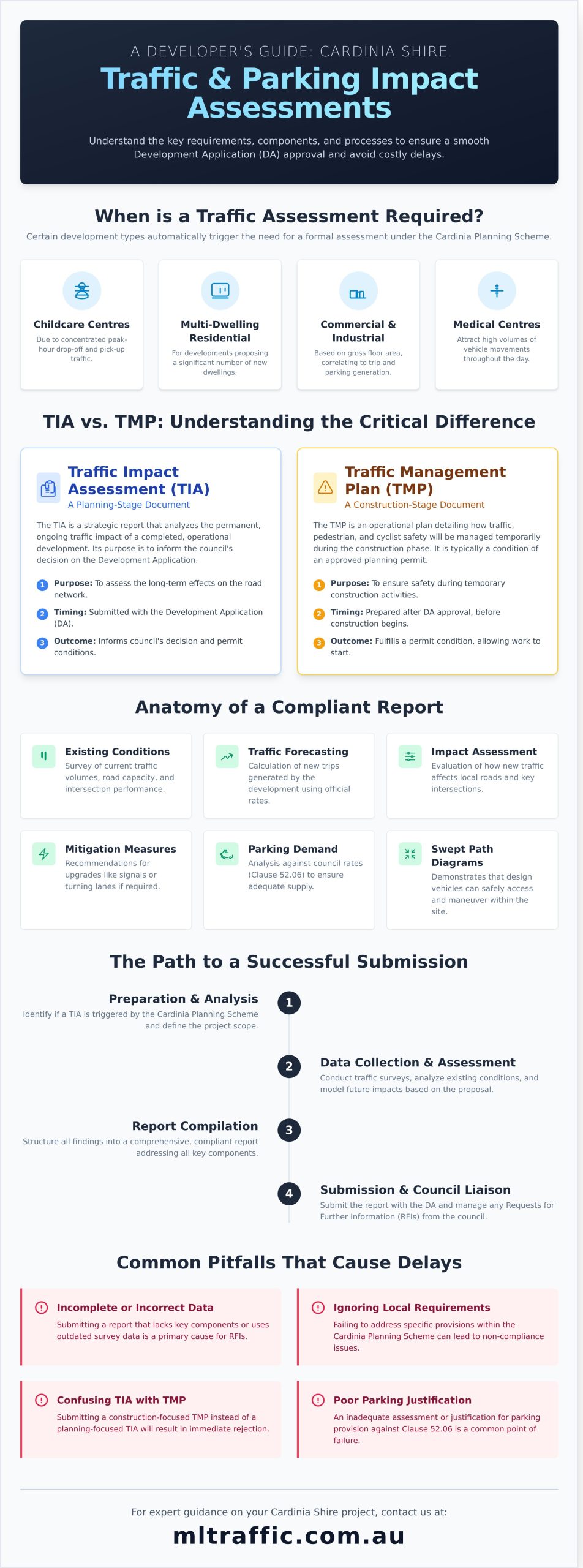
A Traffic and Parking Assessment, commonly referred to as a Traffic Impact Assessment (TIA), is a critical technical document required for many Development Applications (DAs) submitted to Cardinia Shire Council. Its primary function is to formally assess the anticipated effects of a proposed development on the local road network, car parking availability, and overall traffic safety. Successfully undertaking Traffic and Car Parking Impact Assessments in Cardinia Council hinges on first identifying whether your project triggers the need for one.
For a clear overview of what a Traffic Impact Assessment involves, the following presentation is a valuable resource:
Understanding Cardinia Council’s Triggers
The requirement for a TIA is dictated by the Cardinia Planning Scheme, particularly Clause 52.06 for Car Parking and other specific land use zone provisions. Council mandates these reports to ensure new developments do not compromise road safety or create unacceptable levels of congestion. This process is grounded in established transportation planning principles designed to manage infrastructure growth. Key triggers often relate to the development’s size, proposed land use, and location. Examples include:
-
Childcare Centres: Due to concentrated peak-hour drop-off and pick-up times.
-
Multi-Dwelling Residential: Developments that propose a significant number of new dwellings.
-
Commercial and Industrial Sites: Based on gross floor area, which correlates with trip generation and parking demand.
-
Medical Centres: Which attract high volumes of vehicle movements throughout the day.
Traffic Impact Assessment (TIA) vs. Traffic Management Plan (TMP)
It is crucial for applicants to distinguish between a Traffic Impact Assessment (TIA) and a Traffic Management Plan (TMP), as they are separate reports for different stages of a project.
A Traffic Impact Assessment (TIA) is a planning-stage document. It analyses the permanent, ongoing impact of a completed and operational development on the surrounding transport network. This report informs the DA process and helps Council decide on the application’s merits.
A Traffic Management Plan (TMP) is a construction-stage document. It details how traffic, pedestrian, and cyclist safety will be managed temporarily during the construction phase. It is a condition of a planning permit, not a tool for assessing the application itself.
Key Components of a Compliant Cardinia Traffic Assessment Report
A comprehensive Traffic Impact Assessment (TIA) report is structured to provide Cardinia Council’s planners with a clear, logical, and technically sound analysis of your development’s transport implications. The primary objective is to demonstrate compliance with relevant standards and proactively address potential impacts. A thorough report is the most effective tool for preventing Council Requests for Further Information (RFIs), which can cause significant project delays. Successfully Undertaking Traffic and Car Parking Impact Assessments in Cardinia Council requires a report that methodically addresses the following key areas.
Traffic Generation and Road Network Analysis
This section establishes the context of your development within the existing road network. It must provide a robust analysis of current conditions and future impacts. A compliant assessment includes:
-
Existing Conditions: A detailed survey of current traffic volumes, road capacities, and the operational performance of nearby intersections.
-
Traffic Forecasting: Calculation of the anticipated traffic generation from your development, using established rates from sources like the former RMS (TfNSW) or VicRoads guidelines.
-
Impact Assessment: An evaluation of how the new traffic will affect the local road network, particularly key intersections, during peak hours.
-
Mitigation Measures: Professional recommendations for any necessary road network upgrades, such as new traffic signals, turning lanes, or other control measures to maintain acceptable levels of service.
Car Parking Demand and Layout Design
Council requires clear justification for the proposed car parking supply and a design that meets strict safety and accessibility standards. This component must demonstrate full compliance with the Cardinia Planning Scheme and Australian Standards.
-
Parking Rate Calculation: A precise calculation of the required number of car parking spaces based on the statutory rates outlined in the Cardinia Planning Scheme.
-
Demand Justification: A clear rationale for any proposed shortfall or surplus in parking, supported by data and first-principles analysis.
-
Compliant Layout: A car park design that adheres strictly to the dimensional requirements of Australian Standard AS 2890.1:2004 (for off-street car parking) and AS 2890.6:2022 (for accessible parking). This includes correct bay dimensions, aisle widths, internal circulation, and safe ramp grades.
Site Access, Swept Path, and Safety Assessment
This section scrutinises the critical interface between the development site and the public road network. It focuses on ensuring all vehicle movements are safe, efficient, and functional for all road users.
-
Access Design: An assessment of proposed driveway locations and geometry for safety and functionality, including adequate sight lines for vehicles entering and exiting the site.
-
Swept Path Analysis: Computer-aided analysis demonstrating that design vehicles (e.g., standard cars, delivery vans, and Council’s waste collection vehicles) can safely manoeuvre into and out of the site without encroaching on kerbs or opposing traffic lanes.
-
Active Transport: A review of provisions for pedestrians, cyclists, and individuals with mobility impairments, ensuring safe and convenient access.
The Submission and Assessment Process with Cardinia Council
Navigating the development application process requires a structured, professional approach. When undertaking Traffic and Car Parking Impact Assessments in Cardinia Council, the procedure follows a clear sequence from initial review to final council determination. A qualified traffic engineer acts as your technical representative, liaising directly with council planners to ensure all requirements are met efficiently and professionally. For larger or more complex projects, a pre-application meeting with Council is highly recommended to identify and resolve potential issues upfront.
Step 1: Engaging a Consultant and Initial Review
The first critical step is engaging a traffic engineering consultant with specific experience working within the Cardinia Shire. To begin, you will need to provide your consultant with key documents, including architectural plans and a detailed description of the proposed land use. Our role at this stage is to conduct a thorough initial review to identify any potential red flags or non-compliance issues with Council’s planning scheme, saving you time and resources down the line.
Step 2: Lodging the Report with Your Development Application
The completed Traffic Impact Assessment (TIA) is submitted to Cardinia Council as a specialist supporting document within your overall Development Application (DA) package. Once lodged, Council’s internal traffic engineering department formally reviews the report. They will scrutinise the methodology, traffic generation data, and recommendations, typically focusing on:
-
Car parking supply calculations and compliance
-
Access driveway design and vehicle swept paths
-
Impact on local road network safety and efficiency
-
Pedestrian and cyclist facilities
Step 3: Responding to Council Feedback (RFIs)
It is common for Council to issue a Request for Further Information (RFI) seeking clarification or additional analysis on specific technical points. An RFI is a standard part of the assessment dialogue, not a rejection of the proposal. Your consultant will manage this correspondence, preparing a formal written response that addresses each of Council’s queries with detailed technical justifications. The objective is to satisfy all concerns and secure a positive recommendation for your DA from the traffic department.
Successfully managing this process is fundamental to achieving a timely planning permit. Our experienced consultants handle every stage, from initial analysis to final negotiations with Council. To discuss your project’s requirements, we invite you to arrange an initial consultation.
Common Pitfalls to Avoid for a Smooth Approval in Cardinia
Navigating the development application process requires precision. When undertaking Traffic and Car Parking Impact Assessments in Cardinia Council, even minor oversights can lead to significant delays and added costs. Based on extensive experience, we have identified the most common pitfalls that applicants face. Avoiding these issues from the outset is the most effective way to ensure a smooth and timely approval for your project.
Inaccurate Data or Flawed Assumptions
A traffic assessment is only as reliable as its foundational data. Council planners will quickly identify reports based on outdated traffic counts, generic trip generation rates that do not reflect local conditions, or a failure to account for approved future developments in the vicinity. A robust, evidence-based analysis is non-negotiable for Cardinia Council; any flawed assumptions will undermine the entire submission and result in requests for a complete reassessment, costing you valuable time and money.
Non-Compliant Parking and Access Design
Strict adherence to Australian Standards is fundamental. Common reasons for rejection stem from car park layouts that ignore the specific dimensions and geometry required by AS 2890.1. Other critical errors that halt applications include:
-
Neglecting to perform a swept path analysis to prove access for service and emergency vehicles.
-
Poor driveway grade or sight-line design that compromises pedestrian or road user safety.
These design flaws are not just compliance issues; they represent real-world safety risks and require costly redesigns. Our range of services includes detailed design reviews to ensure full compliance before submission.
Overlooking Active and Public Transport
Cardinia Council places a strong emphasis on creating integrated and sustainable transport networks. A traffic impact assessment that focuses exclusively on private vehicles is viewed as incomplete. Failing to properly consider pedestrian connectivity, bicycle facilities, and access to nearby public transport services is a frequent oversight. A holistic assessment that demonstrates how a development supports all modes of transport is far more likely to align with Council’s strategic objectives and receive favourable consideration.
Why Choose ML Traffic Engineers for Your Cardinia Project
Navigating the complexities of a Development Application (DA) requires precision, experience, and a deep understanding of council-specific requirements. Successfully undertaking Traffic and Car Parking Impact Assessments in Cardinia Council is not merely a box-ticking exercise; it is a critical step that can determine the commercial viability and timeline of your project. Engaging a specialist traffic engineering consultant de-risks this process, ensuring your application is robust, compliant, and positioned for approval.
ML Traffic Engineers Pty Ltd provides the technical authority and direct, reliable service needed to achieve your development objectives within the Cardinia Shire.
Deep Understanding of Local Council Requirements
With decades of experience across Victoria, our team has a comprehensive understanding of Cardinia Shire Council’s specific planning schemes, policies, and preferences. We are familiar with the expectations of Cardinia’s planning and engineering officers, allowing us to anticipate potential issues and proactively address them in our Traffic Impact Assessments. This local knowledge ensures our reports are tailored to satisfy council requirements from the outset, minimising requests for further information and preventing costly delays.
Efficient, Director-Led Service
We operate on a clear and effective philosophy: the senior consultant who provides your quote is the same expert who completes the technical work. This director-led approach guarantees accountability and the highest standard of quality on every project. You have direct access to our senior engineers, eliminating communication bottlenecks and ensuring a streamlined process that saves you time and money. You can learn more about our experienced team and our commitment to this model.
By choosing ML Traffic Engineers Pty Ltd, you are partnering with seasoned professionals dedicated to achieving compliant and commercially sound outcomes. Our meticulous approach to undertaking Traffic and Car Parking Impact Assessments in Cardinia Council provides the certainty your project needs to move forward. For a professional assessment of your project requirements, contact us directly at mltraffic.com.au.
Partner with the Experts for Your Cardinia Council Submission
Navigating Cardinia Council’s requirements for development applications is a complex but critical task. Successfully undertaking Traffic and Car Parking Impact Assessments in Cardinia Council hinges on a detailed understanding of the local planning scheme, the ability to produce a fully compliant report, and the foresight to avoid common submission pitfalls. A professionally prepared assessment is not just a document; it is a fundamental component for achieving a smooth project approval.
At ML Traffic Engineers, our principal engineers provide the direct, hands-on service your project requires to succeed. With over 15 years of specialised experience and a portfolio of more than 10,000 successfully completed site assessments across Australia, we deliver the authoritative expertise needed to ensure compliance. The consultant who provides your quote is the expert who completes the work, guaranteeing accountability and a seamless process.
Contact ML Traffic Engineers for an expert quote on your Cardinia development project. Let our proven experience streamline your path to approval.
Frequently Asked Questions
How much does a Traffic and Parking Impact Assessment cost for a project in Cardinia?
The cost of a Traffic and Parking Impact Assessment in Cardinia is determined by the scale and complexity of the proposed development. A basic report for a small-scale project, such as a dual-occupancy or small commercial tenancy, typically starts from A$2,000. Larger projects requiring detailed traffic modelling, on-site surveys, or intersection analysis may range from A$5,000 to over A$15,000. We provide a fixed-fee proposal after reviewing your project plans and Council’s specific requirements.
How long does it take to prepare a traffic report for a DA submission?
A standard traffic report for a straightforward Development Application (DA) can generally be prepared within one to two weeks of engagement. For more complex assessments that necessitate on-site traffic counts or detailed intersection analysis, the timeline may extend to three or four weeks. We confirm a precise delivery timeframe upon receiving your project details to ensure your submission schedule is met. Our focus is on providing timely and professional reports to support your application.
What is the difference between a Traffic Impact Assessment and a Parking Demand Assessment?
A Traffic Impact Assessment (TIA) analyses the effect of a development’s generated traffic on the external road network, including intersection performance, road capacity, and safety. In contrast, a Parking Demand Assessment focuses internally on the site, determining the appropriate number of on-site car parking spaces required. It assesses compliance with the Cardinia Planning Scheme rates and provides justification for any proposed variation based on empirical data or first principles.
My development is small. Do I still need a full traffic report for Cardinia Council?
The requirement for a report is dictated by the Cardinia Planning Scheme, not just the size of the development. Even a small project may trigger the need for a formal assessment if it results in a car parking shortfall, involves a change of use with higher traffic generation, or is located on a busy road. Undertaking Traffic and Car Parking Impact Assessments in Cardinia Council is often required to demonstrate compliance and justify the proposal to authorities.
Can you assist if Cardinia Council has already issued a Request for Information (RFI) on my project’s traffic report?
Yes. We are experienced in responding to Council RFIs concerning traffic and parking matters. Our process involves a professional review of the RFI letter and the original traffic report to identify the specific issues raised by Council’s engineers. We then prepare a comprehensive written response or an addendum report containing the necessary additional analysis, swept path diagrams, or revised calculations to satisfy Council’s requirements and progress your application toward approval.
What specific information do I need to provide to get a quote for a traffic assessment?
To provide an accurate, fixed-fee quote for a traffic assessment, we require a complete set of architectural drawings, including the site plan, floor plans, and elevations. We also need the full site address and a clear description of the proposed development (e.g., number of dwellings, type of commercial use and gross floor area). Providing any existing correspondence from Cardinia Council, such as pre-application advice or an RFI, is also highly beneficial.
