

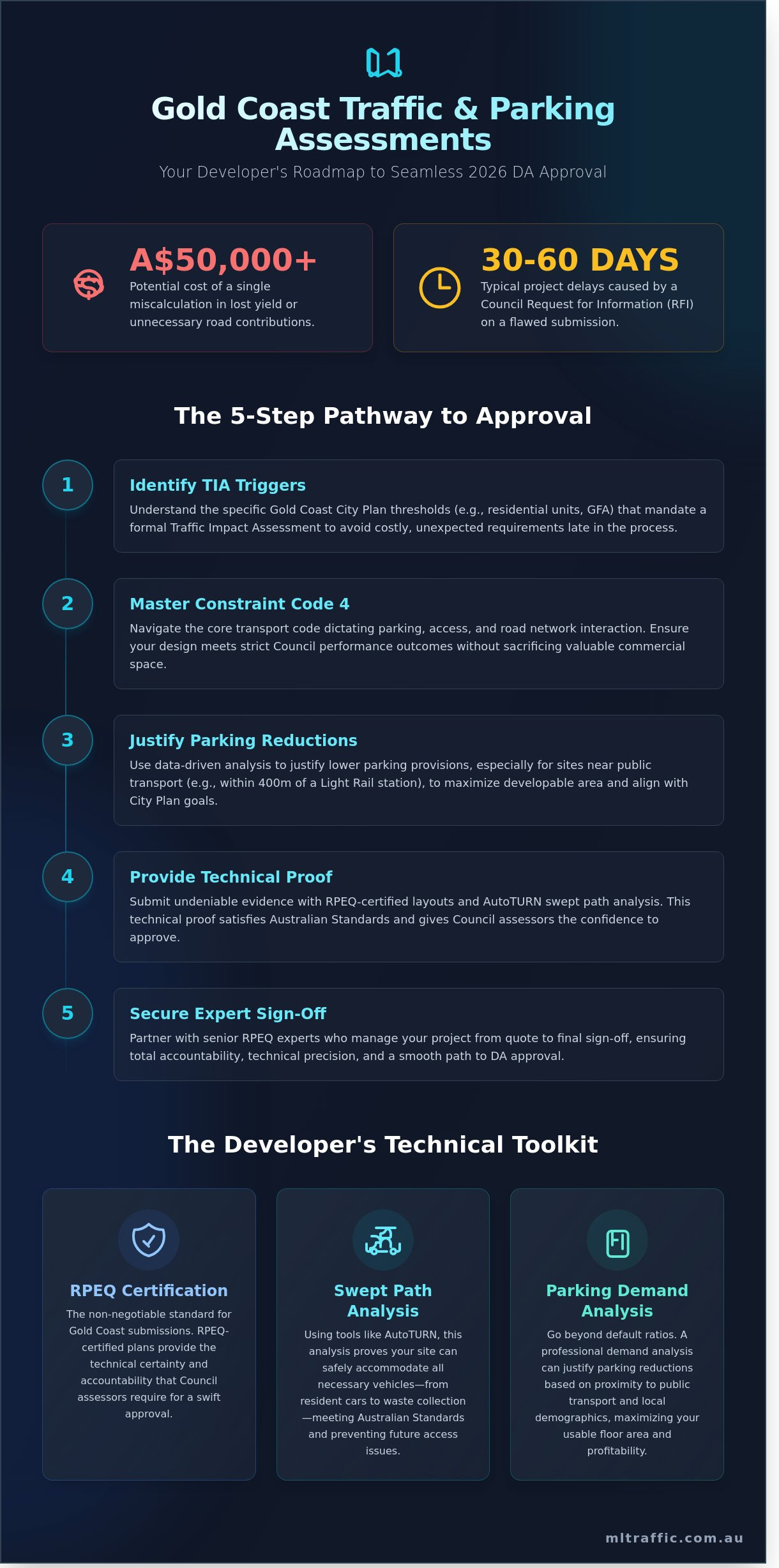
A single miscalculation in your parking layout can cost a Gold Coast developer upwards of A$50,000 in lost yield or unnecessary road contributions. You already know that meeting the strict criteria of Constraint Code 4 often feels like hitting a moving target. When you are Undertaking Traffic and Car Parking Impact Assessments in Gold Coast City Council of Queensland, it is incredibly frustrating when a high-value project stalls because the council questions your traffic distribution or a minor parking shortfall. We understand that the pressure to deliver a profitable development while satisfying every technical requirement is immense. You need a strategy that balances commercial reality with rigorous engineering standards.
This guide provides the exact roadmap to ensure your 2026 submissions are bulletproof and ready for approval. You will learn how to navigate the complex intersection of local and state (TMR) standards without over-engineering your infrastructure. We are going to show you how to optimize your car park design to maximize site yield and clear the path to a seamless DA approval. We have simplified the technical requirements to give you the clarity needed to satisfy RPEQ requirements and avoid the trap of expensive, unnecessary road upgrades.
Key Takeaways
-
Identify the specific triggers within the 2026 Gold Coast City Plan that make a Traffic Impact Assessment mandatory, helping you avoid costly delays in your application.
-
Navigate the complexities of Constraint Code 4 to ensure your parking and access designs meet strict Council performance outcomes without sacrificing valuable commercial space.
-
Learn the science of justifying parking reductions when Undertaking Traffic and Car Parking Impact Assessments in Gold Coast City Council of Queensland to better suit your project’s unique needs.
-
Discover how RPEQ-certified site layouts and AutoTURN swept path analysis provide the technical proof needed to satisfy Australian Standards and Council assessors.
-
Understand the advantage of working directly with senior RPEQ experts who manage your project from the first quote to the final sign-off, ensuring total accountability and results.
Table of Contents
-
Navigating the Gold Coast City Plan: Why Traffic & Parking Assessments Matter in 2026
-
Decoding Constraint Code 4: The Core of Gold Coast Parking Compliance
-
Securing Your Approval: Why ML Traffic Engineers is the Right Choice
Navigating the Gold Coast City Plan: Why Traffic & Parking Assessments Matter in 2026
The Gold Coast City Plan serves as the fundamental blueprint for managing the city’s rapid expansion. As we move toward 2026, the Council’s focus has shifted heavily toward sustainable urban transport and higher density living. For developers, this means that a standard development application is no longer just about the building’s footprint; it’s about how that building breathes within the existing transport ecosystem. Undertaking Traffic and Car Parking Impact Assessments in Gold Coast City Council of Queensland is a mandatory step for any project that significantly alters vehicle movements or parking demand. You’ll find that the Council triggers a formal Traffic Impact Assessment (TIA) based on specific land-use thresholds, such as a set number of residential units or the gross floor area of a commercial site.
A professional assessment goes beyond simple car counts. It involves a deep dive into the principles of traffic engineering to ensure your site is safe and functional. You must account for how your project interacts with local council roads and the state-controlled road networks. Failing to distinguish between these two jurisdictions is a common mistake that leads to jurisdictional friction. By addressing these technical requirements early, you provide the Council with the certainty they need to approve your project without hesitation. A proactive report isn’t just a compliance document; it’s a strategic tool to bypass the dreaded Request for Information (RFI) process, which can delay a project by 30 to 60 days and cost thousands in holding charges.
To better understand the nuances of the assessment process in Queensland, watch this helpful video:
The Shift Toward Transport Integration
The Council’s 2026 strategy prioritizes active transport and public transit proximity. In high-growth corridors like Southport and Surfers Paradise, density targets are pushing developers to rethink traditional parking ratios. With the Light Rail expansion continuing to reshape the coast, parking demand assessments must now account for reduced car ownership trends among residents living within 400 metres of a station. We use specific data to justify lower parking provisions, helping you maximize your developable area while remaining compliant with the City Plan’s transport integration goals.
The Risks of Inadequate Traffic Planning
Inadequate planning is a primary reason for DA refusal in the Gold Coast region. Generic, "copy-paste" reports often fail because they don’t address site-specific constraints like driveway ramp grades or vehicle swept paths for waste collection. If your report doesn’t meet the RPEQ-certified standards required for 2026, the Council will likely issue an RFI. This stalls your progress and increases your overheads. To ensure your project stays on track, learn more about our TIA services and how ML Traffic Engineers Pty Ltd provide the technical precision needed for a smooth approval. Undertaking Traffic and Car Parking Impact Assessments in Gold Coast City Council of Queensland requires a consultant who actually does the work they quote, ensuring every sight-line and turn circle is verified for your specific site.
Decoding Constraint Code 4: The Core of Gold Coast Parking Compliance
Constraint Code 4, formally known as the Transport code within the Gold Coast City Plan, is the primary benchmark for every development application. It dictates exactly how a site interacts with the public road network. When Undertaking Traffic and Car Parking Impact Assessments in Gold Coast City Council of Queensland, you’ll encounter two paths: Acceptable Solutions (AS) and Performance Outcomes (PO). Acceptable Solutions provide a prescriptive "tick-a-box" route, such as providing exactly 1.25 spaces per two-bedroom apartment. However, many urban sites don’t fit this mold. That’s where we use Performance Outcomes to justify a deviation based on empirical data and site-specific constraints.
The council’s 2026 outlook places a heavy emphasis on active transport. You’re no longer just planning for cars. New developments must now integrate high-quality bicycle parking and end-of-trip facilities. For commercial builds, this often means providing one secure bike locker per four employees and dedicated shower facilities. If these aren’t integrated early, you’ll likely face a Request for Information (RFI) that can stall your project for months. Understanding the nuances of Gold Coast traffic management is essential to ensure your site layout aligns with the city’s long-term mobility goals.
Minimum parking rates remain a point of contention for many developers. While a suburban shopping centre might require 4 to 5 spaces per 100 square metres of Gross Floor Area (GFA), a mixed-use tower in Broadbeach might qualify for reductions due to proximity to the G:link light rail. We’ve found that a well-supported Car Parking Demand Assessment can often justify lower rates, saving developers thousands in construction costs. If you need a clear path forward, it’s often best to consult with an RPEQ certified engineer who handles the assessment from quote to completion.
Vehicle Access and Driveway Standards
Compliance with AS 2890.1 is non-negotiable for off-street parking. On the Gold Coast’s undulating terrain, driveway ramp grades are a frequent failure point in DA submissions. You must maintain a maximum grade of 1:4 (25%), but more importantly, you need 1:20 (5%) transitions at the top and bottom. Without these 2.0-metre transition zones, vehicles will scrape their undercarriages, leading to long-term liability issues. We also conduct rigorous sight-line assessments to ensure that exiting motorists can see pedestrians on the footpath at least 2.5 metres away, as per the safety standards required by the City Plan.
Service Vehicle Requirements (AS 2890.2)
Service vehicle planning is often an afterthought that ruins a functional parking layout. Under AS 2890.2, you must account for the specific class of vehicle your land use requires, whether it’s a Small Rigid Vehicle (SRV) for a local cafe or a 12.5-metre Heavy Rigid Vehicle (HRV) for a supermarket. Refuse collection is a major hurdle; the Gold Coast City Council requires waste trucks to enter and exit in a forward direction. This necessitates a "Vehicle Swept Path Assessment" using software like AutoTURN to prove the truck won’t clip parked cars or structural columns. Designing loading docks that operate independently of tenant parking is the only way to ensure long-term operational success for the building manager.
Justifying Parking Reductions: Demand vs. Supply Analysis
The "Acceptable Solutions" within the Gold Coast City Plan Transport Code provide a rigid baseline for parking rates. For many commercial developers, these numbers don’t align with the actual operational needs of a modern site. If the code demands 40 spaces but your site footprint only accommodates 28, you face a commercial bottleneck. Undertaking Traffic and Car Parking Impact Assessments in Gold Coast City Council of Queensland allows us to move beyond these generic templates. We use a Performance Solution approach to justify lower numbers through rigorous demand analysis.
The science of a Parking Demand Assessment relies on empirical data rather than assumptions. We analyze the 85th percentile of parking demand to ensure the site functions during peak periods without over-supplying bitumen. Mixed-use developments on the Coast offer the best opportunities for "shared parking" models. An office space peaks at 10:00 AM while an adjacent restaurant peaks at 7:30 PM. By overlaying these demand profiles, we often find a 25% reduction in total required bays is feasible. This keeps your project viable without compromising the local street network.
Proximity to the G:link light rail is a significant factor in Council’s willingness to reduce rates. Sites located within a 400-metre walking catchment of stations like Cypress Avenue or Broadbeach South naturally attract a higher percentage of non-car trips. In 2023, data showed that developments near high-frequency transit corridors could justify reductions of up to 20% based on transit-oriented development principles. We provide the technical justification to prove that your specific demographic will use the light rail, reducing the pressure on your basement levels.
Empirical Evidence and Case Studies
We don’t rely on guesswork. We use surveys from existing, comparable developments to prove your case. If a 120-seat cafe in Palm Beach operates successfully with 12 spaces, that data becomes a primary tool for your application. At ML Traffic Engineers, the traffic consultant who provides the quote and does the work manages this data collection. This ensures the engineer defending the numbers is the same one who analyzed the site. We address Council’s concerns about over-spill by demonstrating that peak demand remains contained within the site, preventing illegal parking within 10 metres of local intersections.
Alternative Transport Credits
Green Travel Plans offer a strategic path to parking reductions. Providing high-quality end-of-trip facilities, such as 15 secure bike lockers and 2 showers, can sometimes offset the need for 4 car spaces. Looking toward the 2026 outlook, car-sharing pods are becoming a standard feature in DA approvals. One dedicated car-share bay can replace the demand of approximately 8 private vehicles in high-density areas. Negotiating these credits requires a conversational but technical approach. We focus on Performance Outcomes to show how your project supports the City’s broader transport goals while maintaining your commercial yield. Undertaking Traffic and Car Parking Impact Assessments in Gold Coast City Council of Queensland requires this level of detail to ensure a smooth approval process.
The Technical Toolkit: Swept Paths and RPEQ Certification
Designing a high-yield development in the Gold Coast requires more than just architectural vision. It demands a functional layout that satisfies both the driver and the Council assessor. Undertaking Traffic and Car Parking Impact Assessments in Gold Coast City Council of Queensland follows a strict technical sequence to ensure your site doesn’t just look good on paper, but works in practice. This process begins with five critical steps.
-
Step 1: Preliminary Parking Demand. We develop the initial site layout based on the specific parking rates found in the City Plan. This sets the footprint before any concrete is poured.
-
Step 2: AutoTURN Analysis. Our team conducts Vehicle Swept Path Analysis using AutoTURN software. This simulates real-world movements to ensure vehicles can enter, park, and exit in a forward gear.
-
Step 3: Geometry Refinement. We refine driveway and internal aisle widths to accommodate B85 and B99 vehicles. These represent the 85th and 99th percentile of vehicles on Australian roads respectively.
-
Step 4: RPEQ Oversight. A Registered Professional Engineer of Queensland reviews every calculation. This isn’t just a best practice; it’s a legal necessity for engineering services in the state.
-
Step 5: Formal Submission. We finalize the TIA report and submit it to Council alongside a professional Statement of Environmental Effects to address broader planning impacts.
Why Swept Path Analysis is Non-Negotiable
Swept path analysis is the only way to visualize how a 12.5m heavy rigid vehicle maneuvers through your basement or loading bay. Without this, you risk creating "dead spots" where cars cannot physically turn, rendering parking bays useless. We use these simulations to identify tight corners and narrow ramps early. For a closer look at how these simulations function, watch our videos on swept path analysis. Getting this right at the DA stage prevents costly redesigns during the construction phase.
The Value of RPEQ Certification in Queensland
In Queensland, the Professional Engineers Act 2002 mandates that professional engineering services must be performed or supervised by an RPEQ. When Undertaking Traffic and Car Parking Impact Assessments in Gold Coast City Council of Queensland, an RPEQ signature acts as a seal of quality. It tells Council assessing officers that the data is accurate and compliant with AS 2890.1. At ML Traffic Engineers, we’ve worked on over 10,000 sites since 2005. Our senior engineers are involved in every calculation, ensuring your project benefits from decades of technical experience. This status builds immediate trust, often leading to fewer Requests for Information (RFIs) from the City of Gold Coast.
The traffic consultant who provides your quote should be the one doing the work. This hands-on approach ensures that complex ramp grades and sight-line assessments are handled by experts rather than junior staff. We focus on private clients who need their development applications approved without unnecessary delays. By integrating RPEQ oversight from day one, we provide the technical certainty required for both small-scale subdivisions and major commercial hubs.
Ready to secure your RPEQ-certified assessment? Contact ML Traffic Engineers for a professional quote today.
Securing Your Approval: Why ML Traffic Engineers is the Right Choice
Choosing the right consultant can be the difference between a swift approval and a costly Request for Information (RFI) that stalls your project for months. We’ve been trading since 2005, giving us nearly two decades of direct experience with the evolving transport codes in Queensland. Undertaking Traffic and Car Parking Impact Assessments in Gold Coast City Council of Queensland is a specialized task. It requires a deep understanding of the City Plan and the specific expectations of Council assessment officers. We don’t just provide data; we provide solutions that align with local planning objectives.
Our team has successfully completed over 10,000 projects across a massive variety of land uses. This exhaustive history includes high-density Southport apartments, medical centers in Varsity Lakes, and busy Burleigh cafes. We’ve worked on everything from places of worship and schools to industrial warehouses and nightclubs. This breadth of experience means we’ve likely already solved a traffic or parking constraint similar to yours. We know how to balance technical rigor with a persuasive narrative that addresses Council’s concerns before they even ask.
A high-quality assessment must be more than a technical document. It’s a tool for negotiation. While we use industry-standard software and RPEQ-certified methodologies, we focus on the "why" behind the numbers. If your development has a parking shortfall, we don’t just report the deficit. We build a case based on empirical data, peak demand analysis, and local transport context to show why the proposal is still functional and compliant. This proactive approach reduces friction during the DA process.
The Principal Advantage
We operate with a strict "no-gatekeepers" policy. At many large firms, a senior partner signs the quote, but a junior graduate does the actual work. This leads to errors and missed nuances. At ML Traffic Engineers Pty Ltd, the traffic consultant who provides your quote is the person who does the work. You get direct mobile access to our senior engineers, Michael Lee and Benny Chen. They bring between 30 and 40 years of individual experience to your project. You can learn more about our senior team and their qualifications to see why this hands-on approach results in faster, more reliable approvals.
Ready to Start Your Gold Coast Project?
Getting a tailored quote for your project is straightforward. To provide an accurate fee proposal for a Traffic Impact Assessment, we generally need your site address and a basic set of architectural plans. If you’re specifically looking for a Car Parking Demand Assessment, details regarding the proposed floor area and the specific land-use categories are essential. We pride ourselves on being responsive and direct. We’ll tell you exactly what’s required to meet Gold Coast City Council standards without unnecessary padding or hidden costs. Contact ML Traffic Engineers Pty Ltd today for a direct consultation and let’s get your development moving.
-
Direct access to RPEQ-certified senior engineers.
-
Over 15 years of specific Queensland regulatory experience.
-
Proven track record with over 10,000 completed sites.
-
Comprehensive assessments for all land-use types.
-
Persuasive, data-driven reporting designed for Council approval.
Secure Your Gold Coast Development Approval for 2026
Success in the 2026 Gold Coast development landscape depends on more than just meeting basic requirements. You need to master Constraint Code 4 and provide technical precision through RPEQ certified swept path analysis. Navigating these complexities alone often leads to avoidable delays or rejected applications. Undertaking Traffic and Car Parking Impact Assessments in Gold Coast City Council of Queensland requires a partner who understands the local planning scheme’s nuances. It’s about turning technical constraints into viable development opportunities through rigorous data.
ML Traffic Engineers brings over 15 years of specific Gold Coast council experience to your project. We’ve assessed over 10,000 sites nationwide, ensuring our clients receive reliable, data-backed reports that stand up to scrutiny. You won’t deal with junior staff or bureaucratic gatekeepers here. You get direct access to our RPEQ certified principals who actually do the work they quote. Whether you’re justifying a parking reduction or designing a complex driveway ramp, our expertise secures your path to approval. We’re ready to help you move your project forward today.
Get a professional Traffic Impact Assessment quote from our senior engineers
Frequently Asked Questions
When is a Traffic Impact Assessment (TIA) required for a Gold Coast DA?
You need a Traffic Impact Assessment when your project exceeds the trip generation thresholds defined in the Gold Coast City Plan or SC6.12. This typically applies to residential developments with more than 20 units or commercial projects over 1,000 square metres. Council officers also request these reports for sites with complex access or safety concerns. Our team ensures your application meets these specific triggers to avoid unnecessary delays during the Information Request period.
What is Constraint Code 4 in the Gold Coast City Plan?
Constraint Code 4 refers to the Transport Code within the Gold Coast City Plan which dictates parking rates and access standards. It sets the mandatory minimums for car, bicycle, and motorcycle spaces based on land use. Compliance with this code is essential for any development application. We focus on meeting the Performance Outcomes of this code to ensure your project remains viable while satisfying Council requirements.
Can I reduce the number of parking spaces required by the Council?
You can reduce the required parking spaces by providing a Car Parking Demand Assessment that justifies the shortfall based on empirical data. We have successfully negotiated reductions of 15% to 30% for projects near public transport hubs or within mixed-use precincts. Undertaking Traffic and Car Parking Impact Assessments in Gold Coast City Council of Queensland allows us to demonstrate that your specific site has lower peak demand than the generic rates suggested by the City Plan.
What is a Vehicle Swept Path Analysis and do I need one?
A Vehicle Swept Path Analysis is a CAD simulation using software like AutoTURN to prove that a specific vehicle can navigate your site safely. You need one if your project involves tight turn circles, heavy rigid vehicles, or waste collection within the property boundary. We use these plots to confirm compliance with Australian Standard AS 2890.1 and AS 2890.2. This technical proof prevents costly design errors before construction begins.
How much does a Traffic Impact Assessment cost in 2026?
A standard Traffic Impact Assessment in 2026 typically starts from A$3,500 for a basic residential or commercial project. Complex developments involving intersection modelling or state-controlled roads can range between A$6,000 and A$12,000. These figures reflect current market rates for RPEQ certified engineering services. We provide fixed-fee quotes so you know exactly what the professional fees are before we start the technical work.
Is an RPEQ certified engineer required for my traffic report in Queensland?
Yes, the Professional Engineers Act 2002 requires all traffic engineering reports in Queensland to be signed off by a Registered Professional Engineer of Queensland (RPEQ). Council will not accept reports without this certification. Our principals, Michael Lee and Benny Chen, are both RPEQ certified with over 30 years of experience. This ensures your report is legally compliant and carries the necessary authority during the DA process.
How long does it take to prepare a traffic and parking assessment?
It generally takes between 10 and 15 business days to complete a comprehensive traffic and parking assessment from the moment we receive your final architectural plans. If your project requires 7-day traffic counts or complex SIDRA modelling, the timeframe might extend to 20 days. We prioritize efficiency because we know your development schedule depends on timely submissions. The engineer who quotes your project performs the work, which speeds up the entire process.
What happens if my development is on a state-controlled road like the Gold Coast Highway?
Developments on state-controlled roads like the Gold Coast Highway require referral to the Department of Transport and Main Roads (DTMR) under the State Development Assessment Provisions. You must satisfy State Code 1, which focuses on maintaining the safety and efficiency of the state transport network. Undertaking Traffic and Car Parking Impact Assessments in Gold Coast City Council of Queensland for these sites requires specialized knowledge of both local and state-level planning requirements.
What areas do you cover?
We are traffic engineers servicing Advancetown, Alberton, Arundel, Ashmore, Austinville, Beechmont, Benobble, Benowa, Biddaddaba, Biggera Waters, Bilinga, Birnam, Bonogin, Broadbeach, Broadbeach Waters, Bundall, Burleigh Heads, Burleigh Waters, Carrara, Cedar Creek, Clagiraba, Clear Island Waters, Coolangatta, Coombabah, Coomera, Currumbin, Currumbin Valley, Currumbin Waters, Elanora, Gaven, Gilberton, Gilston, Guanaba, Helensvale, Highland Park, Hollywell, Hope Island, Jacobs Well, Kingsholme, Labrador, Lower Beechmont, Luscombe, Main Beach, Maudsland, Mermaid Beach, Mermaid Waters, Merrimac, Miami, Molendinar, Mount Nathan, Mudgeeraba, Natural Bridge, Nerang, Neranwood, Norwell, Numinbah Valley, Ormeau, Ormeau Hills, Oxenford, Pacific Pines, Palm Beach, Paradise Point, Parkwood, Pimpama, Reedy Creek, Robina, Runaway Bay, South Stradbroke, Southport, Southern Moreton Bay Islands, Springbrook, Stapylton, Steiglitz, Surfers Paradise, Tallai, Tallebudgera, Tallebudgera Valley, Tugun, Upper Coomera, Varsity Lakes, Willow Vale, Wongawallan, Woongoolba, Worongary, Yatala.
