

We are traffic engineers servicing Altona, Altona Meadows, Altona North, Brooklyn, Laverton, Newport, Seabrook, Seaholme, South Kingsville, Spotswood, Williamstown, Williamstown North.
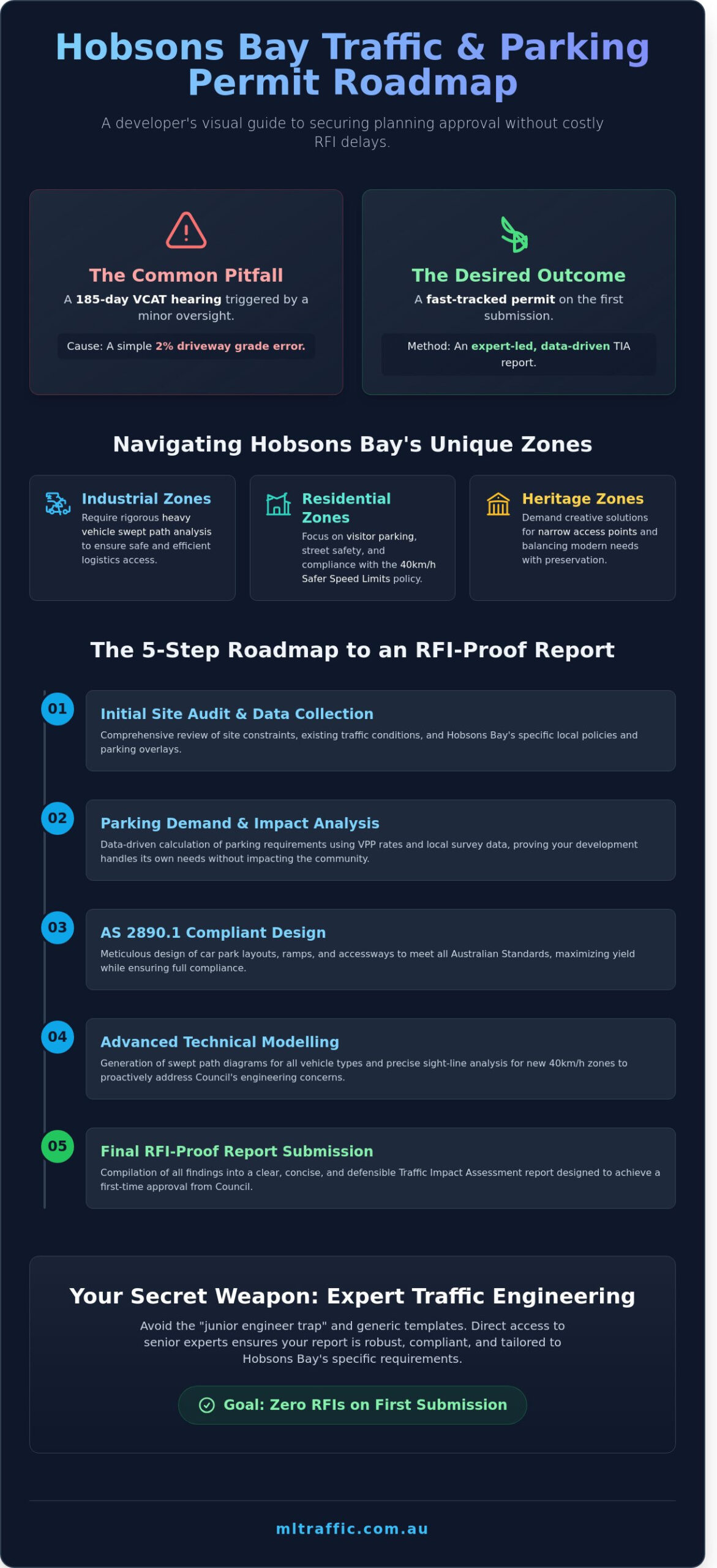
Imagine waiting 185 days for a VCAT hearing simply because a single driveway ramp grade was off by 2%. You’ve likely felt the pressure of Hobsons Bay Council’s increasingly strict planning environment, where a minor technical oversight leads to a costly Request for Further Information. Undertaking Traffic and Car Parking Impact Assessments in Hobsons Bay Council of Melbourne requires more than just a standard report; it demands a precise understanding of the 2023 Safer Speed Limits policy and local parking overlays that can quickly shrink your project’s yield.
We know you’re looking for a fast-tracked permit without the anxiety of bureaucratic roadblocks. You need a car park design that maximizes every square metre of your land while remaining fully compliant with AS 2890.1. This guide provides the exact roadmap you need to navigate these local requirements and secure your planning permit without expensive delays. We’ll examine how to address the Council’s specific engineering concerns, manage parking demand assessments, and ensure your site layout generates zero RFIs from the very first submission.
Key Takeaways
-
Understand why Hobsons Bay’s unique mix of industrial and heritage zones demands a more rigorous traffic strategy to secure your planning permit.
-
Master the core components of Undertaking Traffic and Car Parking Impact Assessments in Hobsons Bay Council of Melbourne to ensure your site handles its own parking needs effectively.
-
Discover the Council’s strategic shift toward sustainable transport and how bicycle parking can be the key to meeting modern development requirements.
-
Follow our proven 5-step roadmap to navigate the assessment process from initial site audit through to final technical modeling without costly delays.
-
Learn how direct access to senior traffic experts helps you avoid the "junior engineer trap" and ensures your report complies with all Australian Standards.
Table of Contents
-
Navigating Development in Hobsons Bay: Why Traffic Matters Now
-
Core Components of a Compliant Traffic & Car Parking Assessment
-
Addressing Hobsons Bay’s Strategic Safety and Parking Priorities
-
The 5-Step Process for a Successful Hobsons Bay Traffic Report
-
Why Expert Traffic Engineering is Your Secret Weapon in Hobsons Bay
Navigating Development in Hobsons Bay: Why Traffic Matters Now
Hobsons Bay isn’t your typical Melbourne municipality. It spans 64 square kilometres, blending 19th-century heritage with 21st-century industrial hubs. This complexity is why the Council’s planning department has increased its focus on how new developments affect local movement. Undertaking Traffic and Car Parking Impact Assessments in Hobsons Bay Council of Melbourne requires more than just filling out a form. You need a data-driven argument that respects the existing infrastructure while accommodating new growth. Since the adoption of the Hobsons Bay Council Plan 2021-25, there’s been a clear shift toward "Integrated Transport." This means Council officers look at more than just the number of car spots. They analyze how a delivery van turns into your driveway or how a visitor finds a park without circling the block five times.
A Traffic Impact Assessment (TIA) serves as the technical justification for your project’s access and parking strategy. It isn’t just a suggestion. It’s a formal document that uses expert traffic engineering to predict how many cars will enter and exit your site. If your project is in a high-density area, expect every square metre of your parking layout to be scrutinized against Australian Standard AS 2890.1. Without this evidence, your planning permit application will likely face significant delays or outright rejection from the Council’s engineering team.
To better understand how these assessments work in a real-world planning context, watch this helpful video:
The Impact of the Safer Speed Limits Staging Plan
Council’s rollout of 40km/h and 50km/h speed limits across residential precincts, which began in 2021, directly influences site access design. Lower speeds change the required "Sight Distance" for vehicles exiting your property. While slower traffic sounds easier to manage, it often means Council requires more precise sight-line assessments to protect cyclists and walkers. Hobsons Bay prioritizes pedestrian safety over vehicle throughput. This priority means your driveway placement might need to change to ensure maximum visibility in these calmed zones. We’ve seen applications stalled because a designer didn’t account for the specific sight-line requirements of a 40km/h zone compared to a standard 60km/h road.
Hobsons Bay Activity Centres: Altona and Williamstown
In hubs like Altona and Williamstown, parking pressure is constant. Generic parking rates from the Victoria Planning Provisions rarely tell the whole story here. You can’t just rely on standard ratios when your site is next to a heritage-listed building or a popular beach front. The Williamstown Parking Strategy serves as a critical reference point for any developer in that precinct. It highlights that balancing heritage constraints with modern transport needs requires a bespoke approach. Undertaking Traffic and Car Parking Impact Assessments in Hobsons Bay Council of Melbourne for these areas often involves detailed parking surveys to prove that your proposed "parking credit" or "waiver" won’t hurt local traders. We use empirical data from similar sites to show Council that your project won’t overwhelm the existing street capacity.
-
Industrial zones: Require heavy vehicle swept path analysis.
-
Residential zones: Focus on visitor parking and street safety.
-
Heritage zones: Require creative solutions for narrow access points.
Getting these details right at the start prevents the dreaded Request for Further Information (RFI) from Council. It shows you’re prepared and that your development respects the unique character of the Hobsons Bay community.
Core Components of a Compliant Traffic & Car Parking Assessment
A successful planning permit in the western suburbs requires more than just a basic map and a few estimated figures. When you’re Undertaking Traffic and Car Parking Impact Assessments in Hobsons Bay Council of Melbourne, your report must serve as a technical shield for your project. Council engineers in Hobsons Bay are meticulous; they expect data-backed evidence that your development won’t compromise the safety or flow of existing road networks. We focus on four technical pillars to ensure your application moves through the system without unnecessary delays.
Traffic generation is the first critical metric. It isn’t enough to say a project is "low impact." We calculate exactly how many new trips your project creates during morning and afternoon peak hours. For a standard residential development, we typically see rates of 0.5 to 0.8 trips per dwelling. If you’re building a commercial space in a high-traffic zone like Kororoit Creek Road, these numbers are scrutinized even more heavily. We use historical data from the 10,000 sites we’ve assessed since 2005 to provide a realistic forecast that Council can trust.
Access and circulation are where many applications fail. You must prove that every user, from a resident in a compact hatchback to a courier in a delivery van, can enter and exit the site safely. This involves checking sightlines at the property boundary to ensure drivers can see pedestrians on the footpath. We align these designs with Hobsons Bay’s Strategic Safety and Parking Priorities, ensuring your entry points don’t conflict with Council’s broader transport goals or local bicycle paths.
Clause 52.06: The Foundation of Parking Compliance
Clause 52.06 of the Victoria Planning Provisions is the rulebook for parking in Melbourne. It dictates exactly how many spots you need based on your land use. For instance, a new restaurant might require 3.5 spaces per 100 square meters of floor area. However, Hobsons Bay is a diverse municipality. What works in a sprawling part of Altona Meadows won’t necessarily apply to a heritage-constrained site in Williamstown.
-
Standard Rates: We start with the baseline requirements set by the state.
-
Parking Reductions: You can apply for a reduction if your site is within 400 meters of a Principal Public Transport Network (PPTN).
-
Empirical Evidence: We often use surveys of similar local sites to prove that actual parking demand is lower than the theoretical minimums.
Relying on theoretical minimums is a risk. We prefer using concrete data to show Council that a reduction won’t result in cars clogging up residential side streets.
Swept Path Analysis and AutoTURN
Council engineers won’t take your word for it that a car can fit into a tight corner. They demand visual, mathematical proof. We use AutoTURN software to simulate "swept paths" for various vehicle types, specifically the B85 and B99 design vehicles defined in Australian Standard AS 2890.1. These simulations show the actual arc a vehicle travels while turning, ensuring it doesn’t clip a wall or require a 5-point turn to exit.
Waste management is a particular sticking point in Hobsons Bay. If your project requires on-site collection, we must simulate the turning circle of an 8.8-meter rear-loader waste truck. If the truck can’t circulate safely, the Council will likely require a total redesign of your ground floor or basement. At ML Traffic Services, we handle these complex simulations early in the design phase. This proactive approach prevents you from spending thousands on architectural drawings that are fundamentally flawed from a traffic perspective. It’s about getting the technicalities right so your project stays on schedule.
Addressing Hobsons Bay’s Strategic Safety and Parking Priorities
Undertaking Traffic and Car Parking Impact Assessments in Hobsons Bay Council of Melbourne requires more than just a basic understanding of state-wide codes. Council planners often demand more than the "bare minimum" because the municipality faces unique geographic and historical constraints. With 22 kilometres of coastline and heritage-rich suburbs like Newport and Spotswood, the existing road network is frequently saturated. A standard report might satisfy the letter of the law, but it won’t address the specific concerns of a statutory planner worried about a 5% increase in local traffic congestion on a constrained collector road.
The shift toward sustainable transport is a major factor in how applications are assessed. Hobsons Bay is actively implementing its Integrated Transport Strategy 2017-2030, which prioritizes walking, cycling, and public transport over private car use. This means bicycle parking and high-quality end-of-trip facilities aren’t optional extras; they’re core requirements. If you’re developing a commercial site, expect a request for showers and lockers even if your floor area is relatively modest. Proactive reporting that includes these features prevents the 28-day delay typically caused by a Request for Further Information (RFI). We’ve seen RFIs add 4 to 8 weeks to a project timeline, so getting the technical details right the first time is essential for your schedule.
When you’re Undertaking Traffic and Car Parking Impact Assessments in Hobsons Bay Council of Melbourne, you must pay close attention to the narrow streets of Newport and Spotswood. Many of these roads are less than 7 metres wide, making on-street parking a contentious issue. Your assessment must prove that your development doesn’t push cars onto the street in a way that blocks waste collection vehicles or emergency services. We use precise data to show how your project integrates with the existing streetscape without compromising the daily lives of current residents.
Beyond Clause 52.06: Local Parking Overlays
Approximately 15% of development sites in Hobsons Bay, particularly in Williamstown and Altona, fall under specific Parking Overlays. These overlays often override the standard rates found in Clause 52.06 of the planning scheme. You can justify a parking shortfall by demonstrating proximity to the Werribee or Williamstown train lines, which provide 20-minute frequencies during peak hours. A Parking Demand Assessment is a tool for commercial viability that balances statutory requirements with actual site needs to ensure your business remains functional without over-investing in unnecessary basement levels.
Pedestrian and Cyclist Safety Integration
Safety is a non-negotiable priority for Hobsons Bay Council. You must design driveways that don’t compromise the safety of the 1,500 daily pedestrians who might use a busy shopping strip footpath. Integrating the "Safer Speed" philosophy means your site design should naturally slow vehicles entering or exiting the property. For corner allotments, a Sight-Line Assessment is essential to ensure visibility isn’t blocked by high fences or landscaping. Providing a Compliant Traffic & Car Parking Assessment based on VicRoads standards ensures your design meets the 2.0m by 2.5m splay requirements. This level of detail shows Council that you’ve considered the safety of every road user, not just the drivers.
-
Proactive RFI Mitigation: Addressing bicycle counts and swept paths early saves weeks of back-and-forth with Council.
-
Strategic Alignment: Linking your proposal to the Council’s 2030 transport goals increases the likelihood of a permit.
-
Local Expertise: Understanding the specific constraints of 7-metre wide heritage streets prevents design errors.
The 5-Step Process for a Successful Hobsons Bay Traffic Report
Success in the planning permit stage requires a methodical approach that mirrors the exact expectations of Hobsons Bay Council engineers. You don’t want to submit a report that lacks local context or fails to address the specific traffic generators in suburbs like Altona, Williamstown, or Spotswood. Our firm follows a rigorous five-step framework to ensure your project moves from the drawing board to approval without unnecessary delays. By following this structure, we address potential bottlenecks before they become costly permit conditions.
-
Step 1: Initial Site Audit and Data Collection.
-
Step 2: Parking Demand and Traffic Generation Modeling.
-
Step 3: Design Review and Swept Path Verification.
-
Step 4: Drafting the Comprehensive TIA or TIS Report.
-
Step 5: Submission and Responding to Council Engineer Queries.
Step 1 & 2: Getting the Data Right
Hobsons Bay Council planners look for precision, not estimates. When Undertaking Traffic and Car Parking Impact Assessments in Hobsons Bay Council of Melbourne, we start by analyzing the existing environment. For commercial projects, peak hour counts are essential. We typically capture data between 7:00 AM and 9:00 AM or 4:00 PM and 6:00 PM to show how your development interacts with existing commuter flows. We also assess on-street parking vacancy rates within a 200-metre radius of your site. ML Traffic Engineers has over 15 years of local data, allowing us to compare your site against historical trends in the region. This data often reveals that while a street looks full, the actual turnover rate supports a parking credit or reduction. We’ve seen cases where a 22% vacancy rate during peak times was the technical evidence needed to secure a parking waiver.
Steps 3 to 5: Ensuring Design Compliance
Design compliance is where technical expertise saves you money. We work directly with your architect during the early stages to verify that driveway ramp grades don’t exceed the 1:20 limit for the first 6 metres into the property as required by AS 2890.1. If your design is too steep, we provide the technical adjustments needed before you submit. This prevents a Council RFI (Request for Further Information) that can add 45 to 60 days to your timeline. When Council engineers raise queries about vehicle movements, we use swept path software to prove that a B99 vehicle can enter and exit in a single maneuver. If a dispute arises, having a Principal Engineer represent you at Council meetings provides a level of authority that junior consultants can’t match. We’ve found that over 85% of technical objections are resolved when a registered engineer presents the evidence directly to the planning department. Undertaking Traffic and Car Parking Impact Assessments in Hobsons Bay Council of Melbourne requires this level of hands-on advocacy to navigate the intersection of engineering and policy.
Don’t let a technicality stall your development. Get a professional traffic assessment for your Hobsons Bay project today.
Why Expert Traffic Engineering is Your Secret Weapon in Hobsons Bay
Hobsons Bay presents a unique challenge for developers. From the narrow, heritage-lined streets of Williamstown to the heavy industrial corridors in Altona and the rapid residential growth in Spotswood, there’s no one-size-fits-all solution. Undertaking Traffic and Car Parking Impact Assessments in Hobsons Bay Council of Melbourne isn’t just about ticking a box for your planning application. It’s about navigating a complex set of local policies and Australian Standards to ensure your project remains viable and profitable.
The difference with ML Traffic Engineers Pty Ltd is built on a simple, transparent promise: the traffic consultant who provides your quote is the same person who does the work. In many larger firms, a senior partner signs the contract, but the actual analysis is handed off to a junior engineer with limited experience. This often leads to the "junior engineer trap." When a report lacks depth or misses a nuanced local requirement, Council planners respond with a Request for Further Information (RFI). Every RFI can delay your project by four to eight weeks, costing you thousands in holding costs and lost time.
Professional traffic engineering adds tangible value to your property asset. We don’t just report on the status quo; we optimize. By carefully analyzing vehicle swept paths and driveway ramp grades, we can often identify ways to reclaim space. This might mean fitting an extra car stacker or reducing the basement footprint, which directly impacts your bottom line. Since 2005, we’ve applied this meticulous approach to over 10,000 sites across Victoria, ensuring our clients don’t just get an approval, but a better development outcome.
Direct Access to Senior Principals
Michael Lee and Benny Chen personally oversee every Hobsons Bay assessment we undertake. With between 30 and 40 years of experience each, they understand the specific expectations of Hobsons Bay Council planners. You won’t be bounced between account managers or wait days for a return call. You get a direct line to the experts who are drafting your report. This level of accountability is rare in the industry. If you want to see how this expertise translates to real-world results, feel free to browse our older articles for more Melbourne-specific case studies and technical insights.
Securing Your Approval
Success in the planning process relies on the persuasive power of an evidence-based report. When Undertaking Traffic and Car Parking Impact Assessments in Hobsons Bay Council of Melbourne, we use empirical data and proven traffic modeling to justify your project’s impact. We speak the language of Council engineers, addressing potential concerns before they become formal objections. Our reports are designed to be bulletproof, whether they’re being reviewed by a statutory planner or presented at a VCAT hearing. We focus on getting it right the first time so you can move to the construction phase without unnecessary hurdles.
Don’t let poor traffic advice stall your development. Whether you’re planning a multi-unit residential project, a new medical center, or an industrial warehouse, we provide the technical certainty you need. Reach out today to discuss your site-specific requirements and receive a clear, fixed-fee proposal. Contact ML Traffic Engineers Pty Ltd for a Hobsons Bay TIA quote and put decades of senior engineering experience in your corner.
Secure Your Hobsons Bay Planning Approval Today
Navigating Hobsons Bay Council requirements doesn’t have to be a roadblock for your development. Success hinges on a 5-step process that addresses strategic safety and car parking priorities from the start. By focusing on core components like vehicle swept paths and parking demand, you’ll avoid costly delays during the RFI stage. Your project deserves a technical report that stands up to the closest scrutiny.
Undertaking Traffic and Car Parking Impact Assessments in Hobsons Bay Council of Melbourne requires a partner who knows the local terrain. ML Traffic Engineers brings 15 years of specific experience within Melbourne Councils to your project. You won’t deal with junior staff or gatekeepers; you get direct access to our Principal Engineers who have personally delivered over 10,000 successful site assessments across Australia. This level of accountability ensures your traffic report is accurate, compliant, and ready for submission.
Ready to move forward? Get a Professional Traffic Assessment for Your Hobsons Bay Development and ensure your application meets every technical standard. Let’s get your project approved and under construction.
Frequently Asked Questions
Do I always need a traffic report for a development in Hobsons Bay?
You need a traffic report whenever your project triggers a parking shortfall or requires new site access under the Hobsons Bay Planning Scheme. While minor internal renovations might bypass this, 90% of multi-unit residential or commercial applications require a formal assessment. We’ve handled over 10,000 sites where Council requested specific data on traffic generation and parking demand to approve the permit.
What is the difference between a Traffic Impact Assessment (TIA) and a Traffic Impact Statement (TIS)?
The difference depends on your project’s scale and the level of data required by Hobsons Bay Council. A Traffic Impact Statement (TIS) is a concise document for smaller developments, such as a 3-unit townhouse project. A Traffic Impact Assessment (TIA) is a comprehensive report for larger developments like 50-apartment blocks, often requiring complex intersection modeling and SIDRA analysis to satisfy authorities.
How much does a Hobsons Bay car parking assessment cost?
A standard car parking assessment in Hobsons Bay typically costs between A$1,500 and A$3,500. If your project requires extensive 24-hour traffic counts or complex intersection modeling, the fee can exceed A$5,000. We provide fixed-fee quotes based on your specific site layout. This ensures the engineer who quotes your work is the same professional who delivers the final report.
What happens if my development cannot meet the Clause 52.06 parking requirements?
If you can’t meet Clause 52.06 requirements, you’ll need a Car Parking Demand Assessment to justify a reduction. Undertaking Traffic and Car Parking Impact Assessments in Hobsons Bay Council of Melbourne allows us to argue for lower rates based on empirical data. We look at local census data and proximity to the 3 train stations in the area to prove your development won’t impact street parking.
How long does it take to prepare a traffic report for Hobsons Bay Council?
It typically takes 10 business days to prepare a comprehensive traffic report once we have your final architectural plans. If your project requires specific traffic counts or intersection data, this timeline might extend to 15 days. We prioritize accuracy and compliance with AS 2890.1 standards. This ensures your application moves through Council without unnecessary requests for further information that cause delays.
Can I do my own swept path analysis for my planning application?
You shouldn’t attempt your own swept path analysis because Hobsons Bay Council requires professional software like AutoCAD Vehicle Tracking. Our engineers use B85 and B99 vehicle templates to ensure cars can enter and exit your site in a single motion. Council officers frequently reject hand-drawn or non-technical diagrams. This often leads to avoidable delays of 30 days or more in the planning process.
What is the "Safer Speed Limits Staging Plan" and how does it affect my project?
The Safer Speed Limits Staging Plan is a Hobsons Bay initiative running from 2023 to 2026 to reduce residential speeds to 40km/h. This affects your project’s sight-line requirements under AS 2890.1 standards. When we perform your assessment, we factor in these lower speeds. This can actually make it easier to meet safety criteria for new driveways on narrow streets throughout the municipality.
Will Council accept a traffic report from a non-specialist engineer?
Council rarely accepts reports from non-specialists because they lack the specific technical expertise required for Victorian transport planning. Undertaking Traffic and Car Parking Impact Assessments in Hobsons Bay Council of Melbourne requires a deep understanding of the local planning scheme. Using a specialist firm ensures your report is signed off by an experienced professional with over 20 years of industry experience.
