
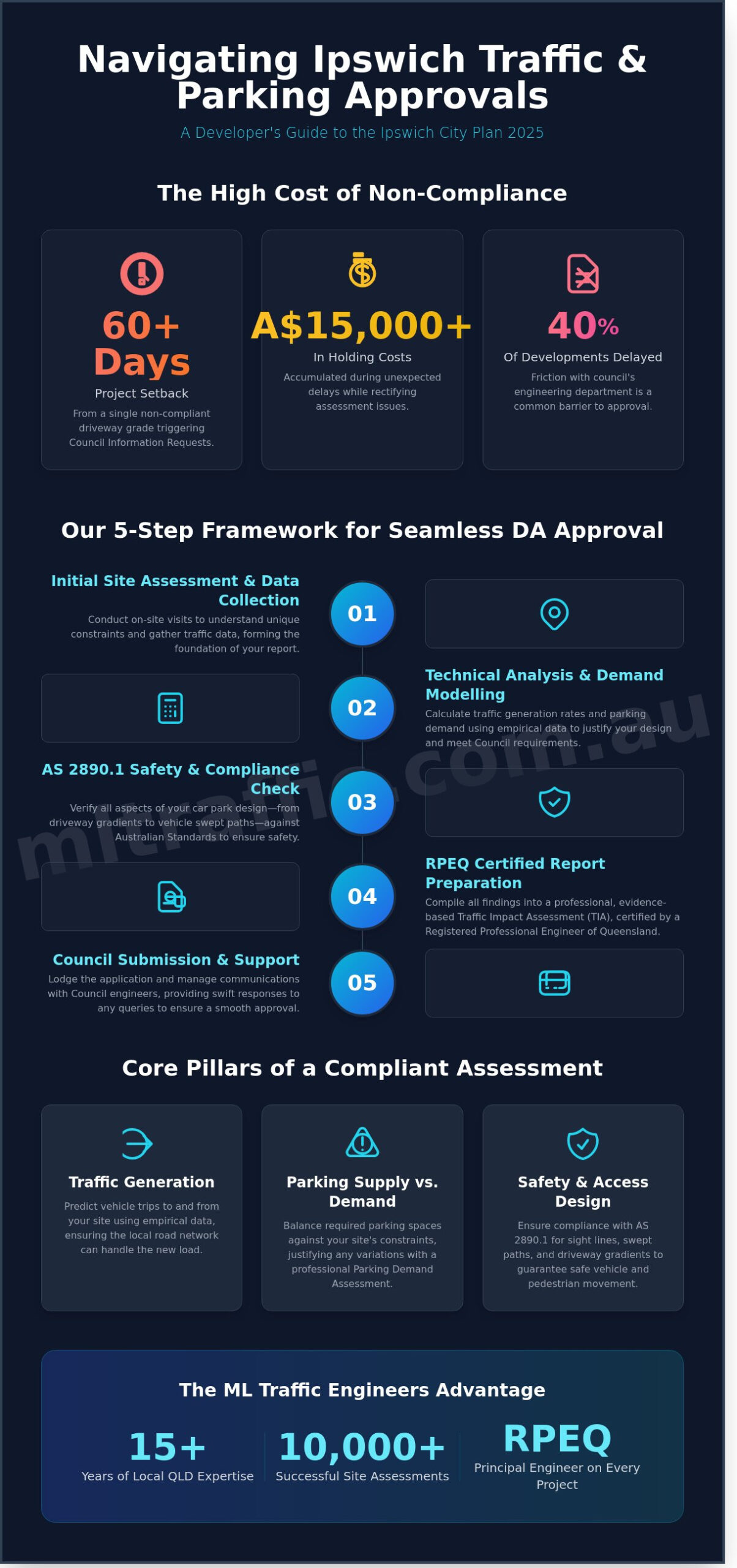
Could a single non-compliant driveway grade in your DA set your project back by 60 days and over A$15,000 in holding costs? Most developers in South East Queensland recognize that even minor deviations from the Ipswich City Plan 2025 trigger exhaustive Information Requests that stall momentum. You likely understand that balancing a high parking yield with site profitability is a difficult task, especially when Council’s engineering department scrutinizes every swept path for compliance. Undertaking Traffic and Car Parking Impact Assessments in Ipswich City Council of Queensland requires more than just ticking boxes. It demands a strategic approach to technical compliance based on data from over 10,000 successful site assessments.
We’re here to ensure your application moves through the system without the typical friction that delays 40% of local developments. This guide provides expert insights on securing traffic and parking approvals while meeting AS 2890.1 standards for optimal car park design. We’ll break down the specific requirements of the 2025 planning scheme and show you how to communicate effectively with Council engineers to achieve a seamless approval. You’ll learn how to present a professional, RPEQ certified case that prioritizes both safety and your bottom line.
Key Takeaways
-
Master the specific requirements of the Ipswich City Plan 2025 to ensure your development meets all technical standards and avoids costly council delays.
-
Learn how to identify the specific project triggers for Undertaking Traffic and Car Parking Impact Assessments in Ipswich City Council of Queensland, helping you determine if you need a full TIA or a simplified statement.
-
Discover how a professional Parking Demand Assessment can justify a reduction in required spaces, balancing Australian Standards (AS 2890) with your site’s unique commercial constraints.
-
Follow our proven 5-step framework for a successful submission, from conducting initial site visits and data collection to navigating the final council approval process.
-
Understand the advantage of working directly with a principal engineer to ensure your traffic report is accurate, compliant, and backed by over 15 years of local Queensland expertise.
Table of Contents
-
What is a Traffic and Car Parking Impact Assessment in Ipswich?
-
Why Partner with ML Traffic Engineers for Your Ipswich Project?
What is a Traffic and Car Parking Impact Assessment in Ipswich?
When you’re planning a project in South East Queensland, you’ll likely encounter a requirement for a technical study known as a Traffic Impact Assessment (TIA). This report evaluates how your proposed development interacts with the existing Ipswich road network and internal parking requirements. It isn’t just a box-ticking exercise; it’s a deep dive into traffic engineering principles to ensure your site doesn’t create a bottleneck. A TIA is a mandatory evidence-based document for any development significantly altering traffic flow in the LGA.
Ipswich City Council relies on these reports to protect local safety and efficiency. If your project adds 40 or 400 trips to the morning peak, the Council needs to know the exact impact on nearby intersections like those along the Warrego Highway or Brisbane Road. Undertaking Traffic and Car Parking Impact Assessments in Ipswich City Council of Queensland ensures that your development aligns with the city’s long-term infrastructure goals while preventing local congestion.
To better understand how Council views these planning decisions, watch this committee meeting snippet:
The Ipswich City Plan 2025 Context
The planning landscape changed significantly on 1 July 2025 when the new Ipswich City Plan 2025 officially replaced the outdated 2004 scheme. This shift reflects the massive population surge in the western corridor, where 500,000 residents are expected by 2041. The new plan moves away from broad categories toward specific ‘Development Codes’ that are much more stringent. You’ll need to reference the ‘Strategic Framework’ to see how your site fits into the broader transport network. This framework dictates infrastructure charges, which can cost developers thousands of A$ if traffic flow isn’t managed correctly from the start.
Key Components of a Standard Assessment
A robust assessment covers three primary pillars to satisfy Council’s RPEQ engineers. First, we calculate traffic generation rates. We don’t guess these numbers; we use empirical data from similar land uses to predict how many vehicles will enter and exit your site. Second, we balance parking demand against supply. You must meet the specific requirements of the Development Code for your zone, whether it’s a high-density residential block in Nicholas Street or an industrial warehouse in Redbank. Finally, safety is paramount for every application. We check the following items against Australian Standards:
-
Sight-line Assessments: Ensuring drivers can see pedestrians and oncoming traffic clearly before exiting the property.
-
Vehicle Swept Paths: Using software to prove a B99 vehicle or a heavy rigid vehicle (HRV) can turn without hitting curbs.
-
Driveway Gradients: Confirming ramp grades meet AS 2890.1 to prevent vehicles from scraping. For example, a transition grade must not exceed 12.5% for certain residential applications.
Undertaking Traffic and Car Parking Impact Assessments in Ipswich City Council of Queensland requires a hands-on approach. At ML Traffic Engineers, we’ve seen over 10,000 sites and understand that the consultant who provides the quote should be the one doing the work. It’s about providing a report that’s dependable, meticulous, and designed to get your DA approved without unnecessary Council RFI (Request for Information) delays.
When Does Ipswich City Council Require a Traffic Report?
Determining whether your project needs a formal traffic submission isn’t always a simple yes or no. Ipswich City Council triggers these requirements based on the scale of your development and how much it intensifies the existing land use. If you’re planning a material change of use (MCU) or reconfiguring a lot (ROL), you’ll likely find yourself Undertaking Traffic and Car Parking Impact Assessments in Ipswich City Council of Queensland to satisfy information requests. Smaller projects might only require a simplified Traffic Statement, while larger developments demand a comprehensive Traffic Impact Assessment (TIA). It’s a matter of volume; a small office addition won’t impact the network like a new 120-place childcare centre would.
The distinction between a Statement and a TIA is critical for your budget and timeline. A Traffic Statement typically addresses basic site access, parking la yout compliance, and minor trip generation. Conversely, a full TIA involves complex intersection modelling and analysis of the broader road network. You’ll certainly need a full TIA for high-impact projects like multi-deck apartments in the CBD or massive industrial warehouses in the 4303 and 4304 postcodes. Council planners look for specific data on how your heavy vehicle movements will affect the pavement life and safety of local connectors.
Every technical report you submit must carry the RPEQ (Registered Professional Engineer of Queensland) seal. This isn’t just a Council preference; it’s a legal requirement under the Professional Engineers Act 2002. Without this certification, your application will stall. At ML Traffic Engineers, we ensure that the engineer who quotes your job is the one who signs off on the final RPEQ certification, providing a direct line of accountability that larger firms often lack. If you’re unsure which report type applies to your site, you can get a direct technical opinion from our senior team.
Assessment Categories and Development Codes
Your report’s depth depends on whether your project is ‘Code Assessable’ or ‘Impact Assessable’. Code assessable developments are measured against the specific benchmarks in the Ipswich City Plan 2025. You must demonstrate strict adherence to the Parking and Access Code, which dictates everything from driveway gradients to the number of visitor bays required. Impact assessable projects face a higher level of scrutiny and public notification. We strongly recommend a pre-lodgement meeting with Council officers to lock down the required scope before you spend a cent on detailed design.
High-Growth Corridors: Springfield and Ripley
Developments in the Springfield and Ripley Valley growth areas face unique hurdles. These regions operate under specific Structure Plans that manage rapid residential expansion. Council is particularly focused on cumulative impacts here; they don’t just care about your 50-lot subdivision, but how it interacts with the 5,000 lots already approved nearby. Managing internal road hierarchies and active transport links is vital in these estates. You can view our specialised services for these high-growth corridors to see how we handle these precinct-wide traffic challenges. We use real-world data to prove your project won’t bottleneck these critical western arteries.
Analysing Parking Demand vs. Australian Standards (AS 2890)
Developers in the Western Corridor frequently encounter a disconnect between the Ipswich City Council Planning Scheme requirements and the physical realities of a site. When undertaking Traffic and Car Parking Impact Assessments in Ipswich City Council of Queensland, we often find that rigid minimum parking rates clash with commercial site constraints. This friction can stall a project before it even leaves the drawing board. We solve this by conducting a formal Parking Demand Assessment. This study uses empirical data and comparative analysis of similar land uses to justify a reduction in the total number of spaces required. It’s about proving that your specific business model won’t overflow into the street, even if you don’t hit the Council’s generic "one size fits all" numbers.
Technical compliance relies heavily on two primary benchmarks: AS 2890.1 for off-street car parking and AS 2890.2 for commercial vehicle facilities. These aren’t just suggestions. They’re the rules of the road for Council engineers and the primary metric used to judge your development application. AS 2890 compliance is non-negotiable for driveway ramp grades and aisle widths. If your design falls short by even a few centimeters, it’s a guaranteed failure during the assessment phase. Our team has handled over 10,000 sites since 2005, so we know how to align your site plan with these rigorous standards while maximizing every square meter of your land.
Vehicle Swept Path Analysis
Council planners won’t take your word that a delivery truck can fit on your site. We use AutoTURN software to provide a definitive Vehicle Swept Path Analysis. This proves that a B99 vehicle or a heavy rigid truck can turn safely within your site’s boundaries. Swept paths are the #1 cause of Council Information Requests (IRs). We eliminate this risk by modeling waste collection vehicles early. This ensures they can access bins and exit in a forward gear without obstructing traffic flow on busy Ipswich roads. If a truck has to reverse out onto a sub-arterial road, your application will likely be refused.
Driveway Ramp Grade Assessments
The hilly terrain in Flinders View and parts of central Ipswich creates significant engineering hurdles. Steep sites require a precise vertical profile design to prevent vehicle scraping at the "breakover" points. We conduct detailed driveway ramp grade assessments to ensure every transition meets the specific maximums allowed under AS 2890.1. For example, a 1:20 grade might be required for the first 6 meters to ensure visibility and safety. Our RPEQ-certified engineers provide the necessary documentation to confirm compliance, preventing costly redesigns after you’ve already started construction. We don’t just find problems; we provide the CAD levels that make the design work.
When you work with ML Traffic Engineers, you’re getting direct access to the experts. The traffic consultant who provides your quote is the one who does the work. We’ve spent decades refining our approach to ensure your project meets the following criteria:
-
User Class Accuracy: We correctly identify whether your site requires User Class 1 for long-term parking or User Class 3 for high-turnover retail.
-
Sight-Line Safety: Ensuring drivers can see pedestrians before crossing the property boundary.
-
Aisle Width Optimization: Balancing Council requirements with the need for efficient parking layouts.
-
Waste Management Integration: Confirming that 12.5-meter heavy rigid vehicles can service the site without incident.
By focusing on these technical details during the initial undertaking Traffic and Car Parking Impact Assessments in Ipswich City Council of Queensland, we help you avoid the back-and-forth of the IR process. We’ve been trading for nearly 20 years because we understand that clarity and compliance are the fastest routes to an approval.
5 Steps to a Successful Traffic Submission in Ipswich
Getting your development application through the approval process requires more than just a basic sketch. It demands a technical roadmap that proves your project won’t gridlock the local street network. When you’re undertaking traffic and car parking impact assessments in Ipswich City Council of Queensland, following a structured process ensures you meet the strict requirements of the 2025 City Plan without unnecessary delays. We’ve refined this process over 20 years to ensure our clients get the results they need.
-
Step 1: Conduct a site visit. We don’t rely solely on Google Maps. A physical inspection identifies existing road conditions, such as the exact location of telecommunications pits, power poles, and street trees that could obstruct a new driveway. We look for constraints that digital data misses, like the actual pavement width and existing verge gradients.
-
Step 2: Collect local traffic data. Council won’t accept assumptions. We gather fresh data, focusing on peak hour counts at nearby intersections between 7:00 AM and 9:00 AM, and 4:00 PM to 6:00 PM. This provides a baseline of the current "Level of Service" on your street.
-
Step 3: Model future traffic generation. We use industry-standard databases like the ITE Trip Generation Manual or the RMS Guide to Traffic Generating Developments. By inputting your specific land use, we can accurately predict how many additional trips your project will add to the Ipswich road network.
-
Step 4: Perform a gap analysis. This is where we compare your architectural design against the Ipswich City Plan 2025 codes. We check every detail, from the number of visitor bays to the specific dimensions of a B99 vehicle swept path. If your design falls short, we find the engineering solution to fix it before lodgement.
-
Step 5: Finalise the RPEQ-certified report. In Queensland, your traffic report must be signed off by a Registered Professional Engineer of Queensland (RPEQ). This certification is a legal requirement that gives Council the confidence to approve your submission.
Avoiding Common Pitfalls
One of the biggest mistakes we see is the use of outdated traffic data. If your data was collected before the 2025 City Plan implementation, it’s likely obsolete. You also need to ensure your sight-line assessments account for local vegetation and street furniture. A beautiful street tree might look great on a landscape plan, but if it blocks a driver’s view of an oncoming cyclist, Council will reject the application. Check our older articles for common DA mistakes to avoid during the design phase.
Responding to Council Information Requests (IRs)
If Council issues a "Request for Further Information" (RFI), don’t panic. These often focus on traffic flow or specific parking shortfalls. The most effective way to handle an IR is to have your traffic engineer talk directly to Council officers. We find that a ten-minute technical phone call can often resolve issues that would take weeks of formal letters to settle. This direct communication is also vital when negotiating infrastructure contributions. If Council asks for a road upgrade that costs A$50,000, we can often demonstrate through data that your project’s impact doesn’t warrant such a high cost, saving you significant capital.
Ready to move your project forward? Contact our senior engineers today for a fixed-price traffic assessment quote for your Ipswich development.
Why Partner with ML Traffic Engineers for Your Ipswich Project?
Choosing a traffic consultant shouldn’t feel like a gamble. At ML Traffic Engineers, we’ve built our reputation on a "Principal-Only" promise that sets us apart from larger, more impersonal firms. This means the senior engineer who assesses your site and provides the initial quote is the same professional who handles every technical detail of the final report. We don’t pass your project off to junior graduates once the contract is signed. This direct accountability ensures that the 15 plus years of experience we’ve gained in Queensland’s unique planning environment is applied to every page of your submission.
Since we began trading in 2005, we’ve successfully completed over 10,000 sites across Australia. This massive volume of work gives us a deep library of precedents to draw from when Undertaking Traffic and Car Parking Impact Assessments in Ipswich City Council of Queensland. Whether you’re developing a childcare centre, a multi-deck apartment complex, or a large scale industrial warehouse, we’ve likely solved similar challenges before. Every report we produce for Ipswich projects includes direct RPEQ certification, ensuring it meets the mandatory professional standards required for Council acceptance.
Local Expertise, National Experience
Ipswich is currently experiencing rapid growth, and its road network is under heavy pressure. We understand the specific bottlenecks where the Warrego and Cunningham Highway interfaces create complex traffic flow issues. These State-controlled road connections often require additional scrutiny from the authorities overseeing the state road network. Our team uses a hands-on approach to cut through the bureaucracy of the new 2025 Plan, ensuring your development isn’t stalled by avoidable information requests. We know what the Council planners are looking for because we’ve been working with them for decades. Contact us for a direct quote on your Ipswich TIA today.
Streamlining Your Approval
One of the biggest risks in any development is a late-stage redesign. A minor error in a driveway ramp grade or a tight turn for a heavy rigid vehicle can force you back to the drawing board. Our meticulous swept path analysis identifies these issues during the design phase, preventing costly modifications that can easily exceed A$25,000 in additional architectural and construction fees. We focus on clear, persuasive communication with Council planners, translating technical data into logical arguments that support your project’s viability.
When you’re Undertaking Traffic and Car Parking Impact Assessments in Ipswich City Council of Queensland, you need a partner who values your time and budget. We’ve refined our process over 10,000 projects to be as efficient as possible without sacrificing the technical rigour that RPEQ certification demands. We’re dependable, meticulous, and focused on getting your project over the line. Ready to start? Learn more about our team and our commitment to professional excellence.
-
Direct access to senior RPEQ engineers throughout the project.
-
Proven experience with over 10,000 successful sites nationwide.
-
Expert knowledge of Ipswich’s 2025 Plan and major state road network interfaces.
-
Accurate swept path analysis to prevent expensive construction redesigns.
-
Fast, direct communication without the overhead of junior account managers.
Secure Your Ipswich Development Approval Today
Navigating the specific requirements of the Ipswich Planning Scheme doesn’t have to be a bottleneck for your project. Success depends on two critical factors: strictly meeting AS 2890 standards and providing data-backed evidence for parking demand. When Undertaking Traffic and Car Parking Impact Assessments in Ipswich City Council of Queensland, precision is your best defense against costly council delays. We’ve seen how a single technical oversight in a swept path analysis can stall a significant development for months.
At ML Traffic Engineers, we bring the expertise of RPEQ Certified Engineers who have assessed over 10,000 sites across Australia since 2005. You won’t be handed off to a junior staff member. Our unique approach ensures the principal engineer who provides your quote is the same expert who completes the technical work. This hands-on involvement ensures your report is accurate, compliant, and ready for immediate submission. We’re here to help you clear the regulatory hurdles so you can start construction sooner.
Get a Professional Traffic Assessment Quote for Your Ipswich Development
Your project deserves the reliability of seasoned experts who understand the local landscape. Let’s get your Ipswich application moving forward with confidence.
Frequently Asked Questions
Does every new business in Ipswich need a traffic assessment?
Not every business requires a full report, but most developments involving a Material Change of Use (MCU) must address the Ipswich Planning Scheme. If your project generates more than 10 vehicle trips per hour, Council will likely request a formal assessment. Small retail fit-outs in existing centers often bypass this, yet new builds or high-intensity uses like childcare and drive-throughs always require professional input to ensure safety.
What is the difference between a TIA and a Swept Path Analysis?
A Traffic Impact Assessment (TIA) evaluates the broad effect of your development on the local road network, while a Swept Path Analysis specifically maps the physical space a vehicle needs to turn. We use specialized software like AutoCAD Vehicle Tracking to prove a 12.5 meter Heavy Rigid Vehicle can enter and exit your site in a forward gear. The TIA focuses on volume and safety; the swept path focuses on physical clearance.
How much does a Traffic Impact Assessment cost in Ipswich for 2026?
For 2026, a standard Traffic Impact Assessment in Ipswich typically costs between A$2,800 and A$7,000 excluding GST. Smaller projects like a 4 unit residential flat may sit at the lower end, while complex commercial sites requiring intersection modeling or 24 hour traffic counts will exceed A$8,500. Our firm ensures the consultant who provides your quote is the one performing the technical work, maintaining total accountability for every dollar spent.
Can I use a generic parking plan for my Ipswich DA?
No, Ipswich City Council will reject generic plans that fail to reference the specific site constraints and the Ipswich Planning Scheme. Your site plan must demonstrate compliance with AS 2890.1 for off-street parking, including exact bay dimensions of 2.6 by 5.4 meters and 5.8 meter aisle widths. Undertaking Traffic and Car Parking Impact Assessments in Ipswich City Council of Queensland requires site-specific data to survive the Information Request stage.
What is an RPEQ, and why does Ipswich City Council require one?
An RPEQ is a Registered Professional Engineer of Queensland, a mandatory legal qualification required under the Professional Engineers Act 2002. Ipswich City Council mandates that an RPEQ signs off on all traffic reports to guarantee the engineering work meets high safety and ethical standards. Without this certification, your traffic assessment holds no legal weight during the Development Application process and will be disregarded by Council officers during their technical review.
How long does it take to prepare a traffic report for Council?
Most traffic reports take between 10 and 15 business days to complete from the moment we receive your final site plans. Complex projects requiring 48 hour tube counts or intersection analysis using SIDRA software might extend to 20 days. We focus on a direct, no-nonsense approach to meet your project deadlines, ensuring all technical documentation is ready for your town planner to lodge with the Development Application promptly.
What happens if my development doesn’t meet the minimum parking requirements?
If your site falls short of the Ipswich Planning Scheme requirements, you must submit a Car Parking Demand Assessment to justify the shortfall. We analyze empirical data from similar land uses or utilize the 85th percentile peak demand to prove the proposed parking is sufficient. Undertaking Traffic and Car Parking Impact Assessments in Ipswich City Council of Queensland allows us to argue for a performance solution, potentially saving you from paying high infrastructure charges.
Does the Ipswich City Plan 2025 change how traffic is calculated?
The Ipswich City Plan 2025 introduces updated trip generation rates and a 15% stronger emphasis on active transport infrastructure like bike lockers and end-of-trip facilities. It shifts focus toward walkable neighborhoods, meaning your assessment must now account for pedestrian connectivity more rigorously than under the 2006 scheme. We stay updated on these 2025 policy shifts to ensure your application remains compliant with the newest Council benchmarks and transport codes.
Which suburbs do you cover?
Amberley, Ashwell, Augustine Heights, Barellan Point, Basin Pocket, Bellbird Park, Blackstone, Booval, Brassall, Brookwater, Bundamba, Calvert, Camira, Carole Park, Churchill, Coalfalls, Collingwood Park, Deebing Heights, Dinmore, East Ipswich, Eastern Heights, Ebenezer, Ebbw Vale, Flinders View, Gailes, Goodna, Goolman, Grandchester, Haigslea, Ipswich, Ironbank, Jeebropilly, Karalee, Leichhardt, Lower Mount Walker, Moores Pocket, Mount Forbes, Mount Mort, Mount Walker West, Muirlea, Mutdapilly, New Chum, Newtown, North Booval, North Ipswich, One Mile, Peak Crossing, Pine Mountain, Purga, Raceview, Redbank, Redbank Plains, Ripley, Riverview, Rosewood, Sadliers Crossing, Silkstone, South Ripley, Springfield Central, Swanbank, Walloon, West Ipswich, White Rock, Willowbank, Woodend, Wulkuraka, Yamanto.
