

Every square metre of your development lost to an unnecessary parking space represents thousands of dollars in forfeited yield. You likely understand the frustration of receiving a Council request for further information (RFI) that stalls your project for months due to a minor technicality in a traffic report. Undertaking Traffic and Car Parking Impact Assessments requires more than just ticking boxes; it demands a strategic engineering approach that balances rigid regulatory requirements with community liveability goals.
At ML Traffic Engineers Australia, we’ll show you how to navigate the relevant planning scheme using expert engineering strategies to secure your DA approval and optimise your development yield. You’ll learn exactly how to handle updated parking rates, when you’ll trigger mandatory Travel Plan requirements, and how to justify parking reductions. This guide provides a clear roadmap through the specific transport overlays and AS 2890 standards that determine the success of your application.
Key Takeaways
- Learn how the Knox Planning Scheme and Clause 52.06 dictate project feasibility and how to avoid common design flaws that lead to Council RFIs.
- Master the process of Undertaking Traffic and Car Parking Impact Assessments in Knox Council to ensure your development meets the June 2026 regulatory updates.
- Optimise your site yield by using Car Parking Demand Assessments to justify reductions in statutory parking requirements where actual demand is lower.
- Utilise Vehicle Swept Path Analysis and AutoTURN simulations to guarantee compliance with AS 2890 standards for internal manoeuvering and driveway access.
- Fast-track your DA approval through direct senior principal involvement, ensuring technical accuracy and accountability throughout the planning process.
The Knox Planning Scheme: Why Traffic Assessments Matter for Your DA
A Traffic Impact Assessment (TIA) is a technical study required for developments that may impact the Knox road network. Under the Knox Planning Scheme, specifically Clause 18 and Clause 52.06, these assessments determine your project’s fundamental feasibility. Traffic engineering principles are applied to ensure your site doesn’t compromise local safety or road capacity. Undertaking Traffic and Car Parking Impact Assessments in Knox Council is a prerequisite for any developer looking to avoid the high cost of RFI delays. It’s a technical necessity that bridges the gap between your architectural vision and Council’s infrastructure requirements.
Inadequate traffic reports are a primary cause of project stagnation. A professional report is a preventative investment, not a luxury. When Council issues a Request for Further Information (RFI), it often adds months to your timeline. Holding costs on a medium-density site can exceed several thousand dollars per week. Knox’s current strategic focus involves balancing vehicle access with the ‘Knox Green Streets’ policy and pedestrian-friendly initiatives. Your report must reflect these local priorities to succeed. If you don’t address these factors during the design phase, you risk losing valuable floor space later to accommodate late-stage Council demands.
Code Assessment vs. Impact Assessment in Knox
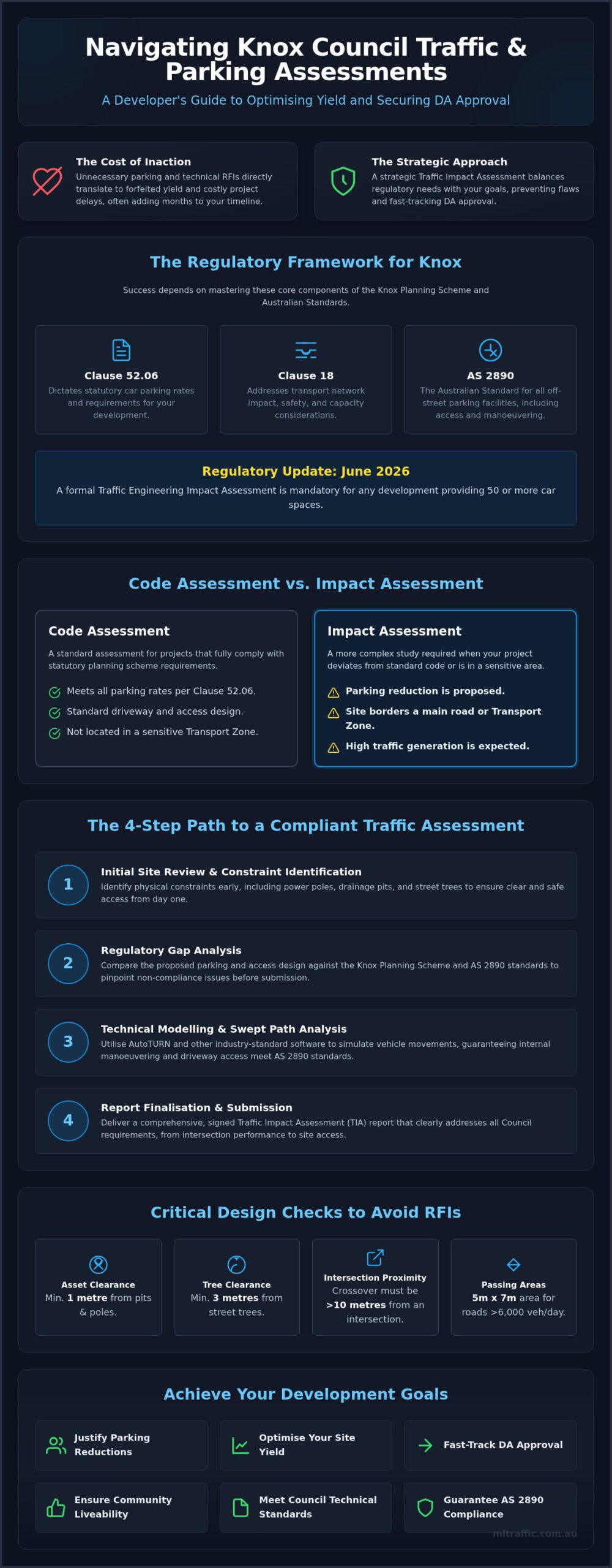
Council distinguishes between standard ‘Code’ assessments and more complex ‘Impact’ assessments. A Code assessment typically applies when you meet every statutory requirement of the planning scheme. However, if your site borders a ‘Transport Zone’ or requires a parking reduction, an Impact assessment is mandatory. Residential developments often face intense scrutiny regarding visitor parking and driveway widths. Commercial projects must focus on intersection capacity and heavy vehicle manoeuvering. We ensure your submission is tailored to the specific level of scrutiny your project will face.
Knox’s Strategic Vision and Your Development
Aligning your TIA with the Knox Community Plan is essential for demonstrating ‘neighbourhood character’ compliance. Council closely monitors traffic generation in high-density activity centres like Westfield Knox and Boronia. Your assessment must prove that the development supports sustainable transport goals without overwhelming existing infrastructure. As of June 2026, the Knox Planning Scheme requires a formal Traffic Engineering Impact Assessment for any development providing 50 or more car spaces. This requirement ensures that large-scale projects don’t create bottlenecks that degrade the local road network’s performance.
Steps to Undertaking a Traffic Impact Assessment in Knox
Moving from a preliminary site plan to a Council-approved development requires a systematic engineering approach. Undertaking Traffic and Car Parking Impact Assessments in Knox Council begins with a rigorous review of your initial layout against Clause 52.06 and AS 2890 standards. The process follows these critical steps:
- Initial Site Review: Identifying physical constraints like power poles, drainage pits, and street trees to ensure the 1-metre asset clearance and 3-metre tree clearance are met.
- Regulatory Gap Analysis: Comparing proposed parking and access against Knox Planning Scheme thresholds, specifically the June 2026 updates.
- Technical Modelling: Simulating traffic flow and vehicle movements using industry-standard software.
- Report Finalisation: Delivering a signed TIA report that addresses intersection performance and site access.
Engaging an expert during the due diligence phase prevents fundamental design flaws that often lead to permit refusals. These flaws include crossovers located within 10 metres of an intersection or inadequate sight distances. Our team identifies these constraints early to ensure your site layout is functional and compliant from the first submission.
Data Collection and Road Hierarchy Analysis
Accurate assessment depends on precise local data. We categorise your site’s frontage as a Link, Collector, or Local road based on Knox City Council’s established road hierarchy. This classification is vital because it determines your site’s access requirements and the acceptable increase in traffic volumes. For driveways connecting to roads with traffic volumes exceeding 6,000 vehicles per day, we must design specific passing areas of 5 metres wide and 7 metres long at the entrance. We establish an accurate baseline by conducting peak hour traffic counts and site observations that reflect current 2026 conditions in the municipality. You can view our full range of technical assessment services to see how we support these early-stage requirements.
Trip Generation and Distribution Models
We apply industry-standard rates to predict your development’s specific traffic footprint. This involves modelling how new vehicle trips will flow onto key Knox arterials such as Burwood Highway, Stud Road, or High Street Road. We address potential bottlenecks at nearby intersections before Council’s engineers identify them in a formal RFI. Our models simulate peak hour distribution to ensure the surrounding transport network maintains its performance. For developments providing 50 or more car spaces, we also prepare the mandatory Travel Plan required under the latest planning updates. This proactive modelling demonstrates to Council that your project won’t compromise local road safety or efficiency.
Car Parking Demand Assessments: Optimising Your Yield
Clause 52.06 parking rates often conflict with the commercial reality of modern Knox developments. While the statutory requirement for a medical centre is 5 spaces per 100 square metres of leasable floor area, actual demand may be significantly lower depending on the specific practice type. Undertaking Traffic and Car Parking Impact Assessments in Knox Council allows you to bridge this gap. A professional demand assessment provides the technical justification needed to reduce parking provision without compromising site functionality.
Protecting your development yield is a primary objective. Every car parking space removed from a basement or ground-floor plan can be converted back into sellable floor area or additional units. We differentiate between a ‘statutory’ requirement, which is a rigid formula, and ‘actual’ parking demand, which accounts for real-world usage patterns. This distinction is the key to maximising your site’s potential, especially under the Knox Planning Scheme last updated on June 16, 2026. If you don’t challenge excessive requirements, you’re essentially leaving money on the table.
Justifying Parking Shortfalls to Knox Council
We use empirical evidence and ‘first principles’ to prove a lower parking rate is sufficient for your specific project. Proximity to high-frequency public transport, such as Boronia or Ferntree Gully railway stations, is a critical factor Council considers for parking waivers. For mixed-use developments, we model shared parking arrangements. This accounts for different peak demand times between residential and commercial users, often allowing for a reduced total number of spaces. We also address the specific visitor parking requirement of 1 space per 5 dwellings, demonstrating how this can be managed efficiently within the site context.
AS 2890.1 Compliance and Design Certification
Design certification ensures every parking space meets the Australian Standard for dimensions and aisle widths. In Knox, a standard 90-degree car parking space must be 2.6m x 4.9m. We must also account for a 300mm manoeuvring clearance when a space is located against a vertical obstruction. We use B85 and B99 vehicle templates to verify that the layout accommodates the 85th and 99th percentile vehicles. This level of technical detail is non-negotiable for securing DA approval. For a deeper look at these requirements, refer to our AS 2890.1 Guide which explains the nuances of compliant car park design. Every garage or carport must also meet the minimum internal dimensions of 6m long and 3.5m wide for a single space to remain compliant.
Swept Path Analysis and Driveway Compliance
Knox Council mandates Swept Path Analysis for almost every development application to ensure vehicle safety and operational efficiency. This technical simulation maps the dynamic path of a vehicle as it turns, proving that your site design can accommodate required vehicle types without striking structures or requiring dangerous multi-point turns. Undertaking Traffic and Car Parking Impact Assessments in Knox Council involves using AutoTURN software to overlay these paths onto your architectural plans. This process identifies conflict points between vehicles and building columns or landscaping early in the design phase, preventing costly modifications after the DA is lodged.
A critical requirement in the Knox Planning Scheme is the forward-entry and forward-exit rule. Vehicles must be able to exit a development in a forward direction if the accessway serves four or more car spaces or connects to a road in a Transport Zone. For commercial vehicles, reversing into roads with 2,000 or more vehicles per day is considered unsafe and is strictly prohibited. We simulate the movements of delivery vans and waste trucks to ensure they can enter, manoeuvre, and leave the site safely. Driveway ramp grades must also comply with AS 2890.1 to prevent vehicles from scraping or ‘bottoming out’ as they transition between the street and the site.
Waste Management and Loading Dock Functionality
For developments with 6 or more dwellings, Knox Council requires waste bin storage and collection to be accommodated within the site boundary. This necessitates a formal Waste Management Plan and a corresponding swept path simulation. We model the path of a Knox Council waste collection vehicle to ensure it can reach the collection point and exit in a forward direction. Proper loading dock design ensures these heavy vehicle movements don’t disrupt resident or visitor parking flow. For a more detailed technical breakdown, you can read our Swept Path Analysis Guide.
Sight Distance and Pedestrian Safety
Safety for Knox pedestrians and cyclists depends on clear sight lines at property boundaries. We assess these lines against the requirements of AS 2890.1, ensuring that drivers exiting the site have an unobstructed view of the footpath. This includes maintaining the required 2.5-metre by 2-metre splay at the exit point. Knox Council views forward-entry and forward-exit as a non-negotiable safety requirement for any accessway serving four or more car spaces. If your site layout requires technical verification, you can contact our senior principals for a direct assessment of your driveway compliance.
Securing Knox Council Approval with Expert Traffic Engineering
The technical quality of your submission directly influences the speed of your DA approval. Undertaking Traffic and Car Parking Impact Assessments in Knox Council is not merely a box-ticking exercise; it’s a strategic negotiation with Council engineers. A high-quality report anticipates potential objections regarding traffic volumes or parking shortfalls and addresses them with empirical data before they become obstacles. This proactive approach reduces the likelihood of complex RFIs that can stall development timelines for months.
Our objective is to ensure your project remains both compliant with AS 2890 standards and commercially viable. We defend every report we produce, providing technical representation during meetings with Knox Council. This involves justifying parking reductions or swept path results based on the most current planning scheme requirements. We don’t just provide a document; we provide a technical pathway to approval that protects your site yield and project momentum.
The Value of Personnel Continuity
Accountability is fundamental to our service delivery. Many larger, impersonal firms rely on junior staff to perform technical modelling, which often leads to errors that Council’s engineers quickly identify. At ML Traffic Engineers Australia, the same senior principal who provides your initial quote performs the technical work and defends it before Council. This ensures no information is lost in transition and provides you with a single point of professional contact. You can learn more about our commitment to this hands-on approach on our About ML Traffic Engineers Australia page.
Next Steps for Your Knox Development
To begin the assessment process, you should prepare a clear set of current site plans and a brief description of the proposed land use. This documentation allows us to provide a fast and accurate fee proposal tailored to your site’s specific challenges. We evaluate several factors to provide an accurate quote, including:
- The proposed number of dwellings or net leasable floor area.
- Site access points and their proximity to existing intersections.
- Required parking provision versus your proposed supply.
- The complexity of required swept path simulations for waste or delivery vehicles.
Early engagement is the most effective way to optimise your site yield and avoid structural redesigns later in the planning process. Contact ML Traffic Engineers Australia for your Knox Council Traffic Assessment to discuss your project requirements with a senior engineer today.
Secure Your Knox Development Approval
Maximising site yield while meeting the rigorous requirements of the Knox Planning Scheme requires a precise engineering strategy. Successful developers understand that a compliant car park design and a robust Car Parking Demand Assessment are not just administrative hurdles; they are tools to protect sellable floor area and prevent project stagnation. By addressing technical constraints like swept path clearances and driveway ramp grades early, you eliminate the risk of costly redesigns during the RFI process.
ML Traffic Engineers Australia provides over 15 years of Australian traffic engineering experience to help you navigate these municipal complexities. When Undertaking Traffic and Car Parking Impact Assessments in Knox Council, our clients benefit from direct access to senior principals who perform the technical work and guarantee AS 2890 compliance. This hands-on approach ensures your project moves through Council with technical authority and professional accountability. We’re ready to help you fast-track your next project. Book a Consultation for Your Knox Development Assessment to ensure your site is optimised for success.
Frequently Asked Questions
When do I need a Traffic Impact Assessment for a Knox Council development?
A Traffic Engineering Impact Assessment is mandatory for any development providing 50 or more car parking spaces under the current Knox Planning Scheme. Council also triggers this requirement for smaller projects if they significantly impact a Transport Zone or a road with high traffic volumes. Engaging an expert early ensures you identify these triggers before lodging your application to avoid costly delays.
Can I reduce the number of parking spaces required by Clause 52.06 in Knox?
Yes, you can apply for a reduction through a formal Car Parking Demand Assessment. This report must justify the shortfall using empirical evidence such as proximity to Boronia or Ferntree Gully railway stations and local shared parking availability. Council evaluates these applications based on the likelihood of multi-purpose trips and the quality of pedestrian and cyclist access provided by the site.
What is a Swept Path Analysis and why is it required for my driveway?
Swept Path Analysis is a technical simulation using AutoTURN software to map the dynamic path of a vehicle as it turns. Knox Council requires this to prove that waste trucks and B85 vehicles can safely navigate your site without striking structural columns. It confirms that vehicles can enter and exit in a forward direction, which is a non-negotiable safety requirement for most developments.
How long does it take to prepare a traffic report for Knox Council?
Preparation times vary depending on project complexity and the requirement for fresh peak hour traffic counts. A standard report typically takes two to three weeks for data collection, modelling, and technical finalisation. Complex sites requiring intersection analysis or extensive swept path simulations for heavy vehicles may require additional time to ensure full compliance with the latest June 2026 planning updates.
Does Knox Council require a Waste Management Plan as part of the traffic report?
Knox Council requires a Waste Management Plan for all developments with six or more dwellings to ensure collection occurs within the site. While it’s a separate document, the traffic report must include the swept path analysis for the collection vehicle. This proves the truck can access the bin storage area and leave the site in a forward direction without compromising resident safety.
What are the most common reasons Knox Council rejects a traffic assessment?
Rejections often stem from technical non-compliance with AS 2890.1 or the Knox Planning Scheme. Common failures include inadequate sight distances at property boundaries, crossovers located within 10 metres of an intersection, or failing to meet the 1-metre asset clearance requirement. Inaccurate trip generation models that underestimate the impact on local intersections also frequently trigger Council refusals or lengthy RFI delays.
How much does a Traffic Impact Assessment cost in Victoria for 2026?
The cost of a Traffic Impact Assessment depends on the scale of the development and the specific technical triggers identified by Council. Factors influencing the fee include the number of intersections requiring analysis and whether a Car Parking Demand Assessment is needed to justify a reduction. Developers should provide their current architectural plans to receive a site-specific fee proposal that covers all regulatory requirements.
What is the difference between a Traffic Management Plan and a Traffic Impact Assessment?
A Traffic Impact Assessment is a planning document used to secure DA approval by predicting a development’s long-term effect on the road network. In contrast, a Traffic Management Plan (or Traffic Guidance Scheme) focuses on temporary safety and vehicle flow during the construction phase. Undertaking Traffic and Car Parking Impact Assessments in Knox Council is the essential first step for establishing the permanent infrastructure requirements of your site.

Disclaimer
The content on www.mltraffic.com.au, including all technical articles, guides, and resources, is provided for general informational and educational purposes only. It is not intended to constitute professional advice in traffic engineering, transportation planning, development approvals, or any other technical or legal field.
While ML Traffic Engineers makes every reasonable effort to ensure the accuracy, completeness, and timeliness of the information published, we do not provide any warranties or representations (express or implied) regarding its reliability, suitability, or availability for any particular purpose. Any reliance you place on the content is strictly at your own risk.
In no event shall ML Traffic Engineers, its directors, employees, authors, or affiliates be liable for any direct, indirect, incidental, special, consequential, or punitive damages (including, without limitation, loss of profits, data, or business opportunities) arising out of or in connection with the use of, or inability to use, any information provided on this website.
The articles and guides on this site are not a substitute for engaging a qualified, registered professional traffic engineer (such as an NPER or RPEQ engineer) to assess your specific project requirements. For tailored advice, compliance assessments, or traffic engineering services, please contact a competent professional.
This disclaimer may be updated from time to time without notice. By accessing or using this website, you agree to be bound by the most current version of this disclaimer.
