

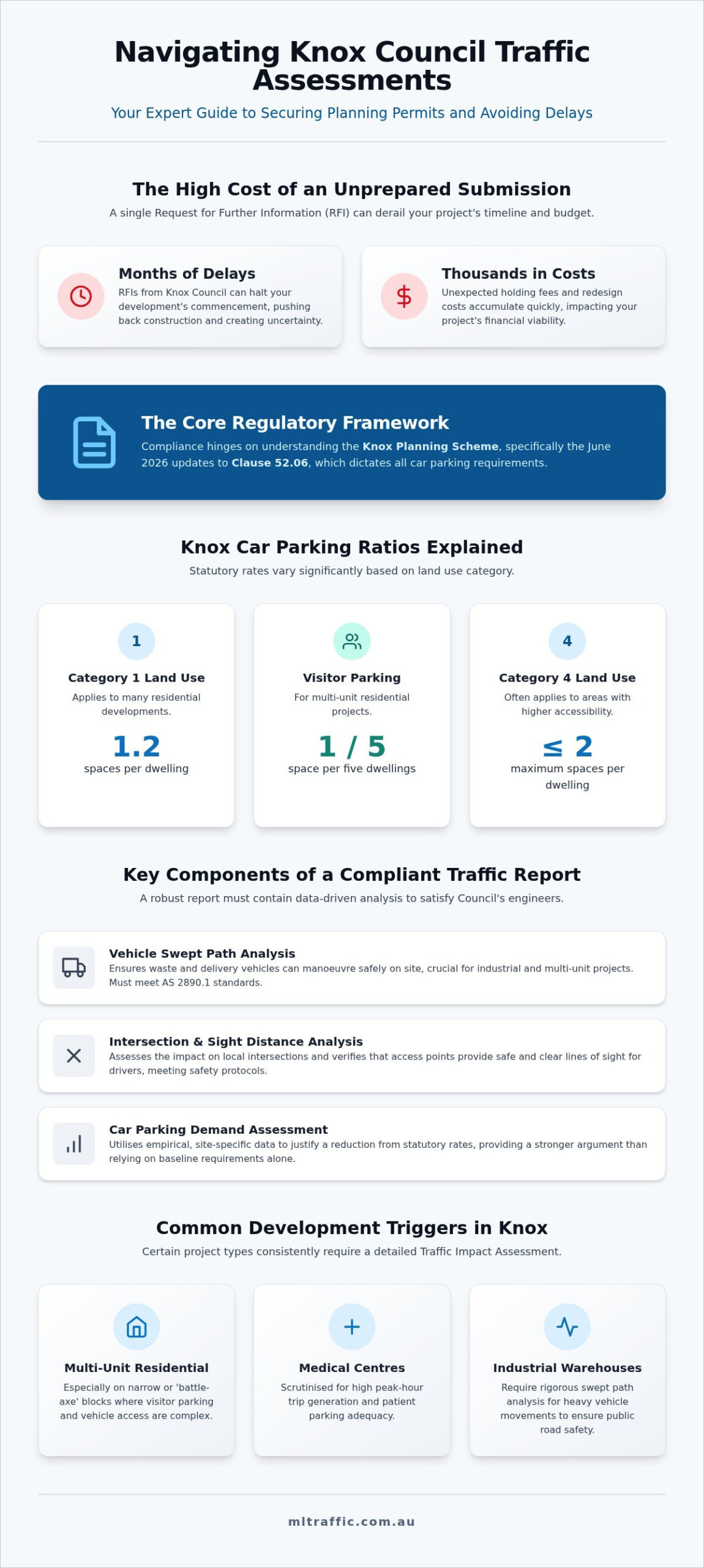
A single Request for Further Information (RFI) from Knox City Council can delay your development’s commencement by months and cost thousands in holding fees. Undertaking Traffic and Car Parking Impact Assessments in Knox Council requires more than just meeting the baseline; it demands a strategic approach to the June 2026 Planning Scheme updates. You likely already know that statutory parking rates, particularly for Category 1 land uses requiring 1.2 spaces per dwelling, can quickly make a site’s footprint unviable. It is frustrating when complex swept path requirements or rigid visitor parking ratios stall a project that should be moving toward construction.
This guide provides the expert traffic engineering insights you need to navigate these hurdles and secure your development approval without unnecessary delays. We will show you how to achieve a compliant TIA report and justify parking reductions under the latest regulatory framework. We’ll cover the updated Clause 52.06-5 standards, the implications of the 2026 Knox Parking Policy review, and the specific technical requirements for vehicle manoeuvres that satisfy Council’s engineering department. You will gain a clear path to your planning permit by leveraging data-driven assessments that stand up to the most rigorous scrutiny.
Key Takeaways
- Navigate the June 2026 Knox Planning Scheme updates to ensure your development meets current statutory requirements and avoids costly project delays.
- Undertaking Traffic and Car Parking Impact Assessments in Knox Council requires a data-driven approach to satisfy Clause 52.06-5 and minimise the risk of Council RFIs.
- Identify strategies for securing car parking reductions by utilising empirical Car Parking Demand Assessments rather than relying solely on standard statutory rates.
- Streamline the planning permit process by integrating precise technical components, including Vehicle Swept Path Analysis and Intersection Analysis, into your submission.
- Leverage over 15 years of consultancy expertise and direct access to senior principals to ensure your traffic report is compliant and results-oriented.
Understanding TIA Requirements in the Knox Planning Scheme
A Traffic Impact Assessment (TIA) is a technical report that evaluates how a proposed land use change or development will influence the surrounding road network. Within the Knox Planning Scheme, which was updated on 16 June 2026, these assessments serve as the evidentiary basis for planning permit approvals. Undertaking Traffic and Car Parking Impact Assessments in Knox Council is a mandatory step for any project that significantly alters traffic generation or seeks a reduction in statutory parking rates. These reports verify that the proposal aligns with the Department of Transport and Planning requirements and local Knox City Council objectives.
The core of these assessments involves Traffic engineering analysis to ensure road safety and network efficiency. Council requires these reports to mitigate the impact of new developments on existing residents and to manage the local transport infrastructure. For larger projects, specifically those providing 50 or more car spaces, a full Traffic Engineering Impact Assessment is triggered. Smaller developments may only require a concise traffic statement or a Car Parking Demand Assessment if they fail to meet the rates specified in Clause 52.06.
To better understand this concept, watch this helpful video:
The Statutory Framework: Clause 52.06 and Knox
Clause 52.06 of the Knox Planning Scheme dictates the minimum and maximum car parking requirements for all developments. The June 2026 updates categorised land into four distinct zones, each with specific parking ratios. Category 1 land uses require 1.2 spaces per dwelling, whereas Category 4 land uses are subject to a maximum cap of 2 spaces. Navigating these variations requires professional expertise to ensure the Traffic Impact Assessment (TIA) Report reflects the correct category. Professional certification is essential, as Knox Council frequently issues Requests for Further Information (RFIs) for reports that lack senior principal oversight or fail to meet Australian Standards such as AS 2890.1.
Common Project Types Requiring Assessment
Several development types in Knox consistently trigger the need for detailed traffic analysis. Multi-unit residential projects on narrow or ‘battle-axe’ blocks must often prove they can accommodate the required visitor parking, which stands at one space per five dwellings. Specialised health consulting rooms and medical centres also require rigorous assessment due to high peak-hour trip generation. Industrial warehouse developments are scrutinised for their ability to handle heavy vehicle movements. These projects must provide a Vehicle Swept Path Analysis to confirm that waste and delivery vehicles can manoeuvre safely within the site boundaries without impacting public road safety.
Technical Components of a Knox Traffic Report
A comprehensive traffic report for Knox City Council must move beyond generalisations to provide site-specific, data-driven evidence. Undertaking Traffic and Car Parking Impact Assessments in Knox Council involves a rigorous step-by-step methodology that begins with existing road network analysis. We perform traffic counts at key intersections and assess current traffic volumes to establish a baseline. This data is then used to calculate trip generation for the proposed development, utilising rates derived from the June 2026 Knox Planning Scheme and empirical data from similar land uses. Safety is the primary objective, necessitating detailed sight distance assessments at all proposed access points to ensure compliance with Australian Standards and local safety protocols.
The technical integrity of the report relies on the accuracy of these calculations. Council engineers scrutinise trip distribution patterns to determine how new traffic will flow through residential streets versus arterial roads. If your project sits near a major activity centre, the analysis must also account for pedestrian movements and public transport interactions. Providing this level of detail upfront reduces the likelihood of an RFI and demonstrates a professional commitment to network safety. For complex sites, a Vehicle Swept Path Analysis during the initial design phase can identify potential access issues before they become permanent permit obstacles.
Vehicle Swept Path Analysis using AutoTURN
Knox Council maintains strict requirements for vehicle manoeuvres, particularly regarding waste collection and delivery services. We utilise AutoTURN software to simulate the movements of B85 and B99 vehicles, ensuring they can enter and exit the site in a forward direction. A common point of failure in Knox applications is the inadequate provision for waste vehicle dimensions. Depending on the specific precinct and development scale, you must demonstrate that a standard 8.8-metre rear loader or a 12.5-metre heavy rigid vehicle can navigate the internal layout without overrunning kerbs or encroaching on designated parking bays. Our reports provide clear, colour-coded templates of these manoeuvres to satisfy Council’s engineering department.
Car Park Design and Ramp Grades
Internal car park functionality is governed by AS 2890.1 and AS 2890.2. Every Knox traffic report must detail parking bay dimensions, aisle widths, and driveway gradients. For residential developments, car spaces in garages must be at least 6 metres long and 3.5 metres wide for single spaces to meet 2026 standards. Driveway ramp grade assessments are critical to prevent vehicle scraping, especially on sloping sites common in parts of the municipality. We calculate the transitions between different gradients to ensure smooth passage. Additionally, we integrate accessible parking requirements under AS 2890.6, ensuring that shared zones and vertical clearances meet the latest Building Code of Australia specifications.
Car Parking Demand Assessments: Arguing for Reductions
Statutory car parking rates within the Knox Planning Scheme are frequently conservative and may not reflect the actual requirements of a modern development. Undertaking Traffic and Car Parking Impact Assessments in Knox Council involves justifying why these reductions are appropriate for the local context. When statutory rates exceed actual demand, they can lead to an over-supply of parking that consumes valuable land and increases construction costs. We bypass generic assumptions by providing empirical evidence from similar land uses to demonstrate that a lower parking provision will not negatively affect the surrounding road network.
Our methodology for a Car Parking Demand Assessment includes surveying nearby proxy sites with similar operational characteristics. This data provides a realistic snapshot of peak parking accumulation, which is often significantly lower than the figures dictated by Clause 52.06. Council is more likely to accept a parking shortfall when it is supported by local data and a clear management plan. The success of your application depends on proving that the proposed parking supply can accommodate the anticipated peak demand without causing overspill into adjacent residential streets.
Statutory Rates vs. Empirical Reality
The following table compares the 2026 statutory rates for Category 1 land uses against typical empirical findings observed in the Knox municipality:
| Land Use | Statutory Rate (Category 1) | Empirical Demand (Observed) |
|---|---|---|
| Office (per 100sqm) | 3.5 spaces | 2.4 spaces |
| Retail (per 100sqm) | 4.0 spaces | 2.7 spaces |
| Dwelling (2-bedroom) | 1.2 spaces | 1.0 space |
Council considers several factors when reviewing a reduction request, including the availability of on-street parking and the site’s proximity to principal public transport networks. Developments near major activity centres can often claim ‘sustainable transport’ credits, arguing that residents or staff are less dependent on private vehicles. Recent policy shifts in Knox also prioritise the inclusion of electric vehicle charging points and car-share spaces as valid justifications for reducing standard parking requirements.
Preparing a Robust Parking Justification
A robust justification must account for the temporal nature of parking demand. In mixed-use developments, for example, the peak demand for an office typically occurs during the day, while residential demand peaks overnight. We utilise shared parking analysis to demonstrate how the same spaces can serve different users at different times, effectively reducing the total number of bays required. This approach maximises site efficiency and supports the project’s commercial viability. Parking demand refers to the total number of vehicles requiring a parking space at a specific site during its peak period of operation, as specified in AS 2890.1.
The Submission Process: Navigating Council Approval
Integrating a technical traffic report into your Development Application (DA) requires precise alignment between the engineering data and your architectural intent. Undertaking Traffic and Car Parking Impact Assessments in Knox Council involves a structured timeline that begins with a comprehensive site visit and manual traffic counts to establish a current baseline. Once this data collection is complete, the analysis phase leads to the production of a formal report for submission to Council. This process ensures that every aspect, from anticipated trip generation to sight distance safety, is documented to meet the 16 June 2026 Knox Planning Scheme standards. A well-prepared report acts as the technical foundation for your permit, reducing the likelihood of objections from internal Council departments.
Knox Council engineers often issue a Request for Further Information (RFI) when submissions lack technical depth or fail to address specific local constraints. Common RFI triggers include inadequate swept path templates or discrepancies in parking bay dimensions compared to the architectural plan set. Effective negotiation with Council officers requires a senior principal who can defend the report’s findings with empirical data rather than generalisations. This direct line of communication between the consultant and the Council engineer is vital for resolving technical disputes and avoiding project delays. ML Traffic Engineers Australia ensures that the person who initiates the technical work is the same expert who handles all subsequent negotiations with Council staff.
Avoiding the RFI: Proactive Reporting
Developers should adhere to a rigorous submission checklist to streamline the approval process and maintain project momentum. In 2026, Knox City Council engineering departments prioritise the following items in their assessments:
- Total consistency between the Traffic Impact Assessment and the latest architectural plan set to avoid conflicting data.
- Verified waste vehicle dimensions for on-site collection, ensuring manoeuvres don’t rely on unrealistic turning circles.
- Clear sight distance diagrams for all proposed vehicle access points, particularly on curved or sloping roads.
- Compliance with AS 2890.1 and AS 2890.6 for all parking layouts, including shared zones and vertical clearances.
Engaging in a pre-application review with a traffic consultant ensures that potential issues are identified and mitigated before the formal submission. This proactive approach demonstrates technical competence to Council and helps establish a clear path to permit issuance without the need for multiple revisions.
Expert Witness and VCAT Representation
If Knox Council refuses an application on traffic or parking grounds, the matter may proceed to the Victorian Civil and Administrative Tribunal (VCAT). In these instances, the traffic engineer serves as an expert witness, providing independent technical evidence to the Tribunal. Our senior principals have extensive experience representing clients at VCAT, ensuring that technical arguments regarding parking reductions or access safety are presented with professional authority. You can access our specialised traffic engineering services for comprehensive VCAT support and expert witness testimony.
To ensure your submission meets all regulatory requirements and avoids costly RFIs, contact the senior principals at ML Traffic Engineers Australia for a compliant assessment.
Why Partner with ML Traffic Engineers Australia for Knox Projects
Selecting the right consultancy is a critical decision in the planning process. ML Traffic Engineers Australia brings over 15 years of consultancy experience to the Knox municipality, providing a level of technical accountability that is often absent in larger, more impersonal firms. Undertaking Traffic and Car Parking Impact Assessments in Knox Council requires a partner who understands the strategic application of national expertise to the specific 2026 Knox Planning Scheme updates. We specialise in securing approvals for complex sites that other firms might deem unviable due to parking shortfalls or manoeuvre constraints.
Our firm is built on the principle of technical excellence and regulatory compliance. We ensure every Traffic Impact Assessment (TIA) Report aligns with AS 2890.1 and AS 2890.2, as well as the local variations unique to Knox City Council. This meticulous attention to detail is designed to achieve first-time Council approval, minimising the risk of a Request for Further Information (RFI) that can stall your project for months. We apply the same rigorous standards to every project, whether it is a small residential subdivision or a large-scale industrial development.
Direct Principal Involvement
Our ‘no-gatekeepers’ promise means you have direct access to senior leadership throughout the project lifecycle. This continuity is vital for complex planning negotiations where technical history and accountability can determine the success of a permit application. The same expert who initiates the client relationship will be the one performing the technical work and defending the findings to Council engineers. This hands-on approach distinguishes us from firms that delegate technical tasks to junior staff. You can learn more about our senior engineering team and our commitment to professional accountability.
Comprehensive Service Offering
We provide a full suite of technical assessments required by Knox City Council. This integrated approach ensures that your traffic, parking, and waste management requirements are coordinated and consistent across all submission documents. Our project history covers a vast range of practical environments, including:
- Multi-unit residential developments and subdivisions.
- Medical centres and specialised health consulting rooms.
- Childcare centres and educational facilities.
- Industrial warehouses and commercial office developments.
- Retail precincts and mixed-use activity centres.
Our technical capabilities include Vehicle Swept Path Analysis, Car Parking Demand Assessment, Driveway Ramp Grade Assessment, Intersection Analysis, and Waste Management Plans. To discuss your specific project requirements, Contact ML Traffic Engineers Australia to speak directly with a senior principal.
Securing Your Development Permit in Knox City
Navigating the technical landscape of the 2026 Knox Planning Scheme requires a meticulous approach to regulatory compliance. Undertaking Traffic and Car Parking Impact Assessments in Knox Council is a strategic requirement to ensure your project remains commercially viable. By leveraging empirical data to justify parking reductions and utilising precise swept path simulations, you can bypass the standard bureaucratic hurdles that often stall local applications. Establishing this technical weight early in the design phase is the most effective way to secure your permit without the burden of multiple RFI cycles.
ML Traffic Engineers Australia provides over 15 years of expert consultancy with a promise of direct access to senior principals for every project. Our assessments are fully compliant with AS 2890.1 and AS 2890.2, providing the authoritative evidence required for Council approval or VCAT representation. We maintain a strict focus on results, ensuring the person who initiates your report is the same expert who defends it throughout the planning process. Secure your Knox Council approval—contact our senior traffic engineers today. We look forward to facilitating your next successful development in the Knox municipality.
Frequently Asked Questions
When is a Traffic Impact Assessment required for a Knox development?
A Traffic Impact Assessment is required for any development providing 50 or more car spaces or for projects that significantly alter local traffic flow. Council also triggers this requirement for land-use changes that seek a reduction in statutory parking rates or involve complex access arrangements. These reports provide a technical evaluation of traffic generation and ensure that the proposed development does not negatively impact road safety or the efficiency of the surrounding network.
What is Clause 52.06 and how does it affect my parking requirements?
Clause 52.06 is the primary regulatory provision in the Planning Scheme governing car parking across Victoria. It sets out the number of spaces required for different land uses and the design standards for car parks. The June 2026 update for Knox introduced land categories that dictate specific minimum and maximum parking ratios. Every development must comply with these rates or provide a formal justification for a variation through a professional technical report.
Can I get Council approval for fewer parking spaces than the scheme requires?
Yes, you can apply for a reduction in the required number of car parking spaces by submitting a Car Parking Demand Assessment. This report must provide empirical evidence, such as surveys of similar sites or proximity to high-frequency public transport, to justify the shortfall. Undertaking Traffic and Car Parking Impact Assessments in Knox Council allows developers to prove that the actual demand is lower than the conservative statutory rates often found in the scheme.
What is a Swept Path Analysis and why does Knox Council ask for it?
A Vehicle Swept Path Analysis uses specialised software like AutoTURN to simulate the path of a vehicle as it manoeuvres through a site. Council requires this to ensure that cars, delivery trucks, and waste collection vehicles can enter and exit in a forward direction without hitting kerbs or other structures. It is a critical component for verifying compliance with AS 2890.1 and ensuring the safety of all road users within the development layout.
How long does it take to prepare a traffic and parking assessment in 2026?
The preparation time typically ranges from two to four weeks depending on the complexity of the project and the data collection requirements. This period includes conducting site visits, performing manual traffic counts, and completing the technical analysis. For projects requiring intersection modelling or extensive parking surveys at proxy sites, the timeline may extend. Providing accurate architectural plans early in the process is essential for maintaining an efficient and reliable delivery schedule.
Does ML Traffic Engineers provide VCAT representation for traffic matters?
Yes, our senior principals provide expert witness testimony and representation at VCAT for matters related to traffic and parking. We offer independent technical evidence to support your application if Council refuses a permit or imposes restrictive conditions. Our team has extensive experience in defending Car Parking Demand Assessments and TIA reports before the Tribunal, ensuring that engineering arguments are presented with professional authority and the required technical rigour for legal proceedings.
What are the standard car park aisle widths for Knox Council compliance?
Standard aisle widths are generally 6.4 metres for 90-degree parking bays to comply with AS 2890.1 standards. However, these dimensions can vary based on the width of the parking spaces and the angle of the bays. For example, wider bays may allow for slightly narrower aisles in specific circumstances. Every layout must be checked against the latest standards to ensure that vehicles can safely manoeuvre without excessive turns or risk of collision with other vehicles.
How much does a professional traffic impact report cost?
The cost of a professional report varies based on the scale of the development and the specific technical requirements, such as swept path analysis or intersection modelling. Each project is unique, and fees reflect the time required for data collection, analysis, and principal-led reporting. We provide tailored quotes based on your specific site constraints and the complexity of the Council requirements. Detailed assessments ensure your project avoids the costly delays of an RFI cycle.

Disclaimer
The content on www.mltraffic.com.au, including all technical articles, guides, and resources, is provided for general informational and educational purposes only. It is not intended to constitute professional advice in traffic engineering, transportation planning, development approvals, or any other technical or legal field.
While ML Traffic Engineers makes every reasonable effort to ensure the accuracy, completeness, and timeliness of the information published, we do not provide any warranties or representations (express or implied) regarding its reliability, suitability, or availability for any particular purpose. Any reliance you place on the content is strictly at your own risk.
In no event shall ML Traffic Engineers, its directors, employees, authors, or affiliates be liable for any direct, indirect, incidental, special, consequential, or punitive damages (including, without limitation, loss of profits, data, or business opportunities) arising out of or in connection with the use of, or inability to use, any information provided on this website.
The articles and guides on this site are not a substitute for engaging a qualified, registered professional traffic engineer (such as an NPER or RPEQ engineer) to assess your specific project requirements. For tailored advice, compliance assessments, or traffic engineering services, please contact a competent professional.
This disclaimer may be updated from time to time without notice. By accessing or using this website, you agree to be bound by the most current version of this disclaimer.
