

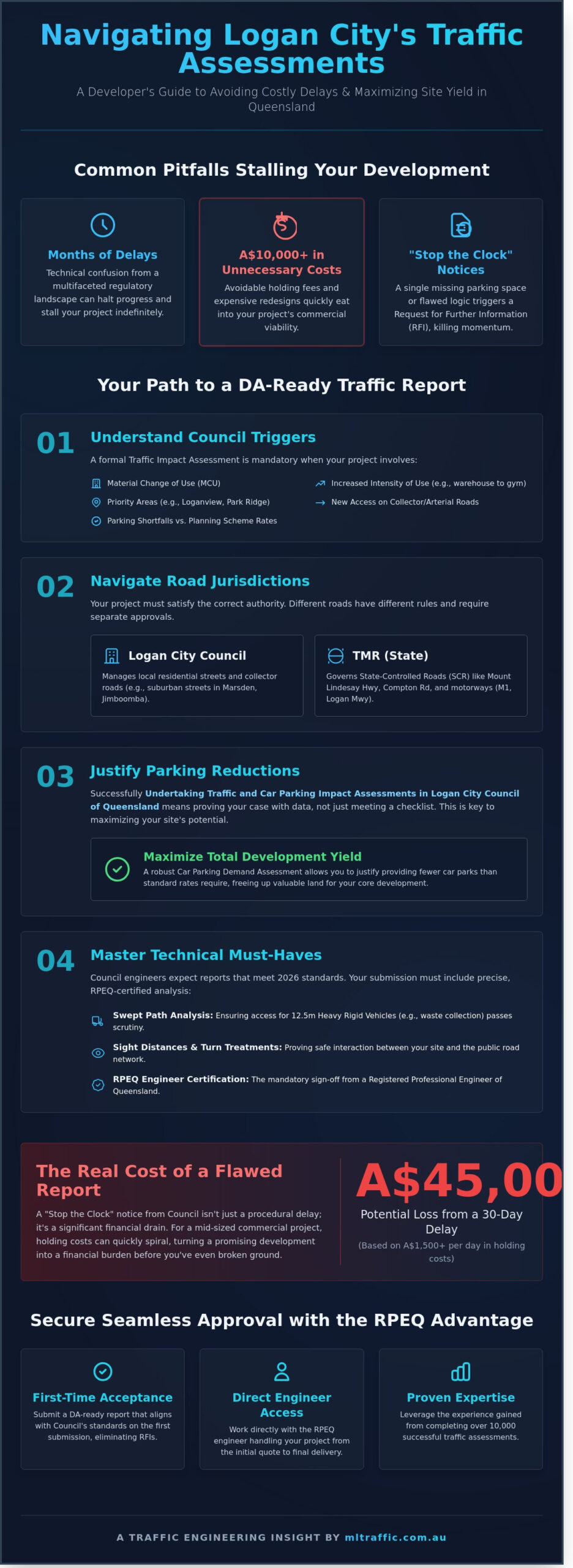
What if your next Logan City development wasn’t stalled by a single missing parking space or an avoidable RFI? You likely already know that strict parking rates and insufficient data are the fastest ways to make a promising project unviable. Undertaking Traffic and Car Parking Impact Assessments in Logan City Council of Queensland shouldn’t feel like a bureaucratic gamble. Since 2005, we’ve observed how technical confusion arising from the multifaceted regulatory landscape can lead to months of expensive delays. It’s a common pain point that often costs developers upwards of A$10,000 in unnecessary holding fees and avoidable redesigns.
You deserve a DA-ready traffic report that Council accepts on the first submission. This guide provides expert engineering insights to help you navigate these complexities and justify the parking reductions necessary to maximize your site yield. We’ll explore the specific 2026 requirements and show you how direct communication with an engineer who has completed over 10,000 assessments ensures your project stays on track. We are going to break down exactly how to bridge the gap between engineering standards and commercial reality to get your project moving.
Key Takeaways
-
Learn exactly when a Material Change of Use (MCU) triggers a formal Traffic Impact Assessment and how to align your project with the specific requirements of the Logan Planning Scheme.
-
Discover how to navigate the jurisdictional differences between local council roads and State-Controlled Roads to ensure your application meets the Department of Transport and Main Roads (TMR) standards.
-
Master the process of Undertaking Traffic and Car Parking Impact Assessments in Logan City Council of Queensland to successfully justify parking reductions and maximize your site’s total development yield.
-
Identify the technical "must-haves," including Swept Path Analysis for 12.5m Heavy Rigid Vehicles, to ensure your waste collection and access designs pass Council scrutiny the first time.
-
Understand why partnering with an RPEQ-certified engineer who handles your project from the initial quote to final delivery is the most reliable way to secure a seamless DA approval.
Table of Contents
Why You Need a Traffic Impact Assessment in Logan City Council
A Traffic Impact Assessment (TIA) is a specialized technical report required by the Logan City Council to evaluate how a proposed development affects the existing transport network. It isn’t just a box to tick; it’s a core requirement of the Logan Planning Scheme 2015. When you’re Undertaking Traffic and Car Parking Impact Assessments in Logan City Council of Queensland, you’re proving to Council that your project won’t cause gridlock or safety hazards. This process relies on established traffic engineering principles to model vehicle movements and parking demand accurately.
Logan is growing rapidly. Council engineers have tightened their requirements to meet 2026 engineering standards, meaning "near enough" or "standard estimates" don’t pass muster anymore. You need precise data. The Logan PD Hub is your starting point. This digital tool helps determine your assessment category by identifying if your site sits within a constrained area or overlaps with future road widening plans. If your development triggers a Material Change of Use (MCU), the PD Hub will often flag the need for a formal traffic report before you even lodge your application.
Council expects reports to be prepared by qualified RPEQ engineers. They look for specific details on how your site interacts with the street, including sight distances and turn treatments. If your data is sloppy, the application will likely stall. Professional assessments ensure that your site layout works for both the end user and the public passing by on the street.
Common Triggers for Logan Traffic Reports
Not every small renovation needs a full TIA, but specific triggers make them mandatory. Council prioritizes safety and flow, especially in high-growth corridors. Common triggers include:
-
Increased intensity of use: Converting a low-traffic warehouse into a high-turnover retail hub or a 24-hour gym.
-
New access points: Any proposal to create a driveway on a busy local collector or an arterial road like Wembley Road or Loganlea Road.
-
Priority areas: Developments within the Loganview or Park Ridge priority infrastructure areas where the road network is already under pressure from rapid expansion.
-
Parking shortfalls: Any time your design provides fewer car parks than the Logan Planning Scheme rates require.
The Cost of Non-Compliance: RFIs and Delays
A poor traffic report is a fast track to a "Stop the Clock" notice. When Council identifies missing data or flawed logic, they issue a Request for Further Information (RFI). This doesn’t just hurt your pride; it hurts your bank account. For a mid-sized commercial project in Logan, holding costs can easily exceed A$1,500 per day in interest and overheads while your application sits in limbo. A 30-day delay caused by a technical oversight can cost you A$45,000 before you’ve even broken ground.
Beyond the financial hit, constant disputes with Council engineers damage your reputation as a developer. It’s far more efficient to get the technical details right the first time. For expert guidance that avoids these pitfalls, you can contact ML Traffic Services for early-stage advice. Their team ensures your Undertaking Traffic and Car Parking Impact Assessments in Logan City Council of Queensland meets every RPEQ standard, keeping your project on schedule and within budget.
Logan Council vs. TMR: Navigating Road Jurisdictions
Developing property in Logan requires serving two distinct masters. You have the Logan City Council managing local residential and collector streets, while the Department of Transport and Main Roads (TMR) governs State-Controlled Roads (SCR). Distinguishing between the two is the first step in any project. Successfully undertaking Traffic and Car Parking Impact Assessments in Logan City Council of Queensland requires a clear map of these jurisdictions. If your site fronts a major artery like the Mount Lindesay Highway or Compton Road, you’re dealing with TMR. If it’s a suburban cul-de-sac in Marsden or a local street in Jimboomba, Council holds the reins.
Developments situated near the Pacific Motorway (M1) or the Logan Motorway face dual-scrutiny. This isn’t just a matter of double the paperwork; it’s about meeting two different sets of engineering standards simultaneously. TMR utilizes the Guide to Traffic Impact Assessment (GTIA) framework, which focuses on the safety and efficiency of the state network. Meanwhile, Council focuses on local amenity and the Logan Planning Scheme requirements. We coordinate with both authorities from day one. This proactive approach prevents the common "ping-pong" effect where one authority approves a driveway location that the other rejects.
Working with the Logan Planning Scheme
Logan’s local requirements are governed by specific transport network and active transport overlays. You must meet the Desired Standard of Service (DSS) for local intersections, ensuring that your project doesn’t push a local junction beyond its capacity. For many developers, the challenge lies in Logan’s specific Operational Work requirements. This includes detailed designs for "Verge and Road" works that must align with Council’s standard drawings. We ensure every Sight-Line Assessment and driveway ramp grade meets these local benchmarks to avoid costly redesigns during the construction phase.
When TMR Steps In: State-Controlled Road Impacts
TMR’s involvement is triggered when a development meets certain "significant impact" thresholds. Generally, if your project increases traffic on a state-controlled road by more than 5%, or if it’s within 100 meters of a state-controlled intersection, TMR will become a referral agency. For projects reaching completion in 2026, TMR now requires rigorous SIDRA modeling to forecast intersection delays a decade into the future.
-
SIDRA Modeling: Required for any development impacting state-controlled intersections to prove post-development queues don’t block through-traffic.
-
Pavement Impact Assessments: Essential for heavy vehicle developments, such as warehouses or distribution centers, to calculate the accelerated wear on state road surfaces.
-
Active Transport: TMR often demands upgrades to cycleways or pedestrian crossings that go beyond Council’s standard requirements.
When undertaking Traffic and Car Parking Impact Assessments in Logan City Council of Queensland for industrial sites, pavement impact is often the most overlooked cost. A 20,000 square meter warehouse can trigger significant monetary contributions for road wear. Our team calculates these impacts precisely, ensuring you aren’t overcharged by the state.
At ML Traffic Engineers, we believe the traffic consultant who provides the quote should be the one who does the work. This hands-on accountability is why we’ve successfully managed over 10,000 sites across Australia. If you’re unsure whether your site falls under Council or TMR jurisdiction, contact our senior engineers for a preliminary review of your site’s road frontage and access requirements.
Car Parking Demand Assessments: Maximizing Your Site Yield
Every square metre of your development site represents potential revenue. When you follow the Logan City Council Planning Scheme’s ‘Schedule 6’ parking rates blindly, you’re often over-supplying parking at the expense of sellable floor space. In Logan, the cost to construct a single basement parking space typically ranges from A$45,000 to A$60,000. If an expert assessment identifies that your site actually requires 10 fewer bays than the standard rate suggests, you’ve just saved A$450,000 or more in construction costs. This is why Undertaking Traffic and Car Parking Impact Assessments in Logan City Council of Queensland is a strategic financial decision, not just a regulatory hurdle.
Council’s default rates are designed to be conservative to prevent overspill onto local streets. However, these rates don’t always reflect how people actually move. For instance, the 2026 public transport proximity targets mean that sites within 400 metres of a high-frequency bus corridor or a rail station like Loganlea or Woodridge can often qualify for significant parking credits. We look at the empirical data to prove that your specific demographic or location doesn’t need the "one size fits all" approach dictated by Schedule 6.
The AS 2890.1 Compliance Check
Standard bay dimensions of 2.4m by 5.4m are just the beginning. We assess your layout based on ‘User Class’ requirements. A Class 1 residential bay has different maneuvering needs than a Class 3 high-turnover retail bay. One of the most common reasons for council rejection is the ‘blind-aisle’ turnaround. If an aisle extends more than six spaces deep without a dedicated turning area, it fails AS 2890.1 standards. We ensure your design works the first time. You can learn more About our parking expertise and how we prevent these costly design revisions.
Justifying Shared Parking for Mixed-Use
Mixed-use developments offer the best opportunity for parking reductions through diurnal demand patterns. Residential parking demand peaks at 2:00 AM when everyone is home. Retail and office demand peaks at 11:00 AM or 2:00 PM when residents are away at work. By Undertaking Traffic and Car Parking Impact Assessments in Logan City Council of Queensland, we can demonstrate that the same physical bays can serve different users at different times.
-
Empirical Data: We use surveys from similar Logan-based developments to show actual peak occupancy often sits 20% lower than Council estimates.
-
Active Transport: We factor in the impact of end-of-trip facilities. Secure bike storage and scooter charging stations can legally reduce your car parking requirements by encouraging modal shifts.
-
Reciprocal Rights: We draft the shared parking agreements that satisfy Council’s legal requirements for permanent access.
It’s a simple equation. An A$6,000 Parking Demand Assessment that removes the need for an entire basement level provides a massive return on investment. At ML Traffic Engineers Pty Ltd, the consultant who provides your quote is the one who performs the technical work. We don’t hand your project to a junior staffer. We use our 35 years of experience to find the "sweet spot" where your site remains functional, compliant, and, most importantly, profitable.
Technical Must-Haves: Swept Paths and Access Design
Logan City Council doesn’t leave vehicle movement to chance. When you’re undertaking traffic and car parking impact assessments in Logan City Council of Queensland, the technical drawings often carry more weight than the written report. Council engineers require a Vehicle Swept Path Assessment to prove that the largest expected vehicle can navigate your site without hitting curbs, parked cars, or structural columns. If your design looks tight on paper, it’ll likely fail in reality, which is why we use precision modeling to verify every turn.
The most significant hurdle for most developers is waste collection. Logan’s planning scheme typically demands that service vehicles, specifically the 12.5m Heavy Rigid Vehicle (HRV), enter and exit the site in a forward gear. This requirement often dictates the entire layout of a basement or loading bay. We’ve seen projects stalled for months because a turning circle was just 200mm too narrow for a standard refuse truck. Getting these dimensions right during the initial design phase saves you from expensive redesigns later.
Safety at the property boundary is another non-negotiable. We conduct rigorous sight-line assessments to ensure drivers exiting the property can see pedestrians and oncoming traffic. Following AS 2890.1, we implement the 2.0m by 2.5m clear sight triangles at the exit point. In high-density areas of Logan, where street trees or power poles might obstruct the view, this assessment becomes a critical safety barrier that protects you from future liability.
Using AutoTURN for Council Approval
Static diagrams and manual circles are no longer accepted by Logan engineers. We use AutoTURN software to create dynamic simulations of vehicle movements. This technology allows us to visualize the exact path of a 12.5m HRV or a B-double as it maneuvers through your car park or loading dock. It provides the "ghost" path that proves clearance. You can see these simulations in action by viewing our Technical Videos for swept path examples. These digital models provide the level of certainty Council demands for complex developments.
Driveway and Access Compliance
Steep sites in suburbs like Cornubia or Shailer Park present unique challenges for driveway ramp grades. We provide detailed longitudinal sections to ensure your driveway complies with AS 2890.1. If the transition between the road and your ramp is too sharp, vehicles will scrape their undercarriages. While Council has standard drawings for driveways, we often develop custom engineering solutions to solve "bottoming out" issues on difficult terrain. This level of detail is essential when undertaking traffic and car parking impact assessments in Logan City Council of Queensland to ensure the site is actually functional.
Don’t risk a Council refusal because of a tight turning circle or a steep driveway. Our team has over 30 years of experience ensuring site designs meet every technical requirement. We identify these "deal-breakers" early so your development application moves forward without friction. Every millimeter counts when you’re dealing with heavy vehicles and strict Australian Standards.
Ready to verify your site layout? Contact our RPEQ-certified engineers for a detailed swept path assessment today.
The ML Traffic Advantage: RPEQ-Certified Success in Logan
Success in a Logan City Council Development Application (DA) often hinges on the technical precision of your engineering reports. Since 2005, our team has helped developers navigate the specific requirements of the Logan Planning Scheme with a focus on practical, cost-effective outcomes. When you are Undertaking Traffic and Car Parking Impact Assessments in Logan City Council of Queensland, you aren’t just looking for a document; you’re looking for a project approval. This requires a deep understanding of how local council engineers evaluate access, safety, and parking demand.
In Queensland, RPEQ certification isn’t just a badge of quality. It’s a legal requirement. Under the Professional Engineers Act 2002, any professional engineering service in Queensland must be carried out or directly supervised by a Registered Professional Engineer of Queensland (RPEQ). If your traffic report lacks this certification, Logan City Council will likely reject the submission immediately. We provide that essential RPEQ sign-off, ensuring your report carries the necessary legal and professional weight to be accepted by Council’s assessment team.
Most large consultancy firms operate on a "bait and switch" model. A senior partner might show up to the initial meeting, but the actual analysis is often handed off to a junior graduate. We find that approach leads to errors and missed opportunities for site optimization. At ML Traffic Engineers Pty Ltd, we stand by our "Principal-Led" promise. The engineer who reviews your site and provides your fixed-fee quote is the same expert who performs the vehicle swept path analysis and writes the final report. This ensures that 30 to 40 years of individual experience is applied to every driveway grade and parking layout we touch.
We’ve spent over 18 years dealing directly with Logan City Council’s engineering department. We’ve seen the evolution of their planning policies and understand their specific concerns regarding the Logan Planning Scheme Policy 5 (Infrastructure). This history allows us to anticipate potential Information Requests (IRs) before they are issued. By addressing these issues in the first submission, we save our clients significant time and thousands of dollars in holding costs.
Direct Access to Senior Expertise
You won’t find any gatekeepers or administrative layers when you call our office. You get direct access to Michael Lee or Benny Chen. This "no-nonsense" communication style is vital when 10,000+ completed sites across Australia inform every recommendation we make. Our accountability is total. We don’t just deliver a PDF and disappear. We stand by our reports during Council negotiations, ensuring your development yield isn’t compromised by overly conservative traffic requirements. We’ve worked on everything from small unit blocks to massive industrial warehouses, giving us a broad perspective on what works for Logan’s unique road network.
Next Steps for Your Development
The most effective way to start is with an initial site review. This allows us to catch "DA killers" like non-compliant sight-lines or impossible driveway gradients before they become permanent fixtures of your design. We coordinate directly with your Town Planner to ensure our traffic data supports the broader planning narrative, creating a seamless submission package. If you’re ready to secure your approval, you can Contact ML Traffic Engineers Pty Ltd for a Logan-specific quote. We offer fixed-fee pricing for Undertaking Traffic and Car Parking Impact Assessments in Logan City Council of Queensland, giving you 100% budget certainty for your engineering costs from the very beginning.
Secure Your 2026 Development Approval in Logan
Navigating the 2026 development landscape requires more than just a basic report. You’ve got to manage the specific, often conflicting requirements of both Logan City Council and the Department of Transport and Main Roads (TMR) to avoid costly RFI delays. Our team brings over 15 years of local experience to your project, ensuring every swept path and parking demand assessment meets strict Australian Standards. We focus on maximizing your site yield while maintaining full safety compliance across every square metre of your layout.
The traffic consultant who provides your quote is the same RPEQ-certified engineer who completes the technical work. This direct, hands-on approach has helped us successfully deliver over 10,000 sites across Queensland since 2005. When you’re Undertaking Traffic and Car Parking Impact Assessments in Logan City Council of Queensland, having direct access to principal consultants like Michael Lee and Benny Chen makes the difference between a stalled application and a fast-tracked approval. We don’t hide behind junior staff or gatekeepers; you get senior expertise from day one. Let’s ensure your Logan project stays on schedule and within budget.
Get a fixed-fee quote for your Logan Traffic Assessment today and let’s get your development moving forward with confidence.
Frequently Asked Questions
How much does a Traffic Impact Assessment cost in Logan City?
A standard Traffic Impact Assessment for a Logan development generally costs between A$2,500 and A$6,000 depending on the project’s scale. Small scale commercial sites sit at the lower end of this range. Complex multi-residential projects that require extensive intersection modeling or SIDRA analysis reach the higher bracket. We provide a fixed quote so you know the exact cost before we start. The consultant who quotes your job is the one who completes the technical work.
Does Logan City Council allow for parking reductions near train stations?
Logan City Council allows for parking reductions of up to 20% for developments located within 400 meters of a railway station. This provision is part of the Logan Planning Scheme 2015 to encourage public transport use in Transit Oriented Development zones. You’ll need a Car Parking Demand Assessment to justify any proposed shortfall. We use empirical data from similar sites to prove that the lower rate won’t impact local street capacity or safety.
What is an RPEQ engineer and why do I need one for my traffic report?
An RPEQ is a Registered Professional Engineer of Queensland, which is a mandatory qualification under the Professional Engineers Act 2002. You need one because Logan City Council won’t accept traffic reports unless they’re signed off by a registered professional. It ensures your Undertaking Traffic and Car Parking Impact Assessments in Logan City Council of Queensland meets all relevant safety and engineering standards. Our senior engineers have over 30 years of experience and hold current RPEQ registration.
How long does it take to prepare a DA-ready traffic report?
Preparing a DA-ready traffic report usually takes between 10 and 15 business days. This timeframe allows for site inspections, traffic counts, and the technical analysis required for a formal council submission. If your project involves complex intersection modeling, it might take closer to 20 days to ensure every detail is accurate. We focus on efficiency to ensure your development application stays on schedule without sacrificing the technical quality council expects.
Can I use a NSW traffic engineer for a Queensland development?
You can only use a NSW traffic engineer if they hold a valid RPEQ registration. Engineering is a strictly regulated profession in Queensland, and practicing without local registration is a breach of state law. While many firms work across borders, we’ve focused on the Queensland market since 2005. This local focus means we understand the specific nuances of the Logan Planning Scheme and the preferences of the council’s assessment officers.
What happens if TMR objects to my development in Logan?
If the Department of Transport and Main Roads (TMR) objects, you’ll need to revise your plans to meet the State Controlled Roads Co-contribution Policy. This frequently happens if your site is near a major artery like the Pacific Motorway or Logan Motorway. We negotiate directly with TMR technicians to find a practical middle ground. Usually, this involves modifying driveway locations or adding a dedicated turn lane to maintain the safety of the state controlled road network.
Do I need a swept path analysis for a small residential subdivision?
You need a vehicle swept path analysis for any subdivision that creates new road infrastructure or shared driveways for three or more dwellings. Council requires proof that an 8.8 meter Medium Rigid Vehicle (MRV) can turn around within the site safely. We use specialized software to simulate these movements against AS 2890.1 standards. This prevents costly redesigns after you’ve already submitted your plans to the Logan City Council.
What are the specific waste collection vehicle requirements for Logan?
Logan City Council requires a 12.5 meter Heavy Rigid Vehicle (HRV) clearance for most commercial and industrial developments. For residential sites, you’ll typically need to accommodate an 8.8 meter rear-loading waste truck. All designs must comply with the Logan Planning Scheme’s Planning Scheme Policy 5. We ensure your driveway grades and overhead clearances of at least 4.5 meters meet these specific local requirements to avoid a Request for Further Information.
Which areas do you cover?
We are traffic engineers servicing Bahrs Scrub, Bannockburn, Beenleigh, Belivah, Berrinba, Bethania, Boronia Heights, Browns Plains, Buccan, Carbrook, Cedar Creek, Cedar Grove, Cedar Vale, Chambers Flat, Cornubia, Crestmead, Daisy Hill, Eagleby, Edens Landing, Flagstone, Flinders Lakes, Forestdale, Glenlogan, Greenbank, Heritage Park, Hillcrest, Holmview, Jimboomba, Kagaru, Kairabah, Kingston, Logan Central, Logan Reserve, Logan Village, Loganholme, Loganlea, Lyons, Maclean, Marsden, Meadowbrook, Monarch Glen, Mount Warren Park, Mundoolun, Munruben, New Beith, North Maclean, Park Ridge, Park Ridge South, Priestdale, Regents Park, Riverbend, Rochedale South, Shailer Park, Silverbark Ridge, Slacks Creek, South Maclean, Springwood, Stockleigh, Tamborine, Tanah Merah, Underwood, Undullah, Veresdale, Veresdale Scrub, Waterford, Waterford West, Windaroo, Wolffdene, Woodhill, Woodridge, Yarrabilba.
