

We are traffic engineers servicing Carlton, Carlton North, Docklands, East Melbourne, Flemington, Hotham Hill, Kensington, Melbourne, Melbourne West, North Melbourne, Parkville, Port Melbourne, South Yarra, Southbank, South Wharf, Fishermans Bend.
Planning permit delays, costly redesigns of access points, and navigating complex CBD parking restrictions are significant risks for any Melbourne development project. These issues often stem from a traffic report that fails to meet stringent local requirements. Successfully undertaking Traffic and Car Parking Impact Assessments in Melbourne City Council is not just a procedural step; it is a critical component for project viability and timely approval.
This 2026 developer’s guide provides a direct, technical roadmap to master the intricate requirements of the council. We detail the specific policy nuances and technical standards necessary to achieve full compliance with both Australian Standard AS 2890 and Clause 52.06 of the Melbourne Planning Scheme. Our objective is to equip your project team with the essential knowledge to secure a planning permit without traffic-related delays, optimize car park yield within site constraints, and eliminate the risk of expensive redesigns after submission.
Key Takeaways
-
Identify the specific triggers, from land-use changes to new constructions, that mandate a formal Traffic Impact Assessment from Melbourne City Council.
-
Understand how Clause 52.06, Australian Standard AS 2890, and the CBD’s unique Parking Overlay (PO1) dictate statutory car parking requirements for your project.
-
Discover why vehicle Swept Path Analysis is the most critical technical component for gaining development approval on constrained sites within the Hoddle Grid.
-
Master the essential steps for Undertaking Traffic and Car Parking Impact Assessments in Melbourne City Council, from conducting accurate field surveys to preparing a compliant submission.
Table of Contents
-
Understanding the Triggers for Traffic and Car Parking Assessments in Melbourne
-
Technical Compliance: Clause 52.06 and Australian Standards (AS 2890)
-
Navigating CBD-Specific Constraints: Swept Paths and Sustainable Transport
-
The Assessment Process: From Field Surveys to Council Submission
-
Why Expert Traffic Engineering is Critical for Melbourne DA Success
Understanding the Triggers for Traffic and Car Parking Assessments in Melbourne
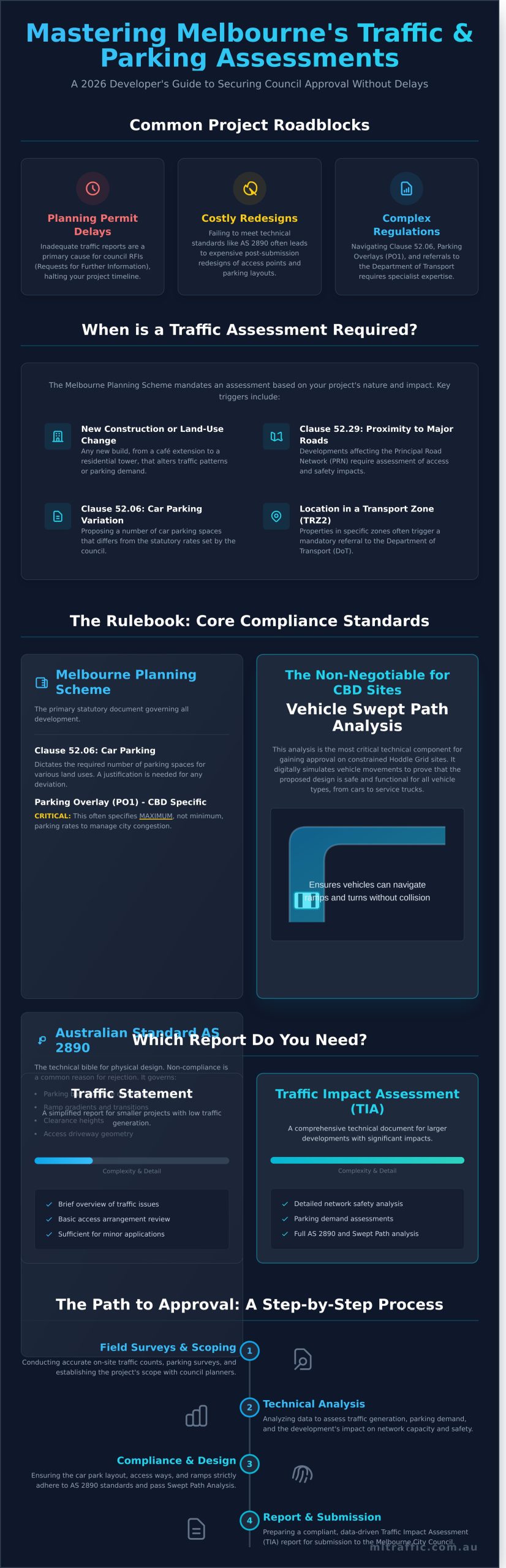
A Traffic Impact Assessment (TIA) is a specialist report required by the City of Melbourne to evaluate how a proposed development will affect the surrounding transport network. It is a critical component for any development application involving a change of land use or a new build, from a small café extension to a multi-storey residential tower. Successfully undertaking Traffic and Car parking Impact Assessments in Melbourne City Council requires a precise understanding of the specific triggers outlined in local planning provisions.
To better understand this concept, watch this helpful video overview:
The requirement for a traffic report is not arbitrary; it is dictated by the Melbourne Planning Scheme. This scheme contains specific clauses that determine the depth of analysis required for any given project. The purpose of this formal Impact Assessment is to provide Council’s planners with the data needed to ensure a development does not adversely affect traffic flow, parking availability, or public safety. Furthermore, developments located within a Transport Zone 2 (TRZ2) or affecting major arterial roads often trigger a mandatory referral to the Department of Transport (DoT), adding another layer of regulatory scrutiny.
Statutory Triggers under the Melbourne Planning Scheme
Several key clauses within the planning scheme mandate a traffic or parking assessment. The most common triggers include:
-
Clause 52.06 (Car Parking): This is the primary trigger for assessing car parking demand. It sets out statutory parking rates for different land uses. Any proposal that does not meet these rates, or seeks a reduction, requires a detailed Car Parking Demand Assessment to justify the proposed supply.
-
Clause 52.29 (Land Adjacent to a Road Zone): This clause assesses a development’s impact on the Principal Road Network (PRN). It focuses on access arrangements, traffic generation, and the safety of all road users on major arterial roads.
Even developments considered "minor" in the CBD often require professional traffic input due to the high density of pedestrians, cyclists, and public transport services. A small change in vehicle movements can have a significant cumulative effect on the network’s operation.
The Difference Between a TIA and a Traffic Statement
Council will determine the level of detail required based on the scale and complexity of your proposal. A simplified Traffic Statement may be sufficient for smaller projects with low traffic generation, providing a brief overview of traffic and access issues. In contrast, a full Traffic Impact Assessment (TIA) is required for larger developments with significant potential impacts. A TIA is a technical document evaluating a development’s impact on road network safety, local amenity, and operational capacity. Council’s transport planners assess the specifics of your application to decide which report level is necessary for a compliant and successful outcome.
Technical Compliance: Clause 52.06 and Australian Standards (AS 2890)
Compliance with Clause 52.06 of the Melbourne Planning Scheme and Australian Standard AS 2890.1 is the foundation of any successful development application. These regulations govern both the required number of parking spaces and the physical design of vehicle access. A failure to meet these technical requirements is a primary reason for Council rejection, making expert assessment essential.
Clause 52.06 dictates the statutory car parking rates for different land uses across Melbourne. However, developments within the Hoddle Grid and surrounding areas fall under the Parking Overlay (PO1), which often specifies maximum parking rates, not minimums. This is a critical distinction designed to manage inner-city traffic congestion. Furthermore, developers must now plan for the significant 2026 updates to bicycle parking and end-of-trip facility requirements, which will impose more stringent standards.
Car Parking Demand vs. Statutory Rates
A key part of Undertaking Traffic and Car Parking Impact Assessments in Melbourne City Council is justifying a variation from statutory rates. A parking shortfall can be approved if a robust Car Parking Demand Assessment demonstrates a lower actual demand. This is typically argued using empirical data, first principles analysis of the proposed use, and proximity to public transport. A formal Green Travel Plan (GTP) can also be used to support a parking reduction by committing the development to sustainable transport initiatives.
Design Standards for Access and Ramps
A compliant parking provision is not just about the numbers; it must be physically functional and safe. AS 2890.1 (Off-street car parking) provides the technical specifications for all design elements. Common design errors that lead to immediate Council refusal are almost always related to non-compliance with this standard. These include:
-
Incorrect Driveway Gradients: Exceeding the maximum 1 in 4 (25%) grade or failing to provide compliant transition zones at the top and bottom of ramps, which causes vehicles to scrape.
-
Inadequate Sight Distance: Failing to provide clear lines of sight for drivers exiting the property to see pedestrians, as mandated by Clause 52.06-9.
-
Substandard Dimensions: Designing parking bays, ramps, or circulation aisles that are too narrow for the designated user class, preventing safe vehicle manoeuvring.
Ensuring these technical details are correct from the initial design phase is crucial for avoiding costly delays and redesign requests from Council.
Navigating CBD-Specific Constraints: Swept Paths and Sustainable Transport
Development within Melbourne’s Hoddle Grid presents unique traffic engineering challenges not found in other municipalities. Access is frequently restricted to narrow "Little" streets and laneways, placing immense pressure on site layout and vehicle accessibility. The City of Melbourne’s "Pedestrian First" policy further complicates vehicle movements, demanding designs that prioritise walker safety and amenity over vehicle convenience. Consequently, a successful development application hinges on demonstrating meticulous planning for all vehicle types, from resident cars to essential service vehicles.
For this reason, detailed swept path analysis is often the most critical technical component when undertaking Traffic and Car Parking Impact Assessments in Melbourne City Council. It provides the definitive evidence that a proposed design can safely accommodate vehicle entry, exit, and internal circulation without conflicting with structural elements, other vehicles, or pedestrian pathways. This includes demonstrating access for council waste collection vehicles, which have specific and non-negotiable operational requirements.
Vehicle Swept Path Analysis (AutoTURN)
Our assessments utilise industry-standard AutoTURN software to model the precise movements of design vehicles. For residential and commercial basements, this means demonstrating compliance with Australian Standard AS 2890.1 for B85 and B99 vehicles. A key council requirement is proving a minimum 300mm clearance from all structural elements like columns and walls. A common challenge we resolve involves designing access ramps and basement layouts for sites with narrow laneway frontages, ensuring even the largest required service vehicle can manoeuvre without encroachment.
Bicycle and Micro-mobility Infrastructure
A modern TIA must look beyond private cars to satisfy council’s sustainable transport objectives. Our reports provide detailed strategies for integrating end-of-trip facilities, ensuring full compliance and future-readiness. Key considerations include:
-
Bicycle Parking: Meeting the statutory requirements of Clause 52.34 for both resident and visitor bicycle hoops, including compliant layout and accessibility.
-
EV Charging Bays: Designing electric vehicle charging spaces that conform to current best practice and anticipate mandatory standards expected by 2026.
-
Micro-mobility Storage: Allocating secure and convenient storage areas for e-scooters and other personal mobility devices, reflecting their growing use in the CBD.
The Assessment Process: From Field Surveys to Council Submission
Successfully undertaking Traffic and Car Parking Impact Assessments in Melbourne City Council requires a methodical, evidence-based process. The objective is to provide Council with a robust technical document that quantifies a development’s impact and presents viable mitigation measures. This structured approach minimises delays and addresses planner concerns proactively.
Data Collection and Site Observations
The foundation of any credible traffic assessment is accurate, relevant data. Council planners now frequently require traffic and parking data that reflects post-pandemic patterns, often with projections to a 2026 baseline. Our initial work involves identifying "Critical Intersections" near the subject site-those already operating near capacity that will face the most scrutiny. In precincts like Carlton and North Melbourne, where weekend activity is significant, we conduct both weekday and weekend parking occupancy surveys to provide a complete picture of existing demand.
Our assessment framework is a disciplined, five-step process:
-
Step 1: On-Site Data Acquisition: We conduct comprehensive peak hour traffic counts at key intersections and detailed on-street and off-street parking occupancy surveys.
-
Step 2: Traffic Generation Modelling: Using recognised ITE (Institute of Transportation Engineers) trip rates or approved local data, we accurately model the traffic generation of the proposed development.
-
Step 3: Melbourne Planning Scheme Assessment: The proposal is rigorously assessed against the relevant clauses of the Melbourne Planning Scheme, including car parking provision rates, access requirements, and local policy objectives.
-
Step 4: Mitigation Strategy Formulation: Where potential impacts are identified, we formulate practical and cost-effective mitigation measures, such as traffic signal timing adjustments, pedestrian facility upgrades, or on-site management plans.
-
Step 5: Final Report Compilation: All data, analysis, modelling outputs, and recommendations are compiled into a professional report, ready for submission with your Development Application (DA).
Managing the Council RFI Process
Even a thorough report may receive a Request for Further Information (RFI) from Council planners. Common RFI items include requests for additional sensitivity analysis on traffic models, further justification for proposed parking shortfalls, or clarification on vehicle swept paths. Responding effectively requires direct, technical rebuttals that address the specific concerns with supporting evidence. Our senior engineers are adept at navigating this stage to achieve a positive outcome. See our services page for how we handle RFI responses and council negotiations.
Why Expert Traffic Engineering is Critical for Melbourne DA Success
Securing a Development Application (DA) within the City of Melbourne requires more than a standard, template-based report. The complexities of the local planning scheme mean that undertaking Traffic and Car Parking Impact Assessments in Melbourne City Council demands strategic insight and senior engineering expertise. An inadequate assessment not only risks delays and costly Requests for Information (RFIs) but can jeopardise the entire project. This is where specialist experience becomes your most valuable asset.
By engaging expert traffic engineers at the earliest design stage, you can significantly reduce project risk. We identify potential traffic, access, and parking issues before they become embedded in architectural plans, saving you from expensive redesigns and council objections down the line. Our proactive approach ensures your proposal is viable and defensible from the outset.
The Value of Senior Expertise
At ML Traffic Engineers Pty Ltd, we operate on a core principle: the consultant who provides the quote, does the work. For complex Traffic Impact Assessments (TIAs), this continuity is critical. It guarantees that the project is managed by a senior engineer with comprehensive knowledge of the site’s challenges. You gain direct access to our principals for strategic advice, a benefit you can read more about our principals, Michael Lee and Benny Chen, and their 30+ years of industry experience.
Our 15+ years of direct engagement with Melbourne City Council planners provides an unmatched advantage. We understand their specific requirements and assessment criteria, allowing us to prepare reports that anticipate and address their concerns. We also ensure your development is future-proofed for emerging transport trends through 2026 and beyond, safeguarding your investment’s long-term viability.
Partnering for Planning Approval
Our objective is to streamline your path to approval. A meticulously prepared, compliant TIA significantly reduces the likelihood of council objections and provides a robust foundation should a matter proceed to the Victorian Civil and Administrative Tribunal (VCAT). Our track record, built across more than 10,000 sites Australia-wide, demonstrates our capability in delivering reports that withstand scrutiny. To secure your Melbourne DA approval with a robust and compliant assessment, contact ML Traffic Engineers Pty Ltd today.
Navigating Melbourne’s Traffic Assessment Requirements with Confidence
Successfully undertaking Traffic and Car Parking Impact Assessments in Melbourne City Council is a critical component of any development application. As this guide has shown, a comprehensive understanding of Clause 52.06, CBD-specific constraints, and Australian Standards is not just beneficial-it is essential for approval. A technically sound report, backed by robust data and analysis, is your key to navigating the council’s rigorous review process efficiently.
At ML Traffic Engineers, we provide the specialised expertise your project demands. Our principal engineers, with over 15 years of direct experience with Melbourne City Council, personally handle every report. With a track record of over 10,000 successful site assessments nationwide, we deliver the authoritative guidance required to secure your DA success. Don’t let compliance issues delay your project.
Ensure your development proceeds with certainty. Get a Quote for Your Melbourne Traffic Assessment today and partner with the experts.
Frequently Asked Questions
Do I need a traffic report for a small change of use in the Melbourne CBD?
Yes, it is highly probable. The Melbourne City Council planning scheme is stringent, and even a minor change of use-such as from a retail premises to a small café-can trigger the need for a traffic report. This is because different land uses have different traffic generation and car parking demand characteristics. A professional assessment is required to quantify these impacts and demonstrate compliance to Council’s traffic engineering department.
How much does a Traffic Impact Assessment cost for a Melbourne City Council project?
The cost is directly related to the scale and complexity of the development. A basic Traffic Impact Statement for a small-scale project may range from A$2,000 to A$4,000. More complex projects requiring detailed traffic and parking analysis, on-site surveys, and extensive reporting for a major development can cost from A$5,000 to over A$20,000. We provide a fixed-fee proposal based on a detailed review of your project’s specific requirements.
What is the "Parking Overlay" and how does it affect my Melbourne development?
The Parking Overlay is a specific planning control that overrides or modifies the standard car parking requirements outlined in Clause 52.06 of the Melbourne Planning Scheme. Depending on the precinct, it can impose maximum parking rates to discourage car use, or set specific conditions for parking provision. If your site is within a Parking Overlay, your development must be assessed against these unique local requirements, which often differ significantly from the standard rates.
Can I reduce the number of car parks required by Clause 52.06?
Yes, a reduction to the statutory car parking rates stipulated in Clause 52.06 can be sought, but it must be rigorously justified through a Car Parking Demand Assessment. This report must provide empirical evidence that a lower rate is appropriate, considering factors such as excellent access to public transport, the specific operational characteristics of the use, and local parking availability. The Council will not approve a reduction without a robust, evidence-based justification.
What is a Swept Path Analysis and why is it mandatory for Melbourne basements?
A Swept Path Analysis is a technical assessment that uses CAD software to simulate the movement of vehicles, ensuring they can safely manoeuvre through driveways, ramps, and parking areas. It is mandatory for developments with basement or multi-level car parks to demonstrate compliance with Australian Standard AS 2890.1. The analysis confirms that the proposed layout can accommodate design vehicles without collisions, a critical safety and functional requirement for Council approval.
How long does it take for Melbourne City Council to review a traffic report?
The review of a traffic report is integrated into the broader statutory planning permit process. Typically, a Council traffic engineer will assess the submitted report within 4 to 8 weeks of application lodging. This timeframe can be extended if the Council requires further information (RFI) or if the proposal is particularly complex. Properly Undertaking Traffic and Car Parking Impact Assessments in Melbourne City Council from the outset is the most effective way to minimise delays.
What happens if my development is on a road managed by the Department of Transport (DoT)?
If your property has frontage or access to an arterial road, the application will be referred to the Department of Transport (DoT) as a determining referral authority. Your Traffic Impact Assessment must therefore address the specific safety and operational requirements of the DoT in addition to those of the Council. Gaining DoT approval for access arrangements is a critical step and often requires a more detailed level of technical analysis regarding traffic flow and road safety.
Are bicycle parking requirements mandatory for all Melbourne developments?
Yes, for most new developments and significant changes of use, bicycle parking is mandatory under Clause 52.34 of the planning scheme. This clause specifies the required number of bicycle spaces for employees and visitors, and often requires associated end-of-trip facilities like showers and lockers. A compliant Traffic Impact Assessment must include a section that explicitly demonstrates how the development satisfies these bicycle parking and facility requirements.
