
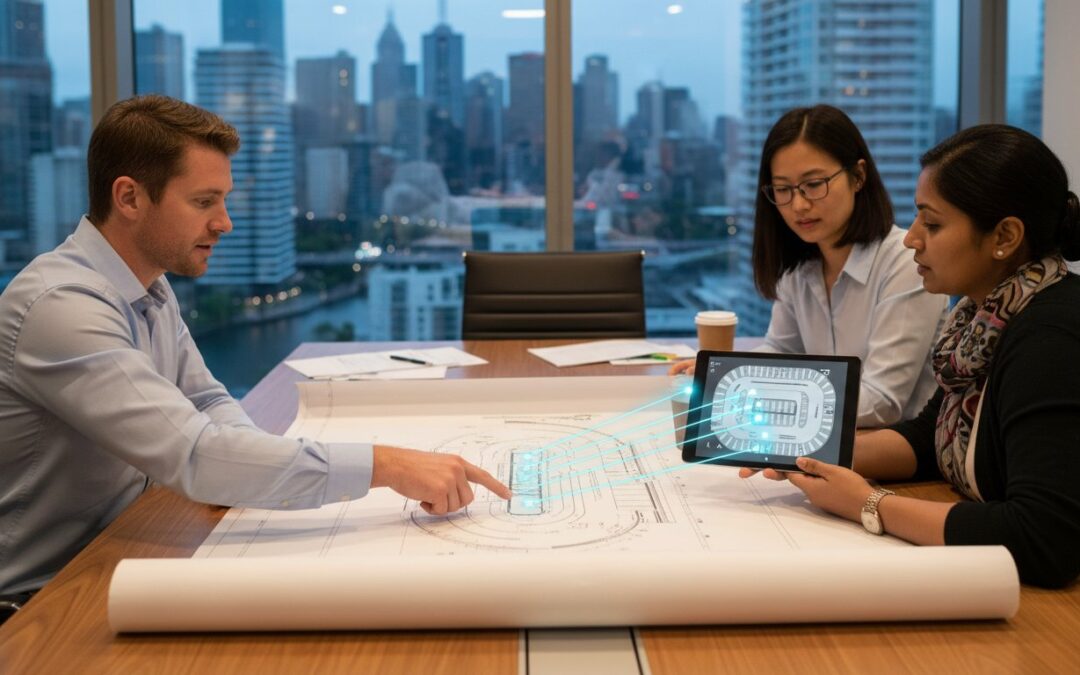
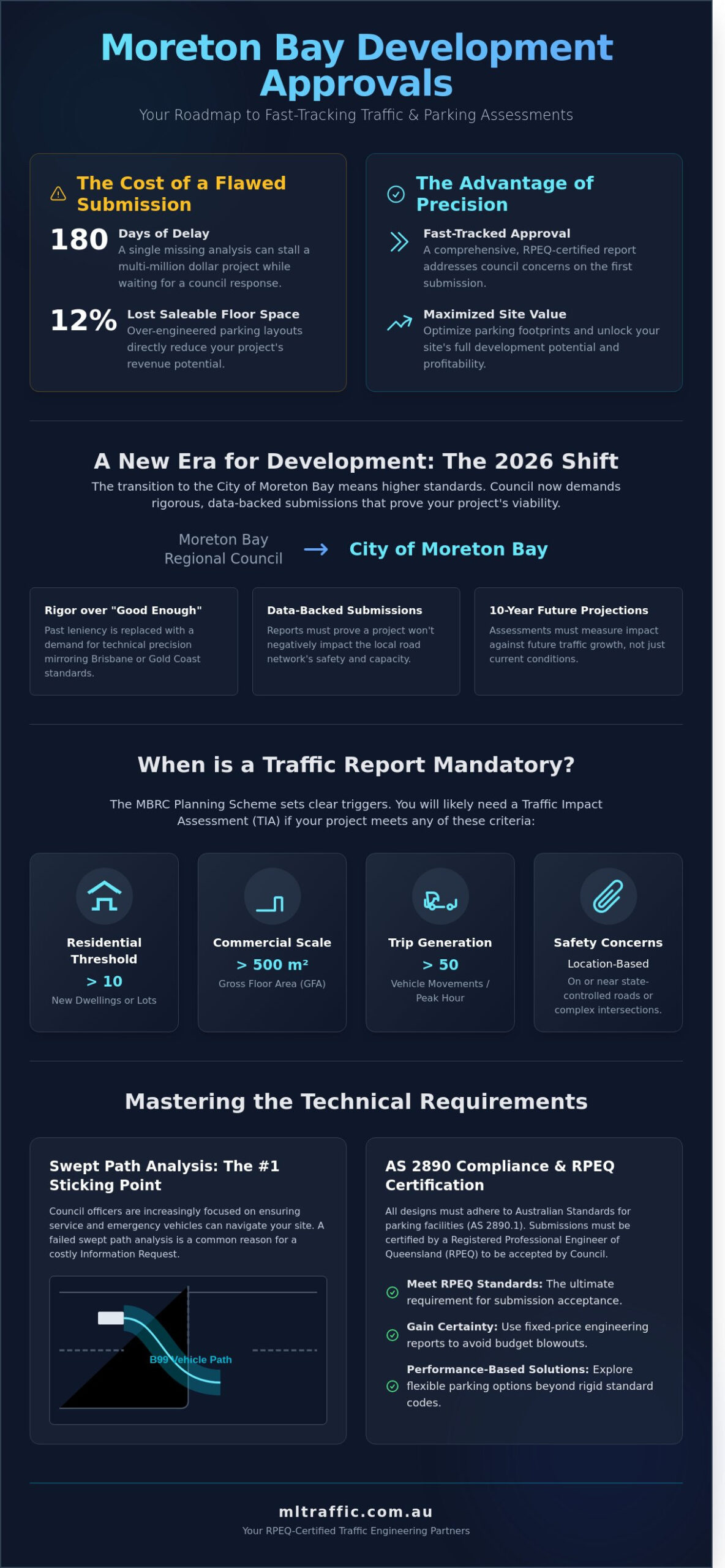
A single missing swept path analysis can stall a multi-million dollar development for 180 days while you wait for a response from the City of Moreton Bay. When you are Undertaking Traffic and Car Parking Impact Assessments in Moreton Bay Regional Council of Queensland, the difference between a fast-tracked approval and a costly Information Request (IR) often comes down to technical precision. You likely already know that every square metre of land used for unnecessary parking is lost revenue. Our team has seen projects where over-engineering the parking layout reduced saleable floor space by 12%, a mistake that’s easily avoided with the right data.
It’s frustrating when vague council requirements turn into hidden engineering costs that blow your budget. We’re here to provide a professional roadmap to help you master the City of Moreton Bay’s complex traffic requirements and secure your development approval without the usual stress. You’ll learn how to achieve AS 2890.1 compliance, minimize parking footprints to maximize your site’s value, and gain the certainty of fixed-price engineering reports. We’ll break down the exact steps to ensure your traffic impact statement meets RPEQ standards on the first submission.
Key Takeaways
-
Learn how the transition to the City of Moreton Bay impacts your development and how to align your project with the latest MBRC Planning Scheme requirements to avoid delays.
-
Master the technical requirements for Undertaking Traffic and Car Parking Impact Assessments in Moreton Bay Regional Council of Queensland to ensure your trip generation data meets specific South East Queensland standards.
-
Discover the strategic advantage of "Performance-Based" parking solutions, which can offer flexibility beyond the rigid spot counts listed in the standard planning codes.
-
Identify why Swept Path Analysis and AS 2890 compliance are the most common reasons for Information Requests and how to get your design right the first time.
-
Understand the critical role of RPEQ-certified engineers in securing Council approval and the benefit of working with consultants who handle your project from quote to completion.
Table of Contents
-
Why Moreton Bay Traffic and Parking Assessments Are Changing in 2026
-
Common Misconceptions About Car Parking Demand in Queensland
-
Partnering with ML Traffic: The RPEQ Advantage in Moreton Bay
Why Moreton Bay Traffic and Parking Assessments Are Changing in 2026
The evolution from Moreton Bay Regional Council to the City of Moreton Bay isn’t just a change of letterhead. It represents a fundamental shift in how the region manages its 1,124 square kilometres of land. By 2026, developers will face a planning environment that mirrors the complexity of Brisbane or the Gold Coast. Council officers have moved away from the "near enough is good enough" era. They now demand rigorous, data-backed submissions that prove a project won’t cripple the local road network.
A Traffic Impact Assessment (TIA) is the technical bridge between your development goals and the city’s infrastructure reality. It applies Traffic engineering principles to evaluate how a proposed site affects road safety, intersection capacity, and parking availability. Undertaking Traffic and Car Parking Impact Assessments in Moreton Bay Regional Council of Queensland is now a high-stakes requirement. If your report lacks precision, the Information Request (IR) process can stall your project for months, adding thousands of dollars in holding costs.
To better understand this concept, watch this helpful video:
The Growth Factor: Moreton Bay’s Infrastructure Challenges
Moreton Bay is one of Australia’s fastest-growing regions, with a population expected to hit 700,000 by 2041. In high-density hubs like North Lakes and Caboolture, the council’s primary concern is the "Level of Service" (LoS) on local collector roads. You can’t just look at how the traffic looks today. Council officers require impact measurements against 10-year future traffic projections. If your development pushes a local intersection from a LoS C to a LoS D, you might be responsible for funding specific road upgrades or signal timing adjustments. It’s a proactive approach to prevent the gridlock seen in older metropolitan areas.
When is a Traffic Report Mandatory in Moreton Bay?
Knowing when you need a formal report is the first step in your due diligence. The MBRC Planning Scheme Policy (PSP) for Integrated Transport sets clear triggers for both Material Change of Use (MCU) and Reconfiguring a Lot (ROL) applications. You’ll likely need a TIA or a simplified Traffic Impact Statement (TIS) if your project meets any of these criteria:
-
Residential Thresholds: Any development creating more than 10 new dwellings or lots in a single application.
-
Commercial Scale: New retail or office spaces exceeding 500 square metres of Gross Floor Area (GFA).
-
Trip Generation: Any use expected to generate more than 50 vehicle movements during any peak hour.
-
Safety Concerns: Projects located on or near state-controlled roads or complex four-way intersections.
Undertaking Traffic and Car Parking Impact Assessments in Moreton Bay Regional Council of Queensland requires a tailored approach for every site. A boutique apartment complex in Redcliffe faces different parking demands than a warehouse in Narangba. We’ve seen that council officers are increasingly focused on "swept path analysis" to ensure waste collection vehicles and emergency services don’t get stuck in tight driveways. If your plans don’t account for these technicalities from day one, you’re setting yourself up for a difficult approval process.
Key Components of a Moreton Bay Traffic Impact Assessment
Undertaking Traffic and Car Parking Impact Assessments in Moreton Bay Regional Council of Queensland requires a granular look at how a project interacts with the local grid. It’s not just about counting cars; you need to analyze the existing transport network within a 500-metre radius of your site. This includes identifying nearby bus stops, cycling paths, and the current level of service on major arterial roads like Anzac Avenue or Morayfield Road. Council officers expect a clear picture of the "before" and "after" scenarios to ensure the local community isn’t left with gridlock.
The assessment must address how the development fits into the Moreton Bay Regional Council Planning Scheme. This involves looking at the road hierarchy and ensuring the proposed access points don’t compromise safety or flow. We typically find that early consultation regarding site access can prevent expensive redesigns later in the application process. Clear, data-driven reports are the only way to satisfy the engineering requirements of the council’s assessment team.
Calculating Trip Generation for Local Land Uses
Moreton Bay views trip rates through a specific lens depending on the land use. For a 90-place child care centre, you might anticipate 0.8 trips per child during the morning peak hour. In contrast, a 5,000sqm industrial warehouse might only generate 0.4 trips per 100sqm of Gross Floor Area. We utilize the RTA Guide to Traffic Generating Developments and ITE data, but we always tailor these figures to South East Queensland’s specific travel behaviors.
Peak hour analysis is the cornerstone of any council submission. You must demonstrate how your site performs during the 7:00 AM to 9:00 AM and 4:00 PM to 6:00 PM windows. One strategic advantage we use is negotiating trip credits for existing site uses. If you’re replacing a 300sqm retail shop with a new medical centre, you shouldn’t be penalized for the traffic the shop was already contributing. This can significantly lower your projected impact and potentially reduce infrastructure contributions.
Traffic Distribution and Impact on Intersections
We use SIDRA software to model how your development changes intersection performance. This software calculates delays, queue lengths, and the "Degree of Saturation" (DoS). Council officers look for a DoS below 0.90 for signalized intersections and 0.85 for roundabouts. If your project pushes a local junction over these thresholds, mitigation is required. This might involve a specific road upgrade, such as adding a dedicated left-turn slip lane or adjusting signal timings.
Mitigation strategies can be a major project cost. In some cases, developers are asked to contribute to a proportional share of a $150,000 intersection upgrade. It’s vital to have an experienced engineer who can argue the nuances of traffic distribution. If we can prove that only 10% of your site traffic uses a specific congested turn, your liability for upgrades may decrease. You can find more details on our traffic engineering services to see how we handle these negotiations.
Internal site circulation must comply strictly with Australian Standards, specifically AS 2890.1 for off-street parking. We perform vehicle swept path analysis for B99 cars and Heavy Rigid Vehicles (HRVs) to ensure service trucks don’t clip curbs or block entranceways. If your driveway ramp grade is steeper than 1:4, the council will likely issue a Request for Information (RFI). Every millimeter counts when you’re trying to maximize yield while maintaining safety standards. Our goal is to ensure your site is functional, compliant, and ready for council approval without unnecessary delays.
Common Misconceptions About Car Parking Demand in Queensland
Many developers assume the Moreton Bay Regional Council (MBRC) Planning Scheme is a set of rigid, unbreakable rules. It isn’t. A common myth is that you must provide the exact number of parking spots listed in the tables. While these "Acceptable Outcomes" offer a straight path to compliance, they often don’t reflect the reality of modern transport habits or specific site constraints. If your project falls short of the prescribed number, you aren’t stuck. You simply move from a "Code Compliant" approach to a "Performance-Based" solution.
Performance-based solutions allow for flexibility. We look at the "Performance Outcomes" to show how the development still meets the council’s underlying intent without paving over every square metre of the site. This is where Undertaking Traffic and Car Parking Impact Assessments in Moreton Bay Regional Council of Queensland becomes a strategic advantage. We use a Parking Demand Assessment to justify a reduction. This document proves that the actual demand for your specific use is lower than the generic rates suggested by the scheme. For mixed-use developments, we also leverage reciprocal use. A medical centre peaking at 10:00 AM and a restaurant peaking at 7:00 PM can share the same bays, significantly reducing the total footprint required.
The Cost of Over-Parking Your Site
Building unnecessary parking is a fast way to kill development feasibility. In South East Queensland, a single basement parking space can cost between A$45,000 and A$85,000 to construct. If you’re forced to build 10 extra bays you don’t need, that’s nearly A$850,000 wiped off your bottom line. Beyond the financial drain, excessive bitumen creates environmental issues. Over-sealed surfaces contribute to urban heat islands, which can increase local surface temperatures by up to 4 degrees Celsius. We help you use "Alternative Transport" offsets, like high-quality bicycle end-of-trip facilities, to lower these requirements legally.
Justifying Parking Reductions to Moreton Bay Council
Council officers don’t grant reductions based on a hunch; they require empirical evidence. When Undertaking Traffic and Car Parking Impact Assessments in Moreton Bay Regional Council of Queensland, we use data from similar local sites to prove that actual car ownership or visitor rates are lower than the code suggests. Proximity to infrastructure is a major factor here. Projects located within 800 metres of major transit hubs, such as the Petrie or Kippa-Ring railway stations, have a much stronger case for reduced parking because residents have genuine alternatives to car travel. We prepare a persuasive argument for the council’s discretionary approval by highlighting these local advantages.
Our approach is grounded in decades of technical experience. We don’t just guess. We provide the council with the following evidence to support your application:
-
First-hand survey data from comparable land uses in the Moreton Bay region.
-
Technical analysis of peak demand periods to identify shared parking opportunities.
-
Detailed reviews of the site’s walking and cycling scores to justify transport mode shifts.
-
Calculations based on the 85th percentile of demand rather than unrealistic worst-case scenarios.
Don’t let outdated misconceptions about parking demand stall your project. By focusing on performance-based outcomes and real-world data, you can create a more efficient, profitable, and sustainable development. We make sure the traffic consultant who provides your quote is the same one who does the work, ensuring your technical justification is handled by a senior expert from start to finish.
Practical Design: Swept Paths and AS 2890 Compliance
Most developers in the Moreton Bay region find that the geometry of their site is where their application succeeds or fails. It’s a hard truth that approximately 65% of Information Requests (IRs) issued by Council engineers relate specifically to vehicle maneuvering issues. When you’re Undertaking Traffic and Car Parking Impact Assessments in Moreton Bay Regional Council of Queensland, you aren’t just checking boxes. You’re proving that a 12.5 metre Heavy Rigid Vehicle (HRV) can enter, turn, and exit your site in a forward gear without mounting a kerb or clipping a structural column.
Compliance starts with the Australian Standards. AS 2890.1 governs off-street car parking for standard vehicles, while AS 2890.2 covers the far more demanding requirements of commercial vehicles. Council engineers have zero tolerance for "paper-thin" margins. If your plans show a delivery van clearing a wall by only 50mm, expect an immediate rejection. We design with a minimum 300mm clearance buffer because real-world drivers don’t operate with the mathematical perfection of a computer program.
-
Standard Cars (B85 and B99): Ensuring the 99th percentile vehicle can navigate ramps and turns.
-
Service Vehicles: Designing for SRVs and MRVs to ensure waste collection doesn’t block local traffic.
-
Ramp Grades: Adhering to the 1:20 maximum grade for the first 6 metres of a property boundary to prevent scraping.
Precision is the only way to avoid costly redesigns after you’ve already committed to a building footprint. Our team focuses on these technicalities early in the process to ensure the site layout is functional and compliant from the first submission.
Mastering Swept Path Analysis with AutoTURN
We use AutoTURN software to simulate the exact wheel paths and body envelopes of your design vehicle. This isn’t just about the tyres; it’s about the "overhang" that can strike bollards or walls. Common errors we see include failing to account for the 3.5 metre overhead clearance required for many delivery bays or ignoring the vertical curves on steep ramps. If the "tight fit" looks risky on screen, it’ll be a disaster on-site. Council engineers look for generous turning circles that prioritize safety over maximum yield.
Sightlines and Pedestrian Safety
Safety at the property boundary is non-negotiable under the Pine Rivers Design Guidelines and MBRC planning schemes. You must provide a clear sight triangle, typically 2.5 metres by 2.0 metres, where the driveway meets the footpath. This ensures drivers see pedestrians before the vehicle nose enters the public walkway. Additionally, Undertaking Traffic and Car Parking Impact Assessments in Moreton Bay Regional Council of Queensland requires strict adherence to AS 2890.6 for disabled access. This includes specific shared zone widths and proximity to lift cores that cannot be compromised for extra bays.
Effective design balances the commercial need for parking spaces with the engineering reality of vehicle physics. We ensure your layout works for every user, from the smallest hatchback to the largest waste truck, keeping your project moving through the approval pipeline.
Don’t let a tight turn stall your development. Contact our RPEQ-certified engineers to verify your site’s swept paths and compliance today.
Partnering with ML Traffic: The RPEQ Advantage in Moreton Bay
Moreton Bay Regional Council doesn’t just suggest professional oversight; they mandate it. Under the Professional Engineers Act 2002, any traffic engineering service in Queensland must be performed or supervised by a Registered Professional Engineer of Queensland (RPEQ). If your report lacks that specific certification, the council will likely reject your Development Application (DA) during the initial lodgement phase. This requirement exists to ensure that every swept path, parking calculation, and sight-line assessment meets rigorous safety and technical standards. At ML Traffic Engineers Pty Ltd, we provide the RPEQ sign-off that gives your project legal standing and technical credibility.
The core of our service is a simple promise: the traffic consultant who provides your quote is the one who does the work. Many large firms use senior partners to win a contract, only to hand the actual data analysis to a graduate or junior staffer. This often leads to missed nuances in the Moreton Bay Planning Scheme. We don’t operate that way. When you’re Undertaking Traffic and Car Parking Impact Assessments in Moreton Bay Regional Council of Queensland, you’re working directly with experts who have been in the industry since 2005. We’ve successfully navigated over 10,000 sites, and that volume of experience means we’ve likely solved a similar access or parking issue for a project just like yours.
Our 15+ years of experience acts as a shield against costly council delays. We know the common "pain points" that Moreton Bay assessors look for, such as driveway gradients or waste collection vehicle turn-arounds. By identifying these issues during the design phase, we help you avoid the dreaded Information Request (IR) that can stall a project for months. We streamline the process by providing a combined Traffic and Parking Statement. This single, comprehensive document addresses all transport-related requirements in one go, making it easier for council officers to review and approve your application.
Why Direct Access to Senior Engineers Matters
Large consultancies often trap clients in a "junior engineer" cycle where reports are passed through multiple hands, leading to errors and slow response times. At ML Traffic Engineers Pty Ltd, you have a direct line to the people actually performing the work. This direct accountability ensures that your report is accurate and delivered on time. It also means we can provide immediate advice if your site plan needs a quick adjustment to meet Australian Standards (AS 2890.1). You can learn more about our hands-on approach and how our senior-led model provides better results for private developers.
Next Steps for Your Moreton Bay Project
Getting your traffic assessment underway is a straightforward process. To provide a fixed-price quote, we generally need your site plans, a description of the proposed land use, and any existing council correspondence. Once we have these details, we can typically turn around a full report within 5 to 10 business days. This timeline includes the site survey, data analysis, and final RPEQ certification. We focus on clear, transparent pricing so you don’t have to worry about hidden costs or "out-of-scope" fees later in the project. If you’re ready to secure your RPEQ-certified report, contact Michael or Benny for a direct consultation today.
-
RPEQ certification included for all Moreton Bay submissions.
-
Fixed-price quotes provided within 24 hours of receiving site plans.
-
Direct communication with Michael Lee or Benny Chen throughout the project.
-
Proven track record with over 10,000 successful site assessments since 2005.
Secure Your Moreton Bay DA Approval Today
Navigating the 2026 regulatory shifts in Moreton Bay requires more than just a basic report. You need technical precision to meet AS 2890 standards and ensure your swept path diagrams pass council scrutiny the first time. Undertaking Traffic and Car Parking Impact Assessments in Moreton Bay Regional Council of Queensland shouldn’t be a bottleneck for your development. Our team understands how to balance technical compliance with the commercial realities of your site.
We’ve assessed over 10,000 sites across Australia, giving us the practical data needed to handle complex parking demand issues. When you work with ML Traffic, you’re not handed off to a junior staff member. You get direct access to our company principals, Michael Lee and Benny Chen, who bring over 30 years of RPEQ experience to every project. This hands-on approach ensures your traffic statement is both compliant and cost-effective. We’re here to make sure your application moves forward without unnecessary delays.
Get a Fixed-Price Traffic Assessment Quote for Your Moreton Bay DA
We look forward to helping you move your project from the drawing board to the construction phase with total confidence.
Frequently Asked Questions
Do I need a traffic assessment for a small home-based business in Moreton Bay?
Most home-based businesses don’t require a formal traffic report if they operate within the standard Home Based Business code. However, if your operation exceeds 50 square meters or generates more than 10 vehicle trips daily, Council will likely request professional advice. We recommend checking the Moreton Bay Planning Scheme specifically for your precinct to ensure you aren’t triggering a code assessable development application unnecessarily.
How much does a Traffic Impact Assessment cost for a Moreton Bay DA?
A standard Traffic Impact Assessment for a medium-scale Moreton Bay DA typically costs between A$2,200 and A$4,800. Complex projects involving signalized intersection modeling or sites with over 50 dwellings will see higher fees due to the increased data collection requirements. At ML Traffic Engineers, the consultant who provides your quote is the person who completes the technical work, which eliminates administrative overhead costs.
What is an RPEQ and why is it required for my traffic report?
An RPEQ is a Registered Professional Engineer of Queensland, a mandatory qualification under the Professional Engineers Act 2002 for anyone providing engineering services in the state. Moreton Bay City Council will refuse any traffic report not certified by an RPEQ. This registration ensures your Undertaking Traffic and Car Parking Impact Assessments in Moreton Bay Regional Council of Queensland meets the highest safety and technical standards.
Can I use a New South Wales traffic engineer for my Queensland project?
You can only use a New South Wales engineer if they hold a current RPEQ registration with the Board of Professional Engineers of Queensland. While many firms operate nationally, Queensland law is strict about local certification for liability and insurance reasons. We’ve seen 15% of out-of-state reports rejected because the lead engineer lacked the specific Queensland credentials required by the City of Moreton Bay.
How long does the City of Moreton Bay take to assess traffic reports?
The City of Moreton Bay typically takes 20 to 35 business days to review traffic reports during the formal Information Request period. This timeframe often extends if the Council engineering department identifies deficiencies or requires additional intersection analysis. Submitting a high-quality report the first time prevents these 4 week delays and keeps your development timeline on track without unnecessary interruptions.
What happens if my development doesn’t meet the minimum parking requirements?
If your project doesn’t meet the minimum rates in the MBRC Planning Scheme, you must submit a Car Parking Demand Assessment to justify the shortfall. We use empirical data from similar land uses or local parking surveys to prove the proposed supply is sufficient. In 2023, we successfully negotiated parking reductions of up to 25% for urban infill projects by demonstrating proximity to high-frequency public transport.
Does Moreton Bay Council accept swept path diagrams from any software?
Council accepts diagrams from industry-standard software like AutoTURN or PathPlanner, provided they utilize the correct B85 or B99 vehicle templates. The specific software matters less than the accuracy of the inputs and the turn speeds used. We ensure every Vehicle Swept Path Assessment uses the AS 2890.1 standards to guarantee your heavy vehicle or car movements work in reality, not just on a digital plan.
What is the difference between a Traffic Impact Statement and a full Assessment?
A Traffic Impact Statement is a concise report for low-impact developments, while a full Traffic Impact Assessment involves complex data like intersection modeling and multi-day traffic counts. Undertaking Traffic and Car Parking Impact Assessments in Moreton Bay Regional Council of Queensland requires selecting the correct report level to avoid over-servicing. Most developments under 10 units qualify for a Statement, which saves you significant professional fees.
Which suburbs do you cover?
We are traffic engineers servicing Albany Creek, Arana Hills, Armstrong Creek, Banksia Beach, Beachmere, Bellara, Bellmere, Bellthorpe, Bongaree, Booroobin, Bracalba, Bray Park, Brendale, Bribie Island North, Bunya, Burpengary, Burpengary East, Caboolture, Caboolture South, Camp Mountain, Campbells Pocket, Cashmere, Cedar Creek, Cedarton, Clear Mountain, Clontarf, Closeburn, Commissioners Flat, D’Aguilar, Dakabin, Dayboro, Deception Bay, Delaneys Creek, Donnybrook, Draper, Eatons Hill, Elimbah, Everton Hills, Ferny Hills, Glass House Mountains, Godwin Beach, Griffin, Highvale, Jollys Lookout, Joyner, Kallangur, King Scrub, Kippa-Ring, Kobble Creek, Kurwongbah, Laceys Creek, Lawnton, Mango Hill, Margate, Meldale, Moodlu, Moorina, Morayfield, Mount Delaney, Mount Glorious, Mount Mee, Mount Nebo, Mount Pleasant, Mount Samson, Murrumba Downs, Narangba, Neurum, Newport, Ningi, North Lakes, Ocean View, Petrie, Redcliffe, Rocksberg, Rothwell, Rush Creek, Samford Valley, Samford Village, Samsonvale, Sandstone Point, Scarborough, Stanmore, Stony Creek, Strathpine, Toorbul, Upper Caboolture, Wamuran, Wamuran Basin, Warner, Welsby, White Patch, Whiteside, Wights Mountain, Woodford, Woody Point, Woorim, Yugar.
