

We are traffic engineers servicing Arthurs Seat, Balnarring, Balnarring Beach, Baxter, Bittern, Blairgowrie, Boneo, Cape Schanck, Crib Point, Dromana, Fingal, Flinders, Hastings, HMAS Cerberus, Main Ridge, McCrae, Merricks, Merricks Beach, Merricks North, Moorooduc, Mornington, Mount Eliza, Mount Martha, Pearcedale, Point Leo, Portsea, Red Hill, Red Hill South, Rosebud, Rosebud West, Rye, Safety Beach, Shoreham, Somers, Somerville, Sorrento, St Andrews Beach, Tootgarook, Tuerong, Tyabb.
A development application submitted to the Mornington Peninsula Shire can be significantly delayed or rejected due to an inadequate traffic and parking report. The specific requirements and terminology used by the council often create confusion for developers, leading to costly Requests for Further Information (RFIs) and uncertainty about whether a report is even required. This ambiguity can stall projects and impact financial viability. A compliant, professionally prepared assessment is not an option; it is a critical component for a successful application.
This definitive guide provides the technical clarity needed to navigate the approval process with confidence. We detail the essential procedures for undertaking Traffic and Car Parking Impact Assessments in Mornington Peninsula Council, explaining the specific thresholds and criteria you must meet. By understanding these requirements, you can ensure your submission is comprehensive, compliant, and structured to facilitate a smooth and timely development approval. This guide will equip you with the expert knowledge to avoid common pitfalls and advance your project without unnecessary delays.
Key Takeaways
-
Understand Mornington Peninsula Shire’s specific triggers for requiring a traffic report to ensure your development application is prepared correctly from the start.
-
Identify the core components and data-driven analysis Council planners demand in a compliant report to facilitate a smoother assessment process.
-
Learn the step-by-step methodology for undertaking Traffic and Car Parking Impact Assessments in Mornington Peninsula Council to avoid common procedural errors.
-
Discover the most frequent mistakes that lead to council objections and costly DA delays, and learn the actionable strategies to prevent them.
Table of Contents
-
Understanding When a Traffic & Parking Assessment is Required in Mornington Peninsula
-
Core Components of a Compliant Report for Mornington Peninsula Shire
-
Common Pitfalls and How to Avoid DA Delays in Mornington Peninsula
Understanding When a Traffic & Parking Assessment is Required in Mornington Peninsula
The Mornington Peninsula Shire Council mandates traffic and parking assessments to proactively manage the impacts of new developments on the local road network. The primary objective is to ensure any proposed project does not compromise public safety, degrade traffic efficiency, or create parking shortfalls for residents and visitors. Successfully navigating the planning permit process requires a clear understanding of when a professional report is necessary for undertaking Traffic and Car Parking Impact Assessments in Mornington Peninsula Council.
To better understand the core components of these assessments, the following video provides a clear overview.
Triggers for a Traffic Impact Assessment (TIA)
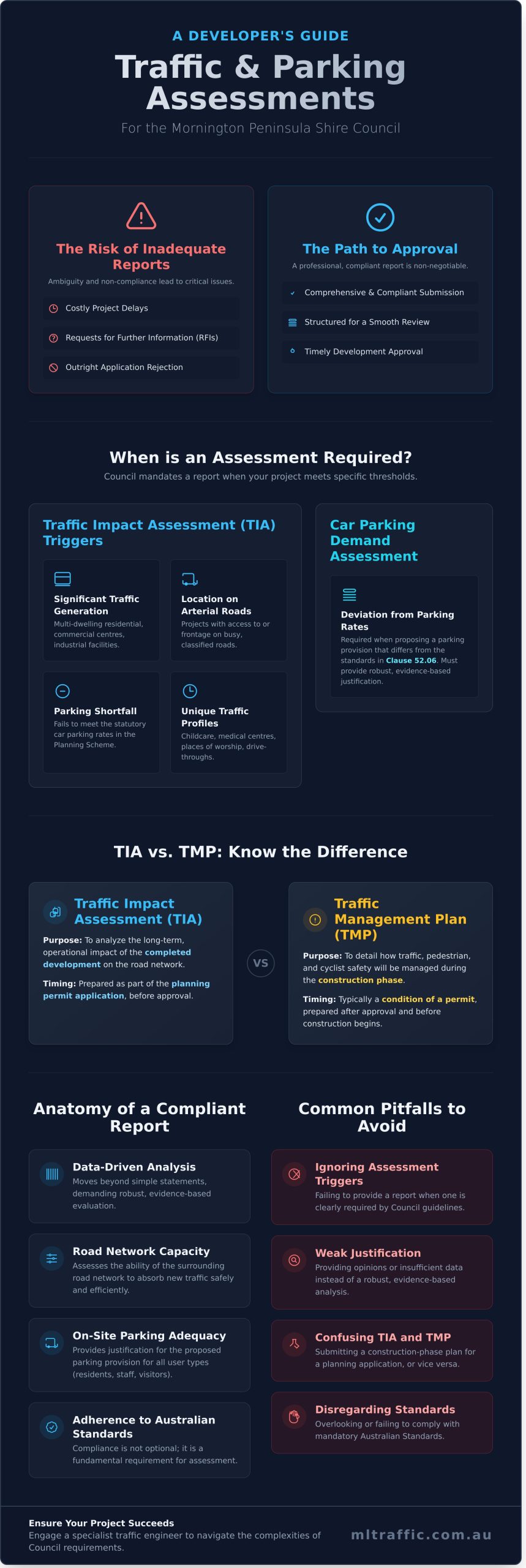
A Traffic Impact Assessment (TIA) is a comprehensive technical report that evaluates a proposed development’s effect on the surrounding transport network. Council will typically request a TIA when a proposal includes one or more of the following elements:
-
Significant Traffic Generation: Developments expected to generate a substantial increase in vehicle movements, such as multi-dwelling residential projects, commercial centres, industrial facilities, or large-scale subdivisions.
-
Parking Shortfall: Any proposal that fails to meet the statutory car parking rates specified in the Mornington Peninsula Planning Scheme.
-
Location on Arterial Roads: Projects with access to or frontage on busy, classified arterial roads require detailed analysis of their impact on traffic flow and intersection performance. This can involve technical evaluations like the Intersection Capacity Utilization method to quantify the development’s impact.
-
Unique Traffic Profiles: Land uses with non-standard peak hours or specific vehicle requirements, including childcare centres, medical facilities, places of worship, and drive-through restaurants.
Requirements for Car Parking Demand Assessments
A Car Parking Demand Assessment is required when a development proposal deviates from the standard car parking rates outlined in Clause 52.06 of the Planning Scheme. This specialised report must provide a robust, evidence-based justification for a proposed parking provision, whether it involves a reduction or a unique allocation. The assessment meticulously analyses demand for all user types-including residents, staff, and visitors-and considers site-specific factors like public transport accessibility and shared parking opportunities to validate the proposed parking arrangement.
Distinguishing Between a TIA and a TMP
It is crucial for applicants to distinguish between a Traffic Impact Assessment (TIA) and a Traffic Management Plan (TMP), as they serve different purposes at different stages of a project.
A Traffic Impact Assessment (TIA) is prepared for a planning permit application. It analyses the long-term, operational impact of the completed development on the road network.
A Traffic Management Plan (TMP) is typically a condition of a permit. It details how traffic, pedestrian, and cyclist safety will be managed during the construction phase of the project. A single development will often require both reports.
Core Components of a Compliant Report for Mornington Peninsula Shire
A successful development application hinges on a Traffic and Parking Impact Assessment that is clear, comprehensive, and technically sound. Mornington Peninsula Shire planners require reports that move beyond simple statements, demanding robust, data-driven analysis. A compliant report must address both the capacity of the surrounding road network to absorb new traffic and the adequacy of on-site parking provision. Adherence to Australian Standards is not optional; it is a fundamental requirement for assessment.
Successfully undertaking Traffic and Car Parking Impact Assessments in Mornington Peninsula Council involves a methodical approach, covering three critical areas to satisfy all planning requirements.
Traffic Impact Analysis
This foundational component establishes the context of your development. It begins with a detailed description of the existing road network, including current traffic volumes, road classifications, and any prevailing safety issues. We then calculate the anticipated traffic generation of the proposed development using established RMS/VicRoads rates. This data is used to analyse the performance of key intersections and access points, ensuring they can operate efficiently post-development. Where potential impacts are identified, we provide clear recommendations for mitigation, referencing official VicRoads traffic management guidelines to ensure proposed solutions are compliant and effective.
Car Parking Demand and Layout Design
Council requires a rigorous assessment of parking provision. The starting point is calculating the required number of car spaces based on the statutory rates within the Mornington Peninsula Planning Scheme (Clause 52.06). If a variation from these rates is proposed, it must be supported by a strong, evidence-based justification. Beyond the numbers, the physical layout of the car park is scrutinised for compliance with Australian Standards AS 2890.1 (Off-street car parking) and AS 2890.6 (Off-street parking for people with disabilities). This includes assessing aisle widths, bay dimensions, and provisions for bicycle parking and associated end-of-trip facilities.
Vehicle Access and Swept Path Analysis
Safe and efficient site access is paramount. This section assesses the proposed driveway location, width, grade, and sight lines to ensure vehicles can enter and exit the property without compromising the safety of pedestrians, cyclists, or other motorists. To demonstrate compliance for larger vehicles, we conduct swept path analysis using industry-standard AutoTURN software. This modelling proves that service, delivery, and waste collection vehicles can manoeuvre safely and effectively within the site. You can review our full range of traffic engineering services for more detailed information on these technical assessments.
The Assessment Process: A Step-by-Step Guide for Applicants
Navigating the requirements for a traffic and parking assessment can appear complex. However, a structured and proactive approach demystifies the process and provides the most efficient path to council approval. This step-by-step guide offers a clear roadmap for developers, architects, and project managers, outlining the key milestones from initial concept to final submission. Adhering to a defined process is fundamental to preventing delays and costly redesigns.
Step 1: Initial Consultation and Scoping
The first and most critical step is engaging a qualified traffic engineer to define the project’s specific requirements. This involves a detailed discussion to understand the development’s scale and nature, followed by direct confirmation of the assessment scope with the Mornington Peninsula Shire. A clear scope of works and a fixed fee proposal are established upfront, ensuring complete transparency. Feel free to contact our senior engineers for an initial discussion about your project.
Step 2: Data Collection and Site Investigation
With a clear scope established, our engineers proceed to the technical data gathering phase. This essential fieldwork and due diligence includes:
-
Site Visits: Observing existing traffic flow, on-street parking utilisation, site access points, and local road network conditions firsthand.
-
Data Sourcing: Obtaining official traffic count data from relevant road authorities to establish an accurate, evidence-based baseline.
-
Plan Review: A meticulous examination of architectural drawings to assess driveway grades, parking layout compliance (AS 2890.1), and vehicle swept paths.
Step 3: Analysis, Reporting, and Recommendations
This stage involves the core technical assessment. The collected data is analysed to forecast the development’s impact on the local road network and parking demand. A comprehensive report is then drafted, presenting the findings with clear diagrams, tables, and technical analyses. Developing practical, cost-effective recommendations to address any identified issues is a crucial part of undertaking Traffic and Car Parking Impact Assessments in Mornington Peninsula Council, ensuring the proposal is robust and defensible.
Step 4: Submission and Council Liaison
The final report is prepared for inclusion with your formal development application submitted to the council. Our professional service does not end at submission. We provide ongoing expert support, liaising directly with the council’s traffic engineer to address any queries. This includes responding promptly to any Requests for Information (RFIs), ensuring a smooth assessment period and facilitating a timely planning decision.
Common Pitfalls and How to Avoid DA Delays in Mornington Peninsula
Based on decades of experience, our senior traffic consultants have identified recurring issues that cause unnecessary delays and objections from the Mornington Peninsula Shire Council. Successfully undertaking Traffic and Car Parking Impact Assessments in Mornington Peninsula Council requires a proactive approach that addresses these potential problems from the outset. By anticipating Council’s concerns, you can significantly streamline the development application (DA) process.
Inadequate or Outdated Traffic Data
A frequent error is the reliance on generic or outdated traffic data that fails to capture the unique conditions of the Mornington Peninsula. As a prominent tourist destination, the area experiences significant seasonal traffic variations, particularly during summer and holiday periods. Submitting an assessment based on off-season data for a peak-period business will be immediately questioned. For complex or high-traffic generating developments, commissioning new, site-specific traffic counts is not just recommended-it is essential for a credible report.
Non-Compliant Car Park and Access Design
Strict adherence to technical standards is non-negotiable. Council planners will meticulously check designs against Australian Standard AS 2890.1 for Off-Street Car Parking. Common points of failure include:
-
Ignoring Swept Path Analysis: Failing to demonstrate that the largest expected vehicle (e.g., a delivery truck or fire engine) can safely navigate the site is a critical oversight.
-
Poor Geometric Design: Car park layouts with excessively steep ramps, narrow aisles, insufficient headroom, or poor sight lines at access points will be rejected.
-
Inadequate Dimensions: Parking spaces, aisle widths, and ramp grades that do not meet the minimum requirements of AS 2890.1 will lead to requests for information (RFIs) and redesigns.
Underestimating Local Context and Concerns
A technically compliant report can still face objections if it ignores the local environment. It is vital to consider the character of the surrounding area, particularly residential amenity, and the impact on pedestrian and cyclist safety. Council has specific local policies and structure plans that guide development, and your assessment must demonstrate how the proposal aligns with these. Disregarding these local nuances is a primary cause of DA delays. To see how these factors are addressed in practice, explore our past projects and articles for real-world examples.
Addressing these common pitfalls early ensures your application is robust, defensible, and prepared for a smoother assessment process. Contact our experienced consultants at mltraffic.com.au to ensure your project is compliant from day one.
Why Engage a Specialist Traffic Engineer for Your Project?
While it may seem like a necessary expense, engaging a specialist traffic engineer is a strategic investment in your project’s success. A cheap or DIY report often leads to significant delays, costly redesigns, and even outright rejection from Council. A professional consultant, however, acts as a crucial part of your development team, mitigating risk and maximising the value of your asset from the very beginning.
Expertise in Council Requirements and Australian Standards
Navigating the specific requirements of the Mornington Peninsula Planning Scheme is critical. A specialist engineer possesses a deep understanding of these local policies and ensures every aspect of your design is compliant with national standards, including:
-
AS 2890.1: Parking facilities – Off-street car parking
-
AS 2890.2: Parking facilities – Off-street commercial vehicle facilities
-
AS 2890.6: Parking facilities – Off-street parking for people with disabilities
This expertise allows for proactive problem-solving and ensures your submission aligns with both documented rules and the unwritten expectations of council planners.
Credibility and Authority in Your Application
A Traffic and Car Parking Impact Assessment prepared by a reputable firm carries significant weight. It demonstrates to council planners that due diligence has been performed by a qualified professional. This authority minimises the likelihood of Requests for Further Information (RFIs) and objections, as the report provides robust, data-driven justifications for all design decisions, from access point locations to car park layouts.
Saving Time and Maximising Project Value
The primary return on investment is time. A thorough, compliant report submitted correctly the first time can prevent months of costly project delays. Furthermore, an experienced engineer can identify design efficiencies that may increase your development’s yield or reduce construction costs without compromising safety or functionality. Our experienced team has successfully completed over 10,000 assessments, demonstrating a proven track record in delivering results for our clients.
Ultimately, the process of undertaking Traffic and Car Parking Impact Assessments in Mornington Peninsula Council is too complex to leave to chance. Engaging a specialist ensures your project is positioned for success from the outset. For expert guidance, contact ML Traffic Engineers Pty Ltd.
Streamline Your Mornington Peninsula DA with a Compliant Traffic Assessment
Navigating the specific requirements of the Mornington Peninsula Shire is critical for a timely development approval. As detailed, understanding precisely when an assessment is triggered, what core components Council officers expect, and how to avoid common submission pitfalls are the cornerstones of a successful application. Successfully undertaking Traffic and Car Parking Impact Assessments in Mornington Peninsula Council is not just a procedural step; it is a strategic necessity that demands specialist expertise to ensure full compliance and mitigate the risk of costly delays.
This is where the experience of ML Traffic Engineers becomes your project’s greatest asset. We provide the professional, authoritative guidance needed to satisfy all council requirements. With over 15 years of direct experience with Victorian councils, a proven track record of over 10,000 successful reports Australia-wide, and a commitment to providing you with direct access to senior engineers on every project, we deliver the certainty your development requires.
Ensure your project proceeds without unnecessary complications. Request a Quote for Your Mornington Peninsula Project Today and move your development forward with confidence.
Frequently Asked Questions
How much does a Traffic and Parking Impact Assessment cost in Mornington Peninsula?
The cost for a Traffic and Parking Impact Assessment in Mornington Peninsula typically ranges from A$1,500 to A$5,000 plus GST. The final fee is determined by the scale and complexity of the proposed development. A small-scale residential project will be at the lower end, whereas a large commercial or mixed-use development requiring detailed traffic surveys, intersection analysis, or extensive swept path diagrams will command a higher fee due to the increased scope of work and technical analysis required.
How long does it take to prepare a traffic report for a development application?
A standard traffic report for a development application can typically be prepared within one to two weeks from engagement. This timeframe assumes all necessary architectural plans and project details are available. More complex assessments, particularly those requiring on-site traffic and parking surveys or detailed liaison with authorities, may require a longer lead time. We always provide a clear delivery schedule upon quoting to ensure your project timelines are met efficiently and professionally.
What is the difference between VicRoads/DoT and Council requirements?
Mornington Peninsula Shire Council governs local roads and enforces parking requirements as stipulated in the local Planning Scheme. The Victorian Department of Transport and Planning (DTP), formerly VicRoads, has jurisdiction over main arterial roads like the Nepean Highway or Moorooduc Highway. If your development has direct access to, or significantly impacts, a DTP-managed road, your traffic assessment must satisfy both the Council’s and the DTP’s distinct technical standards and submission requirements.
Can a good traffic report help justify a reduction in car parking spaces?
Yes, a professionally prepared report is the primary tool for justifying a car parking reduction. When undertaking Traffic and Car Parking Impact Assessments in Mornington Peninsula Council, we can prepare a Car Parking Demand Assessment. This report uses first-principles analysis, survey data, and relevant case studies to demonstrate that the statutory parking rate is excessive for your specific proposal. This evidence-based approach provides Council with the technical justification required to approve a lower provision of on-site parking.
What happens if the council’s traffic engineer disagrees with my report?
If the Council’s traffic engineer raises concerns, our first action is to engage in direct professional dialogue to understand their position. Often, disagreements can be resolved by providing clarification or supplementary information. If a technical dispute remains, we will review their feedback and provide a formal response defending our methodology and conclusions. An experienced consultant can navigate these negotiations effectively, aiming for a mutually acceptable outcome that supports your application’s approval.
Do I need a new traffic report if I amend my development plans?
A revised report is typically required if amendments significantly alter traffic or parking implications. Changes to land use, intensity (e.g., more dwellings or larger floor area), car park layout, or access point locations will necessitate an updated assessment. Minor internal modifications that do not affect these elements may not require a full revision, but a brief addendum letter from your traffic consultant is often advisable to confirm compliance with the original report’s findings.
