
We are traffic engineers servicing Baulkham Hills, Beecroft, Camellia, Carlingford, Clyde, Constitution Hill, Dundas, Dundas Valley, Eastwood, Epping, Ermington, Granville, Harris Park, Mays Hill, Melrose Park, Newington, North Parramatta, North Rocks, Northmead, Oatlands, Old Toongabbie, Parramatta, Pendle Hill, Rosehill, Rydalmere, Sydney Olympic Park, Telopea, Toongabbie, Wentworthville, Westmead, Winston Hills.
A non-compliant traffic report is a primary cause of Development Application (DA) delays and rejections within the City of Parramatta. The financial and time-related costs of Council revisions can be substantial, derailing project timelines and budgets. For developers, navigating the specific local requirements is a critical, yet often unclear, challenge. Successfully undertaking Traffic and Car Parking Impact Assessments in Parramatta Council demands a precise understanding of their unique standards, from determining when a report is first required to ensuring every technical detail achieves full compliance.
This definitive guide provides a clear roadmap to mastering this process. We will detail the specific triggers for an assessment, the essential components of a compliant report, and the key criteria Parramatta Council planners use for evaluation. Our objective is to equip you with the expert knowledge needed to submit a traffic and parking assessment that facilitates a smooth, efficient, and successful DA approval. Gain the confidence to eliminate the risk of costly setbacks and ensure your project proceeds without unnecessary delays.
Key Takeaways
-
Recognise why Parramatta Council’s status as Sydney’s second CBD means your traffic report is a critical component for DA approval, not just a formality.
-
Pinpoint the specific development types that automatically trigger the need for a traffic report, ensuring you prepare for this requirement from the project’s outset.
-
Successfully undertaking Traffic and Car Parking Impact Assessments in Parramatta Council requires a report that addresses specific local policies alongside Australian Standards.
-
Navigate the entire assessment process with confidence, from obtaining an initial quote to achieving final council approval without costly requests for information.
Table of Contents
-
Why Parramatta Council Prioritises Traffic & Parking Assessments
-
Key Triggers: When Do You Need a Traffic Report for a Parramatta DA?
-
Core Components of a Compliant Parramatta Traffic & Parking Report
-
The Assessment Process: A Step-by-Step Guide to a Successful Outcome
Why Parramatta Council Prioritises Traffic & Parking Assessments
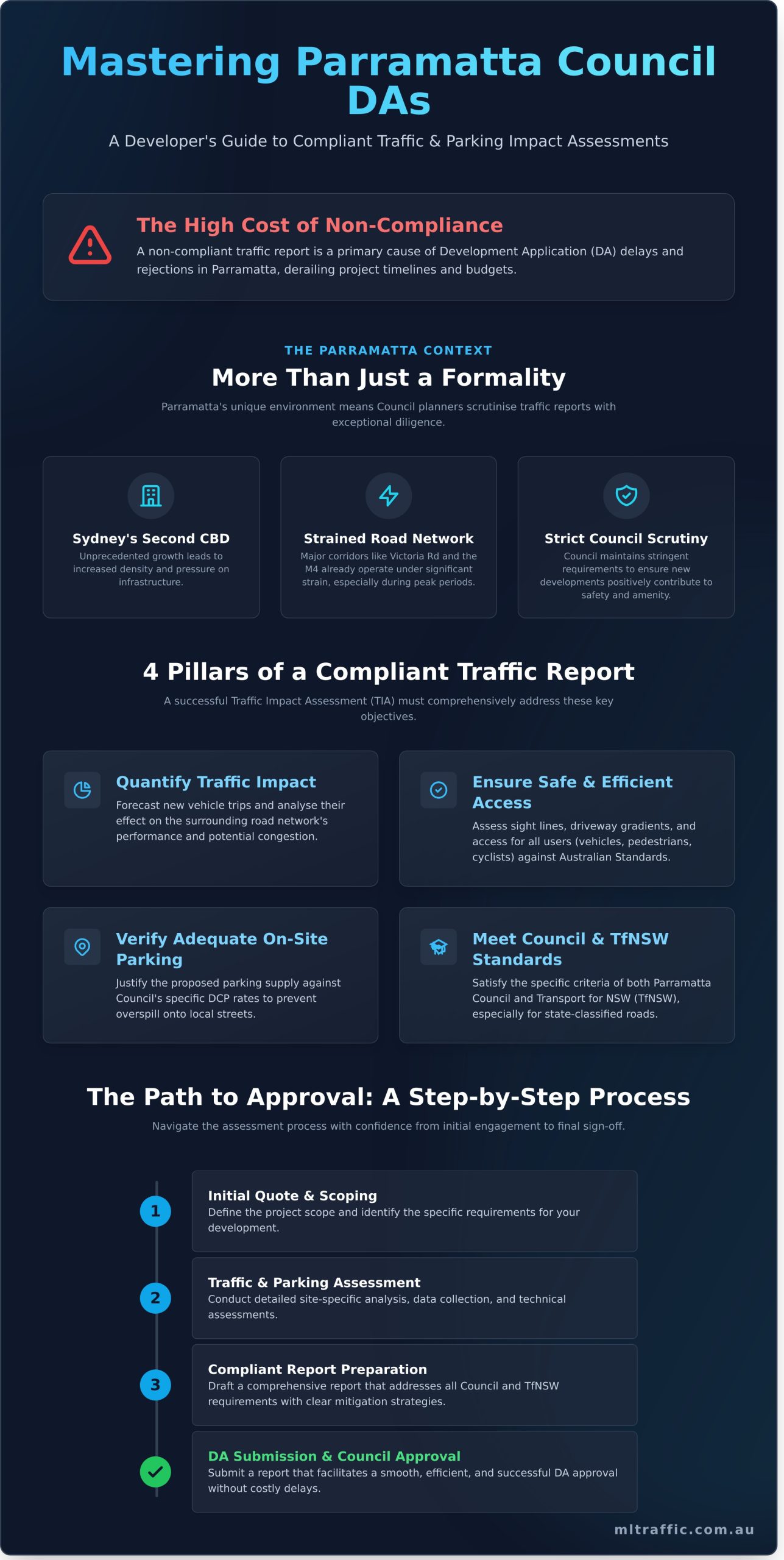
For any developer lodging a Development Application (DA) in the City of Parramatta, a comprehensive traffic and parking assessment is a critical, non-negotiable component. As Sydney’s second CBD, Parramatta is experiencing unprecedented growth, leading to increased density and significant pressure on its transport infrastructure. Consequently, Parramatta Council maintains stringent requirements to ensure all new developments contribute positively to the area’s safety, accessibility, and local amenity.
To understand the core function of these reports, the following video provides a clear overview:
A professionally prepared report demonstrates to Council that your project is a responsible and well-considered addition to the community. It proves that you have analysed the potential impacts and have proposed effective solutions, significantly strengthening your DA and improving the likelihood of approval.
The Purpose of a Traffic Impact Assessment (TIA) in a DA
A Traffic Impact Assessment (TIA), also known as a Traffic and Parking Impact Statement, serves several fundamental purposes within the DA process. It is an essential tool for both the developer and the consent authority to make informed decisions. Its primary objectives are to:
-
Quantify the traffic impact of a proposed development by forecasting new vehicle trips and analysing their effect on the surrounding road network’s performance. This often involves technical analysis using frameworks like the Intersection Capacity Utilization method to measure potential congestion.
-
Ensure safe and efficient access for all users, including vehicles, service trucks, pedestrians, and cyclists. This includes assessing sight lines, driveway gradients, and compliance with relevant Australian Standards (e.g., AS 2890.1).
-
Verify adequate on-site parking is provided to meet demand and prevent overspill onto local streets. The assessment must justify the proposed parking supply against the specific rates outlined in Council’s Development Control Plan (DCP).
-
Satisfy the requirements of both Council and Transport for NSW (TfNSW). For developments on or near state-classified roads, the TIA must address the specific criteria set by TfNSW to gain their concurrence.
Parramatta’s Unique Traffic Environment
Parramatta’s traffic network is a complex mix of a dense CBD, high-traffic arterial roads, mixed-use commercial zones, growing residential precincts, and heritage conservation areas. Major corridors such as Victoria Road, James Ruse Drive, and the M4 Motorway already operate under significant strain, particularly during peak periods. This intricate environment means that Council planners scrutinise traffic reports with exceptional diligence.
Successfully undertaking Traffic and Car Parking Impact Assessments in Parramatta Council requires a deep, localised understanding of these challenges. A generic, template-based report will not meet Council’s expectations. Your assessment must provide a detailed, site-specific analysis that directly addresses the unique pressures of the Parramatta LGA and presents credible, effective mitigation strategies.
Key Triggers: When Do You Need a Traffic Report for a Parramatta DA?
Determining whether a Traffic Impact Assessment (TIA) is required is the critical first step for any Development Application (DA) in Parramatta. The council identifies certain projects as ‘traffic generating development’-proposals that are likely to have a measurable impact on the safety and efficiency of the local road network. Undertaking Traffic and Car Parking Impact Assessments in Parramatta Council is not optional for these developments; it is a mandatory requirement to ensure any new project integrates responsibly with existing infrastructure.
Even developments that seem minor can trigger the need for a professional assessment if they involve changes to vehicle access, complex driveway designs, or are located on a classified road. It is essential to identify these triggers early in the planning process.
Common Development Types Requiring a TIA
While not an exhaustive list, a traffic and parking report is almost always required for the following development types due to their significant impact on vehicle movements and parking demand:
-
New residential flat buildings, boarding houses, and multi-dwelling housing projects.
-
Commercial developments, including new office buildings and retail premises.
-
Community-focused facilities such as childcare centres, medical centres, and places of public worship.
-
Industrial developments, warehouses, and distribution centres with regular heavy vehicle movements.
Calculating Parking Requirements as per Parramatta DCP
The core document governing parking provision is the Parramatta Development Control Plan (DCP). This plan outlines the minimum required car parking rates, which vary significantly based on the specific land use and its location within the LGA. For example, a retail shop in a commercial centre will have different requirements than a warehouse in an industrial zone. These requirements are detailed within Parramatta Council’s official traffic and transport controls, which forms the basis of our assessments. While the DCP rates are prescriptive, Council may consider a reduction in parking rates if a strong justification is provided, such as excellent access to public transport. See our full list of traffic engineering services to ensure full compliance.
Change of Use and Intensification Scenarios
A traffic report is not only triggered by new construction. A ‘change of use’ application for an existing building can also mandate a new assessment. This occurs when the proposed new use generates more traffic or parking demand than the previous one. A classic example is converting a retail shop (low parking demand) into a restaurant (high evening and weekend parking demand). This intensification requires a new assessment to prove the site can accommodate the increased demand. We strongly advise obtaining professional traffic advice before signing a commercial lease to avoid unforeseen compliance costs.
Core Components of a Compliant Parramatta Traffic & Parking Report
A Traffic and Car Parking Impact Assessment is both a technical analysis and a justification document. Its primary function is to demonstrate to Parramatta Council that a development’s traffic and parking arrangements are safe, functional, and compliant. A logically structured report that clearly references Council’s Development Control Plan (DCP), relevant state policies, and Australian Standards makes the assessor’s job straightforward, facilitating a timely approval.
Successfully undertaking Traffic and Car Parking Impact Assessments in Parramatta Council requires a meticulous approach that addresses three critical areas:
Traffic Generation and Distribution Analysis
This foundational analysis quantifies the expected traffic increase from the development. Calculations are based on established rates from the TfNSW Guide to Traffic Generating Developments, ensuring a consistent and accepted methodology. The report then maps the distribution of this new traffic onto the surrounding road network, identifying the primary routes vehicles will use. For larger-scale projects, this section may include detailed intersection analysis to assess the impact on local traffic flow and signal performance.
Car Parking Design and Compliance (AS 2890.1)
Compliance with Australian Standard AS 2890.1 (Off-street car parking) is non-negotiable for Parramatta Council. Our reports provide a rigorous certification that the proposed car park layout adheres to all mandatory design parameters. This includes a detailed check of:
-
Parking space and aisle dimensions
-
Driveway and ramp widths and gradients
-
Vertical clearances for headroom
-
Layouts for accessible parking spaces
This verification gives the council confidence that the facility will be safe and efficient for all users.
Access, Sightlines, and Swept Path Analysis
This section assesses the safety and functionality of vehicle access points. We analyse driveway location to ensure adequate sight lines are available, allowing drivers exiting the site to see pedestrians and oncoming vehicles clearly. To prove vehicles can manoeuvre safely, the report includes detailed swept path diagrams. These CAD-based illustrations demonstrate that design vehicles-from a standard car to a council waste collection truck-can navigate driveways, ramps, and parking aisles without striking kerbs, columns, or other vehicles. Learn more about our experienced team and our rigorous approach.
The Assessment Process: A Step-by-Step Guide to a Successful Outcome
Navigating the requirements for a Development Application (DA) can be a complex task. However, the process of undertaking Traffic and Car Parking Impact Assessments in Parramatta Council follows a structured and logical sequence designed to deliver a compliant and successful outcome. By engaging an experienced traffic engineer early in the design phase, you can prevent costly redesigns and streamline the approval process.
A professional consultant not only prepares the technical report but also acts as your representative, liaising directly with council officers to clarify issues and facilitate a smoother assessment. The following steps outline our proven methodology for achieving this.
Step 1: Initial Consultation and Scoping
The process begins with a thorough review of your architectural plans and project objectives. We identify the specific requirements stipulated in the Parramatta Development Control Plan (DCP) and other relevant planning instruments. Based on this initial analysis, we provide a fixed, lump-sum fee proposal that clearly outlines the scope of work. This ensures complete transparency with no hidden costs or variations.
Step 2: Data Collection and Site Investigation
A senior traffic engineer conducts a physical site visit to observe and document existing traffic conditions, road network characteristics, and site access constraints. This involves gathering relevant traffic count data, either from official sources like Transport for NSW or by commissioning new surveys if required. We photograph the site and its surroundings to provide essential context for the technical analysis and the final report.
Step 3: Analysis and Report Preparation
This stage involves the core technical work. Our engineers undertake detailed analysis, including parking demand calculations based on council rates, traffic generation assessments, and vehicle swept path diagrams to ensure compliance with Australian Standard AS 2890.1. We then draft a comprehensive report that methodically presents the findings, ensuring every claim is justified with clear evidence and sound engineering principles.
Step 4: Lodgement and Council Liaison
Once complete, we provide the final Traffic and Parking Impact Assessment in a high-resolution PDF format, ready for lodgement with your DA. Our role does not end at submission. We remain available to respond to any questions or Requests for Information (RFIs) from council’s traffic engineers. We act as your advocate, managing communications to resolve any issues promptly and help smooth the path to approval.
Ready to start? Contact us for a quote on your Parramatta project.
Ensure DA Success with a Compliant Parramatta Traffic Report
Navigating the development application process in Parramatta requires meticulous attention to its specific traffic and parking regulations. A comprehensive, professionally prepared report is not a procedural formality; it is a critical component for a successful DA. Successfully undertaking Traffic and Car Parking Impact Assessments in Parramatta Council demands a thorough understanding of local planning controls and a technically robust methodology to avoid unnecessary delays.
ML Traffic Engineers Pty Ltd provides the specialised expertise your project needs. With over 15 years of experience with NSW councils and a proven track record of success in the Parramatta LGA, our reports are designed for compliance and approval. You will have direct access to the senior engineers who prepare your quote and complete the work, ensuring accountability and expert oversight throughout the process.
Secure the expert guidance your project deserves. Get a fixed-price quote for your Parramatta traffic report today and let our expertise streamline your path to approval.
Frequently Asked Questions
How much does a Traffic and Parking Impact Assessment cost for a project in Parramatta?
A standard Traffic and Parking Impact Assessment for a small-scale development in Parramatta typically starts from A$2,000 to A$3,500 plus GST. The final cost is determined by the project’s complexity, including the scale of the development, its specific land use, and the level of detail required by Parramatta Council. For a precise, fixed-fee proposal, we recommend contacting one of our senior traffic engineers directly to discuss your project’s specific requirements and receive a comprehensive quote.
How long does it take to prepare a traffic report for Parramatta Council?
The standard turnaround time for preparing a traffic report for Parramatta Council is approximately 5 to 10 working days from the time of engagement. This timeframe can be influenced by the need for on-site traffic surveys or specific data collection, which may require additional time. At ML Traffic, the senior consultant who provides your quote is the same person who completes the work, ensuring an efficient and streamlined process from start to finish.
What is the difference between a Traffic Impact Statement (TIS) and a full Traffic Impact Assessment (TIA)?
A Traffic Impact Statement (TIS) is typically required for smaller developments with low traffic generation, providing a concise overview of parking and traffic impacts. A full Traffic Impact Assessment (TIA) is a more comprehensive and detailed analysis required for larger projects that are expected to have a significant effect on the surrounding road network. The TIA involves more in-depth data collection, traffic modelling, and a broader scope of assessment as stipulated by Council and Transport for NSW guidelines.
Can I prepare my own traffic report to save money?
Preparing your own traffic report is not advisable. Parramatta Council requires these assessments to be conducted by qualified and experienced traffic engineering consultants. Reports must comply with specific Australian Standards (e.g., AS 2890.1), Council’s Development Control Plan (DCP), and Transport for NSW guidelines. Submitting a non-compliant report prepared by an unqualified individual will almost certainly lead to its rejection, causing significant project delays and additional costs that far exceed any initial savings.
What happens if Parramatta Council is not satisfied with the submitted traffic report?
If the Council is not satisfied, they will issue a Request for Further Information (RFI) outlining their specific concerns or required amendments. A professional consultant will then address these points and resubmit a revised report. Our extensive experience in undertaking Traffic and Car Parking Impact Assessments in Parramatta Council means we are adept at anticipating Council’s requirements, minimising the likelihood of RFIs. Should one arise, we manage the response process efficiently to ensure a timely resolution.
Does ML Traffic have experience with projects near major Parramatta landmarks or roads?
Yes, ML Traffic has extensive experience with projects throughout the Parramatta LGA, including those near major landmarks and arterial roads like Church Street, Victoria Road, and James Ruse Drive. Our portfolio includes a vast range of land uses, from residential flat buildings to commercial centres and child care facilities in high-traffic areas. This deep local knowledge is critical for ensuring our reports are robust, accurate, and context-aware for any development application.
