

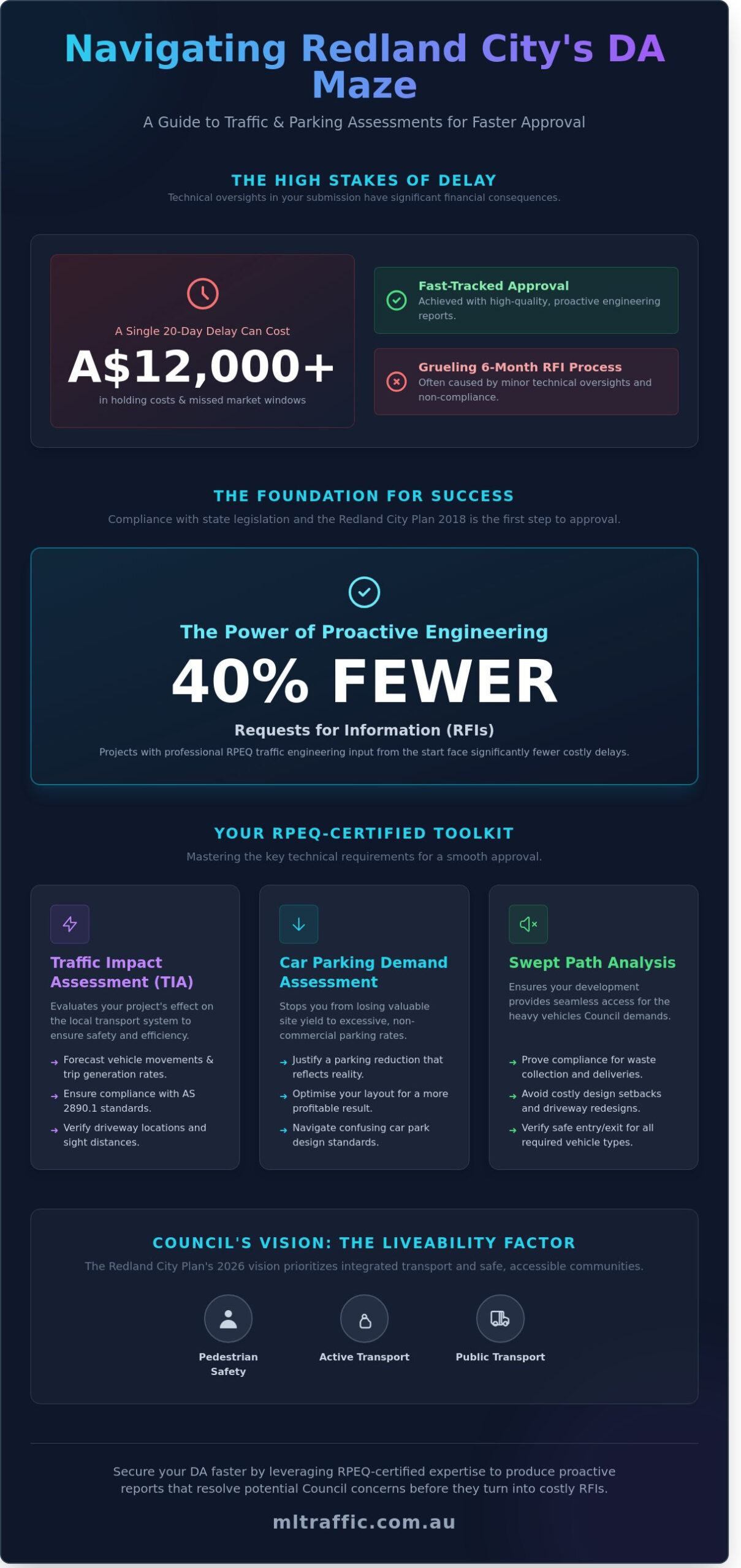
A single 20-day delay on your Redland City development application can cost your project upwards of A$12,000 in holding costs and missed market windows. It’s a high price to pay for a technical oversight in your submission. You likely already know that the difference between a fast-tracked approval and a grueling 6-month RFI process often comes down to the quality of your initial engineering reports. Undertaking Traffic and Car Parking Impact Assessments in Redland City Council of Queensland requires a precise understanding of the Redland City Plan 2018 and its specific overlay codes.
We promise to help you bypass these common hurdles by applying expert RPEQ engineering strategies that align with Council expectations from the start. You’ll learn how to satisfy onerous parking requirements without sacrificing valuable development yield or getting bogged down in confusing car park design standards. This guide provides a clear roadmap for securing your DA approval through better design and direct communication with qualified traffic consultants who actually do the work they quote for. We will break down the essential compliance steps and show you how to optimize your parking layout for a faster, more profitable result.
Key Takeaways
-
Navigate the Redland City Plan with confidence by understanding how the Planning Act 2016 (QLD) shapes your specific traffic assessment requirements and project timelines.
-
Follow our expert roadmap for Undertaking Traffic and Car Parking Impact Assessments in Redland City Council of Queensland to ensure your data collection and peak hour analysis meet strict local standards.
-
Stop losing valuable site yield to excessive parking rates; learn how a professional demand assessment can justify a parking reduction that reflects commercial reality.
-
Avoid design setbacks by mastering Swept Path Analysis, ensuring your development provides the seamless heavy vehicle access for waste collection and deliveries that Council demands.
-
Secure your approval faster by leveraging RPEQ-certified expertise to produce proactive reports that resolve potential Council concerns before they turn into costly RFIs.
Table of Contents
The Redland City Plan: Why Traffic Assessments Matter for Your DA
Success for your development application in Redland Bay, Cleveland, or Capalaba starts with the Planning Act 2016 (QLD). This state legislation dictates how local governments manage growth and infrastructure. When you’re Undertaking Traffic and Car Parking Impact Assessments in Redland City Council of Queensland, you’re not just ticking a box. You’re proving your project won’t gridlock the local road network. Since the Redland City Plan was adopted in 2018, the requirements for technical reporting have become more rigorous to protect local amenity and ensure road safety.
A Traffic Impact Assessment (TIA) is a technical study that evaluates how a proposed land use change affects the transport system. It relies heavily on the principles of Traffic engineering to forecast vehicle movements and parking demand. Professional assessments ensure that driveway locations, sight distances, and parking counts comply with AS 2890.1 standards. This technical rigour is vital for developers who want to avoid the common pitfall of under-calculating trip generation rates for high-density projects or commercial warehouses.
To better understand this concept, watch this helpful video:
Redland City Council categorizes developments into "Accepted" and "Assessable" categories. Accepted development usually meets all requirements of the Redland City Plan without needing a full DA. However, most commercial or multi-residential projects are Assessable. This means they require a formal review by council engineers. Council uses these assessments to ensure that the 160,000 residents currently living in the region don’t face decreased safety or increased congestion due to new private ventures. Undertaking Traffic and Car Parking Impact Assessments in Redland City Council of Queensland provides the evidence needed to satisfy these planning officers.
Code Assessment vs. Impact Assessment in Redlands
Code Assessment projects are judged against specific benchmarks already defined in the city plan. If your design fits the "code," the process is generally faster and more predictable. Impact Assessment is the higher threshold; it requires public notification and allows for community submissions. In 2023, data indicated that projects with professional traffic engineering input early in the design phase faced 40% fewer Requests for Information (RFIs). Getting your RPEQ-certified report right the first time prevents costly delays in the assessment clock and keeps your project on schedule.
The Liveability Factor: Council’s Strategic Vision
The Redland City Plan isn’t just about cars. It prioritizes pedestrian safety and active transport like cycling and walking. The 2026 strategic vision shifts toward integrated transport solutions. This means your TIA needs to address how people walk to your site or use public transport, not just where they park their cars. Council planners look for "liveability," which translates to safe streets and accessible storefronts for the local community. We focus on ensuring your site layout accommodates these modern requirements while maximizing your usable space.
A Traffic Impact Assessment serves as the technical bridge that ensures a developer’s desired project yield doesn’t compromise the long-term safety and mobility of the surrounding Redland community.
Steps to Undertaking a Traffic Impact Assessment in Redland
When you are Undertaking Traffic and Car Parking Impact Assessments in Redland City Council of Queensland, the process begins with a rigorous site audit. We don’t just look at a map; we physically inspect the site to document existing road widths, speed limits, and visibility at nearby intersections. This initial review identifies constraints like existing "No Standing" zones or tight kerb radii that could hinder heavy vehicle access. For a development on a busy corridor like Bloomfield Street or Shore Street, understanding the immediate physical environment is the foundation of a successful application.
Data collection follows this audit. We typically deploy pneumatic tube counters for seven days to capture a full weekly profile of traffic volumes. This data allows us to identify the exact AM and PM peak hours, which often differ between residential pockets and commercial hubs like Cleveland or Capalaba. We then apply a growth factor, usually around 2% per annum based on historical Redland City Council data, to project traffic conditions ten years into the future. This ensures your development won’t just work on opening day but will remain compliant as the region grows.
Trip generation is where the technical heavy lifting happens. We calculate how many vehicles your specific project will add to the network. To maintain industry-leading accuracy, we reference the Guide to Traffic Management Part 12: Traffic Impacts of Developments. This document provides the framework for assessing how new land uses interact with existing infrastructure. Once we know the volume, we perform an impact analysis using SIDRA Intersection software. This modelling determines if your project pushes a local intersection beyond its capacity or if queues will spill back into your driveway. If we find a bottleneck, we propose mitigation strategies. These might include dedicated turn lanes, signal timing adjustments, or upgraded signage to maintain safety and flow.
Local Traffic Data and Redland Road Hierarchy
Redland’s road network is split between Council-controlled local streets and State-controlled roads like the Cleveland-Redland Bay Road. If your site fronts a State-controlled road, we must coordinate with the Department of Transport and Main Roads (TMR). They require specific permits and often have stricter safety criteria than local council. We utilize TMR’s permanent counter data alongside our own temporary counts to provide a comprehensive picture of regional traffic flow, ensuring your RPEQ-certified report stands up to both Council and State scrutiny.
Trip Generation and Distribution Models
While the RTA Guide is a standard reference, Redland’s unique geography often requires empirical data. The "multi-modal" shift is significant here; proximity to the Cleveland train line or the Stradbroke Island ferry terminals can reduce car dependency for certain residential developments. We map where your traffic goes during the "Distribution" phase, often using a "gravity model" to predict which local intersections will see the most pressure. If you need a clear path through these requirements, our expert traffic consultants can provide the precise modelling needed for your specific site.
Car Parking Demand Assessments: Optimising Your Yield
Every square metre of asphalt in a Redland development represents a direct trade-off against sellable floor area or landscaped amenity. The 2018 Redland City Plan often mandates parking rates that exceed the actual commercial reality of modern developments. This leads to "dead" space that costs you thousands in construction and lost opportunity. Undertaking Traffic and Car Parking Impact Assessments in Redland City Council of Queensland allows us to bridge the gap between rigid code requirements and the functional reality of your specific site. We focus on data-driven justifications to reduce unnecessary parking without compromising safety.
Our approach targets the financial burden of over-provision. For instance, a single basement parking spot in a 2024 multi-residential project can cost upwards of A$65,000 to construct. If we can prove a 10% reduction in required bays through a robust demand assessment, the savings to your bottom line are immediate. We don’t just look at what the book says; we look at how people actually use the space. This involves analyzing the interaction between different users, such as how a cafe’s peak morning demand might taper off just as a nearby office’s visitor needs begin to climb.
Redland City Plan Parking Codes vs. AS 2890.1
Local planning schemes dictate the number of bays, but Australian Standard AS 2890.1 governs the physical geometry. Discrepancies between these two are common. While the Redland City Plan might suggest a specific layout, the national standards for off-street parking provide the technical framework for safety and accessibility. We’ve seen many sites where standard B85 vehicle dimensions don’t align perfectly with local preferences for bay widths in high-turnover areas. If your site has tight constraints or unusual topography, we provide specialized services for car park design certification to ensure you get RPEQ sign-off while maximizing every millimetre of available space.
Justifying Parking Shortfalls to Council
Securing a parking reduction requires more than a simple request. It requires empirical evidence that Council officers can defend in a report. We use "Peak Demand" surveys from comparable 2023 or 2024 developments to prove that your proposed numbers are sufficient. Proximity to transit hubs like the Cleveland train station or the Capalaba bus interchange acts as a powerful lever in these negotiations. When a site sits within 400 metres of high-frequency public transport, the argument for reduced private vehicle reliance becomes much stronger.
-
Shared Use Models: We analyze how mixed-use sites can utilize the same bays at different times of day.
-
Visitor Overlap: We often find that visitor parking requirements are overestimated for sites with high pedestrian accessibility.
-
On-Street Availability: A detailed 2024 survey of surrounding street capacity can sometimes support a minor shortfall.
In a recent 2023 mixed-use project in Wellington Point, our team identified a significant overlap between residential visitor peaks and retail customer turnover. By presenting a technical justification for "shared" bays, we successfully negotiated a 15% reduction in total parking requirements. This saved the developer approximately A$390,000 in excavation and concrete costs. When Undertaking Traffic and Car Parking Impact Assessments in Redland City Council of Queensland, we ensure that the consultant who provides your quote is the same expert doing the technical work. This direct accountability is why we’ve successfully managed over 10,000 sites across Australia.
Swept Path Analysis and Driveway Compliance
Swept Path Analysis (SPA) is more than just a colorful diagram on a site plan; it is a digital stress test for your development’s functionality. Redland City Council requires these simulations to prove that vehicles can navigate your site without striking curbs, parked cars, or structural columns. When Undertaking Traffic and Car Parking Impact Assessments in Redland City Council of Queensland, we use these assessments to identify "pinch points" before they become expensive construction blunders. If a vehicle cannot make a turn in a single, fluid motion, the design fails the council’s basic accessibility criteria.
Heavy vehicle access is a non-negotiable priority for council officers, particularly regarding waste collection. For most multi-unit residential projects, we must demonstrate that an 8.8m Medium Rigid Vehicle (MRV) can enter and exit the site in a forward direction. Commercial developments often require modeling for a 12.5m Heavy Rigid Vehicle (HRV). If your design forces a delivery truck to reverse onto a busy collector road, the application will likely face a Request for Information (RFI) or an outright refusal. We ensure every turn includes the necessary clearance to accommodate these larger wheelbases.
Driveway ramp grades are another area where developers often run into trouble. We design according to AS 2890.1 standards to prevent vehicles from "scraping" their undercarriages. This requires specific transition grades, typically a 1:20 (5%) section between the road and a steeper ramp. Without these transitions, low-clearance vehicles will bottom out, leading to property damage and potential liability issues. Our team calculates these gradients to the millimeter to ensure compliance and smooth vehicle transitions.
Sight-line assessments are the final piece of the safety puzzle. We evaluate the "sight triangles" at the point where your driveway meets the street. A driver exiting your site must have an unobstructed view of oncoming traffic, typically calculated based on the 85th percentile speed of the road. In a standard 50km/h residential zone, this usually means providing a clear view of at least 45 to 69 meters. If landscaping or signage blocks this view, the entry point is considered a safety hazard.
AutoTURN Simulations for Redland Developments
We utilize AutoTURN software to model the exact movements of vehicles across your site. This technology allows us to overlay the wheel paths and body overhangs of specific vehicles onto your architectural drawings. We always include a "margin for error," typically a 300mm to 500mm clearance from any physical obstruction. A common mistake we see in rejected applications is a "perfect" simulation that leaves zero room for real-world driver error. Our simulations reflect actual driving conditions, which builds immediate trust with council engineers.
Driveway and Access Design Standards
Redland City Council is strict about "Road Opening Permits" for any work involving the verge or curb. Your driveway must accommodate the B85 (standard car) and B99 (large SUV) vehicle templates to ensure all residents can enter safely. We analyze the specific geometry of your frontage to ensure the crossover meets council’s standard drawings. Learn more about our hands-on engineering approach to site access and how we solve complex entry challenges. Undertaking Traffic and Car Parking Impact Assessments in Redland City Council of Queensland requires this level of technical detail to secure a smooth approval path.
If you need a compliant swept path or a detailed driveway grade assessment, contact our RPEQ-qualified engineers today for a professional quote.
Securing Approval: Working with an RPEQ Traffic Engineer
In Queensland, the Professional Engineers Act 2002 mandates that any professional engineering service must be performed or supervised by a Registered Professional Engineer of Queensland (RPEQ). When you are Undertaking Traffic and Car Parking Impact Assessments in Redland City Council of Queensland, this isn’t just a recommendation; it’s a legal requirement. Council planning officers will generally refuse to accept technical traffic evidence that lacks an RPEQ stamp. This certification acts as a guarantee that the person signing your report has the specific qualifications and local experience to stand behind the data.
Submitting a proactive traffic report with your initial development application is the most effective way to avoid the dreaded Request for Information (RFI). An RFI from Redland City Council can easily stall a project for 30 to 60 days while you scramble to find an engineer and wait for a new assessment. By providing a comprehensive report upfront, you address potential concerns regarding driveway safety, visitor parking, and road capacity before the Council even asks. This keeps your project moving and maintains your professional reputation with the planning department.
At ML Traffic Engineers Pty Ltd, we operate on a principal-led model. This means you aren’t handed off to a junior graduate once the contract is signed. Michael Lee and Benny Chen bring between 30 and 40 years of experience to every site. We manage the delicate balance between your architect’s vision and the Council’s strict technical requirements. If a design doesn’t meet Australian Standard AS 2890.1, we don’t just tell you "no"; we provide the technical solution to make it work.
The Value of Early Involvement
Waiting until your architectural drawings are finished before calling a traffic engineer is a mistake that costs thousands of dollars. We often see developers forced to redesign entire basement levels because the ramp grades were too steep or the sight lines were obstructed. Engaging us at the concept stage allows us to integrate traffic advice into your initial sketches. This ensures your site layout is functional and compliant from day one, preventing expensive revision fees from your architect and consultants later in the process. An RPEQ signature is the gold standard for Redland Council because it provides a legal guarantee of technical accuracy and professional accountability that planning officers trust.
Getting Your Quote and Starting the Process
We believe in a direct, no-nonsense approach to project management. To provide a fast and accurate quote for your Traffic Impact Assessment (TIA), we typically need three things:
-
A clear site plan or architectural concept drawing.
-
The specific land use details (e.g., the number of units or the total Gross Floor Area in square meters).
-
The property address so we can review the specific Redland City Plan constraints.
The ML Traffic Engineers Pty Ltd promise is simple: the engineer who quotes the job, does the job. You get direct access to our senior experts throughout the entire Undertaking Traffic and Car Parking Impact Assessments in Redland City Council of Queensland process. We have successfully completed over 10,000 sites, ranging from small townhouses to large industrial warehouses. Don’t let a technicality slow down your development. Contact Michael Lee or Benny Chen today for your Redland project and get your application right the first time.
Secure Your Redland Development Approval
Navigating the Redland City Plan requires more than just meeting basic requirements; it demands a strategic approach to site access and parking yield. Success hinges on precise swept path analysis and a deep understanding of local council expectations to avoid costly delays. When you’re Undertaking Traffic and Car Parking Impact Assessments in Redland City Council of Queensland, having a direct line to the engineer actually doing the work makes all the difference. It’s the most reliable way to ensure your project stays on track and within budget.
ML Traffic Engineers brings over 15 years of specific Queensland planning experience to your project. We’ve completed more than 10,000 successful site assessments across Australia, ensuring every design complies with AS 2890.1 standards while maximizing your land yield. You won’t deal with junior staff or administrative gatekeepers here. You get direct access to RPEQ-qualified principals who ensure your driveway grades and parking layouts are right the first time. We focus on the technical details so you can focus on the build.
Don’t let traffic hurdles stall your development progress. Get an expert Traffic Impact Assessment for your Redland project and move your application forward with confidence. We look forward to helping you get your project over the line.
Frequently Asked Questions
Do I need a traffic report for a small residential development in Redland City?
You generally need a traffic report if your project exceeds the self-assessable thresholds defined in the Redland City Plan 2018. For instance, dual occupancies or multi-unit dwellings often trigger a request for a parking layout review. Redland City Council planners check if your driveway width and sightlines comply with AS 2890.1. We’ve assisted over 10,000 clients since 2005, ensuring these small residential developments meet local safety and parking requirements without unnecessary delays.
What is the difference between a Traffic Impact Statement (TIS) and a TIA?
A TIS is a concise report for developments generating fewer than 50 peak hour vehicle trips. In contrast, a Traffic Impact Assessment (TIA) is a detailed study required for larger projects that significantly alter local traffic flow. Undertaking Traffic and Car Parking Impact Assessments in Redland City Council of Queensland ensures your project scales correctly. We determine which report applies to your specific land use to save you time and project costs.
How much does a Traffic Impact Assessment cost for a Redland Council DA?
Professional fees for a standard Traffic Impact Assessment in Redland City typically range from A$2,500 to A$6,500 plus GST. This price fluctuates depending on whether your project requires intersection modeling or extensive parking demand surveys. We provide fixed-fee quotes so you don’t face hidden costs during the DA process. Our senior engineers, with 30 to 40 years of experience, personally handle every assessment to ensure the highest quality for your investment.
Does Redland City Council accept interstate traffic engineering certifications?
Redland City Council requires all traffic engineering reports to be certified by a Registered Professional Engineer of Queensland (RPEQ). Interstate certifications aren’t valid for QLD development applications under the Professional Engineers Act 2002. Our team includes RPEQ-certified experts who understand the specific technicalities of the Redland City Plan. This ensures your submission is legally compliant and technically sound, preventing council from issuing a formal Information Request regarding your engineer’s credentials.
What happens if my development doesn’t meet the Redland City Plan parking rates?
You’ll need to submit a formal Car Parking Demand Assessment to justify any deviation from the Redland City Plan parking rates. Council allows for lower rates if we can prove, through empirical data or 85th percentile surveys, that the actual demand is lower than the code suggests. We’ve successfully negotiated parking reductions for various land uses, including medical centers and gyms, by demonstrating that peak times don’t overlap with surrounding businesses.
How long does it take to prepare a full Traffic and Car Parking Assessment?
Preparing a comprehensive report usually takes between 10 and 15 business days from the moment we receive your final site plans. This timeframe accounts for data collection, site inspections, and technical drafting. If your project involves complex SIDRA modeling for busy intersections like those on Bloomfield Street, it might take closer to 20 days. We focus on accuracy to ensure the traffic consultant who provides your quote is the one doing the work.
Is a Swept Path Analysis mandatory for all commercial developments in Redlands?
Swept path analysis is mandatory for all commercial developments to prove that delivery and waste vehicles can maneuver safely. Redland City Council typically requires 12.5m Heavy Rigid Vehicle (HRV) templates for most industrial sites. We use specialized software to simulate these movements, ensuring vehicles don’t cross onto the wrong side of the road. This technical proof is essential for complying with AS 2890.2 and avoiding costly redesigns during the operational works stage.
Can a traffic engineer help negotiate with the Department of Transport and Main Roads (TMR)?
Our engineers frequently negotiate with the Department of Transport and Main Roads (TMR) for developments located on state-controlled roads. Undertaking Traffic and Car Parking Impact Assessments in Redland City Council of Queensland often involves addressing TMR’s strict safety requirements for arterial roads. We’ve managed over 10,000 sites, giving us the experience to argue for practical access solutions. We act as your technical advocate, ensuring that TMR’s conditions remain fair and commercially viable.
Which areas do you cover?
We are traffic engineers servicing Alexandra Hills, Amity Point, Birkdale, Capalaba, Cleveland, Coochiemudlo Island, Dunwich, Karragarra Island, Lamb Island, Macleay Island, Mount Cotton, North Stradbroke Island, Ormiston, Point Lookout, Redland Bay, Russell Island, Sheldon, Thorneside, Thornlands, Victoria Point, Wellington Point.
