

We are traffic engineers servicing Chatswood West, Denistone, Denistone East, Denistone West, East Ryde, Eastwood, Gladesville, Macquarie Park, Marsfield, Meadowbank, Melrose Park, North Ryde, Putney, Ryde, Tennyson Point, West Ryde.
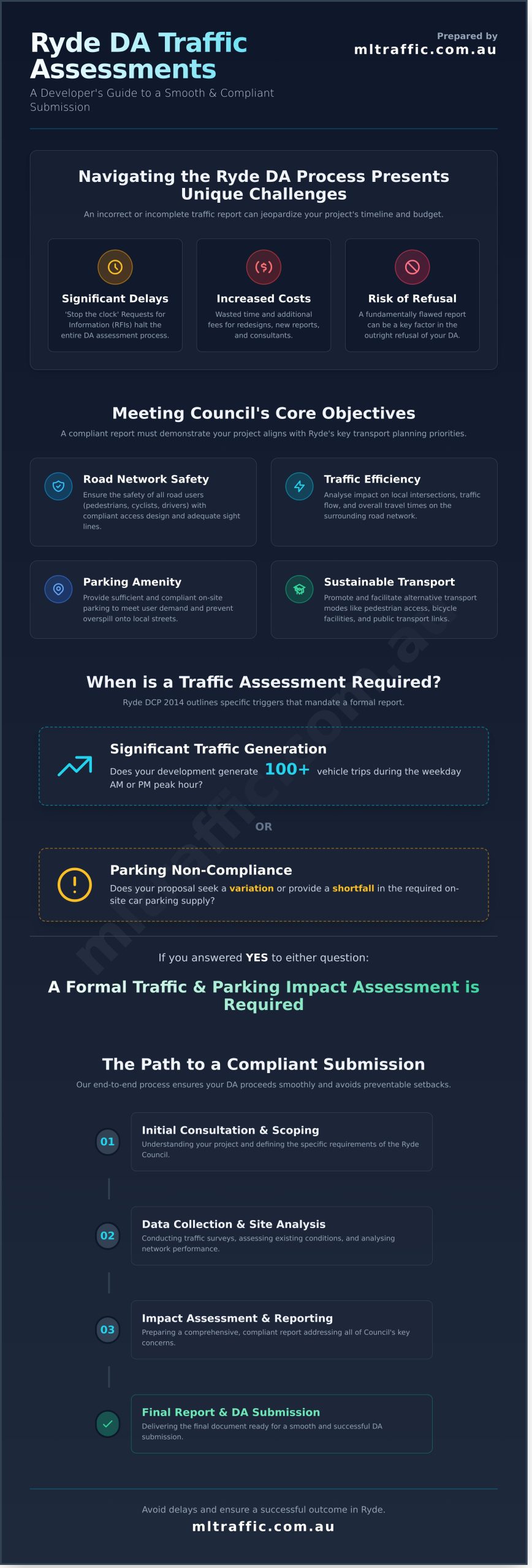
Navigating the Development Application (DA) process within the City of Ryde presents unique challenges, particularly when it comes to undertaking traffic and car parking impact assessments in Ryde Council. Many developers find the official guidelines difficult to interpret, leading to critical questions: Does my project require a Traffic Impact Assessment? What specific local policies must be addressed? An incorrect or incomplete report can result in significant delays, costly requests for information (RFIs), and ultimately jeopardise DA approval. This uncertainty creates unnecessary risk for your project’s timeline and budget.
This definitive guide provides the clarity required for a successful submission. We will demystify the council’s specific requirements, providing a clear checklist of what must be included in a compliant report. You will understand the end-to-end process for preparing a submission that satisfies council planners, ensuring your DA proceeds smoothly and avoids preventable setbacks. Consider this your essential resource for achieving a compliant and successful outcome in Ryde.
Key Takeaways
-
Understand why a Traffic and Parking Impact Assessment is a mandatory requirement for many Development Applications, directly addressing Ryde Council’s objectives for road safety and network efficiency.
-
Identify the specific development thresholds outlined in the Ryde Development Control Plan (DCP) 2014 that trigger the need for a formal traffic and parking report.
-
Learn the essential components of a compliant report, which is the key to successfully undertaking Traffic and Car Parking Impact Assessments in Ryde Council and avoiding DA delays.
-
Gain a clear, step-by-step overview of the entire assessment process, from initial consultation to the final report submission for your DA.
Table of Contents
-
Why a Traffic & Parking Assessment is Crucial for Your Ryde DA
-
When is a Traffic and Parking Impact Assessment Required in Ryde?
-
Navigating Ryde’s Specific Policies: DCP 2014 and Local Guidelines
-
The Assessment Process: From Your First Call to DA Submission
Why a Traffic & Parking Assessment is Crucial for Your Ryde DA
For many developers in the City of Ryde, a Traffic and Car Parking Impact Assessment is a non-negotiable component of a Development Application (DA). This report is a critical technical document that demonstrates to Council how your proposed development will interact with the surrounding road network and parking infrastructure. Far from being a mere procedural hurdle, a professionally prepared assessment is a foundational tool for a successful DA. It functions as a specialised form of Environmental Impact Assessment, specifically focused on transport, providing Council with the necessary assurance that your project has been designed with public safety and local amenity in mind.
To better understand the core components of a transport impact assessment, the following video offers a clear overview:
Understanding Council’s Core Concerns
When reviewing your application, Ryde Council assesses your proposal against several key transport planning objectives. A comprehensive report must directly address these core concerns to demonstrate compliance and merit. The process of undertaking Traffic and Car Parking Impact Assessments in Ryde Council is fundamentally about proving your development positively contributes to, or at least does not detract from, these established priorities:
-
Road Network Safety: Ensuring the safety of all road users, including pedestrians, cyclists, and drivers, through compliant access design and adequate sight lines.
-
Traffic Efficiency: Analysing the development’s impact on the performance of local intersections, traffic flow, and overall travel times on the surrounding network.
-
Parking Amenity: Demonstrating that the development provides a sufficient and compliant supply of on-site parking to meet the demand generated by its users, preventing overspill onto local streets.
-
Sustainable Transport: Promoting and facilitating the use of alternative transport modes by considering pedestrian access, bicycle facilities, and proximity to public transport services.
The Cost of a Non-Compliant Report
Submitting an inadequate or non-compliant traffic and parking report can lead to significant and costly setbacks. These issues directly impact project timelines and budgets, turning a solvable requirement into a major obstacle. The primary risks include:
-
DA Delays: Council may issue a ‘stop the clock’ Request for Further Information (RFI), halting the assessment process until a compliant report is provided.
-
Increased Costs: The need for redesigning parking layouts, access ways, or commissioning a new report wastes valuable time and incurs additional professional fees.
-
Risk of Refusal: A report with fundamental flaws that fails to adequately address Council’s concerns can be a key factor contributing to the outright refusal of your DA.
Navigating these complex requirements is a core function of our professional consulting services, ensuring your project avoids these common pitfalls from the outset.
When is a Traffic and Parking Impact Assessment Required in Ryde?
Determining if your project requires a formal traffic report is a critical first step in the development application process. The City of Ryde Council outlines specific triggers within its Development Control Plan (DCP) 2014. Failure to identify this requirement early can lead to significant delays. The scale and nature of your proposal will dictate whether a brief Traffic Statement is sufficient or if a comprehensive Traffic and Parking Impact Assessment is necessary.
Key Triggers Based on Development Scale
Council mandates an assessment when a development is projected to have a material impact on the local road network or parking supply. The primary triggers outlined in the Ryde DCP 2014 include:
-
Developments generating significant new traffic, typically defined as 100 or more vehicle trips during the weekday AM or PM peak hour.
-
Any proposal that seeks a variation or provides a shortfall against the minimum car parking rates specified in the DCP.
-
Proposals that include new or modified vehicle access points to a classified road, such as Victoria Road, Blaxland Road, or Epping Road.
-
Specific high-impact land uses, including childcare centres, service stations, and large-scale commercial or retail developments, which require assessment irrespective of trip generation.
Specific Scenarios Requiring Assessment
Beyond these primary triggers, a wide range of common development types in Ryde almost invariably require a traffic and parking report to support the DA submission. Developers should anticipate this requirement for the following:
-
Residential: Multi-dwelling housing, residential flat buildings, and boarding houses.
-
Commercial & Industrial: New commercial premises, office buildings, industrial warehouses, and large format retail.
-
Community & Institutional: Places of public worship, educational establishments, and medical centres.
-
Change of Use: Any application for a change of use that results in an intensification of traffic activity or an increased demand for on-site parking.
For developments with a minor impact, a concise Traffic Statement may be sufficient. However, for projects meeting the triggers above, a full report is non-negotiable. Undertaking Traffic and Car Parking Impact Assessments in Ryde Council for these larger projects involves detailed analysis of traffic generation, network capacity, and parking demand, providing Council with the necessary technical assurance to approve your DA.
Key Triggers: When a Traffic and Parking Assessment is Required
Not every Development Application (DA) submitted to the City of Ryde Council requires a formal traffic and parking report. However, the Council has established clear thresholds based on development scale and potential impact. Understanding these triggers is a critical first step for any developer, as it directly influences the scope, timeline, and cost of your DA preparation. Failing to identify the need for a report early can lead to significant delays and requests for information from Council assessors.
To determine if your project requires professional analysis, consider the following key questions. An affirmative answer to any of these indicates a high probability that a report will be a mandatory component of your submission.
Does your DA involve more than five residential dwellings?
For residential projects, the primary trigger is the number of proposed dwellings. Any development that includes the creation of more than five new residences—such as apartment buildings, townhouse complexes, or villa developments—is considered to have a notable impact on local traffic generation and on-street parking demand. For example, a proposal for a block of six townhouses will require a formal assessment to quantify these impacts and demonstrate compliance with Council requirements.
Does your DA involve more than 100sqm of new GFA?
In the context of commercial, retail, or industrial developments, the trigger is typically based on the increase in Gross Floor Area (GFA). Ryde Council generally mandates a traffic and parking assessment for any proposal that introduces more than 100 square metres of new GFA. This applies whether you are constructing a new building or extending an existing one. An extension of 150sqm to an existing medical centre, for instance, would trigger this requirement.
Are you proposing fewer car spaces than required by the Ryde DCP?
The Ryde Development Control Plan (DCP) outlines specific minimum car parking rates for various land uses. If your development proposal provides fewer car parking spaces than the number stipulated by these DCP rates, a report is essential. In this scenario, a specialised Car Parking Demand Assessment is required to professionally justify the proposed parking shortfall, proving that the reduced provision will not negatively impact the surrounding road network or on-street parking availability.
In summary, undertaking Traffic and Car Parking Impact Assessments in Ryde Council is generally required if your project meets one or more of the following criteria:
-
Residential: Proposing more than 5 new dwellings.
-
Commercial/Retail/Industrial: Proposing more than 100sqm of new GFA.
-
Parking Non-Compliance: Proposing a car parking provision below the minimum rates specified in the Ryde DCP.
If your development falls into any of these categories, engaging an experienced traffic engineering consultant is not an optional step but a fundamental requirement for a successful DA submission.
Core Components of a Compliant Ryde Council TIA Report
A successful Development Application (DA) hinges on a Traffic Impact Assessment (TIA) that is methodologically sound and transparent. Ryde Council assessors require a report built on verifiable data, not assumptions. A compliant TIA systematically deconstructs the potential impacts of a development, providing clear, evidence-based conclusions. The process of undertaking Traffic and Car Parking Impact Assessments in Ryde Council demands a structured approach that addresses several core components, each contributing to the final determination.
Existing Conditions & Site Context
This foundational section establishes the baseline against which all future impacts are measured. It provides a clear, factual snapshot of the current transport environment for Council assessors. A thorough analysis must include:
-
Defining the study area and identifying the key roads and intersections in the vicinity.
-
Documenting existing traffic volumes through certified counts, particularly during AM and PM peak periods.
-
Auditing available public transport services, pedestrian footpaths, and dedicated cycle routes.
-
Surveying current on-street and off-street parking occupancy levels and any existing restrictions.
-
Identifying any recorded road safety issues or planned TfNSW/Council network upgrades.
Traffic Generation and Distribution
This section quantifies the development’s direct traffic impact. Using the established technical guidelines from Transport for NSW (TfNSW), we calculate the number of vehicle trips the proposed land use will generate. This new traffic is then assigned and distributed onto the local road network based on logical travel patterns. The critical output is a ‘before’ and ‘after’ analysis, often using SIDRA INTERSECTION software, to model the performance of key intersections and assess any adverse effects on the efficiency and safety of surrounding streets.
Car Parking Demand and Layout Assessment
This component assesses whether the proposed parking supply is adequate and geometrically compliant. Parking demand is calculated based on the specific rates outlined in the Ryde Development Control Plan (DCP) 2014 Part 9.3. Any proposed variation or shortfall from these rates must be robustly justified with supporting evidence. Furthermore, the physical car park layout—including aisle widths, bay dimensions, and ramp gradients—must strictly comply with Australian Standards AS 2890.1 and AS 2890.6 for accessible parking. Swept path analysis is essential to prove all design vehicles can enter, manoeuvre within, and exit the site safely.
Navigating Ryde’s Specific Policies: DCP 2014 and Local Guidelines
While state-level planning policies provide a broad framework, success in your development application hinges on mastering local controls. For developers, undertaking Traffic and Car Parking Impact Assessments in Ryde Council requires a detailed understanding of the Ryde Development Control Plan (DCP) 2014 and supplementary guidelines. These documents dictate the specific, non-negotiable standards that Council’s engineers use to assess every application.
Parking Rates and Requirements (Ryde DCP 2014 Part 9.3)
Part 9.3 of the Ryde DCP is the primary reference for determining the minimum required on-site parking for any development. A compliant assessment must accurately apply these rates to the proposed land use. Key considerations include:
-
Correct Application of Rates: Identifying the precise land use category (e.g., residential flat building, commercial premises, industrial) to apply the correct car, bicycle, and motorcycle parking rates.
-
Ancillary Parking: Calculating and providing separate provisions for visitor and accessible parking spaces as mandated by the DCP and Australian Standards.
-
Parking Shortfalls: If a proposal cannot meet the minimum rates, a robust justification is required. Council assesses these variations on merit, demanding a detailed analysis of site context, public transport accessibility, and traffic generation impacts. A Green Travel Plan is often a necessary supporting document to justify a reduction in parking.
Vehicular Access and On-Site Design (Ryde DCP 2014 Part 7.2)
Beyond parking numbers, the physical design of vehicle access and circulation is scrutinised under Part 7.2 of the DCP. Compliance with these controls is essential for safety and functionality. Your design must demonstrate adherence to:
-
Driveway and Access Handle Design: Driveway locations, widths, and gradients must align with Council’s standards to ensure safe interaction with the public road network.
-
Sight Lines: Pedestrian sight lines at the property boundary must be clear and unobstructed, a critical safety requirement for vehicles exiting the site.
-
Australian Standards: All internal circulation, including ramp grades, transitions, and vertical clearances (headroom), must be designed in strict accordance with AS 2890.1.
-
On-Site Turning: The layout must provide sufficient space for all vehicles, including service and waste collection vehicles where applicable, to enter and exit the site in a forward direction.
The Role of the Interim TIA Procedure
To streamline the assessment process, Ryde Council has published an ‘Interim Traffic Impact Assessment (TIA) Procedure’. This document standardises the required format, content, and methodology for all submitted traffic reports. Adherence is not optional; it ensures your report contains all the information Council’s engineers need for their review, preventing unnecessary delays. Our team’s deep familiarity with these local requirements is a key advantage when preparing your assessment. Learn more about us and our extensive experience with Ryde Council projects.
The Assessment Process: From Your First Call to DA Submission
Navigating the requirements for a traffic and parking assessment is a structured, multi-stage process. Our approach is designed for clarity and efficiency, ensuring a robust report for your DA submission to Ryde Council. We demystify the process by maintaining a collaborative partnership between the developer, architect, and our senior traffic consultants.
Step 1: Project Scoping and Fee Proposal
The process begins with an initial discussion to understand the specifics of your proposed development. We review your preliminary architectural plans and the relevant sections of the Ryde Development Control Plan (DCP) to identify key traffic and parking considerations. Based on this, we issue a detailed fee proposal that clearly outlines the scope of work, deliverables, and a fixed cost. At ML Traffic Engineers, we guarantee accountability: the senior traffic consultant who provides the quote is the same consultant who will manage and complete the work.
Step 2: Data Collection and Detailed Analysis
This is the core technical phase of the assessment where we perform the detailed analysis. Our work involves:
-
Organising traffic and parking surveys to gather current, site-specific data if required by Council.
-
Conducting a meticulous car park layout review and vehicle swept path analysis to ensure full compliance with Australian Standard AS 2890.1.
-
Performing detailed intersection performance modelling using industry-standard software like SIDRA Intersection to quantify traffic impacts.
-
Assessing site access, sight lines, and pedestrian safety provisions against Council and TfNSW standards.
Following this analysis, we draft the technical report, detailing our findings and formulating practical recommendations. This rigorous stage is critical for successfully undertaking Traffic and Car Parking Impact Assessments in Ryde Council.
Step 3: Draft Review and Final Submission
Collaboration is essential for an optimal outcome. We provide a draft report to you and your project team, including the architect, for review and comment. This step ensures our technical recommendations align with the architectural design and overall project objectives before finalisation. After incorporating any feedback, we finalise the report and issue the signed copy, ready for inclusion in your formal DA submission package.
Ready to begin? Contact us to get a quote for your project.
Your Next Step to a Compliant Ryde Development Application
A comprehensive Traffic and Parking Impact Assessment is not just a formality; it is a critical component for securing your Development Application approval with Ryde Council. Successfully undertaking Traffic and Car Parking Impact Assessments in Ryde Council hinges on a meticulous approach that demonstrates full compliance with the Ryde Development Control Plan (DCP) 2014. A professionally prepared report is your key to navigating these specific requirements efficiently and avoiding costly project delays.
At ML Traffic Engineers, we provide the specialist expertise required. With over 15 years of experience preparing reports for NSW councils, our team possesses in-depth knowledge of Ryde DCP 2014 and local traffic engineering guidelines. You gain direct access to the senior engineer managing your project from start to finish, ensuring clarity and accountability throughout the process. Don’t let traffic and parking compliance become a roadblock for your development.
Request a formal quote for your Ryde Council Traffic Assessment Report. Let our experts ensure your DA submission is robust, compliant, and positioned for success.
Frequently Asked Questions
How much does a Traffic and Parking Impact Assessment cost for Ryde Council?
The cost of a Traffic and Parking Impact Assessment for a Ryde Council DA depends on the scale and complexity of the development. For a standard small-to-medium project, such as a duplex or a small commercial tenancy, you can typically expect costs to range from A$2,000 to A$4,000 plus GST. Larger, more complex developments that require extensive traffic surveys and modelling will have higher fees. We provide a fixed-price, all-inclusive fee proposal upfront for complete certainty.
How long does it take to prepare a traffic report for a DA in Ryde?
Our standard turnaround time for preparing a traffic report for a Development Application (DA) in Ryde is approximately 5 to 7 working days. This timeframe commences once we have received all necessary architectural plans and project information from you or your architect. If the project requires new traffic surveys, this may extend the timeline. We prioritise clear communication to ensure you are aware of all timelines from the outset of the project.
What happens if Ryde Council’s traffic engineers request changes to my report?
It is common for Council’s traffic engineers to issue a Request for Information (RFI) during the DA assessment process. Our professional service includes liaising directly with Council on your behalf. We will review their requests, provide you with expert advice, and undertake any necessary report amendments to address their comments. Our extensive experience with Ryde Council’s requirements ensures this process is managed efficiently to facilitate a positive outcome for your application.
My development proposes a shortfall in parking. Can a traffic report help justify this?
Yes, a specialised traffic report is the primary tool used to justify a car parking shortfall. Our reports present a detailed Car Parking Demand Assessment, which analyses the development based on first principles. Undertaking Traffic and Car Parking Impact Assessments in Ryde Council often involves demonstrating that factors like excellent access to public transport, availability of local on-street parking, and the specific nature of the land use make the proposed parking provision adequate, despite not meeting the prescriptive rate.
Do I need to conduct new traffic surveys for my development site?
Whether new surveys are required depends on the scope of your development. For smaller projects with low traffic generation, we can often rely on existing data from Transport for NSW (TfNSW) and previous local studies. However, for larger developments that will significantly impact the local road network, Ryde Council will require new, site-specific traffic counts and on-street parking surveys to ensure the assessment is based on current and accurate data.
What is a ‘swept path analysis’ and why does Ryde Council require it?
A swept path analysis is a technical assessment using specialised software to model the path of a vehicle manoeuvring through a proposed driveway, ramp, or car park. Ryde Council requires these plans to verify that the design complies with Australian Standard AS 2890.1. It provides definitive proof that vehicles, from standard cars to service and emergency vehicles, can safely and efficiently access and egress the site without striking walls, columns, or other vehicles.
