

A single Request for Further Information (RFI) from Ryde Council can stall your development for months, turning a profitable project into a bureaucratic headache. You probably already know that meeting the prescriptive parking rates of the Ryde Development Control Plan (DCP) 2014 is only half the battle. Undertaking Traffic and Car Parking Impact Assessments in Ryde Council requires more than just ticking boxes; it demands precise technical modelling and a deep understanding of local triggers.
This article provides a comprehensive technical framework for developers to secure DA approval through compliant traffic engineering and parking assessments within the City of Ryde. We’ll show you how to satisfy Council requirements while maximising your site’s yield through the lens of senior engineering expertise. You’ll gain a clear understanding of TfNSW triggers, the nuances of the Ryde DCP 2014, and the technical requirements for swept path compliance. By the end of this guide, you’ll know exactly how to produce a compliant report that moves through the assessment process without unnecessary delays.
Key Takeaways
- Navigate the specific requirements of Ryde DCP 2014 Part 9.3 to ensure your development meets all local parking controls and statutory obligations.
- Identify the core components of a compliant Traffic Impact Assessment, including trip generation modelling and empirical data analysis of existing traffic flow.
- Ensure technical adherence to AS 2890.1 and AS 2890.2 through professional car park design that optimises yield while maintaining safety standards.
- Understand the technical framework for undertaking traffic and car parking impact assessments in Ryde Council to prevent RFIs and secure faster DA approvals.
- Learn why direct involvement from senior principals in swept path analysis and technical reporting is vital for navigating complex site constraints.
The Necessity of Traffic and Parking Impact Assessments for Ryde DAs
Undertaking Traffic and Car Parking Impact Assessments in Ryde Council is a mandatory requirement for most development applications (DAs). A Traffic Impact Assessment (TIA) is a technical study that evaluates how a proposed development will interact with the existing local road network. In high-growth precincts such as Macquarie Park and Ryde’s town centres, traffic engineering plays a critical role in preserving local amenity while ensuring road safety. It’s not just about counting cars; it’s about proving your project won’t cause gridlock in an already busy LGA.
A professional traffic impact assessment is a non-negotiable component of a Statement of Environmental Effects (SEE). Without accurate data, developers face the financial risk of prolonged DA delays caused by Requests for Further Information (RFIs). These delays don’t just stall timelines; they increase holding costs and can jeopardise financing. Inadequate traffic data or non-compliant access designs often lead to costly redesigns after the initial submission. This formal Impact Assessment process ensures that every vehicle movement is accounted for before construction begins, providing Council with the certainty they need to grant approval.
To better understand this concept, watch this helpful video:
Traffic Impact Statement vs. Full TIA: Which Do You Need?
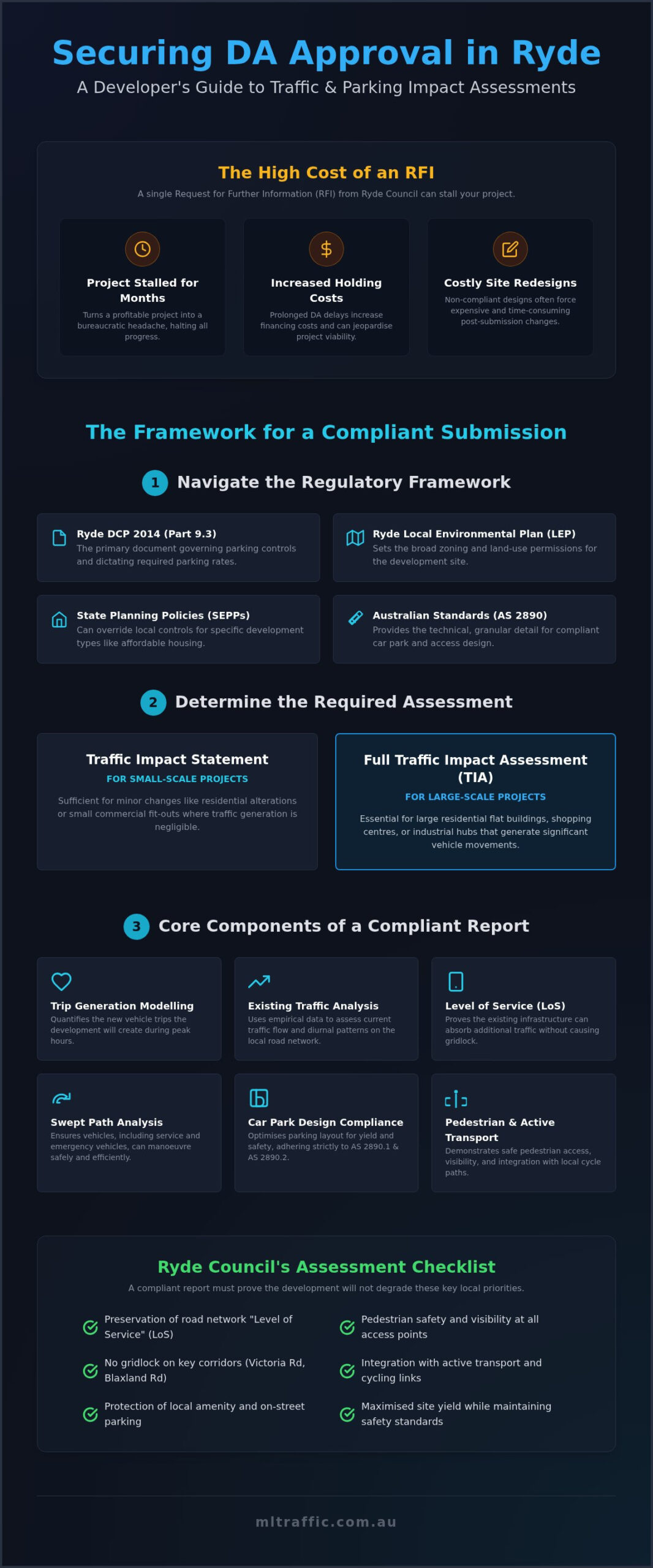
Council requirements vary depending on the scale of the proposal. A Traffic Impact Statement is typically sufficient for small-scale residential changes or minor commercial fit-outs where traffic generation is negligible. However, a full TIA is triggered by large-scale residential flat buildings, shopping centres, or industrial hubs. Council determines the level of detail required based on projected trip generation rates. If your project generates significant vehicle movements, a comprehensive report is essential. Our senior principals ensure these reports address every technical trigger, preventing the “back-and-forth” that often plagues less rigorous submissions.
The Objectives of Ryde Council Assessment
The City of Ryde prioritises the “Level of Service” (LoS) across its road network. Assessments must prove that the existing infrastructure can absorb additional volume without causing gridlock. This is especially vital along busy corridors like Victoria Road or Blaxland Road, where diurnal patterns (peak morning and afternoon flows) are already under pressure. Beyond vehicle counts, Council focuses on pedestrian safety and visibility at site access points. They also look for integration with active transport links and cycling paths. Reports must demonstrate that the development won’t degrade the local amenity or strip away on-street parking availability for existing residents.
Statutory Requirements and the Ryde Development Control Plan (DCP)
Statutory compliance is the bedrock of any successful development application in the City of Ryde. Undertaking Traffic and Car Parking Impact Assessments in Ryde Council requires strict adherence to the Ryde Development Control Plan (DCP) 2014, specifically Part 9.3 (Parking Controls). This document serves as the primary governing framework, dictating exactly how many spaces your project must provide. While the Ryde Local Environmental Plan (LEP) sets the broad zoning and land-use permissions, the DCP provides the technical granular detail that traffic engineers must satisfy.
State Environmental Planning Policies (SEPPs) often complicate this local framework. In many instances, SEPPs related to affordable housing or seniors’ living can override local parking rates. This creates a complex hierarchy of controls. Engaging an experienced traffic engineer during the early design phase is essential for identifying these overlaps. Identifying compliance hurdles before your plans are finalised prevents expensive redesigns and ensures your Statement of Environmental Effects remains robust. For projects with complex zoning overlaps, reaching out for a professional consultation can streamline your path to approval.
Navigating Ryde DCP 2014 Parking Rates
Ryde Council applies specific formulas to determine parking demand. For residential flat buildings, the allocation differs significantly between a studio and a three-bedroom apartment. Council is particularly meticulous regarding visitor parking provisions. These spaces must remain unobstructed and easily accessible for guests, rather than being tucked behind secure resident gates without intercom access. Commercial and retail developments face a different set of challenges. Engineers must balance the parking needs of long-term employees with the high turnover requirements of customers to ensure the site functions efficiently without spilling over into neighbouring residential streets.
Referrals to Transport for NSW (TfNSW)
Not all traffic decisions stay within Council chambers. Large-scale projects often trigger a referral to the Sydney Regional Development Advisory Committee (SRDAC). This typically occurs when a development meets specific size thresholds or sits on a “Classified Road” like Victoria Road or Lane Cove Road. Developments on these corridors face rigorous safety assessments and special access requirements to ensure they don’t impede the flow of arterial traffic. We utilise the TfNSW Guide to Traffic Generating Developments to calculate trip rates, ensuring our projections align with the benchmarks used by state evaluators. This dual-layered assessment process demands a report that is technically flawless and highly defensible.
Core Components of a Compliant Traffic Impact Statement
Undertaking Traffic and Car Parking Impact Assessments in Ryde Council requires a structured methodology that addresses both immediate site access and the broader precinct’s performance. A compliant report must bridge the gap between architectural vision and engineering reality. It’s a data-driven process that provides Council with the technical assurance that a development is sustainable. Every report we produce includes a detailed analysis of existing conditions, analysing current traffic flow, public transport proximity, and on-street parking availability to establish an accurate baseline.
The core of the assessment involves predicting future behaviour through trip generation and distribution modelling. We use empirical data to predict how many vehicles will enter and exit the site during morning and afternoon peaks. For developments in high-growth corridors, we employ SIDRA software for intersection modelling. This tests the performance of nearby junctions under future loads, ensuring the “Level of Service” remains acceptable. Additionally, we assess the “walkability” and “cyclability” of the proposal, aligning with Ryde’s target to increase public transport modal share to 40% in key areas like Macquarie Park.
Site Analysis and Data Collection
Accurate modelling starts with high-quality field data. We often conduct 7-day traffic counts to establish a reliable baseline of local road behaviour, capturing both weekday commutes and weekend shopping peaks. Our engineers also scrutinise the accident history in the vicinity to identify existing safety risks that must be mitigated by the new design. We meticulously document existing driveway locations and sight distance constraints to ensure the proposed entry points meet Australian Standards for safety and visibility.
Impact Analysis and Mitigation Strategies
Once the data is collected, we determine the “Degree of Saturation” and “Average Delay” for all affected intersections. If the modelling shows a significant drop in performance, we propose physical mitigation works. This might include new turning lanes, traffic signals, or median strips to offset the development’s impact. Beyond the final operational state, we consider the logistical challenges of the build itself. A robust Traffic Management Plan is essential during the construction phase to manage heavy vehicle movements and ensure pedestrian safety without disrupting the existing road network.
Practical Assessment of Parking and Access Compliance
Undertaking Traffic and Car Parking Impact Assessments in Ryde Council transitions from broad network modelling to the granular physical constraints of the site. Compliance hinges on strict adherence to AS 2890.1 for off-street car parking and AS 2890.2 for commercial vehicle facilities. Council assessors in Ryde are particularly vigilant regarding driveway ramp grades. On the sloping sites common in Gladesville or West Ryde, managing these gradients is essential to prevent vehicle scraping and ensure safe sightlines at the property boundary.
Sustainability targets within the Ryde LGA also dictate the provision of bicycle parking and end-of-trip facilities. These aren’t merely suggestions; they are calculated requirements that support the Council’s goal of reducing private vehicle dependency. If your site layout is constrained, contact our senior principals for a compliant Car Park Design that maximises yield without compromising on Australian Standards.
Vehicle Swept Path Analysis for Ryde Developments
A professional swept path analysis is the only way to prove vehicle manoeuvrability on tight urban sites. We utilise AutoTURN software to simulate the movements of B85 and B99 vehicles through every basement level and access point. Proving service vehicle access is a frequent hurdle in Ryde DAs. Waste collection trucks and delivery vehicles must demonstrate they can enter and exit the site in a forward direction. Design iteration is often required to ensure these large vehicles don’t clip structural columns or require dangerous multi-point turns in high-pedestrian areas.
Car Park Design and Manoeuvrability
Optimising a car park layout requires balancing parking yield with technical compliance. Column placement must strictly follow the “User Class” requirements of AS 2890.1 to ensure doors can open and vehicles can swing into spaces without obstruction. We pay close attention to dead-end aisles, which require a specific 1-metre extension to facilitate turn-around movements. Additionally, designing for accessible parking involves more than just wider spaces; it requires adherence to AS 2890.6 for people with disabilities. This includes specific gradients and shared zones that often impact the placement of structural elements in the early design phase.
National Expertise for Local Approvals: The ML Traffic Engineers Approach
ML Traffic Engineers leverages over 15 years of industry experience to navigate the specific bureaucratic and technical requirements of the City of Ryde. Undertaking Traffic and Car Parking Impact Assessments in Ryde Council requires more than local knowledge; it requires a deep understanding of how national standards integrate with the Ryde DCP 2014. Our national consultancy experience provides a broader perspective on complex traffic problems. We’ve managed thousands of successful developments nationwide, from residential flat buildings to large-scale industrial hubs. This breadth of experience allows us to apply proven strategies to local challenges, ensuring your project remains compliant and efficient.
Our brand promise centres on direct access to senior leadership. Unlike larger, impersonal firms, the senior principal who starts your project is the one performing the technical work. This “no-gatekeepers” approach ensures accountability and personnel continuity from inception to approval. We collaborate closely with architects and planners to integrate traffic requirements into the early design phase. This proactive method identifies potential compliance hurdles before they become “deal-breakers,” streamlining the DA process through meticulous, right-first-time documentation.
Our Process for Ryde Council Submissions
Our methodology begins with an initial site feasibility assessment. We identify critical constraints in access or parking before the DA is even lodged. This early intervention prevents costly redesigns after the plans are finalised. Once the design is set, we draft detailed technical reports that speak the language of Council engineers. Our TIAs are structured to answer every likely query, significantly reducing DA processing times. Should Council issue an RFI, we provide comprehensive post-lodgement support. We attend pre-DA meetings and represent your interests during the assessment phase, ensuring the technical merits of your proposal are clearly communicated.
Partnering with ML Traffic Engineers
Choosing the right consultant is vital for project success. Our firm maintains a proven track record across a vast range of practical environments, including child care centres, medical facilities, shopping centres, and mixed-use developments. We hold a deep commitment to Australian Standards, including AS 2890.1 and AS 2890.2, and local government planning controls. This meticulous attention to detail ensures your project moves through the Council assessment process without unnecessary friction. To see how we can support your specific development, learn more about our full range of services. We provide the technical certainty needed to secure your approval.
Securing DA Approval through Technical Precision
Success in the City of Ryde depends on a technical report that bridges the gap between architectural vision and strict regulatory requirements. We’ve detailed the necessity of navigating Ryde DCP 2014 and the critical nature of swept path analysis for proving manoeuvrability on constrained sites. Undertaking Traffic and Car Parking Impact Assessments in Ryde Council requires a meticulous approach to ensure every vehicle movement complies with AS 2890 standards while maintaining the safety of the local road network.
ML Traffic Engineers brings over 15 years of industry experience to your project. Our reports are authored by senior principals, ensuring that technical complexities are addressed before they trigger costly Council RFIs. This direct involvement guarantees that your car park design is both compliant and optimised for maximum yield. We provide the technical certainty needed to move your development from the drawing board to construction.
Contact our senior traffic engineers for a Ryde-compliant assessment to streamline your DA process. We look forward to supporting your next project with reliable expertise.
Frequently Asked Questions
When is a traffic report mandatory for a DA in Ryde Council?
A report is mandatory for developments likely to generate significant traffic or parking, or for land uses not specified in the DCP. Council generally defines large-scale developments as those with parking provision exceeding 100 spaces. When undertaking traffic and car parking impact assessments in Ryde Council, even smaller projects may require documentation if they impact the Level of Service on classified roads or involve complex site access.
What is the difference between a Traffic Impact Statement and a full TIA?
A Traffic Impact Statement is a concise document for small-scale residential or minor commercial changes with minimal traffic generation. In contrast, a full Traffic Impact Assessment (TIA) is a comprehensive technical study required for large-scale residential flat buildings or shopping centres. The TIA includes detailed intersection modelling and empirical trip generation data to evaluate the impact on the broader road network.
How does Ryde Council assess a car parking shortfall?
Council assesses shortfalls by comparing the proposed parking provision against the prescriptive rates in Ryde DCP 2014 Part 9.3. If a development fails to meet these rates, a Car Parking Demand Assessment must be provided. This technical study uses empirical data and proximity to public transport to justify why a lower parking rate won’t result in adverse on-street parking impacts for existing residents.
Do I need a swept path analysis for a small residential development?
Yes, if the site layout involves tight turns, basement access, or specific waste collection requirements. Council frequently requests a swept path analysis to prove that B85 or B99 vehicles can enter and exit the site in a forward direction. This is especially critical for dual occupancies or small multi-dwelling housing projects where driveway space and manoeuvring areas are limited.
What are the current Ryde Council DCP parking rates for apartments?
Parking rates for residential flat buildings are dictated by the number of bedrooms per unit. For example, studio and one-bedroom apartments typically require one space, while larger three-bedroom units have higher allocations. Additionally, visitor parking must be provided at a rate specified in Part 9.3 of the DCP, ensuring guests have unobstructed access without entering secure resident areas or requiring remote gate opening.
How long does it typically take to complete a traffic impact assessment?
A standard assessment usually takes between two to four weeks depending on the complexity of the project and the required data collection. Undertaking Traffic and Car Parking Impact Assessments in Ryde Council often involves 7-day traffic counts or intersection modelling, which can extend the timeline. Early engagement with a senior principal ensures that data collection begins promptly to meet DA lodgement deadlines and project milestones.
Can a traffic engineer help reduce the required number of parking spaces?
Yes, through a formal Car Parking Demand Assessment. By analysing the site’s proximity to high-frequency public transport and using empirical data from similar developments, an engineer can justify a reduction in parking spaces. This approach aligns with Ryde’s sustainability targets, particularly in corridors like Macquarie Park where Council aims to increase public transport modal share to 40 per cent by 2031.
What is SIDRA modelling and why does Council ask for it?
SIDRA is a specialised software tool used to model the performance of intersections and junctions. Council requires SIDRA modelling for developments that generate significant vehicle movements to test the “Level of Service” and “Degree of Saturation.” This analysis proves that the existing road network can absorb the additional traffic volume without causing excessive delays or compromising safety for local residents and road users.

Disclaimer
The content on www.mltraffic.com.au, including all technical articles, guides, and resources, is provided for general informational and educational purposes only. It is not intended to constitute professional advice in traffic engineering, transportation planning, development approvals, or any other technical or legal field.
While ML Traffic Engineers makes every reasonable effort to ensure the accuracy, completeness, and timeliness of the information published, we do not provide any warranties or representations (express or implied) regarding its reliability, suitability, or availability for any particular purpose. Any reliance you place on the content is strictly at your own risk.
In no event shall ML Traffic Engineers, its directors, employees, authors, or affiliates be liable for any direct, indirect, incidental, special, consequential, or punitive damages (including, without limitation, loss of profits, data, or business opportunities) arising out of or in connection with the use of, or inability to use, any information provided on this website.
The articles and guides on this site are not a substitute for engaging a qualified, registered professional traffic engineer (such as an NPER or RPEQ engineer) to assess your specific project requirements. For tailored advice, compliance assessments, or traffic engineering services, please contact a competent professional.
This disclaimer may be updated from time to time without notice. By accessing or using this website, you agree to be bound by the most current version of this disclaimer.
