

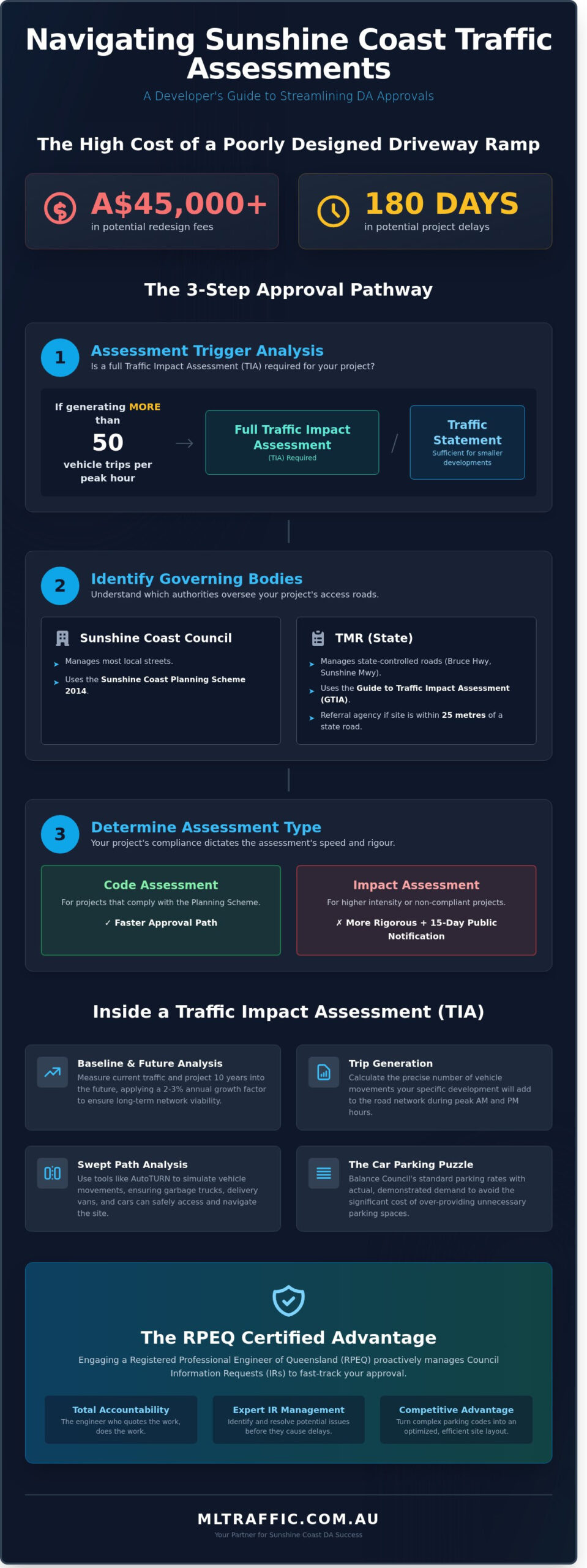
A single poorly designed driveway ramp can cost a Sunshine Coast developer over A$45,000 in redesign fees and stall a project for 180 days. You likely already feel that the Council transport requirements are often opaque and difficult to satisfy without sacrificing valuable floor area. It’s a common frustration. Successfully Undertaking Traffic and Car Parking Impact Assessments in Sunshine Coast Council of Queensland requires a strategic engineering approach that identifies potential "Information Requests" (IRs) before they are even issued.
We believe that the engineer who provides the quote should be the one doing the work to ensure total accountability. This guide promises to simplify the DA process by providing expert RPEQ insights that turn complex parking codes into a competitive advantage for your site. You’ll find a detailed breakdown of how to optimise parking layouts and the specific technical benchmarks required to satisfy Sunshine Coast evaluators on the first submission.
Key Takeaways
-
Master the essential steps for Undertaking Traffic and Car Parking Impact Assessments in Sunshine Coast Council of Queensland to ensure your development application aligns perfectly with the 2014 Planning Scheme.
-
Learn how to solve the "Car Parking Puzzle" by balancing Council’s standard outcomes with actual demand, helping you avoid the significant costs of over-providing parking.
-
Discover how technical tools like Swept Path Analysis and AutoTURN simulations verify your site layout’s functionality, ensuring all vehicles can move safely and efficiently.
-
Understand the vital importance of RPEQ certification and how expert engineering insights can effectively manage Council Information Requests (IRs) to fast-track your approval.
-
Gain a clear strategy for analyzing baseline traffic and trip generation to accurately demonstrate your project’s impact on the local Sunshine Coast road network.
Table of Contents
-
Navigating the Sunshine Coast Planning Scheme for Traffic and Transport
-
Solving the Car Parking Puzzle in Sunshine Coast Developments
Navigating the Sunshine Coast Planning Scheme for Traffic and Transport
The Sunshine Coast Planning Scheme 2014 serves as the primary regulatory framework for all development within the region. It dictates how land is utilized and what technical standards must be met to ensure the community remains functional. When you’re planning a new project, you’ve got to align your proposal with the Transport and Parking Code. This isn’t just a suggestion; it’s a legal requirement under the Planning Act 2016. Local authorities use these rules to prevent congestion and ensure safety. Traffic engineering principles provide the scientific data needed to justify your development’s impact on these local networks.
Undertaking Traffic and Car Parking Impact Assessments in Sunshine Coast Council of Queensland is a critical step for most Material Change of Use (MCU) applications. If your project is expected to generate more than 50 vehicle trips during any peak hour, Council will typically require a full Traffic Impact Assessment (TIA). For smaller developments, a simpler Traffic Statement might suffice. Engaging a Registered Professional Engineer of Queensland (RPEQ) during the pre-lodgement phase is a smart move. We’ve seen cases where failing to address access issues early resulted in a 6 month delay during the Information Request stage. Getting the technical details right from the start protects your timeline and your budget.
To better understand how the Council manages these transport pressures, watch this helpful video regarding their parking strategy:
Code vs. Impact Assessment: What it Means for Your Project
Developers often find themselves confused by assessment categories. Code Assessment applies to projects that generally comply with the Sunshine Coast Planning Scheme 2014 and are considered "self-assessable" against specific benchmarks. If your project fits this category, the approval path is usually faster. Impact Assessment is more rigorous. It’s triggered when a development is higher in intensity or varies from the intended land use for that zone. These applications require a 15 business day public notification period. During this time, neighbors can lodge formal objections. Council will scrutinize your TIA to ensure the local street performance doesn’t drop below acceptable levels of service.
The Role of the Department of Transport and Main Roads (TMR)
Identifying who owns the road is your first priority. While Council manages most local streets, major corridors like the Bruce Highway, Sunshine Motorway, and Nicklin Way are State-controlled. If your site sits within 25 metres of a State-controlled road, TMR becomes a formal referral agency. They don’t use the local Council code; they use the Guide to Traffic Impact Assessment (GTIA). This manual is highly technical and focuses on the safety and efficiency of the state’s strategic transport network. In 2023, TMR updated several requirements regarding turn lane lengths and site access geometry. You need an engineer who understands how to balance Council’s local requirements with TMR’s strict state standards. Undertaking Traffic and Car Parking Impact Assessments in Sunshine Coast Council of Queensland requires navigating both of these bureaucracies simultaneously to avoid conflicting conditions of approval.
The Core Components of a Traffic Impact Assessment (TIA)
Undertaking Traffic and Car Parking Impact Assessments in Sunshine Coast Council of Queensland involves a rigorous technical process that moves far beyond simple car counts. We start by establishing a baseline of the existing road network. This means measuring current traffic volumes on key corridors like Nicklin Way or the Sunshine Motorway during AM and PM peak periods. We don’t just look at today’s numbers; we apply growth factors, often 2% to 3% annually, to project what the network looks like 10 years into the future. This ensures your development won’t buckle under the weight of regional growth.
Trip generation is the next critical step. We calculate exactly how many vehicle movements your specific land use will create. For a standard residential flat building, we might use a rate of 0.5 to 0.8 trips per dwelling during peak hours based on historical data. Once we have those numbers, we map the trip distribution. We determine which percentage of your tenants will head north toward Noosa or south toward Brisbane. This mapping must align with the broader goals found in the Sunshine Coast Integrated Transport Strategy, which prioritizes managing congestion and supporting sustainable growth patterns across the region.
To prove the network can handle the load, we use SIDRA Intersection software. This industry-standard tool models how your traffic interacts with existing lights, roundabouts, and priority junctions. We look for the Degree of Saturation (DOS). If a nearby intersection is already at a 0.95 DOS, adding even a small amount of traffic could trigger a requirement for you to fund an upgrade. Getting these calculations right during the initial Undertaking Traffic and Car Parking Impact Assessments in Sunshine Coast Council of Queensland saves you from expensive surprises during the Information Request (IR) stage.
Site Access and Frontage Requirements
Your entry and exit points are the most scrutinized parts of your DA. We design these to meet AS 2890.1 standards, focusing heavily on sight distance. In a 60km/h zone, you typically need a clear line of sight of at least 65 metres in both directions. If a power pole or a neighbor’s fence blocks that view, Council will likely refuse the application. We also ensure your frontage accommodates pedestrians and cyclists, as the Sunshine Coast Council is increasingly focused on active transport links between new developments and existing transit hubs.
Mitigating Traffic Impacts on Local Streets
If our modeling shows your project negatively impacts local road performance, we have to find a solution. This might involve identifying "pavement impacts" where heavy construction vehicles or increased daily traffic accelerate road wear. In these cases, you might need to provide a proportional financial contribution to road resurfacing. We often suggest Green Travel Plans to reduce these costs. By implementing dedicated car-share pods or enhanced end-of-trip facilities for cyclists, we can sometimes negotiate a reduction in required parking spaces or traffic mitigation fees. If you’re unsure how these contributions might affect your project’s bottom line, you can request a technical review of your site plan to identify potential hurdles early.
Negotiating with Council requires a data-backed approach. We don’t just accept their initial assessment of infrastructure contributions. Instead, we use our RPEQ-certified reports to show exactly where your responsibility ends and the Council’s broader network maintenance begins. This direct, evidence-based strategy is the only way to ensure your development remains financially viable while meeting all safety and engineering benchmarks set by the Sunshine Coast planning scheme.
Solving the Car Parking Puzzle in Sunshine Coast Developments
Developers often face a significant disconnect between the rigid "Acceptable Outcomes" defined in the Sunshine Coast Planning Scheme 2014 and the actual parking demand generated by modern users. While the code provides a baseline, these generic rates often lead to an oversupply of expensive concrete. Building a single basement car park space in urban hubs like Maroochydore or Mooloolaba currently costs between A$45,000 and A$65,000. If your project over-provides by just 10 spaces, you are effectively stripping up to A$650,000 from the project’s bottom line. This capital is better spent on high-quality finishes or increasing the yield of the building.
Undertaking Traffic and Car Parking Impact Assessments in Sunshine Coast Council of Queensland requires a strategic balance between regulatory compliance and commercial reality. We focus on the "Performance Outcomes" of the planning scheme, which allow for a merit-based assessment. By analyzing the 85th percentile of peak demand rather than relying on outdated broad-brush averages, we can often demonstrate that a development requires fewer spaces than the code suggests. This data-backed approach ensures your site remains functional without being burdened by redundant infrastructure.
Compliance with Australian Standards (AS 2890 Series)
Strict adherence to the AS 2890 series is non-negotiable for RPEQ certification and Council approval. AS 2890.1 dictates the requirements for off-street car parking, specifying bay widths ranging from 2.4 to 2.7 meters depending on the user class. AS 2890.2 covers commercial vehicle facilities, ensuring that loading docks can accommodate heavy rigid vehicles (HRVs) without blocking internal circulation. Common design errors we frequently identify include "blind aisles" that extend more than six spaces without a turnaround area and inadequate aisle widths that fail to support B85 vehicle turns. These technical oversights lead to failed swept path analyses and costly redesigns during the Information Request (IR) stage.
Justifying Parking Reductions and Waivers
You don’t have to accept default parking rates if they don’t reflect your project’s specific context. A Parking Demand Assessment is a data-driven justification for deviating from generic Council rates. We use empirical data from 2023 and 2024 surveys of similar land uses to prove that actual occupancy is lower than the Planning Scheme predicts. This is particularly effective for mixed-use sites where reciprocal parking can be applied. If a commercial office peaks at 10:00 AM and an on-site restaurant peaks at 7:00 PM, they can share the same physical bays, reducing the total requirement by up to 30% in some instances.
Proximity to public transport serves as another powerful lever for reductions. Sites within 400 meters of high-frequency bus corridors or the proposed Sunshine Coast Light Rail path qualify for Transit-Oriented Development (TOD) arguments. When Undertaking Traffic and Car Parking Impact Assessments in Sunshine Coast Council of Queensland, we highlight these alternative transport options to justify a lower car-to-unit ratio. This approach aligns with Council’s own goals for sustainable transport while significantly lowering your construction costs. Our role is to ensure that every space on your basement plan is necessary and contributes to the project’s overall success.
Swept Path Analysis: Ensuring Your Site Actually Works
You can’t just draw a driveway on a plan and hope for the best. Sunshine Coast Council requires proof that vehicles can navigate your site without clipping curbs, hitting structural pillars, or mounting footpaths. This is the core purpose of a Swept Path Analysis. It’s a technical simulation that maps the envelope of a vehicle as it turns. When Undertaking Traffic and Car Parking Impact Assessments in Sunshine Coast Council of Queensland, this analysis is often the difference between a seamless approval and a costly redesign phase.
Our team utilizes AutoTURN software to overlay precise vehicle movements onto your architectural site plans. We don’t guess. We simulate the exact wheel paths and body overhangs of the "Design Vehicle" relevant to your project. For most residential developments, this involves testing for the B85 and B99 vehicles as defined by AS 2890.1. The B99 represents the 99th percentile of cars on Australian roads. If your basement layout doesn’t allow a B99 vehicle to turn safely, Council will likely reject the application based on poor internal functionality.
Waste Collection and Service Vehicle Access
Sunshine Coast Council is particularly strict regarding on-site waste collection for multi-unit dwellings and commercial hubs. Most 2024 development approvals require a 12.5-metre Heavy Rigid Vehicle (HRV) to enter and exit the site in a forward direction. We’ve seen many designs fail because they rely on "three-point turns" in tight spaces. Council planners generally reject these because they increase the risk of collisions and block internal traffic flow. You also need to account for vertical clearance. A standard waste truck requires at least 4.5 metres of clear height. If your basement pipes or fire sprinklers hang too low, the truck won’t fit, and your waste management plan will be void.
Driveway Ramp Grades and Ground Clearance
Steep sites are common across the Sunshine Coast, from Buderim to Coolum. While a steep ramp saves space, it creates a high risk of vehicles "scraping" their undercarriages. AS 2890.1 mandates specific transition grades to prevent this. For example, a 1 in 4 ramp requires a 2-metre long transition at a 1 in 8 grade at both the top and bottom. We provide ML Traffic’s services to perform detailed ramp grade assessments that ensure your design complies with these technical standards. It’s much cheaper to fix a ramp on paper than to jackhammer concrete after the building is finished.
Precision matters when you’re Undertaking Traffic and Car Parking Impact Assessments in Sunshine Coast Council of Queensland. A single misplaced pillar can render three parking bays useless. We analyze the "turn-in" and "turn-out" capabilities for every bay to ensure they meet the 2.4-metre to 2.7-metre width requirements based on the user class. Don’t let a simple geometric error stall your project at the information request stage. Our engineers check every radius and clearance point to ensure the site functions exactly as intended for the end user.
Ready to ensure your site layout meets every Council requirement? Contact ML Traffic Engineers today for a professional swept path assessment that keeps your project moving forward.
Partnering with ML Traffic for Sunshine Coast DA Success
Successfully navigating a Sunshine Coast Development Application (DA) requires more than just a basic report. It demands technical precision and a deep understanding of the Sunshine Coast Planning Scheme 2014. When you’re Undertaking Traffic and Car Parking Impact Assessments in Sunshine Coast Council of Queensland, RPEQ (Registered Professional Engineer of Queensland) certification is your most valuable asset. This isn’t just a badge of quality; it’s a legal requirement under the Professional Engineers Act 2002. Our RPEQ status ensures that every calculation, from peak hour trip generation to complex swept path analysis, stands up to the highest level of scrutiny.
Council Information Requests (IRs) are often the biggest hurdle in the approval process. A poorly handled IR can stall a project for months, costing developers thousands in holding fees and lost time. We don’t guess when it comes to Council feedback. We handle IRs effectively by providing data-driven responses that address the specific concerns of Council officers. Our goal is to provide the technical evidence needed to move your application from "pending" to "approved" without unnecessary delays.
We pride ourselves on a hands-on approach that is rare in larger firms. At ML Traffic, the engineer who provides your quote is the engineer who actually visits the site and writes your report. This "no-gatekeepers" philosophy means you get direct access to senior expertise. You won’t be passed off to a junior graduate who doesn’t understand the nuances of your specific site. This accountability ensures that the strategy we discuss during the quoting phase is exactly what’s delivered in the final document.
-
RPEQ Certified: All reports are signed off by registered professionals to ensure legal and technical compliance.
-
Risk Mitigation: Proactive traffic planning identifies potential access or parking issues before they become expensive problems.
-
Direct Accountability: You deal directly with the principals, Michael Lee or Benny Chen, throughout the entire project.
-
Technical Accuracy: We use industry-standard software for vehicle swept paths and intersection modeling to provide foolproof data.
Our Experience with Sunshine Coast Council
Our team has completed over 10,000 successful site assessments across Australia since 2005. This vast experience includes a wide variety of land uses, from boutique residential builds in Noosa to industrial complexes in Kunda Park. We maintain a direct-to-principal communication style that cuts through bureaucracy and gets results. You can view our 15+ years of specialist experience to see how we’ve helped thousands of developers achieve their project goals through expert traffic engineering.
Ready to Start Your Assessment?
Getting your traffic report shouldn’t be a bottleneck. We provide fast, accurate quotes within 24 hours of receiving your site plans. For a standard project involving Undertaking Traffic and Car Parking Impact Assessments in Sunshine Coast Council of Queensland, our typical turnaround time is between 7 and 10 business days. We focus on providing a seamless experience that reduces project risk and keeps your timeline on track. Contact ML Traffic today to secure an RPEQ-certified assessment and take the next step toward your DA approval.
Secure Your Sunshine Coast DA Approval Today
Navigating the technical requirements of the Sunshine Coast Planning Scheme doesn’t have to be a bottleneck for your next development project. Success hinges on precise swept path analysis and a deep understanding of AS 2890.1 standards to ensure your site functions safely and efficiently. Undertaking Traffic and Car Parking Impact Assessments in Sunshine Coast Council of Queensland requires a level of technical detail that only seasoned professionals can provide. Since 2005, we’ve successfully assessed over 10,000 sites across Australia, helping developers move from application to construction without the usual bureaucratic friction.
You’ll work directly with our senior principals, Michael Lee and Benny Chen, ensuring RPEQ certified expertise is applied to every technical drawing and report. We don’t pass your project to juniors; the engineer who quotes your work is the one who performs the assessment. This hands-on approach minimizes errors and accelerates your approval timeline. Let’s get your project moving with the technical certainty it deserves.
Contact our expert traffic engineers today for a project-specific quote
Frequently Asked Questions
When is a Traffic Impact Assessment required by Sunshine Coast Council?
Sunshine Coast Council requires a formal assessment when a development exceeds the intensity thresholds defined in the Transport and Parking Code. You’ll generally need a report for residential projects exceeding 20 dwellings or commercial developments with more than 500 square metres of Gross Floor Area. If your project generates 10 or more vehicle trips during any peak hour, a technical report is mandatory to ensure road safety and network efficiency.
What is the difference between a Traffic Statement and a TIA?
A Traffic Statement is a concise document for low-impact developments that generally comply with code but require professional confirmation on specific access or safety issues. A Traffic Impact Assessment (TIA) is a more comprehensive technical report required for larger or more complex projects. While a statement focuses on site-specific access, a TIA includes detailed intersection modelling and broader network analysis to satisfy Council’s performance outcomes.
Does my development need an RPEQ certified engineer for the traffic report?
Yes, your traffic report must be certified by a Registered Professional Engineer of Queensland (RPEQ) to be accepted by Council. Under the Professional Engineers Act 2002, all engineering services in Queensland must be performed or supervised by an RPEQ qualified professional. At ML Traffic Engineers, our principals hold these credentials, ensuring your submission is legally compliant and carries the necessary authority during the assessment process.
Can I reduce the number of parking spaces required by the Planning Scheme?
You can reduce the number of parking spaces if a Car Parking Demand Assessment proves the Planning Scheme rates are excessive for your specific use. We use empirical data, such as 2021 Census travel-to-work statistics or surveys of similar sites, to justify lower rates. Successfully Undertaking Traffic and Car Parking Impact Assessments in Sunshine Coast Council of Queensland often involves demonstrating that proximity to public transport or specific operational hours reduces actual demand.
What vehicle types does Council require for Swept Path Analysis?
Council requires Swept Path Analysis for the largest vehicle expected to service the site, which ranges from a B99 car to a 12.5 metre Heavy Rigid Vehicle (HRV). Most residential developments must demonstrate safe entry and exit for an 8.8 metre Medium Rigid Vehicle (MRV) for refuse collection. We use specialized software to map these movements against Australian Standards AS 2890.1 and AS 2890.2 to ensure no conflict with parked cars or infrastructure.
How much does a Traffic Impact Assessment cost in Queensland?
Professional fees for a Traffic Impact Assessment in Queensland typically range from A$2,500 for simple statements to over A$8,500 for complex intersection modelling. Costs vary based on whether you need manual traffic counts, which can add A$1,200 per intersection, or detailed SIDRA analysis. We provide fixed-price quotes where the traffic consultant who provides the quote is the one who does the work.
What happens if Council issues an Information Request (IR) regarding traffic?
If Council issues an Information Request, you must provide a detailed technical response addressing every point raised by the transport planners. These requests often demand more data on peak hour queues or driveway gradients. We handle these responses by providing the exact technical clarifications or revised plans needed to clear the IR and move your development application toward approval.
How long does it take to prepare a parking demand assessment?
A standard parking demand assessment takes between 5 and 10 business days to complete once we receive your final site plans. This timeframe allows us to gather local data and conduct necessary site visits. If your project requires Undertaking Traffic and Car Parking Impact Assessments in Sunshine Coast Council of Queensland during peak seasonal periods, we recommend booking early to avoid delays in your planning submission.
Which suburbs do you cover?
We are traffic engineers servicing Alexandra Headland, Aroona, Bald Knob, Balmoral Ridge, Banya, Baringa, Battery Hill, Beerburrum, Beerwah, Belli Park, Bells Creek, Birtinya, Bli Bli, Bokarina, Booroobin (part), Bribie Island North, Bridges, Buddina, Buderim, Burnside, Caloundra, Caloundra West, Cambroon, Chevallum, Coes Creek, Conondale, Coochin Creek, Coolabine, Cooloolabin, Coolum Beach, Crohamhurst, Curramore, Currimundi, Diamond Valley, Dicky Beach, Diddillibah, Doonan (part), Dulong, Eerwah Vale, Elaman Creek, Eudlo, Eumundi, Flaxton, Forest Glen, Gheerulla, Glass House Mountains, Glenview, Golden Beach, Highworth, Hunchy, Ilkley, Image Flat, Kenilworth, Kiamba, Kidaman Creek, Kiels Mountain, Kings Beach, Kulangoor, Kuluin, Kunda Park, Kureelpa, Landers Shoot, Landsborough, Little Mountain, Maleny, Mapleton, Marcoola, Maroochy River, Maroochydore, Meridan Plains, Minyama, Moffat Beach, Mons, Montville, Mooloolaba, Mooloolah Valley, Mount Coolum, Mount Mellum, Mountain Creek, Mudjimba, Nambour, Ninderry, North Arm, North Maleny, Obi Obi, Pacific Paradise, Palmview, Palmwoods, Parklands, Parrearra, Peachester, Pelican Waters, Peregian Beach (part), Peregian Springs, Perwillowen, Point Arkwright, Reesville, Rosemount, Shelly Beach, Sippy Downs, Tanawha, Towen Mountain, Twin Waters, Valdora, Verrierdale, Warana, West Woombye, Weyba Downs, Witta, Woombye, Wootha, Wurtulla, Yandina, Yandina Creek, Yaroomba.
