

We are traffic engineers servicing Alfords Point, Bangor, Barden Ridge, Bonnet Bay, Bundeena, Burraneer, Caringbah, Caringbah South, Como, Cronulla, Dolans Bay, Engadine, Grays Point, Greenhills Beach, Gymea, Gymea Bay, Heathcote, Holsworthy (part), Illawong, Jannali, Kangaroo Point, Kareela, Kirrawee, Kurnell, Lilli Pilli, Loftus, Lucas Heights, Maianbar, Menai, Miranda, Oyster Bay, Port Hacking, Royal National Park, Sandy Point, Sutherland, Sylvania, Sylvania Waters, Taren Point, Waterfall, Woolooware, Woronora, Woronora Dam (part), Woronora Heights, Yarrawarrah, Yowie Bay.
Successfully navigating the development application (DA) process in Sutherland Shire hinges on a meticulous approach to its specific traffic and parking regulations. The complexities of Chapter 36 of the SSDCP 2015 frequently lead to unexpected Council pushback on parking shortfalls and costly redesigns for non-compliant access, delaying projects and inflating budgets. For any developer aiming for a seamless approval, correctly undertaking Traffic and Car Parking Impact Assessments in Sutherland Shire Council is a non-negotiable, critical requirement that demands expert attention to detail.
This definitive 2026 developer’s guide provides the professional engineering insights required to master these local complexities. We will detail the critical components of a successful assessment, from providing robust justification to minimise parking requirements to ensuring your driveway and car park designs are safe, compliant, and meet Council’s stringent standards. Gain the technical knowledge to streamline your DA process and secure project approval with confidence.
Key Takeaways
- Understand how Sutherland Shire’s unique coastal and rail constraints directly influence traffic planning and Development Application requirements.
- Learn to navigate Chapter 36 of the Sutherland Shire DCP 2015 and master the ‘Parking Matrix’ to accurately calculate your project’s parking needs.
- Discover the step-by-step process for undertaking Traffic and Car Parking Impact Assessments in Sutherland Shire Council to identify red flags early and streamline your DA submission.
- Master the core components of a compliant Traffic Impact Assessment (TIA), from conducting accurate traffic surveys to applying TfNSW traffic generation guidelines.
Table of Contents
- Why Traffic and Parking Assessments are Critical in Sutherland Shire
- Key Components of a Compliant Traffic Impact Assessment (TIA)
- Navigating Chapter 36: Vehicle Access, Traffic, and Parking
- The Step-by-Step Process for Undertaking Assessments in the Shire
- Why ML Traffic Engineers is the Preferred Choice for Sutherland Shire
Why Traffic and Parking Assessments are Critical in Sutherland Shire
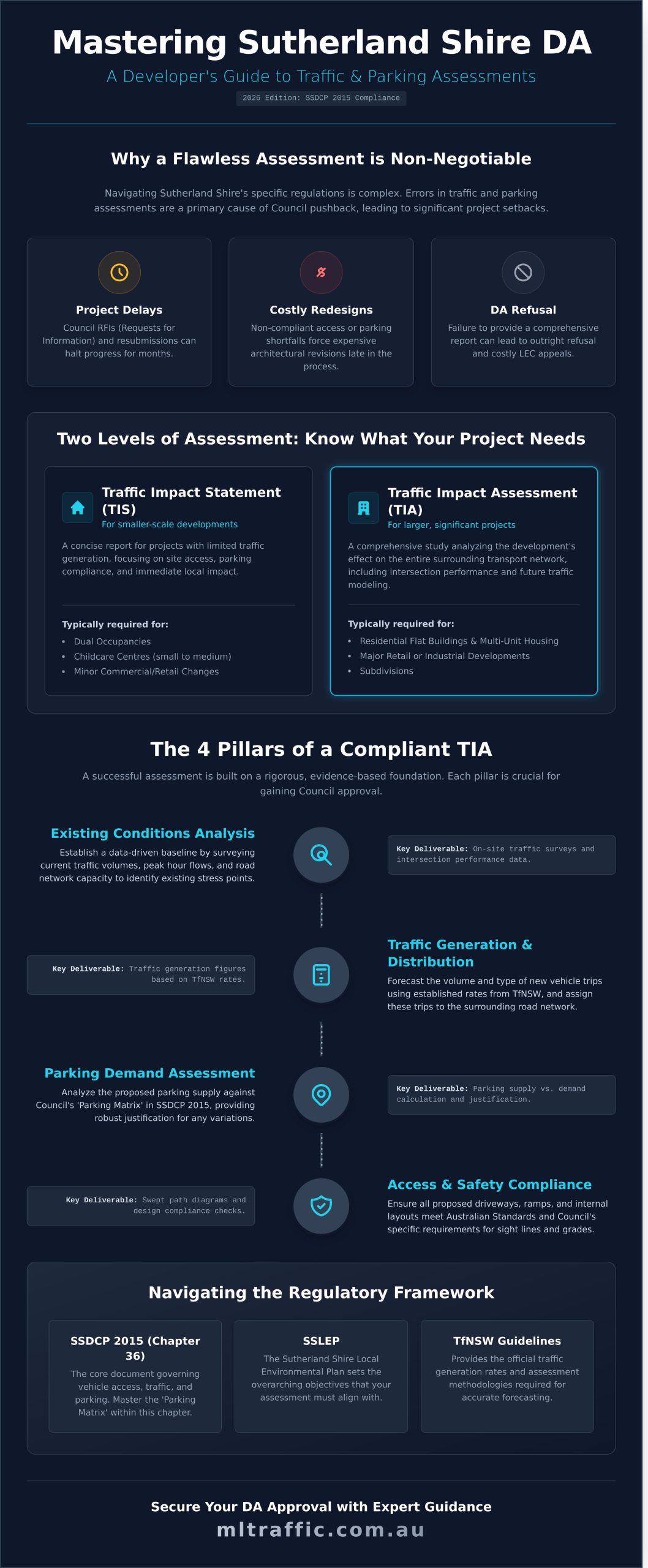
A Traffic Impact Assessment (TIA) is not a procedural formality; it is a critical component of any successful Development Application (DA) submitted to Sutherland Shire Council. This technical report provides a rigorous analysis of a proposed development’s effect on the local road network, traffic flow, and parking availability. Successfully undertaking Traffic and Car Parking Impact Assessments in Sutherland Shire Council requires a deep understanding of local geography-from coastal constraints to major rail corridors-and the specific requirements of Council’s planning controls. Failure to provide a comprehensive and compliant report often results in costly Requests for Information (RFIs), significant project delays, and even refusal, which may lead to Land and Environment Court (LEC) appeals.
To clarify the function of these essential reports, the following video provides a concise overview:
The scope of the required report depends on the scale of the development. Council typically distinguishes between two types of assessments:
- Traffic Impact Statement (TIS): A concise report for smaller-scale developments like dual occupancies, childcare centres, or minor commercial changes with limited traffic generation.
- Traffic Impact Assessment (TIA): A comprehensive study required for larger projects such as residential flat buildings, major retail or industrial developments, and subdivisions that will have a significant impact on the surrounding transport network.
Local Traffic Dynamics: From Cronulla to Menai
Sutherland Shire’s unique layout presents distinct traffic engineering challenges. High-density commercial and transport hubs in Miranda and Sutherland CBD are congestion hotspots that require careful management of access and parking. In coastal suburbs like Cronulla and Bundeena, seasonal visitor traffic places immense pressure on a road network not designed for such peaks. Consequently, Council planners are increasingly critical of developments that rely on ‘on-street’ parking, particularly in established residential areas where availability is already at a premium.
The Regulatory Framework: SSDCP 2015 and SSLEP
All assessments must demonstrate strict compliance with the Sutherland Shire Development Control Plan (DCP) 2015 and the objectives of the Sutherland Shire Local Environmental Plan (SSLEP). These documents outline specific requirements for parking rates, sight lines, driveway grades, and vehicle access, all grounded in established transportation planning principles. As we move towards 2026, there is a growing expectation for assessments to incorporate a more data-driven, digital-first approach to traffic modelling to accurately predict future impacts.
Key Components of a Compliant Traffic Impact Assessment (TIA)
Successfully undertaking traffic and car parking impact assessments in Sutherland Shire Council requires a meticulous, evidence-based approach. A compliant report must go beyond simple vehicle counts to provide a comprehensive analysis of the development’s effect on the local road network. The assessment provides Council with the technical evidence needed to make an informed decision on a Development Application (DA).
A professional TIA for a Sutherland Shire development is built upon four fundamental pillars:
- Existing Conditions Analysis: This involves on-site surveys to establish a baseline of current traffic volumes, intersection performance, and road network capacity. We measure peak hour flows to understand existing stress points.
- Traffic Generation and Distribution: We forecast the volume and type of new vehicle trips the development will generate. These predictions are based on established rates from Transport for NSW (TfNSW), as outlined in technical documents like the NSW Guide to Transport Impact Assessment, and are then assigned to the surrounding road network.
- Parking Demand Assessment: We conduct a thorough analysis to determine if the proposed parking supply meets the requirements of the Sutherland Shire Development Control Plan (DCP). Where a shortfall is proposed, a first-principles assessment is required to justify the parking provision based on the specific needs of the development.
- Safety and Access Review: This crucial step evaluates the safety of proposed access driveways, including sight distances for entering and exiting vehicles. We also assess the impact on pedestrian and cyclist safety, particularly for sites near sensitive areas like schools, parks, or transport hubs in the Shire.
Swept Path Analysis: Ensuring Maneuverability
For developments with constrained access or internal loading docks, swept path diagrams are non-negotiable. Using industry-standard AutoTURN software, we simulate the turning paths of design vehicles, such as a B99 passenger car or the Council’s garbage collection truck. This analysis is critical for the tight residential blocks common in Sutherland, ensuring vehicles can manoeuvre safely and efficiently without encroaching on property or landscaping. For commercial sites, compliance with AS 2890.2 for service vehicle access is mandatory.
Intersection Modeling with SIDRA
For major developments that significantly increase traffic, Sutherland Shire Council will require a SIDRA Intersection analysis. This software models the performance of key intersections with and without the proposed development traffic. The results are reported as a ‘Level of Service’ (LoS) grade and a ‘Degree of Saturation’. If the analysis shows an unacceptable decline in performance, we propose and model effective mitigation measures, such as new turn lanes, traffic signal phasing adjustments, or roundabout upgrades to ensure network efficiency is maintained.
Navigating Chapter 36: Vehicle Access, Traffic, and Parking
Chapter 36 of the Sutherland Shire Development Control Plan (DCP) 2015 is the definitive document governing all traffic and parking matters for development applications. A thorough understanding of its requirements is non-negotiable for a compliant and successful DA submission. This chapter dictates the standards for everything from parking provision to driveway design, forming the basis of Council’s assessment criteria.
At its core is the ‘Parking Matrix’, a set of tables that specify the minimum number of car parking spaces required based on land use. For example, a residential flat building has a different requirement per dwelling than a medical centre does per practitioner. The DCP also reflects a shift toward sustainable transport, mandating the provision of bicycle parking and associated End-of-Trip (EoT) facilities like showers and lockers for certain development types.
While the DCP rates are prescriptive, Council may consider a reduction in parking provision. Applying for a parking variation requires a robust, evidence-based justification, typically in the form of a detailed Car Parking Demand Assessment. Successfully arguing for a variation is a key component when undertaking Traffic and Car Parking Impact Assessments in Sutherland Shire Council, demanding expert analysis of site specifics, public transport accessibility, and anticipated demand.
AS 2890.1 Compliance for Off-Street Parking
All off-street car parking facilities must be designed in strict accordance with Australian Standard AS 2890.1. This standardises critical design elements to ensure safety and functionality. Key requirements include:
- Dimensions: Minimum bay widths and lengths, aisle widths, and vertical headroom clearances.
- Accessibility: Disabled (accessible) parking spaces must comply with the specific dimensions and shared area requirements of AS 2890.6.
- Layout: Common design errors in Shire basement car parks include poorly placed structural columns that obstruct car doors, inadequate swept paths for vehicle manoeuvring, and non-compliant sight lines at exits.
Driveway Ramps and Grade Assessments
Given the varied topography of the Sutherland Shire, driveway ramp design is a critical safety and access consideration. Council requires detailed grade assessments to ensure vehicles can traverse ramps without ‘bottoming out’ or scraping. This involves calculating maximum gradients (typically 1 in 4 or 25%) and incorporating correctly designed transition zones at the crest and sag of the ramp. All driveway ramp grade designs submitted to Council must be certified by a qualified engineer to confirm compliance with AS 2890.1.
The Step-by-Step Process for Undertaking Assessments in the Shire
Successfully navigating the development application process in Sutherland Shire requires a methodical and professional approach to traffic and parking assessments. A structured process minimises delays and addresses Council requirements upfront, ensuring a smoother path to approval. The following steps outline the critical path from initial concept to final submission.
Engaging a Qualified Traffic Consultant
The first and most critical step is selecting the right expert. At ML Traffic, we operate on a core principle: the consultant who provides the quote, does the work. This ensures you have direct access to a senior, experienced engineer throughout your project. Verify that your consultant holds senior engineering certifications like RPEQ or equivalent, as this is a key indicator of competence and accountability. Learn more about our expert traffic engineering services and our commitment to principal-led projects.
1. Initial Site Feasibility & Scoping: Before architectural plans are finalised, a preliminary traffic review can identify potential ‘red flag’ issues. This includes assessing site access, driveway grades, sight lines, and potential parking shortfalls against Council’s Development Control Plan (DCP). Identifying these constraints early prevents costly redesigns and is a fundamental part of successfully undertaking traffic and car parking impact assessments in Sutherland Shire Council.
2. Data Collection: A robust assessment is built on accurate data. Depending on the scale of the development, this may involve conducting 7-day traffic counts using pneumatic tubes to understand existing road network volumes, or manual peak-hour intersection surveys to analyse operational performance. This data forms the baseline for assessing the development’s impact.
Preparing for a Pre-DA Meeting
A Pre-Development Application (Pre-DA) meeting with Sutherland Shire Council is an invaluable opportunity. Presenting preliminary traffic findings and swept path diagrams can secure ‘in-principle’ support for key design elements, particularly for any proposed parking variations from standard rates. This proactive engagement demonstrates due diligence and helps align the project with Council expectations early. To better grasp complex engineering concepts for these discussions, explore ML Traffic’s video resources.
3. Drafting the Report & Council Liaison: The final stage involves integrating all findings-traffic generation, parking demand analysis, and vehicle swept path diagrams (AS 2890.1)-into a cohesive Traffic and Parking Impact Assessment report. Once submitted, the report is reviewed by Council’s traffic engineers. We manage this liaison process directly, providing clear, evidence-based responses to any requests for information to facilitate a timely and positive determination.
Why ML Traffic Engineers is the Preferred Choice for Sutherland Shire
Navigating the development application process requires precision, experience, and a deep understanding of local council requirements. For over 20 years, ML Traffic Engineers Pty Ltd has been the trusted partner for developers, architects, and builders across NSW, successfully delivering over 10,000 site assessments. Our expertise ensures your project complies with all necessary standards, minimising delays and maximising your chance of approval.
Our approach is defined by direct access and comprehensive capability. When you engage us, you speak directly with a principal engineer-not a junior gatekeeper. This guarantees accountability and senior-level oversight on your DA from start to finish. Our services cover every stage of your development:
- Traffic Impact Assessment (TIA) Reports
- Car Parking Demand Assessments
- Vehicle Swept Path Analysis (AS 2890.1)
- Construction Traffic Management Plans (CTMPs)
- Road Safety Audits
Our Experience in the Sutherland Shire
We have a proven track record of securing approvals for a diverse range of projects within the Sutherland Shire, from multi-unit residential developments in Caringbah and Cronulla to commercial and retail sites in Miranda. We specialise in resolving challenges unique to the area, such as steep site topography in Lilli Pilli or managing access on congested thoroughfares. For every project, our commitment is simple: the qualified engineer who prepares your quote is the same expert who completes the technical work and liaises directly with you and Council.
Ready to Start Your Sutherland Shire Project?
Engaging a traffic engineering consultant during the concept design phase is the most effective way to avoid costly redesigns and Council requests for information (RFIs). A professionally prepared report proactively addresses potential issues, saving you thousands of dollars and significant time. For architects and developers undertaking Traffic and Car Parking Impact Assessments in Sutherland Shire Council, our early input provides certainty and a clear path forward. Protect your investment by ensuring your design is compliant from day one.
To discuss your development and receive an obligation-free quote, Contact Michael Lee or Benny Chen today for a direct quote.
Secure Your DA with a Compliant Traffic and Parking Assessment
Successfully navigating the development application process in Sutherland Shire hinges on a meticulously prepared report. As outlined, Undertaking Traffic and Car Parking Impact Assessments in Sutherland Shire Council is a non-negotiable step that demands strict compliance with local planning controls, particularly Chapter 36 of the DCP. The accuracy of this assessment directly influences project timelines and approval success.
With over 15 years of specialised experience and more than 10,000 sites assessed, ML Traffic Engineers provides the authoritative guidance required. We ensure every report is robust, compliant, and tailored to the specific requirements of the Shire. Our principals, Michael Lee and Benny Chen, are directly involved in every project, guaranteeing senior-level oversight from quotation to submission.
To ensure your development application is positioned for a successful outcome, Request a Direct Quote from a Principal Traffic Engineer today. Let our proven expertise streamline your approval process.
Frequently Asked Questions
When is a Traffic Impact Assessment actually required by Sutherland Shire Council?
Sutherland Shire Council typically requires a Traffic Impact Assessment based on the triggers outlined in its Development Control Plan (DCP). This is often necessary for developments with specific land uses like childcare centres, medical facilities, or medium-density housing. An assessment is also mandated for any project expected to generate significant traffic volumes or impact a classified road. An experienced traffic consultant can provide a definitive assessment of your project’s specific requirements against Council’s criteria.
Can I get a parking reduction for my development in the Shire?
Yes, a car parking reduction is achievable in Sutherland Shire, but it requires a robust, evidence-based justification. This is typically presented in a formal Car Parking Demand Assessment. Strong justifications include close proximity to public transport, such as a train station, or demonstrating sufficient on-street parking availability through certified surveys. Council will rigorously assess any proposed shortfall against its DCP rates, so a technically sound report is critical for a successful outcome.
How much does a Traffic Impact Assessment cost for a Sutherland Shire DA?
The cost for a Traffic Impact Assessment varies with project complexity. For a straightforward development in Sutherland Shire, fees typically range from A$2,000 to A$3,500. Larger or more complex sites that require detailed traffic modelling, on-site surveys, or intersection analysis will incur higher costs. We provide a fixed-fee proposal upfront, and the senior engineer who provides the quote is the same professional who completes the technical work and liaises with Council on your behalf.
What is the difference between a Traffic Management Plan and a Traffic Impact Assessment?
A Traffic Impact Assessment (TIA) is a planning report for a Development Application that analyses the long-term operational impact of a completed development on the local road network and parking supply. In contrast, a Traffic Management Plan (TMP) or Traffic Control Plan (TCP) addresses the temporary and safe management of traffic, pedestrians, and workers during the construction phase only. The TIA is for the permanent land use, while the TMP is for the temporary construction period.
How long does it take to prepare a car parking demand assessment?
A standard car parking demand assessment can typically be completed within one to two weeks. This timeframe allows for a detailed site inspection, data analysis, and preparation of a comprehensive report that addresses Council’s specific requirements. If the project necessitates on-site parking occupancy surveys to gather empirical data, the timeline may be extended to accommodate the scheduling and completion of that fieldwork. We focus on providing a thorough and timely report to support your DA submission.
Does Sutherland Shire Council accept swept path analysis from all software?
Sutherland Shire Council requires that all vehicle swept path analysis be conducted using industry-recognised software that complies with Australian Standards, specifically AS 2890.1 and AS 2890.2. The universally accepted software for this is AutoTURN. Submitting diagrams from non-standard or unverified software risks Council rejection and will cause significant delays to your application. We use fully compliant software to ensure our analysis meets all technical requirements for approval.
What happens if Council’s traffic engineer disagrees with my report?
It is not uncommon for a Council traffic engineer to request clarification or further information as part of their assessment. If this occurs, we act as your direct technical liaison. We will engage with the engineer to fully understand their concerns and provide a formal written response, which may include additional analysis or justification. Our experience in undertaking Traffic and Car Parking Impact Assessments in Sutherland Shire Council allows us to pre-empt many issues, ensuring a smooth and efficient process.
