

We are traffic engineers servicing Bondi, Bondi Beach, Bondi Junction, Bronte, Clovelly, Dover Heights, North Bondi, Queens Park, Rose Bay, Tamarama, Charing Cross, Mill Hill, Vaucluse.
Navigating a Development Application (DA) through Waverley Council presents unique challenges. The combination of high parking demand, heritage streetscapes, and the specific requirements of the Waverley Development Control Plan (DCP) can lead to significant delays or rejection if your report is non-compliant. Successfully undertaking Traffic and Car Parking Impact Assessments in Waverley Council requires a deep understanding of local traffic patterns, council expectations, and relevant Australian Standards. A non-compliant report is one of the most common reasons for DA setbacks, costing developers both time and money.
This comprehensive guide provides developers and architects with a clear, direct pathway to compliance. We outline the specific technical requirements for a Traffic and Parking Impact Assessment as stipulated by Waverley Council, explain how to address unique local conditions, and detail the necessary components for a report that supports a smooth DA approval process. Our objective is to equip you with the expert knowledge required to navigate the local planning system efficiently and secure a successful outcome for your project.
Key Takeaways
- Recognise why Waverley Council’s unique urban density and traffic congestion place intense scrutiny on traffic reports, making them a critical component for DA success.
- Learn the essential components and technical analyses that must be included in your traffic report to meet Waverley Council’s stringent submission standards.
- Successfully undertaking Traffic and Car Parking Impact Assessments in Waverley Council requires a detailed application of the specific car parking rates found in the Waverley Development Control Plan (DCP).
- Follow a clear, step-by-step process from initial project scoping to final submission to streamline your assessment and facilitate a smoother DA approval journey.
Table of Contents
- Why Traffic and Parking Assessments are Critical for DAs in Waverley
- Core Components of a Compliant Traffic Report for Waverley Council
- Mastering Waverley’s Car Parking Requirements: Design and Demand
- The Step-by-Step Process for Your Waverley Traffic Assessment
Why Traffic and Parking Assessments are Critical for DAs in Waverley
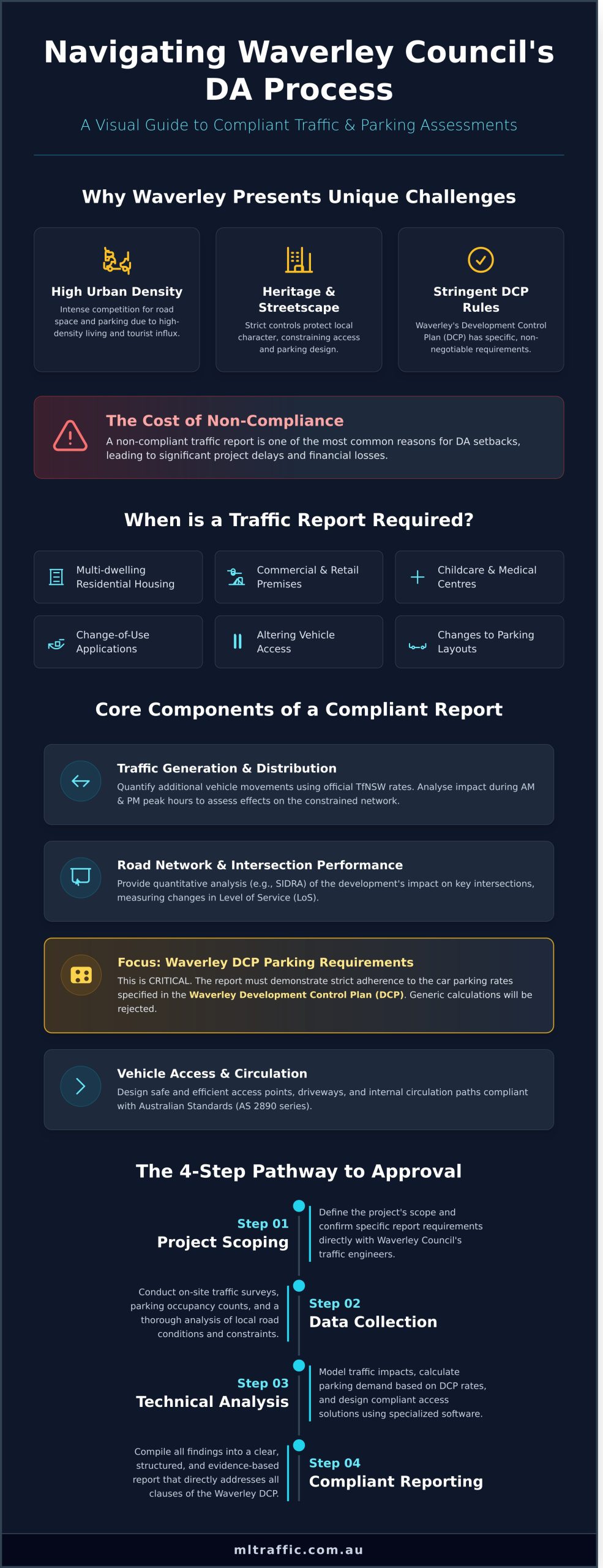
Waverley Council’s unique urban environment-characterised by high-density living, significant tourist influx, and chronic road congestion-places immense pressure on its local infrastructure. Consequently, Council rigorously scrutinises Development Applications (DAs) for their potential impact on the road network and parking availability. A professional Traffic Impact Assessment (TIA) is the primary mechanism for demonstrating that a proposed development complies with Council’s stringent requirements. Submitting a substandard or generic report often leads to costly DA rejections, causing significant delays and financial losses for the applicant. Therefore, successfully undertaking Traffic and Car Parking Impact Assessments in Waverley Council is not a procedural formality, but a critical step for project approval.
To better understand the core function of these reports, the following video provides a clear overview of the Traffic Impact Assessment process:
Understanding the Waverley Development Control Plan (DCP)
The key document governing all development is the Waverley Development Control Plan (DCP). Specifically, parts such as Part B: General Development Requirements outline the precise rules for traffic, access, and car parking. A compliant report must address both the traffic generation of the proposed development and the adequacy of its parking provision against Council’s specified rates. A generic report that fails to directly address the detailed clauses within the Waverley DCP will be deemed insufficient by Council’s traffic engineers.
Common Triggers for a Required Traffic Report
While requirements can vary, certain development types almost invariably trigger the need for a formal traffic and parking report. The process of undertaking Traffic and Car parking Impact Assessments in Waverley Council is essential for DAs involving:
- Multi-dwelling residential housing (e.g., apartment blocks, townhouses).
- Commercial and retail premises, including cafes and restaurants.
- Childcare centres, medical centres, and places of public worship.
- Applications for a change-of-use that intensifies site activity (e.g., converting an office to a gym).
- Any works that alter existing vehicle access or parking arrangements, even if considered minor.
Effectively, any proposal that increases vehicle movements or parking demand on a site will require a professional assessment to satisfy Council’s requirements.
Core Components of a Compliant Traffic Report for Waverley Council
A successful Development Application (DA) depends on a traffic report that is both comprehensive and compliant with Council standards. When undertaking Traffic and Car Parking Impact Assessments in Waverley Council, the report must be a structured, evidence-based document that systematically addresses all potential impacts. It serves as a checklist to demonstrate due diligence and compliance with the Waverley Development Control Plan (DCP) and broader state government transport policies.
The following components are essential for a report to be accepted by Council assessors.
Traffic Generation and Distribution Analysis
This is the foundational analysis of your report. It quantifies the additional vehicle movements the proposed development will create. The methodology involves applying standard traffic generation rates from the official Transport for NSW (TfNSW) guidelines to the development’s size and use. This traffic is then distributed onto the local road network based on logical travel patterns and existing traffic flows. A critical part of this assessment is analysing the impact during the weekday AM and PM peak hours to understand the effect on the network when it is most constrained. Our complete list of services provides further detail on the specific traffic and parking assessments we conduct.
Road Network and Intersection Performance
Waverley Council requires a quantitative assessment of the development’s impact on the performance of the surrounding road network, particularly key intersections. This is typically demonstrated using SIDRA Network analysis or similar traffic modelling software. The analysis measures the existing and future Level of Service (LoS), an industry-standard A-F grading system for intersection efficiency. As detailed in the official NSW Guide to Transport Impact Assessment, any proposal that causes a significant decline in LoS must be accompanied by viable mitigation measures. Furthermore, a thorough assessment of pedestrian and cyclist safety and connectivity is non-negotiable.
Construction Traffic and Pedestrian Management
Before approval is granted, Council must be satisfied that the construction phase will be managed safely and with minimal disruption. A preliminary Construction Traffic Management Plan (CTMP) is therefore a mandatory component of the traffic report. This plan must clearly define:
- Designated truck routes for entry and exit.
- Location of any proposed work zones and materials handling areas.
- Procedures for loading and unloading within the site boundaries.
- Measures to maintain safe access for pedestrians and cyclists around the site.
The CTMP must also address the requirements for obtaining relevant permits, such as for hoardings or a dedicated works zone on the public road.
Mastering Waverley’s Car Parking Requirements: Design and Demand
Car parking provision is one of the most scrutinised and contentious issues for Development Applications within the Waverley LGA. A successful DA hinges on a clear demonstration of compliance with Council’s dual requirements: satisfying the calculated parking demand and adhering to strict geometric design standards. The process of undertaking Traffic and Car Parking Impact Assessments in Waverley Council therefore requires a meticulous, two-pronged approach.
Calculating Parking Demand as per the DCP
Parking rates are not discretionary; they are explicitly defined in the Waverley Development Control Plan (DCP). Your traffic report must accurately calculate the total required provision based on your specific land use. For example:
- Residential Developments: Rates are typically based on the number of bedrooms per dwelling, with separate, additional requirements for visitor parking (e.g., 1 space per 5 units).
- Retail/Commercial Developments: Demand is calculated based on Gross Floor Area (GFA), such as 1 space per 40m² of retail GFA.
- Other Requirements: Provision for accessible, motorcycle, and bicycle parking is mandatory and must be calculated according to the rates specified in the DCP.
For mixed-use developments, the parking demand for each land use component must be calculated individually and then summated to determine the total site requirement.
Car Park Design and Access Compliance
Meeting the numerical parking rate is insufficient without a design that is safe, accessible, and compliant. All car park layouts, accessways, and driveways must strictly conform to Australian Standards, primarily AS 2890.1:2004 (for off-street car parking) and AS 2890.6:2009 (for accessible spaces). Key design elements that Council will assess include:
- Geometric Dimensions: Car space dimensions, aisle widths, and headroom clearances.
- Ramp Design: Maximum ramp grades and the inclusion of compliant transitions to prevent vehicle scraping.
- Vehicle Manoeuvring: A comprehensive Swept Path Analysis is required to demonstrate that the design vehicle can safely enter, manoeuvre within, and exit the site in a forward direction.
- Sight Lines: Clear sight lines for vehicles exiting the property onto the public road are a critical safety requirement.
Justifying a Parking Shortfall
While the DCP rates are the standard, Waverley Council may consider a proposed parking shortfall in specific circumstances. A reduction in the required parking is not granted lightly and requires a robust, evidence-based justification. The most common argument is exceptional access to public transport, such as for sites located within the Bondi Junction Strategic Centre. To support such a claim, your traffic impact assessment must include detailed on-street parking surveys, conducted in accordance with Council guidelines, to prove that the surrounding road network can accommodate the displaced parking demand. Failure to provide a compelling, data-driven case will almost certainly result in the rejection of the proposed shortfall. For expert assistance in preparing a persuasive justification, contact our senior traffic engineers.
The Step-by-Step Process for Your Waverley Traffic Assessment
Successfully undertaking Traffic and Car Parking Impact Assessments in Waverley Council requires a structured, phased approach. From initial feasibility to final submission, each step is critical for a smooth Development Application (DA) process. This timeline outlines the key stages, ensuring your project is supported by a robust and compliant traffic report that meets Council’s specific requirements.
Phase 1: Scoping and Consultant Engagement
The process begins with defining the project scope. Where appropriate, a pre-DA meeting with Waverley Council can identify specific traffic or parking concerns early. The next critical step is selecting a traffic consultant with proven experience in the local area. To receive an accurate quote, you will need to provide architectural plans and a detailed project description. A consultant’s familiarity with Waverley’s unique road network and planning controls is invaluable. Learn more about our experience with Sydney councils.
Phase 2: Site Investigation and Data Analysis
Once engaged, our senior engineers conduct a thorough site investigation to document existing traffic conditions, road network characteristics, and pedestrian infrastructure. This is followed by methodical data collection, which typically includes:
- Traffic volume surveys on surrounding roads during peak periods.
- On-street and off-street parking occupancy counts to establish current demand.
- Assessment of public transport accessibility and active transport routes.
This data is analysed using specialised traffic modelling software to forecast the development’s impact. We also review local traffic committee minutes to understand pre-existing issues in the vicinity, ensuring our assessment is comprehensive and context-aware.
Phase 3: Report Finalisation and DA Lodgement
Following the analysis, we prepare a draft Traffic and Parking Impact Assessment report for review by you and your project team. This collaborative step allows for feedback and ensures all aspects of the development are accurately represented. After incorporating any revisions, all calculations, swept path diagrams, and recommendations are finalised. The final report is meticulously checked to ensure it directly addresses all relevant clauses within the Waverley Development Control Plan (DCP), providing Council with clear, evidence-based information. The completed report then becomes an essential component of your DA submission package.
Ready to start? Contact our expert team for a quote.
Secure Your Waverley DA Approval with Expert Traffic Engineering
Navigating Waverley Council’s development application process requires a meticulous approach to traffic and parking. A compliant traffic report, grounded in a thorough understanding of local car parking requirements and design standards, is not just a formality-it is a critical component for success. Successfully undertaking Traffic and Car Parking Impact Assessments in Waverley Council demands specialist expertise to address all council-specific regulations and ensure a smooth approval pathway.
Partner with ML Traffic Engineers Pty Ltd to leverage over 15 years of specialised experience with Sydney councils. Our proven track record in securing DA approvals throughout the Eastern Suburbs is built on providing direct access to senior traffic engineers who manage your project from quote to completion. We deliver the authoritative, compliant documentation your project requires.
For a comprehensive traffic report that meets Waverley Council’s stringent standards, contact ML Traffic Engineers Pty Ltd for a fixed-price quote on your Waverley DA traffic report. Let our expertise clear the way for your development’s success.
Frequently Asked Questions
When is a Traffic Impact Assessment officially required by Waverley Council?
Waverley Council requires a Traffic Impact Assessment (TIA) for any Development Application (DA) that is likely to have a notable impact on local traffic, parking, or road safety. This is explicitly triggered by specific development types and scales outlined in the Waverley Development Control Plan (DCP). Common triggers include new multi-dwelling housing, commercial or retail premises, childcare centres, and any change of use that intensifies site activity. The assessment ensures the proposed development’s traffic implications are properly managed.
What are the most common reasons Waverley Council rejects a traffic report?
Traffic reports are most frequently rejected for non-compliance with technical standards. Common reasons include car park and access designs that fail to meet Australian Standard AS 2890.1, inadequate or inaccurate Swept Path Analysis for the design vehicle, and insufficient sight lines at driveway exits. Other critical errors include incorrect car parking calculations based on Waverley DCP rates or a failure to adequately address feedback from Transport for NSW (TfNSW) on nearby classified roads.
How do I find the specific car parking rates for my development type in the Waverley DCP?
The specific car parking rates are detailed within the Waverley Development Control Plan (DCP). You must consult Part B of the DCP, which contains the general provisions, and locate the section dedicated to ‘Parking and Access’. This section provides a table of rates for various land uses, such as residential flat buildings, retail premises, and commercial offices. Due to the complexity and specific definitions, professional interpretation is essential to ensure accurate application to your development.
Can I get a reduction in the required number of parking spaces for my site?
A reduction in the statutory car parking requirement is possible but requires a robust justification report. This is typically argued under Section 4.15 of the Environmental Planning and Assessment Act 1979. Strong justifications include the site’s close proximity to high-frequency public transport, the provision of dedicated car-share spaces, or a detailed on-street parking survey that demonstrates sufficient local capacity. A professionally prepared Car Parking Demand Assessment is critical for Council to consider any variation.
What is a Swept Path Analysis and why does Waverley Council require it?
A Swept Path Analysis is a technical CAD-based assessment that models the turning path of a specific design vehicle, typically the B85 or B99 vehicle as defined in Australian Standard AS 2890.1. Waverley Council requires this analysis to verify that vehicles can safely and efficiently enter and exit a site, manoeuvre within car parks, and access loading docks without encroaching on footpaths, landscaping, or structural elements. It is a critical tool for demonstrating design compliance and operational safety.
How long does it take to prepare a comprehensive traffic report for a Waverley DA?
The timeframe for undertaking Traffic and Car Parking Impact Assessments in Waverley Council typically ranges from one to three weeks. A straightforward report for a small residential development can often be completed within a week. However, more complex projects requiring on-site traffic surveys, detailed intersection analysis, or consultation with Transport for NSW (TfNSW) will extend the timeline. Early engagement with a professional traffic consultant is crucial to meet your DA submission deadlines without delay.
