

We are traffic engineers servicing Artarmon, Castle Cove, Castlecrag, Chatswood, Chatswood West, Gore Hill, Lane Cove North, Middle Cove, Naremburn, North Willoughby, Northbridge, Willoughby, Willoughby East.
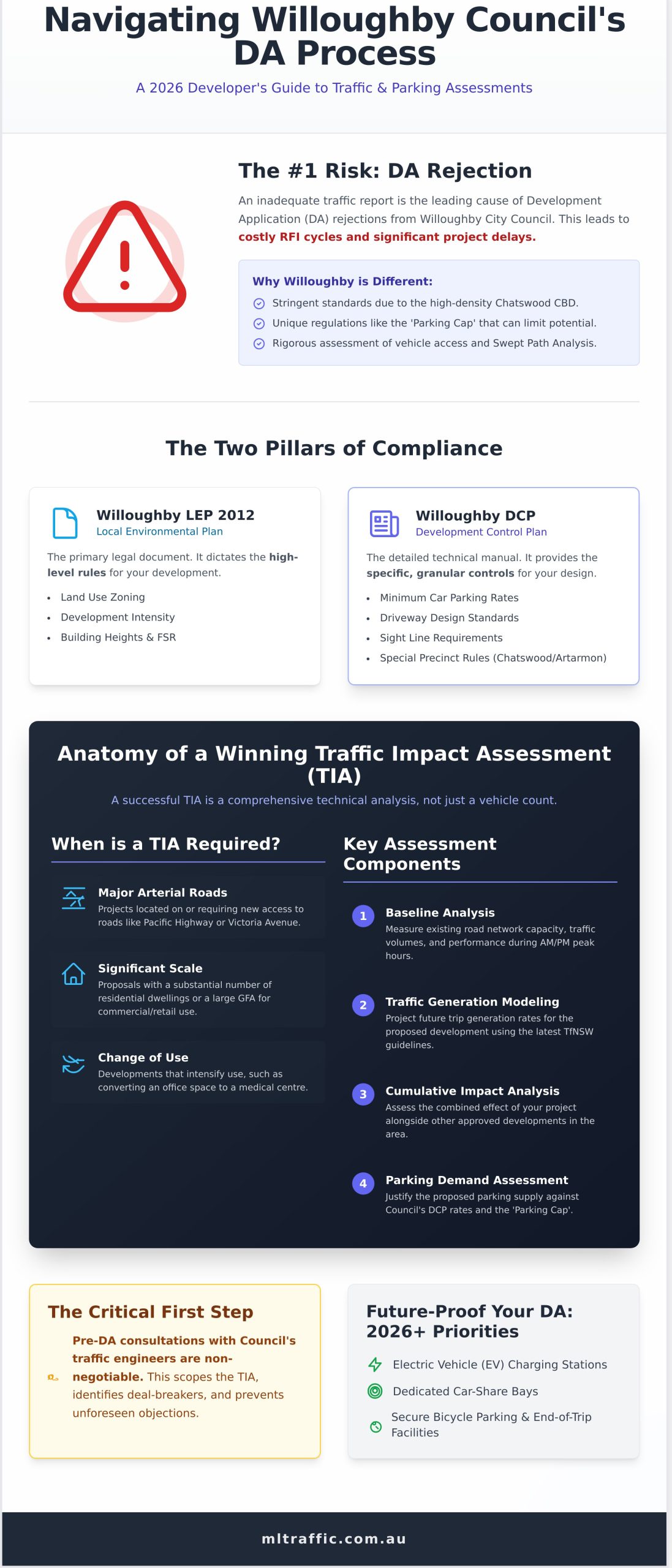
A Development Application rejection from Willoughby City Council due to an inadequate traffic report is a significant and avoidable project risk. For developers facing the complexities of the Chatswood CBD or vague feedback on swept path requirements, correctly undertaking Traffic and Car Parking Impact Assessments in Willoughby Council is not merely a procedural step—it is the foundation of a successful DA submission. Failure to meet the council’s stringent standards often results in costly RFI cycles and extensive project delays.
This 2026 developer’s guide provides a direct, technical roadmap for navigating these requirements with confidence. Inside, you will find a clear checklist of Willoughby-specific criteria, detailed guidance on ensuring full compliance with AS 2890.1 and the Willoughby DCP, and expert strategies to minimise council requests for further information. Our objective is to provide the critical information needed to streamline your assessment process and secure timely DA approval.
Key Takeaways
-
Understand why Willoughby Council’s Local Environmental Plan (LEP) and Development Control Plan (DCP) are uniquely stringent, particularly around the Chatswood CBD.
-
Learn to navigate Willoughby’s specific car parking rates, including the counter-intuitive ‘Parking Cap’ that can limit development potential.
-
Ensure your site’s vehicle access and driveway designs comply with Council’s engineering standards by correctly applying Swept Path Analysis.
-
Discover the essential components for successfully undertaking Traffic and Car Parking Impact Assessments in Willoughby Council, and why a generic report will fail to secure DA approval.
Table of Contents
-
Understanding Willoughby Council’s Traffic and Parking Requirements for 2026
-
Core Components of a Willoughby Traffic Impact Assessment (TIA)
-
Navigating Willoughby’s Car Parking Rates and Demand Assessments
-
Vehicle Access and Swept Path Analysis for Willoughby Developments
-
Expert Traffic Engineering: Securing Your Willoughby Council DA Approval
Understanding Willoughby Council’s Traffic and Parking Requirements for 2026
Successfully navigating the development application (DA) process in Willoughby City Council requires a precise understanding of its stringent traffic and parking regulations. Compared to neighbouring LGAs, Willoughby maintains a more rigorous assessment standard, a direct result of the high-density, transit-oriented development centred on the Chatswood CBD. Any significant proposal must demonstrate a negligible impact on the existing road network and align with Council’s future transport strategies. This process is a specialised component of a project’s overall Environmental Impact Assessment, focusing specifically on transport, access, and parking demand.
To better understand the scope of a professional transport assessment, the following video provides a helpful overview of the core principles involved:
The trigger for a formal Traffic Impact Assessment (TIA) is not arbitrary. Council mandates a TIA when a development is likely to generate significant additional vehicle movements. Key triggers include:
-
Proposals involving a substantial number of residential dwellings or a large gross floor area (GFA) for commercial or retail use.
-
Developments that involve a change of use with a higher traffic generation rate, such as converting office space to a medical centre.
-
Projects located on or requiring access to major arterial roads.
For 2026 and beyond, Council’s assessment criteria increasingly prioritise sustainable transport. A successful application must integrate ‘active travel’ provisions, such as secure bicycle parking and end-of-trip facilities, alongside modern mobility solutions like dedicated car-share bays and electric vehicle (EV) charging stations.
The Statutory Framework: LEP vs. DCP
Undertaking Traffic and Car Parking Impact Assessments in Willoughby Council begins with two key documents. The Willoughby Local Environmental Plan (LEP) 2012 is the primary legal instrument dictating land use zoning and development intensity. The Willoughby Development Control Plan (DCP) provides the detailed, granular controls, specifying minimum car parking rates, driveway design standards, sight line requirements, and vehicle access controls. Special precincts, such as the Chatswood CBD and the Artarmon Industrial Area, have their own specific sections within the DCP that require expert interpretation.
Pre-DA Consultations and Traffic Scoping
Engaging with Willoughby Council’s traffic engineers during a pre-DA meeting is a critical, non-negotiable step. This early consultation helps to scope the required assessment, determining the study area for traffic counts and identifying Council’s key concerns or potential ‘deal-breakers’ upfront. This proactive approach saves significant time and cost by ensuring the final traffic report directly addresses all of Council’s strategic transport objectives, preventing unforeseen objections during the formal DA assessment phase.
Core Components of a Willoughby Traffic Impact Assessment (TIA)
A Traffic Impact Assessment (TIA) for Willoughby Council is a detailed technical document that moves beyond simple vehicle counts. It provides a comprehensive analysis of a development’s effect on the surrounding transport network. The success of your Development Application (DA) hinges on this report’s accuracy and adherence to both Council and Transport for NSW (TfNSW) standards. The process of undertaking Traffic and Car Parking Impact Assessments in Willoughby Council requires a meticulous approach to data, modeling, and strategic planning.
The assessment begins by establishing a baseline, analysing the existing road network capacity, particularly along high-traffic arterial roads like the Pacific Highway and Victoria Avenue. We then project the development’s trip generation rates for AM and PM peak hours, using the latest TfNSW (formerly RMS) technical guidelines. Crucially, your project is not assessed in a vacuum. Council requires an analysis of the ‘Cumulative Impact’—the combined effect of your development alongside other approved or proposed projects in the vicinity. This ensures the local network can sustain phased growth.
Traffic Generation and Distribution Modeling
Accurate modeling is non-negotiable for Willoughby Council. This involves using industry-standard software like SIDRA to simulate traffic flows and predict performance at key local intersections, such as those along Mowbray Road and Archer Street. The objective is to quantify the change in traffic conditions, focusing on:
-
Peak Hour Vehicle Movements: Calculating the number of additional vehicles generated by residential, commercial, or mixed-use sites during critical morning and evening periods.
-
Trip Distribution: Modeling how this new traffic will disperse across the local road network.
-
Level of Service (LoS): Assessing the performance of intersections post-development. LoS is a grading system (A to F) that measures delay and congestion, and maintaining an acceptable LoS is a primary factor in Council’s decision-making.
Sustainable Transport and Green Travel Plans
Willoughby Council places significant emphasis on reducing car dependency, especially within the strategic Chatswood-to-St-Leonards corridor. A TIA must therefore address sustainable transport initiatives. A robust Green Travel Plan (GTP) is often required to demonstrate how the development encourages walking, cycling, and public transport use. This is critical for justifying any proposed reduction in on-site car parking. Key components include:
-
Provision of compliant bicycle parking and modern end-of-trip facilities (showers, lockers).
-
Integration of dedicated Electric Vehicle (EV) charging stations.
-
Strategies to promote public transport use and car-sharing schemes.
A well-prepared GTP can effectively mitigate the perceived traffic impact, aligning your project with Council’s long-term transport objectives.
Navigating Willoughby’s Car Parking Rates and Demand Assessments
Successfully undertaking traffic and car parking impact assessments in Willoughby Council requires a detailed understanding of the balance between prescriptive council rates and actual on-site demand. Willoughby City Council’s Development Control Plan (DCP) Part C.4 outlines specific parking rates, but these are often a starting point for negotiation, not an absolute mandate. A rigid application of these rates can lead to an oversupply of parking, adding unnecessary cost and complexity to a project.
A prime example of Council’s strategic approach is the ‘Parking Cap’ within the Chatswood CBD. Here, Council actively limits the maximum number of parking spaces to encourage public transport use and manage congestion. This policy highlights that justifying a parking provision that deviates from the DCP—whether it’s a shortfall or an alternative arrangement—hinges on providing robust, evidence-based analysis. This often involves demonstrating excellent proximity to public transport hubs like Chatswood or Artarmon train stations.
Crucially, any parking proposal must strictly adhere to Australian Standards for specific bay types. This includes dedicated visitor parking and accessible spaces, which must be designed and located in full compliance with AS 2890.6 to ensure equitable access.
DCP Compliance vs. Parking Demand Statements
For smaller-scale developments where traffic generation is minimal, a focused Traffic Impact Statement (TIS) or Car Parking Demand Assessment can often be used instead of a full TIA. We conduct on-street parking accumulation surveys in areas like Artarmon and North Willoughby to establish genuine local demand. Case Study: For a mixed-use development near St Leonards, our firm successfully justified a 15% reduction in residential parking by providing empirical data on low car ownership in the area and its direct proximity to the train station.
Loading and Service Vehicle Requirements
Willoughby Council maintains strict requirements for on-site loading and service vehicle facilities to minimise impact on the public road network. Developments must provide dedicated zones for waste collection and deliveries, designed to accommodate the appropriate vehicle size—typically a Small Rigid Vehicle (SRV) or Medium Rigid Vehicle (MRV). All loading docks and service bays must be designed using swept path analysis to ensure vehicles can enter and exit in a forward direction, without encroaching on footpaths or disrupting traffic flow.
Vehicle Access and Swept Path Analysis for Willoughby Developments
A compliant car parking provision is redundant if vehicles cannot safely and efficiently access the site. The physical design of driveways, ramps, and parking layouts is a non-negotiable component when undertaking Traffic and Car Parking Impact Assessments in Willoughby Council. Architectural plans must be validated with precise engineering analysis to demonstrate full compliance with both Australian Standards and Council’s specific engineering specifications. This verification process prevents costly redesigns and delays during the Development Application (DA) process.
Swept Path Modeling for Constrained Sites
Swept Path Analysis, conducted using industry-standard AutoTURN software, provides irrefutable proof that a site’s layout can accommodate the required design vehicles. For developments in Willoughby, this involves demonstrating that B85 and B99 vehicles can navigate tight basement ramps and parking aisles without conflicting with columns or walls. A critical requirement is simulating waste collection vehicle access, proving it can enter and exit the site in a forward direction, thereby avoiding dangerous reversing maneuvers onto public roads.
Common pitfalls leading to council rejection include:
-
Insufficient turning radii at ramp corners or within parking aisles.
-
Conflict points between vehicles and structural elements like columns or service pits.
-
Failure to model the largest required vehicle (e.g., a Medium Rigid Vehicle for deliveries or waste).
Driveway and Ramp Design (AS 2890.1)
All off-street car parking facilities must strictly adhere to Australian Standard AS 2890.1. This standard dictates maximum ramp grades, which is particularly relevant in Willoughby’s varied terrain to prevent vehicle undercarriage scraping. The design must incorporate correctly calculated ‘transition grades’ at the crest and sag of steep ramps to ensure smooth vertical clearance. Furthermore, the driveway crossover design must integrate seamlessly with Council’s assets, respecting streetscape character, footpath levels, and any Tree Protection Zones (TPZs).
Finally, ensuring adequate ‘Sight-Line’ triangles at the property boundary is critical for pedestrian safety on Willoughby’s busy footpaths. This assessment proves that drivers exiting the site have a clear and unobstructed view of pedestrians. Correctly addressing vehicle access and safety is a core part of undertaking Traffic and Car Parking Impact Assessments in Willoughby Council. For expert analysis of your development’s compliance, contact the professional consultants at ML Traffic Engineers.
Expert Traffic Engineering: Securing Your Willoughby Council DA Approval
A generic, ‘one-size-fits-all’ traffic report is insufficient for a successful Development Application (DA) in the Willoughby Local Government Area. The Council’s specific planning controls, particularly within the Chatswood CBD, demand a nuanced and technically robust assessment. A report that fails to address local conditions and specific clauses within the Willoughby DCP and LEP is a common cause for delays and costly RFIs.
ML Traffic Engineers mitigates this risk by providing specialised expertise grounded in over 15 years of direct experience with NSW councils. When undertaking Traffic and Car Parking Impact Assessments in Willoughby Council, we ensure a senior engineer manages your project from the initial quote to the final submission. This guarantees the highest level of technical oversight and a report tailored to meet Council’s precise expectations.
The ML Traffic Advantage: Local Expertise
Our firm possesses a significant track record of securing DA approvals throughout the Willoughby LGA. This local knowledge is invaluable. Every client benefits from direct access to our principals, Michael Lee and Benny Chen, ensuring accountability and senior-level strategy on every project. We integrate essential technical studies, such as Vehicle Swept Path Analysis, early in the design process to verify compliance with Australian Standards (AS 2890.1) and prevent access-related design flaws.
Streamlining the DA Process
Our primary objective is to facilitate a smooth and efficient DA process. By proactively checking for compliance and addressing all relevant Council controls, our reports are structured to minimise Council RFIs. We routinely coordinate with other consultants, including acoustic and civil engineers, to ensure a cohesive and comprehensive submission package. Ready to start? Contact our Sydney office for a project-specific quote and let our expertise guide your development through Council.
The consultant who provides your quote is the expert who completes the work. This core principle at ML Traffic Engineers ensures a direct, efficient, and accountable partnership for your Willoughby project.
Secure Your Willoughby DA with Expert Traffic Engineering
Navigating Willoughby Council’s development landscape in 2026 demands a precise and compliant approach. A successful Development Application hinges on a meticulously prepared Traffic Impact Assessment (TIA) that satisfies all local requirements, from parking rates to vehicle access design. Successfully undertaking Traffic and Car Parking Impact Assessments in Willoughby Council is a critical component that protects your project’s viability and timeline.
Ensure your project is backed by proven expertise. ML Traffic Engineers brings specialised knowledge of the Willoughby DCP and AS 2890 compliance to every project. With senior engineers offering over 30 years of direct experience and a track record of over 10,000 sites assessed across Australia, we provide the authoritative, technical documentation required to gain approval.
Secure your Willoughby DA approval with an expert Traffic Assessment from ML Traffic Engineers.
Partner with us to navigate the complexities of council regulations and move your development forward with confidence.
Frequently Asked Questions
Is a traffic report required for all Development Applications in Willoughby?
No, a traffic and parking assessment is not a mandatory requirement for every Development Application (DA). It is typically required for developments that are likely to significantly impact traffic generation, parking demand, or access arrangements. This includes new multi-dwelling housing, commercial and retail developments, changes of use, and any project that proposes a variation to the car parking rates stipulated in the Willoughby Development Control Plan (DCP). Minor applications like internal alterations generally do not require a report.
How much does a Traffic Impact Assessment cost for a Willoughby project?
The cost is directly related to the scale and complexity of the proposed development. A straightforward Traffic Impact Statement (TIS) for a small-scale project may cost between A$2,500 and A$4,000. A more comprehensive Traffic Impact Assessment (TIA) for a larger development requiring traffic surveys and modelling can range from A$5,000 to A$15,000 or more. It is essential to obtain a site-specific quote based on the DA requirements set by Willoughby Council.
What is the ‘Chatswood CBD Parking Cap’ and does it apply to my site?
The Chatswood CBD Parking Cap is a planning control within the Willoughby Local Environmental Plan (LEP) that sets a maximum limit on the number of car parking spaces for non-residential development in the designated Chatswood CBD area. Its purpose is to manage traffic congestion and promote the use of public transport. If your development site is located within this defined boundary, the cap applies, and your proposed parking provision cannot exceed the maximum permissible rate, regardless of demand.
Can I use standard RMS trip generation rates for a Willoughby DA?
Yes, the Transport for NSW (formerly RMS) ‘Guide to Traffic Generating Developments’ provides the foundational trip generation rates used for assessments in Willoughby. However, Council may require these standard rates to be validated or supplemented with local traffic surveys, particularly for unique land uses or sites in sensitive locations. A robust report will justify the selected rates and demonstrate their suitability for the specific context of the development site and the surrounding road network.
What happens if my development cannot meet the DCP parking requirements?
A variation from the Willoughby DCP parking rates requires a detailed justification. This is typically presented as a merit-based assessment arguing that the proposed parking shortfall is acceptable. Supporting arguments often include high levels of public transport accessibility, opportunities for shared parking, or a detailed car parking demand assessment demonstrating that the specific land use generates lower-than-standard demand. Council approval of a parking shortfall is discretionary and requires a compelling, evidence-based case.
How long does it take to prepare a Willoughby-compliant traffic report?
The timeframe for preparing a report depends on its complexity. A standard Traffic and Parking Impact Statement can typically be completed within 2 to 3 weeks from engagement. More complex assessments requiring on-site traffic and parking surveys may take 4 to 6 weeks. The process of Undertaking Traffic and Car Parking Impact Assessments in Willoughby Council efficiently relies on clear architectural plans and a defined project scope, so early consultation with a qualified traffic engineer is recommended to meet submission deadlines.
Does Willoughby Council allow reversing movements onto local streets?
Generally, Willoughby Council prohibits vehicle reversing movements onto or off a public road for new developments, in accordance with Australian Standard AS 2890.1. All vehicles are required to enter and exit a site in a forward direction to ensure safety for pedestrians and other road users. Limited exceptions may be considered for single dwellings on very low-volume, local roads, but this is subject to a rigorous safety assessment and is not a guaranteed approval.
What are the bicycle parking requirements for new commercial developments in Willoughby?
Bicycle parking requirements are specified in the Willoughby Development Control Plan (DCP). The rates are typically calculated based on the development’s gross floor area (GFA) and distinguish between spaces for employees (secure, long-term) and visitors (short-term). The DCP also mandates the provision of associated end-of-trip facilities, such as showers and lockers, for staff. Developers must consult the most current version of the Willoughby DCP to ensure the proposed design is fully compliant.
