

A single non-compliant driveway gradient or an overlooked turning circle can stall a development application for months. Most developers find local government requirements opaque, leading to costly redesigns and significant delays in DA approval. It’s a common frustration to discover that a car park layout doesn’t meet AS 2890.1 standards only after the plans have been submitted and rejected. Ensuring your project includes a precise swept path analysis that planning authorities will accept is the first step toward avoiding these expensive setbacks.
This article ensures you master the technical requirements and planning authority expectations for successful traffic and parking assessments. We provide a detailed breakdown of applicable local design specifications and current regulatory guidelines. You’ll learn how to satisfy AUSTROADS standards for various vehicle types and integrate these into your site layout to maximise space. We also preview the essential components of a compliant Traffic Impact Assessment (TIA), from intersection analysis to maximum grade transitions, ensuring your project moves from submission to approval with professional precision.
Key Takeaways
- Understand how the Wollondilly Local Environmental Plan 2011 and DCP 2016 interact to dictate site-specific parking rates and access requirements.
- Learn to accurately forecast traffic generation using the RMS Guide and local network data to ensure your Traffic Impact Assessment meets Council standards.
- Master the technical application of swept path analysis wollondilly shire council planners require to demonstrate vehicle manoeuvrability and AS 2890.1 compliance.
- Identify the critical traffic documentation needed for a Statement of Environmental Effects to minimise the risk of Requests for Information (RFIs).
- Discover why direct involvement from senior principals ensures personnel continuity and technical accuracy for complex developments in the Wollondilly Shire.
The Planning Framework for Wollondilly Traffic Assessments
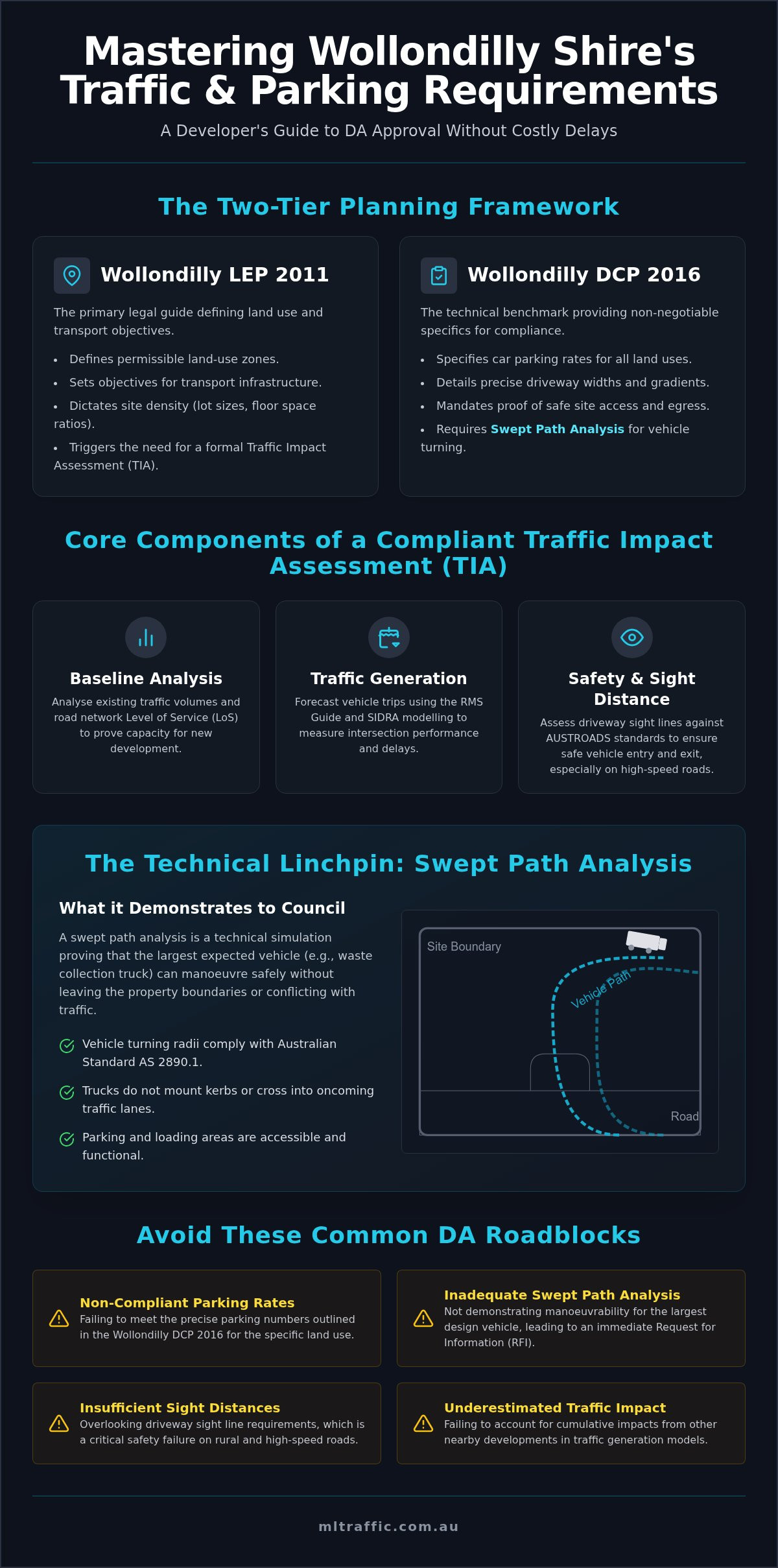
The Wollondilly Local Environmental Plan (LEP) 2011 acts as the primary legislative instrument for all development within the Shire. It defines land-use zones and sets the objectives for transport infrastructure. For developers, the LEP is the first point of reference to determine if a proposed land use is permissible and what broad traffic impacts Council will scrutinise. Zoning directly influences traffic generation rates. An industrial development in Tahmoor faces different scrutiny than a medium-density residential project in Picton. Council expects every proposal to maintain the safety and efficiency of the existing road network without compromise.
Wollondilly LEP 2011 and Traffic Implications
Zoning considerations are central to traffic planning. The LEP 2011 specifies minimum lot sizes and floor space ratios that dictate the density of a site. Higher density leads to increased vehicle movements. Key clauses within the LEP mandate that transport infrastructure must be adequate to support the scale of the development. This often triggers the need for a formal Traffic Impact Assessment (TIA) when a proposal exceeds standard generation thresholds or impacts key intersections. Developers must also account for the Shire’s growth management strategies, ensuring that new projects don’t hinder future road infrastructure plans.
Development Control Plan (DCP) Compliance
While the LEP provides the legal framework, the Wollondilly Development Control Plan (DCP) 2016 provides the technical benchmarks. It contains specific car parking rates for residential, commercial, and industrial land uses. For example, a childcare centre or a medical suite has vastly different parking requirements than a warehouse. Compliance with the DCP is non-negotiable for DA approval. It’s a precise document that leaves little room for interpretation regarding parking numbers or driveway widths.
A critical requirement within the DCP is the demonstration of safe access and egress. This is particularly complex at the urban-rural interface where road widths and sight distances vary. A swept path analysis wollondilly shire council planners expect must prove that the vehicle turning radius of the largest expected vehicle fits within the site boundaries. This technical simulation ensures that heavy vehicles or waste collection trucks don’t mount kerbs or cross into oncoming traffic lanes. Failing to provide this level of detail often results in immediate requests for further information. Engaging with professional traffic engineering services at the design stage ensures these planning layers are addressed before submission. This proactive approach prevents the high costs associated with redesigning access points after a DA has been lodged.
Core Components of a Compliant Traffic Impact Assessment
A compliant Traffic Impact Assessment (TIA) Report must provide a data-driven justification for a development’s interaction with the Wollondilly road network. It begins with a baseline analysis of existing traffic volumes on local collectors and distributors. Council planners require evidence that the current infrastructure can absorb additional load without degrading the Level of Service (LoS). If a project requires a swept path analysis wollondilly shire council submission, it must be integrated into this broader traffic context to show that site access doesn’t compromise road safety or impede existing traffic flow.
Traffic Generation and Distribution Modelling
Accurate forecasting relies on the RMS Guide to Traffic Generating Developments, supplemented by local surveys where specific land uses differ from standard models. Traffic generation for Wollondilly developments refers to the total number of vehicle trips produced by a specific land use during peak operational hours. We use SIDRA software to model intersection performance, measuring degree of saturation and average delay. Council expects these models to account for cumulative impacts from nearby approved developments, ensuring the network remains functional as the Shire grows.
Road Safety and Sight Distance Assessments
Safety assessments are critical in the Shire due to the prevalence of high-speed rural roads and limited street lighting in certain sectors. A Sight Distance Assessment ensures that vehicles exiting a site have sufficient time to see oncoming traffic, adhering strictly to Australian Standards. Precise swept path analysis wollondilly shire council planners can trust ensures that heavy vehicles don’t encroach on opposite lanes during entry or exit. We evaluate:
- Safe Intersection Sight Distance (SISD) for all proposed access points.
- Impacts on vulnerable road users, including pedestrians and cyclists in urban centres like Wilton or Picton.
- The interaction between heavy vehicle movements and existing school zones or bus routes.
Justifying departures from standard DCP parking rates is possible but requires a robust Car Parking Demand Assessment. This involves analysing empirical data from similar sites to prove that the proposed supply meets actual demand, preventing overspill into public streets. Our senior engineers handle these complex negotiations, providing the technical weight needed to support non-standard layouts. We often demonstrate that specific operational hours or site-specific factors reduce the peak parking requirement below Council’s generic rates, allowing for a more efficient use of land.
Car Parking Design and Swept Path Analysis Requirements
Wollondilly’s varied topography often presents significant challenges for car park design. Compliant layouts must adhere strictly to AS 2890.1 for off-street parking. This involves calculating precise aisle widths and space dimensions based on the designated user class. For instance, a retail development in Wilton requires different specifications than a residential staff car park. A technical swept path analysis wollondilly shire council submission provides the visual proof that these designs work in practice, ensuring vehicles enter and exit in a forward direction without excessive manoeuvres.
AS 2890 Compliance for Wollondilly Sites
Steep terrain across the Shire requires careful Driveway Ramp Grade Assessment. The Wollondilly Design Specification 2016 mandates a maximum grade of 1 in 6 (16.67%) for commercial driveways. If a change of grade exceeds 1 in 8 (12.5%), you must include transition sections at least 2.0 metres long to prevent vehicle scraping. We also ensure full adherence to AS 2890.6 for disabled parking, which is a frequent point of failure in non-specialist reports. For a deeper look at these technicalities, see our article on AS 2890.1 Explained.
Swept Path Analysis for Service and Waste Vehicles
Rural-residential interfaces often lack the wide road reserves found in established urban centres. This makes waste collection and delivery access a primary concern for Council. We use AutoTURN software to simulate the exact movements of a 12.5m single unit truck or a standard garbage vehicle. Our swept path analysis wollondilly shire council documentation demonstrates that these heavy vehicles can navigate the site safely. This includes verifying turn-around areas for dead-end accessways, which must accommodate the vehicle’s full turning radius without mounting kerbs.
Optimising the car park layout isn’t just about compliance; it’s about space efficiency. By refining aisle widths and bay angles, we often find additional parking capacity that non-specialist designers overlook. This meticulous approach ensures the site remains functional for all users while meeting the strict requirements of AS 2890.2 for commercial vehicles. You can find more detail on our professional methodology in our Swept Path Analysis Guide.
Navigating the Wollondilly Council Submission Process
The Statement of Environmental Effects (SEE) requires a dedicated traffic and parking section that distils the findings of your full TIA Report. Council planners use this summary to assess the overall impact on the local community. For developments involving complex access, such as those in the rural-residential zones of Tahmoor or Thirlmere, your swept path analysis wollondilly shire council submission must be clearly referenced within the SEE. This ensures that the assessing officer understands exactly how heavy vehicles or waste trucks will navigate the site without relying on external guesswork. A well-prepared SEE component reduces initial friction and sets a professional tone for the entire application.
Pre-DA Consultations and Scoping
For large-scale or high-impact projects, we recommend a formal pre-DA consultation. Meeting with Council officers early allows us to agree on the traffic study parameters, such as the required extent of intersection modelling or specific peak-hour survey dates. This step identifies potential deal-breakers, like inadequate sight distances or non-compliant driveway gradients, before you invest in detailed architectural plans. Early scoping reduces the likelihood of significant redesigns after the DA is lodged, saving thousands in drafting fees and preventing unnecessary project holding costs.
Managing Council Engineering Referrals
Once submitted, your DA is referred to Council’s internal traffic engineers. They scrutinise the TIA for technical compliance with the Wollondilly Design Specification 2016. A common cause of delay is the Request for Information (RFI), often triggered by ambiguous diagrams or insufficient justification for parking shortfalls. Providing a high-quality swept path analysis wollondilly shire council planners can verify against AS 2890.2 prevents these technical bottlenecks. If your design departs from standard rates, our senior engineers provide the robust technical justification needed to satisfy Council’s performance-based criteria. Traffic engineering reviews in the Shire typically follow the standard DA assessment clock, but technical RFIs can pause this progress for weeks if the initial report is non-compliant.
Avoid the delays associated with poorly prepared reports. You can contact our senior traffic engineers to ensure your submission meets every technical benchmark from the first day of lodgement. Our personnel continuity promise means the expert who initiates your project will be the one defending the technical work during the referral process, providing a seamless line of communication between you and the Council.
Why Expert Traffic Engineering is Critical for Your Project
Engaging a generalist civil engineer or an architect to handle complex traffic requirements often results in technical oversights that Council’s referral team will inevitably identify. Wollondilly Shire Council maintains strict engineering standards, particularly regarding vehicle access in transitioning rural-urban zones. If a swept path analysis wollondilly shire council planners receive is missing specific transition sections for steep gradients or fails to use the correct AUSTROADS design vehicle, the DA process will stall. Specialist traffic engineers provide the technical precision needed to avoid these bottlenecks, ensuring that the car park design is not only compliant but also operationally efficient for the long term.
Operational efficiency goes beyond mere compliance. A poorly designed car park layout leads to congestion, vehicle scraping, and safety hazards that can diminish the value of a commercial or residential development. By optimising aisle widths and ensuring correct sight distances from the outset, we prevent the high costs associated with post-submission redesigns. Our senior engineers focus on creating layouts that maximise available space while strictly adhering to AS 2890.1 and AS 2890.2, providing a reliable foundation for your project’s success. It’s often the difference between a functional site and one that requires constant maintenance or poses liability risks.
The ML Traffic Engineers Australia Advantage
ML Traffic Engineers Australia brings over 15 years of consultancy experience to every project within the NSW planning system. We distinguish ourselves through a personnel continuity promise; the senior principal who initiates your project is the same expert who performs the technical work and defends the report during Council negotiations. This “no-gatekeepers” approach ensures total accountability and technical accuracy. Our expertise spans a comprehensive range of project environments, including:
- Childcare centres and educational facilities
- Medium-density residential flat buildings
- Industrial warehouse and logistics hubs
- Mixed-use commercial and retail developments
- Rural-residential subdivisions and dual occupancies
- Medical centres and specialised health suites
Our commitment to senior leadership involvement ensures that every swept path analysis wollondilly shire council submission meets the highest professional standards. You can view our full range of capabilities on our services page.
Next Steps for Your Wollondilly Development
To secure a compliant traffic assessment, you should provide our team with your current site plans and a detailed description of the proposed land use. We will then prepare a formal fee proposal tailored to the specific requirements of your Wollondilly development. Whether you require a basic Car Parking Demand Assessment or a complex Traffic Impact Assessment with intersection modelling, we provide a direct line to the experts who will deliver the work. Contact our team today to discuss your project parameters and ensure a seamless path to DA approval.
Securing Your Wollondilly DA Approval
Successful developments in the Shire depend on aligning with the LEP 2011 and DCP 2016 technical benchmarks from the earliest design phase. A precise Traffic Impact Assessment ensures that parking rates and access gradients meet Australian Standards before the initial lodgement. Integrating a swept path analysis wollondilly shire council planners will accept is essential for proving the site’s operational safety for heavy vehicles and waste collection. This technical rigour prevents the common pitfalls of non-compliant reports and the resulting delays in the referral process.
ML Traffic Engineers Australia provides over 15 years of specialist traffic engineering expertise with a proven track record across NSW Councils. Our senior principals oversee every report to guarantee personnel continuity and technical accuracy throughout the assessment. We ensure your car park design is efficient and fully compliant with AS 2890.1 and AS 2890.2 requirements. Taking a proactive approach to traffic engineering simplifies the Council referral process and protects your project from avoidable redesign costs. Get a Professional Traffic Assessment for Your Wollondilly DA today to ensure your project moves forward with confidence.
Frequently Asked Questions
When does Wollondilly Council require a Traffic Impact Assessment?
Wollondilly Council requires a Traffic Impact Assessment whenever a proposed development is likely to generate significant vehicle movements or impact the safety and efficiency of the existing road network. This requirement is typically triggered by land-use thresholds defined in the Wollondilly DCP 2016 or the RMS Guide to Traffic Generating Developments. Council officers will also mandate a TIA if a project involves complex access points or high-speed rural road interfaces.
What are the car parking rates for new developments in Wollondilly?
Car parking rates are strictly defined within the Wollondilly Development Control Plan (DCP) 2016 and vary according to the specific land-use category. Residential developments follow different metrics than commercial, retail, or industrial sites. It is essential to verify the current rates for your specific development type to ensure the site layout accommodates the mandatory number of spaces and meets all AS 2890.1 dimensions for the designated user class.
Do I need a Swept Path Analysis for a small residential subdivision?
Council typically mandates a swept path analysis wollondilly shire council for any subdivision that involves shared accessways, cul-de-sacs, or heavy vehicle movements. This technical simulation provides the visual evidence that waste collection trucks and emergency vehicles can navigate the site safely. It is a critical component for proving that vehicles can enter and exit the property in a forward direction without mounting kerbs or crossing into oncoming traffic.
Can a general civil engineer prepare my traffic report for Council?
Specialist traffic engineers are highly recommended because they utilise industry-standard software like SIDRA and AutoTURN which Council engineers expect. While a general civil engineer can technically sign off on a report, they often lack the specific expertise required for complex intersection modelling or sight distance assessments. Using a specialist reduces the risk of receiving technical Requests for Information (RFIs) that can stall your DA for weeks.
How long does it take to complete a TIA for a Wollondilly DA?
Completing a comprehensive Traffic Impact Assessment generally takes between two to four weeks. This timeline accounts for the collection of onsite traffic data, intersection modelling, and the technical preparation of the final report. If your project requires external data from Transport for NSW or specialised surveys during school peak hours, you should allow for additional time to ensure the data is accurate and current for Council’s review.
What happens if my development cannot meet the DCP parking requirements?
If your development is unable to meet the minimum DCP parking requirements, you must provide a robust Car Parking Demand Assessment to justify a lower rate. This assessment relies on empirical data from similar developments and local parking surveys to demonstrate that the actual demand will not exceed the proposed supply. Our senior engineers specialise in negotiating these departures by providing the technical justification Council needs to approve non-standard car park layouts.
Does Council require a separate Construction Traffic Management Plan (CTMP)?
Council often requires a Traffic Guidance Scheme (TGS) to manage road and pedestrian safety during the construction phase of your development. While this is frequently a condition of consent rather than a DA lodgement requirement, identifying the need for construction traffic management early prevents operational bottlenecks. These plans ensure that heavy machinery and delivery vehicles can access the site without compromising the safety or flow of the public road network.
What is the difference between a Traffic Statement and a full TIA?
A Traffic Statement is a simplified document for low-impact developments, while a full TIA involves rigorous intersection modelling and traffic generation forecasting. The level of assessment required depends on the scale of the proposal and its location within the Shire’s road hierarchy. We recommend consulting with a specialist engineer to determine which document is necessary to satisfy Wollondilly Council’s specific technical requirements for your project site.

Disclaimer
The content on www.mltraffic.com.au, including all technical articles, guides, and resources, is provided for general informational and educational purposes only. It is not intended to constitute professional advice in traffic engineering, transportation planning, development approvals, or any other technical or legal field.
While ML Traffic Engineers makes every reasonable effort to ensure the accuracy, completeness, and timeliness of the information published, we do not provide any warranties or representations (express or implied) regarding its reliability, suitability, or availability for any particular purpose. Any reliance you place on the content is strictly at your own risk.
In no event shall ML Traffic Engineers, its directors, employees, authors, or affiliates be liable for any direct, indirect, incidental, special, consequential, or punitive damages (including, without limitation, loss of profits, data, or business opportunities) arising out of or in connection with the use of, or inability to use, any information provided on this website.
The articles and guides on this site are not a substitute for engaging a qualified, registered professional traffic engineer (such as an NPER or RPEQ engineer) to assess your specific project requirements. For tailored advice, compliance assessments, or traffic engineering services, please contact a competent professional.
This disclaimer may be updated from time to time without notice. By accessing or using this website, you agree to be bound by the most current version of this disclaimer.
