

We are traffic engineers servicing Bellevue Hill, Darling Point, Double Bay, Edgecliff, Paddington, Point Piper, Rose Bay, Vaucluse, Watsons Bay, Woollahra, Rushcutters Bay, Centennial Park, Bondi.
Securing Development Application (DA) approval within Woollahra Council presents a unique set of challenges, where inadequate traffic reports frequently lead to costly delays and re-submissions. Developers are often confronted with the Council’s stringent parking rate requirements in high-density areas and the technical complexities of designing vehicle access on narrow or heritage-listed streets. An oversight in these areas can stall a project indefinitely, impacting timelines and budgets.
This professional guide is engineered to navigate these specific obstacles. Successfully undertaking Traffic and Car Parking Impact Assessments in Woollahra Council demands a meticulous, engineering-led approach. We provide the critical insights needed to prepare a fully compliant Traffic Impact Assessment (TIA) that will pass Council review, optimise your car parking layouts to maximise site yield, and facilitate clear, productive communication with the Council’s traffic department. Our objective is to equip you with the technical knowledge to secure your DA approval in 2026 without unnecessary complications.
Key Takeaways
-
Master the Woollahra Development Control Plan (DCP) 2015, including key 2026 updates, to address the LGA’s unique heritage and network constraints from the outset.
-
Discover the engineering methodologies required to justify a parking shortfall against the strict rates outlined in Woollahra DCP Chapter E1.
-
Learn why a compliant Swept Path Analysis based on AS 2890.1 is a non-negotiable component for achieving DA approval on Woollahra’s tight urban sites.
-
A successful DA submission depends on a systematic approach to Undertaking Traffic and Car Parking Impact Assessments in Woollahra Council, from calculating trip generation to proving network capacity.
Table of Contents
-
Navigating Woollahra Council’s Traffic and Parking Requirements
-
Components of a Traffic Impact Assessment (TIA) for Woollahra DAs
-
Calculating Parking Demand vs. Woollahra DCP Chapter E1 Standards
-
Mastering Access Design: Swept Path Analysis and Driveway Compliance
Navigating Woollahra Council’s Traffic and Parking Requirements
Successfully lodging a Development Application (DA) in the Woollahra Local Government Area (LGA) requires a meticulous approach to traffic and parking. The primary governing document is the Woollahra Development Control Plan (DCP) 2015, with draft updates for 2026 indicating future policy shifts. Woollahra presents unique constraints, including significant heritage conservation areas, constrained street networks, and high competition for on-street parking. These factors make the process of undertaking Traffic and Car Parking Impact Assessments in Woollahra Council particularly complex, demanding expert analysis to ensure compliance and a positive outcome.
To better understand the core component of this process, the Traffic Impact Assessment, review the following overview.
For any DA, a transport assessment is a critical component of the Statement of Environmental Effects (SoEE). This assessment, based on established Traffic Engineering Principles, quantifies the impact of a proposed development on the local road network. Depending on the scale and nature of the proposal, Council will require either a comprehensive Traffic Impact Assessment (TIA) or a simplified Traffic Impact Statement. A full TIA is typically mandated for developments generating significant traffic volumes, such as multi-unit residential buildings or commercial premises. A Traffic Impact Statement may suffice for smaller projects with minimal impact, like single dwelling alterations or minor changes of use.
Woollahra DCP Chapter E1: The Parking Bible
Chapter E1 of the Woollahra DCP 2015 outlines the specific requirements for vehicle access, circulation, and car parking rates. Its core objectives are to ensure new developments provide adequate off-street parking while encouraging the use of public and active transport. Council places a strong emphasis on protecting residential amenity and pedestrian safety, particularly in ‘Special Character’ areas like Paddington and Watsons Bay, where narrow streets and heritage restrictions impose severe design constraints.
Key Stakeholders in the Woollahra DA Process
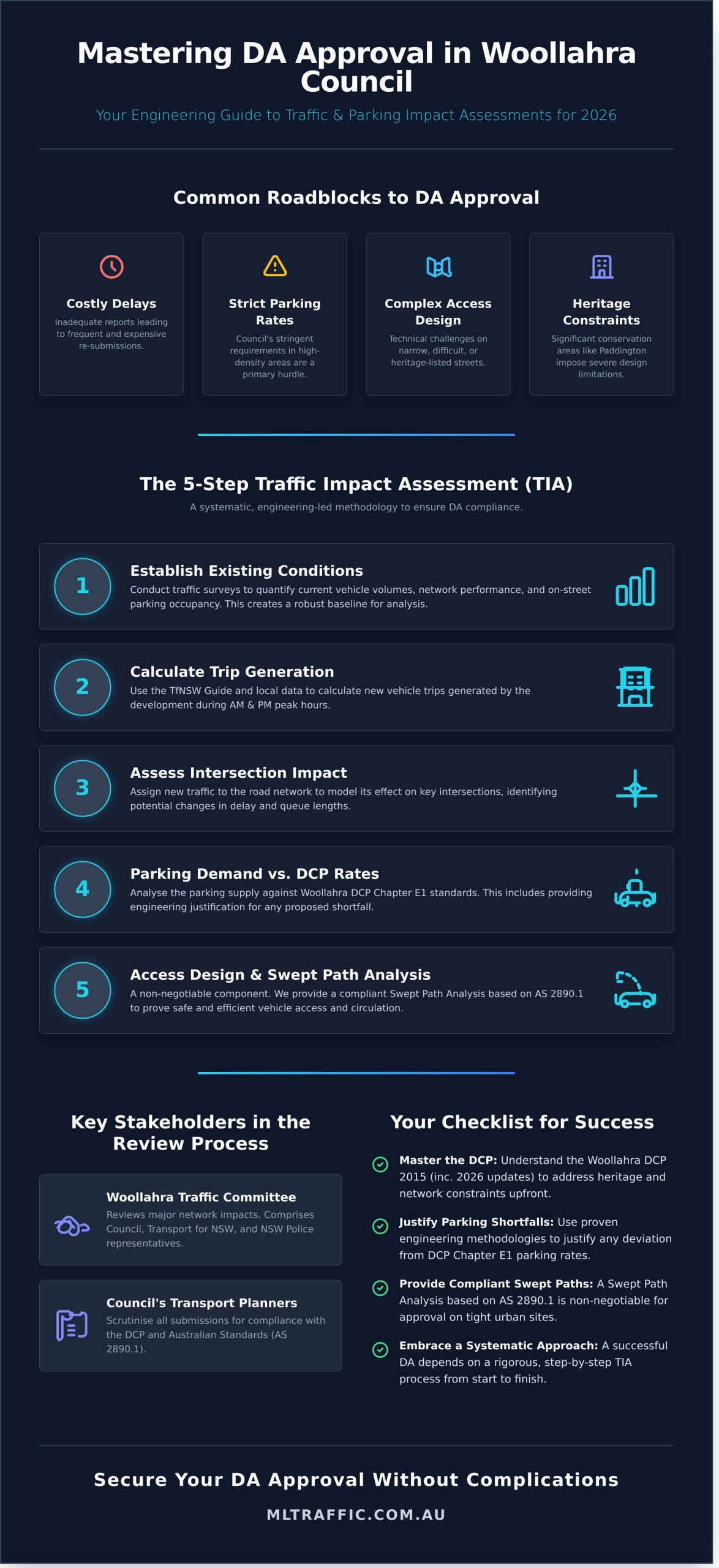
When undertaking Traffic and Car Parking Impact Assessments in Woollahra Council, it is essential to understand the key stakeholders involved in the review process. For major developments, the Woollahra Traffic Committee-comprising representatives from Council, Transport for NSW, and NSW Police-reviews significant network impacts. Internally, Council’s transport planners scrutinise all submissions for compliance with the DCP and Australian Standards (AS 2890.1). For complex sites, a pre-DA consultation with Council’s planners is a valuable step to identify and resolve critical traffic and access issues before formal submission.
Components of a Traffic Impact Assessment (TIA) for Woollahra DAs
A Traffic Impact Assessment (TIA) is a mandatory technical report for many Development Applications (DAs) within the Woollahra LGA. It provides Council with a detailed analysis of a development’s effect on the local road network. The process of undertaking Traffic and Car Parking Impact Assessments in Woollahra Council is a structured, five-step methodology designed to ensure any new development integrates safely and efficiently with existing infrastructure.
A comprehensive TIA systematically addresses the following core components:
-
Step 1: Establishing Existing Conditions: We begin by conducting traffic surveys to quantify current vehicle volumes, network performance, and on-street parking occupancy. This establishes a robust baseline against which the development’s impact is measured.
-
Step 2: Calculating Trip Generation: Using the Transport for NSW (TfNSW) Guide to Traffic Generating Developments and localised survey data, we calculate the number of new vehicle trips the proposed land use will generate during weekday AM and PM peak hours.
-
Step 3: Assessing Intersection Impact: The new traffic is assigned to the road network to model its effect on key intersections, particularly critical arterials like New South Head Road. This analysis identifies potential changes in delay and queue lengths.
-
Step 4: Evaluating Site Access and Safety: This step involves a detailed review of proposed driveways, sight lines, and internal circulation to ensure compliance with Australian Standards (AS 2890.1). Pedestrian amenity and safety are critical considerations.
-
Step 5: Proposing Mitigation Measures: If the assessment identifies adverse impacts, we propose practical mitigation measures. These can range from optimising signal timings to recommending infrastructure upgrades, which are then reviewed by bodies such as the Woollahra Traffic Committee for approval.
Trip Generation and Traffic Modeling
Accurate modeling is crucial for a successful DA. We utilise industry-standard SIDRA Intersection software to model intersection performance and demonstrate the "before and after" scenarios to Woollahra Council. While TfNSW Guide rates provide a starting point, we often supplement this with local traffic surveys to reflect the unique trip generation characteristics of commercial hubs like Double Bay, ensuring a more precise and defensible assessment.
Safety and Sight Distance Assessments
Safety is a non-negotiable element of any DA. Our assessments rigorously verify that all access driveways meet or exceed the required Stopping Sight Distance (SISD) as per Austroads guidelines, ensuring drivers have adequate visibility to avoid collisions. We pay particular attention to pedestrian safety in high-footfall areas, such as those near Woollahra public schools, and identify potential conflict points between vehicles, cyclists, and pedestrians.
Calculating Parking Demand vs. Woollahra DCP Chapter E1 Standards
A core component of undertaking Traffic and Car Parking Impact Assessments in Woollahra Council involves a detailed analysis of the parking requirements outlined in Chapter E1 of the Woollahra Development Control Plan (DCP). While these standards provide a baseline, a successful development application often requires a nuanced justification for either compliance or a well-reasoned variation from these rates.
Residential Parking Requirements
The DCP stipulates minimum parking rates for residential developments, which are critical for site feasibility. These rates are generally calculated as follows:
-
Studio dwelling: 0.6 spaces per dwelling
-
1-bedroom dwelling: 1 space per dwelling
-
2-bedroom dwelling: 1.2 spaces per dwelling
-
3+ bedroom dwelling: 1.5 spaces per dwelling
-
Visitor parking: 1 space per 5 dwellings
Visitor parking must be clearly designated and accessible, impacting the overall site layout. Council may consider a reduction in these rates where a dedicated car-share space is provided, acknowledging alternative transport options.
Commercial and Retail Parking Demand
For commercial premises, such as boutique retail or cafes in areas like Rose Bay, parking demand is calculated based on Gross Floor Area (GFA). A ‘Change of Use’ application-for instance, a shop converting to a restaurant-can trigger a requirement for additional parking. If providing new spaces is unfeasible, a traffic engineering report must demonstrate that the change will not create adverse on-street parking impacts. All developments must also assess loading dock requirements against Australian Standard AS 2890.2 to ensure service vehicles can operate safely and efficiently without disrupting traffic.
The ‘Parking Shortfall’ Dilemma
Proposing fewer parking spaces than the DCP requires is a common challenge. Justification for a parking shortfall relies on robust evidence. For developments near major transport hubs like Edgecliff Station, a detailed assessment can demonstrate lower car ownership and usage rates among residents and patrons, justifying a significant reduction. Furthermore, the ‘Parking Credit’ system allows developers to offset parking demand by acknowledging the existing, approved use of a site. An expert traffic assessment quantifies this credit and integrates it into a comprehensive argument for a reduced parking provision, ensuring Council has the technical basis required for approval.
Mastering Access Design: Swept Path Analysis and Driveway Compliance
A successful Development Application in Woollahra depends on meticulous access design. Given the area’s narrow streets, steep topography, and constrained sites, proving that vehicles can safely enter and exit a property is non-negotiable. It is a fundamental part of Undertaking Traffic and Car Parking Impact Assessments in Woollahra Council, where flawed access design is a primary reason for Council rejection or costly Requests for Information (RFIs).
All access designs must adhere to Australian Standard AS 2890.1 (Off-street car parking). However, applying this standard to Woollahra’s unique environment requires specialised expertise. The assessment must also account for larger service vehicles, including Council’s waste collection trucks and emergency vehicles, to ensure they can access the site as functionally required.
The Technicality of Swept Paths
Swept path analysis uses industry-standard software like AutoTURN to simulate the precise path of a vehicle’s body during manoeuvres. For Woollahra submissions, this involves demonstrating compliance for B85 (medium car) and B99 (large car) design vehicles. Common errors that lead to Council delays include:
-
Failing to show adequate clearance to walls, columns, or other vehicles.
-
Using incorrect or unrealistic entry and exit paths.
-
Not maintaining the required 300mm clearance in critical areas like ramps and tight corners.
Driveway and Ramp Design
Preventing vehicle scraping is a major concern on Woollahra’s steep hills. Driveway ramp grades and transitions must be expertly designed to manage the change in gradient between the private driveway, the public footpath, and the road. This involves assessing approach, departure, and ramp-over angles to ensure vehicles do not bottom out. Expert analysis is essential for Undertaking Traffic and Car Parking Impact Assessments in Woollahra Council that satisfy these strict geometric requirements. For certification of these technical designs, our expert services provide the necessary reports and drawings to ensure a compliant outcome for your development.
Securing DA Approval with ML Traffic Engineers
Navigating the Development Application (DA) process requires more than just technical data; it demands specialist expertise and a proven track record. At ML Traffic Engineers Pty Ltd, we provide direct, principal-led consultancy to ensure your project meets all council requirements. Our core promise is simple: the consultant who quotes the work, does the work. This guarantees accountability and access to senior expertise from start to finish.
With over 15 years of experience negotiating with Sydney councils, our team has a deep, practical understanding of local planning controls. We specialise in translating complex traffic modelling and parking data into clear, compliant reports that directly address the specific concerns of Council planners. This proactive approach is critical when undertaking Traffic and Car Parking Impact Assessments in Woollahra Council, as it minimises ambiguity and streamlines the response to any post-submission requests for information (RFIs), saving you time and money.
Our Process for Woollahra Projects
Our methodology is structured to maximise the probability of a successful DA outcome. Every project is managed directly by one of our principals, Michael Lee or Benny Chen, and follows a clear, effective process:
-
Initial Assessment: We begin with a thorough site inspection and data collection phase to understand the unique constraints and opportunities of your Woollahra property.
-
Direct Principal Involvement: Your project is not delegated to junior staff. A senior engineer manages the technical analysis and reporting, ensuring the highest standard of work.
-
Strategic Report Drafting: The Traffic and Parking Impact Assessment is meticulously drafted and refined to be robust, defensible, and aligned with Woollahra Council’s DCP and LEP requirements.
Beyond the DA: Construction Traffic Management (CTMP)
Once your DA is approved, the next critical step is preparing a Construction Traffic Management Plan (CTMP). This document is essential for managing site logistics and minimising disruption to the community. We are highly experienced in developing practical CTMPs that address the specific challenges of Woollahra’s narrow residential streets and heritage conservation areas, ensuring safe and efficient construction vehicle access and movement. For a comprehensive service that covers your project from initial assessment to final construction, contact our Sydney office for a project-specific quote.
Secure Your Woollahra DA with an Expert Traffic Assessment
Successfully undertaking Traffic and Car Parking Impact Assessments in Woollahra Council requires a meticulous and compliant approach. From correctly calculating parking demand against the DCP Chapter E1 standards to verifying access design with precise swept path analysis, a robust report is fundamental to a successful Development Application.
ML Traffic Engineers provides the specialist expertise your project demands. Our principal engineers offer 30-40 years of direct experience and have assessed over 10,000 sites nationwide. We deliver the authoritative traffic engineering reports required to satisfy Council, ensuring you have direct access to the senior consultant managing your project from quote to completion.
Avoid unnecessary delays and position your development for a smooth approval process. Get a Traffic Assessment Quote for Your Woollahra Project and let our proven experience clear the path forward.
Frequently Asked Questions: Woollahra Traffic & Parking Assessments
When is a Traffic Impact Assessment required by Woollahra Council?
Woollahra Council typically requires a Traffic Impact Assessment (TIA) when a development is likely to generate significant traffic movements. This is often triggered by specific thresholds in their Development Control Plan (DCP), such as developments proposing more than 10 residential dwellings, a substantial increase in Gross Floor Area (GFA) for commercial sites, or for specific land uses like childcare centres or medical facilities. The assessment is necessary to quantify the impact on the local road network’s safety and efficiency.
Can I get a parking waiver for a heritage site in Woollahra?
Obtaining a parking waiver for a heritage-listed site in Woollahra is possible but requires a comprehensive justification. Council acknowledges the physical constraints that heritage buildings often present. A successful application relies on a detailed Car Parking Demand Assessment that demonstrates lower parking generation rates, availability of on-street parking, or excellent access to public transport. The report must prove that the parking shortfall will not adversely impact local amenity or on-street parking availability for residents.
What is the difference between a Traffic Impact Statement and a TIA?
A Traffic Impact Statement (TIS) is required for smaller-scale developments with minor traffic implications. It provides a concise overview of the site, proposed parking, and basic traffic generation. A Traffic Impact Assessment (TIA) is a more comprehensive report for larger developments with significant traffic impacts. A TIA involves detailed analysis, including traffic surveys, intersection modelling (e.g., SIDRA), and a thorough assessment of the road network’s capacity and safety, which is a more complex undertaking.
How much does a traffic engineering report cost for a Woollahra DA?
The cost of a traffic engineering report for a Development Application (DA) in Woollahra varies with the project’s scale. A basic Traffic Impact Statement (TIS) for a minor development, such as a dual occupancy or small commercial change of use, typically starts from A$2,000 to A$3,500. A more detailed Traffic Impact Assessment (TIA) for a multi-unit residential or mixed-use development will cost significantly more, often ranging from A$5,000 to A$15,000+ depending on the need for traffic surveys and intersection modelling.
How long does it take to get a Construction Traffic Management Plan (CTMP) approved?
The approval time for a Construction Traffic Management Plan (CTMP) by Woollahra Council depends on the project’s complexity and Council’s assessment workload. After submission, a standard review period is typically 4 to 6 weeks. However, this can be extended if the CTMP is complex, involves road closures, or if Council requests further information or revisions. Engaging an experienced traffic consultant to prepare a thorough and compliant CTMP is critical to minimising delays in the approval process.
What vehicle sizes are used for Swept Path Analysis in residential DAs?
For residential DAs in Woollahra, Swept Path Analysis is conducted in accordance with Australian Standard AS 2890.1:2004. The standard design vehicle for passenger cars is the B85 vehicle, with the B99 vehicle often assessed for larger or less constrained layouts. Additionally, Council will require an assessment for the site’s waste collection vehicle, which is typically a Small Rigid Vehicle (SRV) with a length of 8.8 metres, to ensure it can safely access and egress the site without issue.
Does Woollahra Council allow car stackers to meet parking requirements?
Yes, Woollahra Council does permit the use of car stackers to meet parking requirements, but under strict conditions outlined in their DCP. Stackers must not be visible from the public domain, should be located within a secure basement or garage, and are generally not permitted for visitor parking spaces. The design must demonstrate adequate queuing space, safe vertical clearances, and ensure that the operational characteristics do not cause delays or conflicts for users or pedestrians accessing the site.
What happens if my development increases traffic on New South Head Road?
Any development proposing to increase traffic on a state-classified road like New South Head Road will face significant scrutiny from both Woollahra Council and Transport for NSW (TfNSW). Undertaking Traffic and Car Parking Impact Assessments in Woollahra Council for such sites requires a detailed TIA. This report must analyse the performance of key intersections, assess impacts on road safety and public transport, and may require SIDRA intersection modelling to prove the development’s impact is manageable and acceptable.
