

We are traffic engineers servicing Cocoroc, Eynesbury, Hoppers Crossing, Laverton, Laverton North, Little River, Mambourin, Manor Lakes, Mount Cottrell, Point Cook, Quandong, Tarneit, Truganina, Werribee, Werribee South, Williams Landing, Wyndham Vale.
A Development Application (DA) rejection from Wyndham City Council due to an inadequate traffic report is a significant and avoidable setback, costing developers both time and money. The uncertainty surrounding local requirements and the technical jargon of the planning scheme often leads to costly revisions. Successfully undertaking traffic and car parking impact assessments in Wyndham Council is not just a procedural step; it is a critical component for project approval.
This definitive guide provides a direct, step-by-step framework to remove that uncertainty. We detail the precise requirements for preparing a traffic and car parking impact assessment that satisfies Wyndham City Council’s standards for a successful DA. You will gain a clear checklist of essential report inclusions, understand the key assessment criteria used by Council planners, and be positioned to achieve a smooth and timely approval. The following information is designed to ensure your submission is correct the first time, safeguarding your project timeline and budget.
Key Takeaways
-
Understand Wyndham Council’s core objectives for managing growth and congestion to ensure your report directly addresses planners’ primary concerns.
-
A compliant Traffic Impact Assessment (TIA) must extend beyond simple traffic counts to include a detailed analysis of network performance and road safety.
-
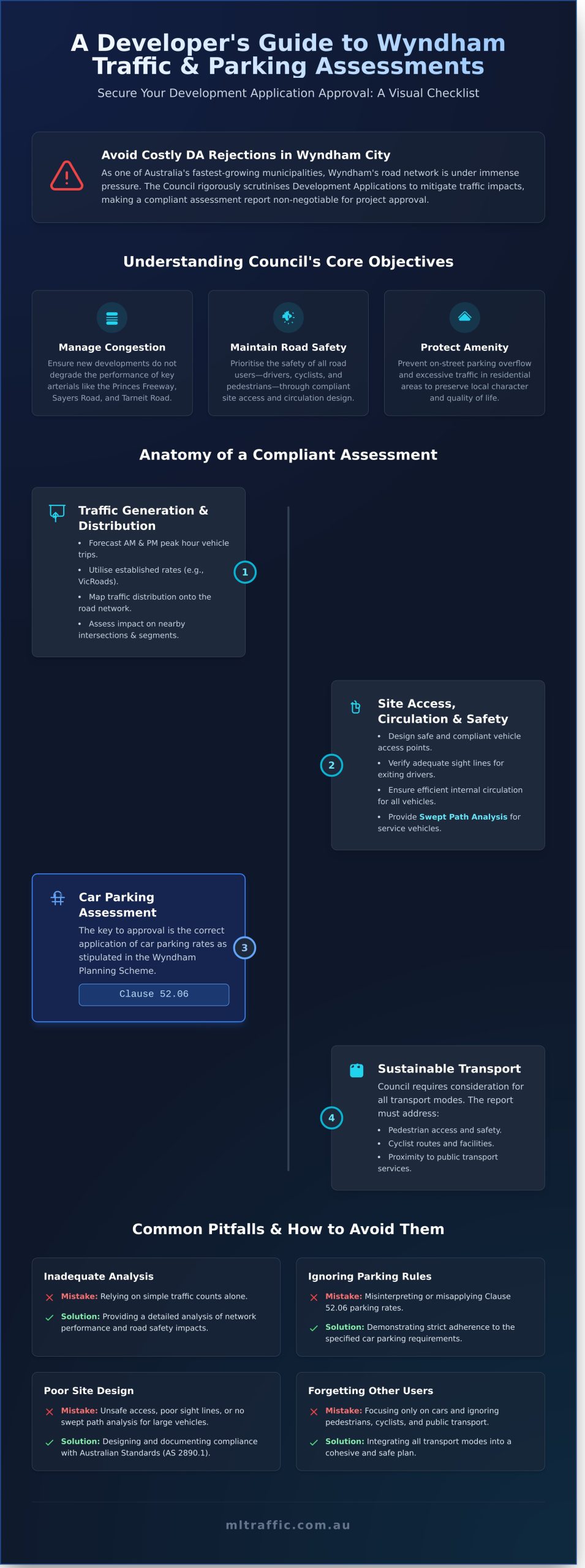
The key to successfully undertaking Traffic and Car Parking Impact Assessments in Wyndham Council is the correct application of car parking rates as stipulated in Clause 52.06.
-
Identify the common, avoidable pitfalls that frequently delay Development Applications to ensure a more efficient and cost-effective approval process.
Table of Contents
-
Core Components of a Wyndham-Compliant Traffic Impact Assessment (TIA)
-
Common Pitfalls & How to Ensure a Smooth Approval in Wyndham
Why Wyndham Council Scrutinises Traffic & Parking Reports
Wyndham City is one of Australia’s fastest-growing municipalities, a status that brings both opportunity and significant infrastructure challenges. This rapid population growth places immense pressure on the existing road network. Consequently, Wyndham Council rigorously examines any application, making the process of undertaking Traffic and Car Parking Impact Assessments in Wyndham Council a critical step for developers. The core objectives are clear: manage traffic congestion, maintain road safety for all users, and protect the amenity of residential areas from excessive traffic and on-street parking overflow.
To understand the fundamentals of this process, the following video provides a clear overview of what a Traffic Impact Assessment involves.
Understanding the Local Traffic Environment
The local traffic environment in Wyndham is complex, dominated by major arterials such as the Princes Freeway, Sayers Road, and Tarneit Road. These networks are already operating under significant strain, particularly during peak periods. Council’s assessment of a development application will differ based on its location; a project in a new growth corridor has different infrastructure considerations than one in an established suburb with a fixed road layout. Furthermore, Council places a strong emphasis on promoting sustainable transport, requiring developers to consider access for pedestrians, cyclists, and public transport users.
The Role of the Wyndham Planning Scheme
The Wyndham Planning Scheme is the statutory document that governs land use and development. It provides the framework for all traffic and parking requirements. Key provisions, most notably Clause 52.06 for car parking, dictate when a formal assessment is required and the standards that must be met. The principles of What is Traffic Engineering? are applied to determine a development’s impact on traffic flow and safety. A successful application requires a detailed report that not only satisfies these specific clauses but also aligns with the broader strategic objectives for integrated transport and land use planning outlined in the scheme.
Core Components of a Wyndham-Compliant Traffic Impact Assessment (TIA)
A Traffic Impact Assessment (TIA) submitted to Wyndham Council is far more than a simple traffic count. It is a comprehensive engineering analysis designed to demonstrate that a proposed development will not adversely affect the safety, efficiency, and amenity of the local transport network. When undertaking Traffic and Car Parking Impact Assessments in Wyndham Council, every component must be substantiated with clear data, transparent methodology, and sound engineering principles to satisfy planner requirements.
Traffic Generation & Distribution Analysis
The foundation of any TIA is an accurate forecast of the vehicle trips a development will generate. We utilise established rates from authorities like VicRoads to project traffic volumes for AM and PM peak hours. This analysis includes mapping the likely distribution of this new traffic onto the surrounding road network. The objective is to assess the specific impact on nearby intersections and road segments, demonstrating that the existing infrastructure can accommodate the additional load without unacceptable degradation in performance. The methodologies for this are well-established, drawing upon industry best practices and specific guidelines from authorities like the Victorian Department of Transport and Planning (DTP).
Site Access, Circulation, and Safety
This component focuses on the interface between the development and the public road network, as well as on-site functionality. Wyndham planners require detailed evidence that the design is both safe and compliant with Australian Standards (such as AS 2890.1). Key elements include:
-
Vehicle Access Points: Designing driveways with appropriate width, grade, and location to ensure safe entry and exit.
-
Sight Lines: Verifying that drivers exiting the site have adequate visibility of oncoming traffic, pedestrians, and cyclists.
-
Internal Circulation: Ensuring vehicles, including service and delivery trucks, can manoeuvre efficiently and safely within the car park and loading areas.
-
Swept Path Analysis: Providing diagrams to prove that the largest expected vehicle (e.g., a waste collection truck) can navigate the site without conflict.
Assessment of External Road Network Impacts
Beyond the site’s boundaries, the TIA must quantify the development’s effect on the broader transport system. This involves analysing potential queuing and delays at key local intersections, often using specialised traffic modelling software. The assessment identifies if any upgrades-such as new traffic signals, turning lanes, or pedestrian crossings-are necessary to mitigate the development’s impact. A critical part of undertaking Traffic and Car Parking Impact Assessments in Wyndham Council is also considering the effects on all road users, including pedestrians, cyclists, and access to public transport services.
Navigating Car Parking Assessments: Key Metrics for Wyndham
Car parking provision is one of the most frequent points of contention in Development Applications submitted to Wyndham City Council. A report that fails to adequately justify the proposed number of car parking spaces can lead directly to a Request for Further Information (RFI) or an outright rejection, causing significant delays and costs. Your Traffic and Parking Assessment must provide a robust, evidence-based justification for the parking strategy.
A successful application demonstrates a thorough understanding of Council’s specific requirements and the potential impacts on the surrounding area. The objective is to prove that the proposed development is adequately serviced by on-site parking without negatively affecting local street networks or neighbourhood amenity.
Calculating Parking Demand using Clause 52.06
The foundation of any car parking assessment in Wyndham is Clause 52.06 of the Wyndham Planning Scheme. The process involves identifying the correct land use category for your development and applying the statutory parking rates specified. When undertaking traffic and car parking impact assessments in Wyndham Council, any proposed reduction from these standard rates must be rigorously justified. For unique land uses not covered by the scheme, a first-principles analysis based on empirical data or comparable sites is required to establish a credible parking demand.
Car Park Design and Layout Compliance
Beyond simply providing the right number of spaces, the design and layout of the car park must be compliant and functional. All parking spaces, access aisles, and circulation roadways must meet the stringent requirements of Australian Standards, primarily AS 2890.1 for off-street parking and AS 2890.6 for accessible spaces. The design must also ensure safe and efficient pedestrian movement within the car park. Our full range of traffic engineering services includes detailed car park design and compliance reviews.
Addressing Parking Spillover and Amenity
Wyndham Council will closely scrutinise the potential for parking spillover, where vehicles associated with your development park on surrounding residential streets. Your assessment must analyse this risk and outline clear strategies to manage on-site parking effectively. This can be achieved through a detailed Car Parking Management Plan (CPMP) that outlines operational rules, signage, and enforcement measures to discourage off-site impacts and preserve local amenity, strengthening the overall merit of your application.
The Step-by-Step Process for Your Wyndham DA Submission
A successful Development Application (DA) hinges on a methodical and compliant approach. Following a structured process ensures your Traffic and Car Parking Impact Assessment is comprehensive, addressing all council requirements from the outset. This timeline outlines the critical stages from project inception to final submission. Engaging an experienced traffic consultant early is the most effective strategy for minimising council queries, preventing delays, and accelerating the approval timeline for your Wyndham project.
Stage 1: Pre-Application & Feasibility
The initial phase is critical for establishing a viable project framework. Proactive engagement at this stage identifies and mitigates potential issues before they become costly problems in later design stages. Key actions include:
-
Engage a Traffic Engineer: Obtain a professional site review and initial advice on traffic generation, parking requirements, and vehicle access in accordance with Australian Standards (AS 2890.1).
-
Identify Potential Challenges: Assess site constraints, driveway sight lines, swept paths for design vehicles, and potential impacts on the surrounding road network.
-
Pre-Application Meeting: A meeting with Wyndham Council’s planning and traffic departments can clarify specific requirements and expectations for your development type, saving significant time.
Stage 2: Data Collection and Analysis
With a feasible concept established, the next stage involves rigorous data collection to form the technical basis of the report. This empirical data ensures all assessments are accurate and defensible. The process of undertaking Traffic and Car Parking Impact Assessments in Wyndham Council demands precise inputs, including:
-
Traffic Surveys: Conducting traffic volume and vehicle speed surveys on adjacent roads to establish baseline conditions.
-
Site Data Collation: Gathering essential information on local road geometry, existing traffic controls (like signs and line marking), and proximity to public transport services.
-
Demand Calculations: Using the final architectural plans to calculate the precise traffic generation and car parking demand based on relevant council rates and the nature of the proposed land use.
Stage 3: Report Preparation and Submission
The final stage consolidates all analysis into a formal report ready for council assessment. A professionally prepared document demonstrates due diligence and directly addresses all relevant planning scheme clauses and checklists. This ensures a smoother assessment process for your development.
This involves drafting the full Traffic and Car Parking Impact Assessment report, meticulously checking that all Wyndham Council requirements are met, and submitting the final report as a key component of your complete DA package.
Ready to begin the process for your Wyndham development? Contact our expert team for a quote.
Common Pitfalls & How to Ensure a Smooth Approval in Wyndham
Many development applications in Wyndham are delayed or rejected due to common, avoidable traffic and parking issues. These oversights can result in significant costs and lengthy revisions. A proactive design approach, supported by a comprehensive and technically sound traffic report, is the most effective strategy to mitigate these risks. Understanding council’s specific concerns from the outset is critical for a streamlined approval process.
Underestimating Parking Demand
A frequent error is relying solely on the minimum parking rates specified in the Wyndham Planning Scheme without considering the site’s unique local context. This can lead to a shortfall, particularly when failing to account for staff parking needs in commercial or industrial developments. If a parking reduction is sought, it must be supported by a robust, evidence-based justification that demonstrates why the proposed supply is sufficient for the development’s operational needs.
Poor Site Access and Circulation Design
Deficiencies in site layout are a primary cause for council requests for further information (RFIs). Key issues that must be addressed to comply with Australian Standards (AS 2890.1) include:
-
Non-compliant access: Driveway grades that are too steep or widths that are insufficient for safe two-way vehicle movement.
-
Inadequate swept paths: Failure to demonstrate that the largest design vehicle, such as a council waste collection truck, can safely enter, manoeuvre within, and exit the site in a forward direction.
-
Pedestrian safety: Overlooking the need for clear sight lines and safe passage for pedestrians at all vehicle crossing points.
Insufficient Data or Analysis
A generic report lacking specific local detail will not meet council’s standards. Successful outcomes when undertaking Traffic and Car Parking Impact Assessments in Wyndham Council depend on rigorous, tailored analysis. Common failings include using outdated traffic survey data that doesn’t reflect current road conditions or failing to assess the cumulative traffic impact of other approved developments in the vicinity. For examples of the detailed analysis required, review our past projects and articles.
Navigating these complexities requires specialist expertise. An experienced traffic engineering consultant with a deep understanding of Wyndham’s specific requirements can anticipate and address potential council concerns before they become problems. This local knowledge is invaluable when undertaking Traffic and Car Parking Impact Assessments in Wyndham Council, ensuring your report is robust and your project proceeds without unnecessary delays. Contact ML Traffic Engineers Pty Ltd to ensure your development application is built on a solid foundation.
Partner with Experts for a Compliant Wyndham Submission
Successfully undertaking Traffic and Car Parking Impact Assessments in Wyndham Council demands a precise understanding of the Council’s specific expectations and a meticulous approach to data analysis. Key to a smooth approval is a comprehensive report that accurately details traffic generation, satisfies local car parking metrics, and proactively addresses potential objections before they become delays.
Navigating these complexities is our specialty. ML Traffic Engineers brings over 15 years of direct experience with Victorian councils and a proven track record in securing DA approvals across Melbourne. When you partner with us, you gain direct access to senior traffic engineers who will manage your assessment from start to finish, ensuring your submission is robust, compliant, and positioned for success.
Remove the guesswork from your development application. Get a professional quote for your Wyndham project today. Let our expertise pave the way for your approval.
Frequently Asked Questions
When is a Traffic and Parking Impact Assessment mandatory for a DA in Wyndham?
A Traffic and Parking Impact Assessment is mandatory when a development is likely to generate significant traffic or has a shortfall in statutory car parking. In Wyndham, this typically includes applications for multi-dwelling residential buildings, childcare centres, medical facilities, commercial or retail premises, and industrial uses. The specific triggers are detailed within the Wyndham Planning Scheme. If your proposal involves a change of use or an intensification that impacts traffic flow, an assessment will be required.
How much does a Traffic Impact Assessment report typically cost for a project in Wyndham?
The cost of a Traffic Impact Assessment report in Wyndham is determined by the project’s scale and complexity. A straightforward report for a small-scale development typically costs between A$2,500 and A$4,000. For larger projects requiring extensive on-site traffic surveys, detailed intersection modelling, and analysis, the fee can range from A$5,000 to over A$10,000. We provide a fixed-fee proposal outlining all costs before commencing any work, ensuring complete transparency for our clients.
Can I request a reduction in the number of required car parking spaces from Wyndham Council?
Yes, a reduction in the statutory car parking rates stipulated by the Wyndham Planning Scheme can be requested. This request must be supported by a comprehensive Car Parking Demand Assessment prepared by a qualified traffic engineer. The report must provide a robust, evidence-based justification for the proposed shortfall, referencing factors such as high public transport accessibility, shared parking opportunities, or the specific operational nature of the proposed land use. Council will review this justification on its merits.
What are the key Australian Standards I need to comply with for car park design?
Compliance with Australian Standards is critical for gaining approval for any car park design. The principal standard is the AS/NZS 2890 series. Key documents include AS/NZS 2890.1:2004 for off-street car parking, which dictates the geometric design of parking spaces, aisles, and ramps. Furthermore, AS/NZS 2890.6:2009 specifies the requirements for parking facilities for people with disabilities. Adherence to these standards is a fundamental component of our assessment process to ensure full compliance.
How long does it take to prepare a traffic report for a Wyndham Council submission?
The preparation timeframe for a traffic report is contingent on its required scope. A standard Traffic Impact Statement (TIS) for a less complex development can generally be completed within one to two weeks. A comprehensive Traffic Impact Assessment (TIA) for a major project, which may require new traffic surveys and detailed modelling, typically requires three to four weeks. We always provide a clear project timeline in our initial proposal to manage client expectations effectively.
What is the difference between a Traffic Impact Statement (TIS) and a full Traffic Impact Assessment (TIA)?
The difference lies in the project’s scale and potential traffic impact. A Traffic Impact Statement (TIS) is a concise report suitable for smaller developments with minimal impact, focusing on site access, parking, and basic traffic generation. A full Traffic Impact Assessment (TIA) is a detailed and comprehensive study for larger projects. Undertaking Traffic and Car Parking Impact Assessments in Wyndham Council at the TIA level involves extensive data collection, traffic modelling, and analysis of the wider road network.
