

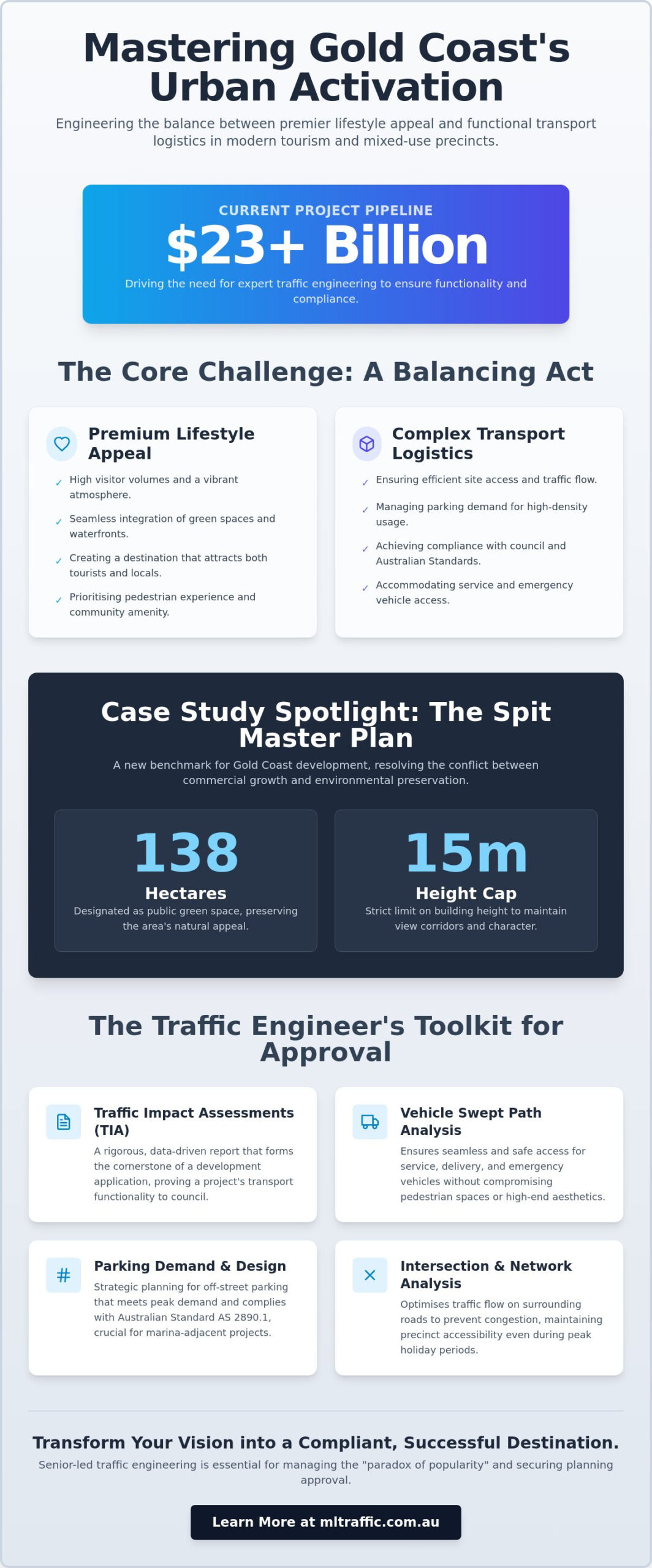
With a pipeline of major projects exceeding $23 billion currently underway across the Gold Coast, the challenge for developers isn’t just creating a vision; it’s ensuring that vision remains functional, accessible, and compliant. You recognise that the commercial success of a mixed-use precinct depends on its ability to handle high visitor volumes without sacrificing the premium atmosphere that draws people in. Achieving the necessary balance for Urban Activation and Tourism Precincts Lifestyle Appeal The Spit Master Plan, The Isles, Mantaray Marina, Broadwater Improvements requires precise traffic engineering that aligns with strict council expectations and Australian Standards for parking and access.
Navigating the complex approval processes for such significant developments often involves managing competing priorities between transport logistics and lifestyle design. This article explains how expert master planning and rigorous traffic impact assessments transform ambitious concepts into viable, compliant destinations. We will detail the specific strategies used to manage parking demand, vehicle swept paths, and intersection analysis to ensure your project secures planning approval. By the end, you will understand how to integrate transport functionality with high-end lifestyle appeal to deliver a seamless experience within the Gold Coast’s rapidly evolving urban landscape.
Key Takeaways
- Understand how urban activation transforms underutilised land into multi-use economic hubs by prioritising lifestyle appeal alongside functional transport logistics.
- Learn how to navigate the technical requirements for Urban Activation and Tourism Precincts Lifestyle Appeal The Spit Master Plan, The Isles, Mantaray Marina, Broadwater Improvements through rigorous Traffic Impact Assessments.
- Discover how Vehicle Swept Path Analysis ensures seamless service access without compromising the pedestrian experience in high-density tourism zones.
- Identify the critical regulatory standards, including AS 2890.1 for off-street car parking, necessary to secure planning approval for marina-adjacent developments.
- Gain insights into why senior-led traffic engineering is essential for managing the “paradox of popularity” and maintaining long-term precinct accessibility.
The Evolution of Urban Activation and Tourism Precincts in Australia
Urban activation is the strategic process of transforming underutilised land into high-functioning, multi-use hubs that generate both social value and economic returns. In the current Australian development climate, this process has evolved beyond simple land-use changes. Modern precincts now prioritise “Lifestyle Appeal” as the core driver for investment and visitation. This shift is clearly demonstrated in the ongoing revitalisation of the Southport Spit, where the focus has moved from isolated commercial sites to an integrated community and tourism ecosystem. Successful projects require a precise balance between high-end aesthetics and rigorous technical functionality.
Transport connectivity serves as the backbone of any viable precinct master plan. Without a data-driven approach to traffic flow and site access, the lifestyle benefits of a development are quickly undermined by congestion and poor accessibility. Expert traffic engineering ensures that Urban Activation and Tourism Precincts Lifestyle Appeal The Spit Master Plan, The Isles, Mantaray Marina, Broadwater Improvements remain accessible to both locals and tourists while maintaining the premium atmosphere intended by the designers. Effective planning allows for high-density usage without compromising the user experience.
Key Drivers of Modern Tourism Precinct Design
Modern precinct design relies on the seamless integration of open green spaces with commercial and residential offerings. Developers are no longer building standalone attractions; they’re creating environments where people can live, work, and recreate in a single, connected zone. The preservation of 138 hectares of green space within The Spit Master Plan exemplifies this trend. Accessible maritime infrastructure and “waterfront experiences” are also critical, particularly for projects like the Mantaray Marina, which position the Gold Coast as a premier superyacht destination. Balancing the needs of a seasonal tourist influx with the amenity requirements of permanent residents is a technical challenge that necessitates sophisticated traffic engineering services to manage mixed-use demands.
The Engineering Behind the Appeal
The visual appeal of a precinct is often the result of invisible engineering. Traffic flow data informs the strategic placement of community facilities, ensuring that high-traffic areas don’t clash with quiet residential pockets. Infrastructure improvements must also support active transport, such as dedicated cycling and walking paths, to reduce vehicle dependency within the precinct. By using detailed intersection analysis and car parking demand assessments, engineers create pedestrian-friendly environments that still accommodate necessary vehicle access for residents, visitors, and service providers. This technical foundation is what allows lifestyle-driven precincts to function at peak capacity without failing during peak holiday periods.
Navigating Technical Requirements: The Spit Master Plan and National Frameworks
The Spit Master Plan represents a significant shift in how regional authorities manage the tension between growth and preservation. Historically, Gold Coast development conflicts have often pitted commercial interests against environmental protection. This plan resolves that conflict by imposing strict 15-metre height caps and designating 138 hectares for public green space. For developers, these constraints mean that every square metre of land must be optimised. Success in these environments relies on the seamless integration of Urban Activation and Tourism Precincts Lifestyle Appeal The Spit Master Plan, The Isles, Mantaray Marina, Broadwater Improvements. Ensuring that a project meets these benchmarks requires a comprehensive Traffic Impact Assessment (TIA) to validate that the proposed density won’t overwhelm existing transport corridors.
Master plans do more than just limit building heights; they dictate land use and define critical transport corridors that must remain functional as the city grows. With the Gold Coast’s population expected to exceed one million by 2046, the intersection of state-led infrastructure and private development obligations has never been more critical. Developers are often required to contribute to external infrastructure upgrades that support the broader precinct’s viability. This ensures that the high-level vision of a vibrant tourism hub is supported by a robust, compliant transport network.
Transport Infrastructure Obligations for Developers
Developments within these precincts are typically categorised as either “Code Assessable” or “Impact Assessable” under the City Plan. Code assessable projects must demonstrate strict adherence to pre-defined benchmarks, while impact assessable developments undergo more rigorous public scrutiny. Developers must allocate sufficient space for shared pathways and public transport interchanges to meet the master plan’s connectivity goals. The role of a traffic engineer is to interpret these complex overlays and ensure that the site layout satisfies both regulatory requirements and functional needs. If you’re planning a project in this region, consulting with a principal engineer early in the process ensures your design aligns with council expectations.
Case Study Frameworks: From The Isles to The Spit
Projects like “The Isles,” a $100 million mixed-use precinct at the southern gateway, demonstrate how project-specific guidelines dictate traffic demand. Construction on this site is targeted to begin in mid-2026, requiring a meticulous approach to integrating commercial site releases with existing community infrastructure. Similarly, the Mantaray Marina and Residences, scheduled to open in mid-2026, must manage superyacht logistics alongside residential traffic. Infrastructure upgrades, such as the Broadwater improvements to sewer and stormwater scheduled for late 2026, often overlap with private construction timelines. Engaging traffic expertise during the initial feasibility stage prevents costly design revisions by identifying potential access constraints before the architectural plans are finalised.
Lifestyle Appeal vs. Logistics: Managing High-Traffic Tourism Developments
Managing the “Paradox of Popularity” is the central challenge for modern urban developments. When a precinct succeeds, the resulting congestion can quickly erode the very lifestyle benefits that defined the project. Maintaining the delicate balance of Urban Activation and Tourism Precincts Lifestyle Appeal The Spit Master Plan, The Isles, Mantaray Marina, Broadwater Improvements requires more than just aesthetic design; it demands rigorous transport logistics. By addressing the common objection that development ruins an area’s quiet appeal, expert engineering proves that high visitor numbers and local amenity can coexist through smart spatial planning and technical validation.
A primary method for protecting the pedestrian experience is the application of Vehicle Swept Path Analysis. This assessment allows engineers to simulate the movement of large service vehicles, ensuring they don’t block thoroughfares or create safety hazards in shared zones. This technical foresight prevents the logistical “back-of-house” requirements, such as waste collection and freight deliveries, from spilling into the “front-of-house” lifestyle areas where visitors expect a seamless environment. Without this analysis, service vehicles often end up mounting kerbs or performing multi-point turns that endanger pedestrians and damage infrastructure.
Noise and Amenity Management
Buffer zones and acoustic engineering are essential in high-density tourism precincts to mitigate the impact of increased activity. Traffic calming measures prioritise pedestrian safety in vibrant zones while managing the environmental footprint of vehicle and vessel movements within the Broadwater. Strategies for managing “Joy-Flight” and air service impacts are also integrated into the broader plan to protect precinct amenity from noise pollution. These measures ensure that the activation of the area doesn’t come at the cost of the resident experience, maintaining a premium atmosphere even during peak periods.
Innovative Parking Solutions
Modern precincts are moving away from traditional car parks in favour of integrated transport hubs. The implementation of smart parking technology reduces the time visitors spend cruising for available spots, which significantly lowers local emissions and traffic frustration. In marina-adjacent developments, transport plans must also factor in fair and reasonable access for boat tenders and dinghies. This ensures the maritime lifestyle remains accessible to all users without creating congestion at the water’s edge. Our approach to car park design prioritises efficiency and compliance with Australian Standards to maximise site yield while ensuring user safety.
Ensuring Compliance for Mantaray Marina and Broadwater Improvements
Technical requirements for marina-adjacent projects are complex because they combine standard land-use traffic with specialised maritime logistics. Urban Activation and Tourism Precincts Lifestyle Appeal The Spit Master Plan, The Isles, Mantaray Marina, Broadwater Improvements succeed only when they adhere to stringent regulatory frameworks. For the Mantaray Marina project, scheduled to open in mid-2026, compliance involves managing superyacht provisioning alongside residential vehicle movements. Developers must ensure strict adherence to AS 2890.1 for all off-street car parking design to avoid council rejection and operational failure. Failure to meet these standards during the design phase often leads to expensive retrofitting or the loss of developable area.
Broadwater Improvements, including the Paradise Point boat ramp upgrade that commenced in April 2026, necessitate a deep understanding of trailer parking dynamics and vehicle manoeuvrability. Unlike standard commercial sites, these precincts must accommodate the increased turning radii of boat trailers and heavy service vehicles. Effective waste management planning is equally critical for high-turnover tourism and commercial sites. This planning ensures that collection vehicles can access the site without disrupting the public realm or violating safety standards, which is a key requirement for securing development approval in the Gold Coast’s sensitive coastal zones.
Maritime and Land-Based Access Integration
Designing for the unique swept paths of boat trailers requires precise modelling during the initial site layout phase. Waterfront promenades must also meet DDA (Disability Discrimination Act) standards to ensure equitable access for all visitors, which often impacts the available space for vehicle thoroughfares. Sight distance assessments are mandatory at busy marina entry points to prevent collisions between high-frequency tourist traffic and emerging service vehicles. These assessments must account for the specific geometry of the site and the expected speed of approaching traffic to ensure a safe environment for all users.
Car Parking Demand Assessments
Determining the correct parking provision requires a Car Parking Demand Assessment that distinguishes between short-term tourist visitors and permanent residents. Designing for peak demand during holiday seasons or major events is essential to prevent overflow into surrounding residential streets, which is a common point of contention during the council approval process. AS 2890.2 mandates specific compliance requirements for commercial loading docks, including minimum bay dimensions and clearance heights to accommodate heavy rigid vehicles (HRVs) and articulated vehicles. If your project involves complex maritime and land-based logistics, contact our principals directly to secure a compliant traffic solution that meets all national and local standards.
Securing Planning Approval with ML Traffic Engineers Australia
Securing planning approval for high-stakes developments like Urban Activation and Tourism Precincts Lifestyle Appeal The Spit Master Plan, The Isles, Mantaray Marina, Broadwater Improvements requires technical precision that satisfies both local planning schemes and national benchmarks. These complex mixed-use projects demand senior-led traffic engineering to navigate the specific bureaucratic hurdles of the Gold Coast City Council. With over 15 years of national experience, ML Traffic Engineers Australia provides the authoritative reporting necessary to validate your project’s feasibility. Our involvement ensures your development application is supported by robust data and compliant design from the initial submission.
Our comprehensive suite of services addresses every technical requirement of the planning process. We specialise in delivering Traffic Impact Assessment (TIA) Reports, Car Parking Demand Assessments, and Waste Management Plans that withstand rigorous scrutiny. By integrating these assessments early, we help developers avoid the delays associated with information requests from council. We ensure every aspect of your project, from intersection analysis to sight distance assessments, meets the safety and functionality benchmarks expected for high-profile tourism precincts.
Our Hands-On Approach to Your Project
We provide a unique continuity promise: the senior principal who initiates your project is the one who performs the technical work. This direct access to leadership eliminates the communication gaps common in larger, more impersonal firms. Our track record spans diverse land-use types, including high-density residential, commercial retail, and specialised maritime environments. We utilise industry-standard software like AutoTURN to produce precise Vehicle Swept Path Analysis and vehicle manoeuvring diagrams. This technical accuracy is vital for projects with constrained footprints or complex service vehicle requirements, ensuring every design element is functional and compliant.
Contact Us for Your Next Development
Meticulous technical reporting is the key to streamlining the development application (DA) process. We translate complex traffic data into clear, actionable reports that demonstrate your project’s viability to planning authorities. Whether you’re managing a new commercial site release or a major infrastructure upgrade, our team provides the dependability and results-oriented focus your project requires to move from concept to construction.
If you’re ready to start your next Urban Activation project, Contact ML Traffic Engineers Australia today to discuss your specific requirements with a principal engineer. You can also explore our full range of Traffic Engineering Services to see how we support major developments across Australia.
Achieving Seamless Urban Activation on the Gold Coast
Successful development in high-growth zones requires a technical foundation that supports ambitious lifestyle visions. You’ve seen how integrating transport logistics with Urban Activation and Tourism Precincts Lifestyle Appeal The Spit Master Plan, The Isles, Mantaray Marina, Broadwater Improvements ensures both visitor satisfaction and regulatory approval. Meticulous planning, from car park design to intersection analysis, prevents the logistical failures that often compromise premium destinations.
ML Traffic Engineers Australia brings over 15 years of national consultancy experience to every project. We provide direct access to senior principals, ensuring that your technical work is performed by the same expert who initiates the relationship. Our reports guarantee comprehensive compliance with AS 2890 standards to streamline your development application and protect your site’s long-term functionality. We eliminate the guesswork by delivering data-driven assessments that satisfy council requirements while maintaining the high-end appeal of your precinct.
Get Expert Traffic Engineering Support for Your Development
We look forward to helping you deliver a successful, compliant lifestyle destination that meets the Gold Coast’s evolving urban standards and community expectations.
Frequently Asked Questions
What is a Traffic Impact Assessment (TIA) and why is it required for tourism precincts?
A TIA is a technical report that evaluates the volume of traffic a new development will generate and its subsequent effect on the existing road network. It is required for tourism precincts to ensure that high visitor numbers don’t lead to unacceptable congestion or safety hazards. This assessment is a mandatory component of the development application process for large-scale projects to prove the surrounding infrastructure can support the proposal.
How does the AS 2890.1 standard affect car park design in lifestyle developments?
AS 2890.1 is the national standard for off-street car parking that specifies the minimum dimensions for parking bays, access aisles, and ramps. Compliance with this standard is essential to ensure that facilities are safe, functional, and accessible for all vehicle types. In lifestyle developments, adhering to these strict technical metrics prevents operational failures that would otherwise diminish the premium user experience and precinct appeal.
What is Swept Path Analysis and how does it help with marina planning?
Swept Path Analysis is a computer-aided simulation used to calculate the space required for a vehicle to perform various manoeuvres. In marina planning, this analysis is critical for ensuring that boat trailers and heavy service vehicles can navigate tight turns and access points without striking infrastructure. This technical validation is necessary to secure council approval by demonstrating that the site layout accommodates all required vehicle movements safely.
Can a traffic engineer help reduce the parking requirements imposed by council?
Yes, a traffic engineer can perform a Car Parking Demand Assessment to justify a reduction in the standard parking rates specified by the local planning scheme. By analysing empirical demand data and the availability of alternative transport, we can often demonstrate that a lower parking provision is appropriate for the specific land-use mix. This approach maximises the developable area of your site while maintaining its functional integrity.
How do urban activation projects balance pedestrian safety with vehicle access?
Balancing safety and access involves implementing traffic calming measures and clear spatial separation between motorised vehicles and pedestrians. We use intersection analysis and sight distance assessments to design entry points that prioritise the visibility of vulnerable road users. This ensures that Urban Activation and Tourism Precincts Lifestyle Appeal The Spit Master Plan, The Isles, Mantaray Marina, Broadwater Improvements remain vibrant and walkable without sacrificing the necessary vehicle connectivity for residents and services.
What role does traffic engineering play in The Spit Master Plan implementation?
Traffic engineering provides the technical framework for the transport corridors and parking facilities defined within the master plan. It ensures that infrastructure improvements, such as shared pathways and public transport interchanges, are designed to accommodate the projected population growth of the Gold Coast. Engineers validate that the high-level vision of the plan is physically achievable and compliant with all relevant Australian Standards for transport and access.
How can developers manage the noise and traffic impact of new tourism precincts?
Impact management is achieved through strategic site layout and the implementation of Traffic Guidance Schemes during both construction and operation. Traffic engineers design buffer zones and optimise vehicle flow to minimise idling and congestion, which directly reduces noise and environmental pollution. Meticulous waste management planning also ensures that heavy service vehicle activity occurs in designated areas away from sensitive residential or quiet lifestyle zones.
Why is early consultation with a traffic engineer recommended for large-scale projects?
Early consultation identifies potential access constraints and parking shortfalls before the architectural design is finalised. This prevents costly redesigns and ensures that the project aligns with council expectations from the initial feasibility stage. Engaging a principal engineer early in the process streamlines the development application and increases the likelihood of a successful planning outcome by addressing technical requirements before they become obstacles.

Disclaimer
The content on www.mltraffic.com.au, including all technical articles, guides, and resources, is provided for general informational and educational purposes only. It is not intended to constitute professional advice in traffic engineering, transportation planning, development approvals, or any other technical or legal field. While ML Traffic Engineers makes every reasonable effort to ensure the accuracy, completeness, and timeliness of the information published, we do not provide any warranties or representations (express or implied) regarding its reliability, suitability, or availability for any particular purpose. Any reliance you place on the content is strictly at your own risk. In no event shall ML Traffic Engineers, its directors, employees, authors, or affiliates be liable for any direct, indirect, incidental, special, consequential, or punitive damages (including, without limitation, loss of profits, data, or business opportunities) arising out of or in connection with the use of, or inability to use, any information provided on this website. The articles and guides on this site are not a substitute for engaging a qualified, registered professional traffic engineer (such as an NPER or RPEQ engineer) to assess your specific project requirements. For tailored advice, compliance assessments, or traffic engineering services, please contact a competent professional. This disclaimer may be updated from time to time without notice. By accessing or using this website, you agree to be bound by the most current version of this disclaimer.
