

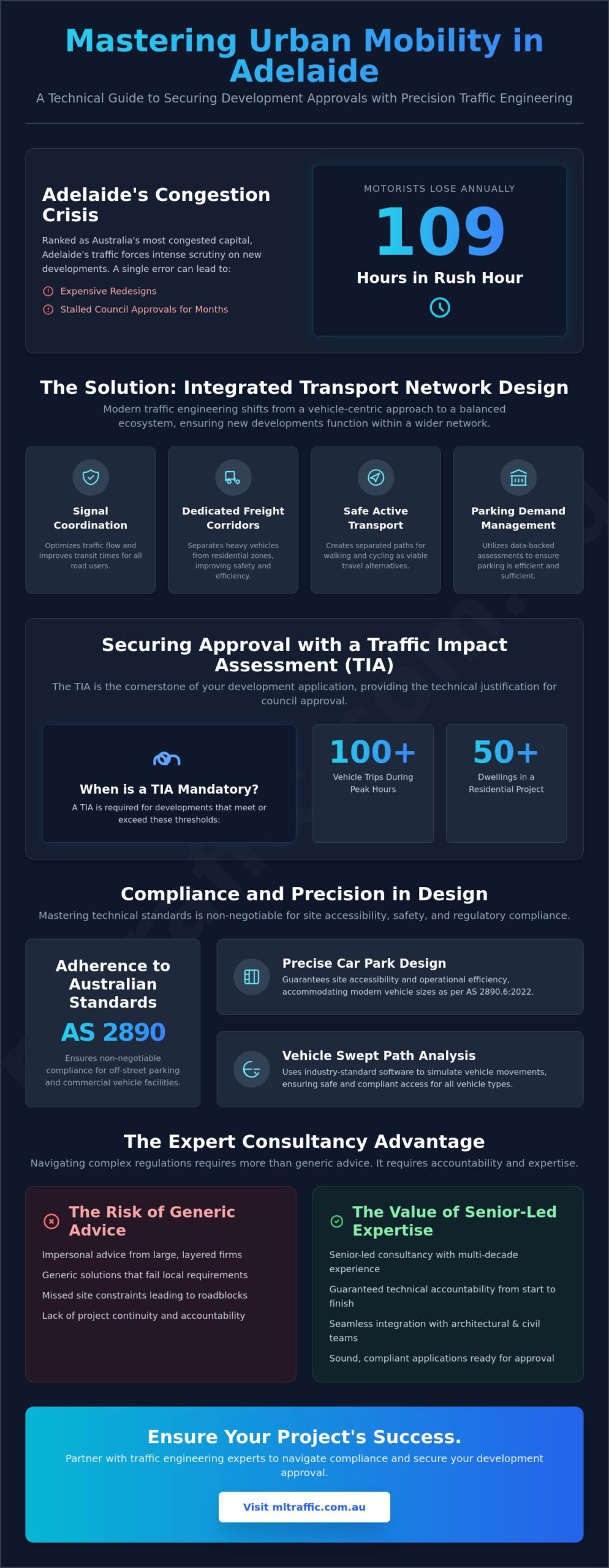
Adelaide was ranked as Australia’s most congested capital city in 2025, with motorists losing an average of 109 hours to rush hour traffic. This statistic has forced authorities to intensify their scrutiny of new developments, making the role of urban mobility traffic engineering adelaide more critical than ever. You likely recognize that a single technical error in a car park layout or a non-compliant Traffic Impact Assessment can trigger expensive redesigns and stall council approvals for months. It’s a frustrating process where impersonal advice from large firms often fails to address specific site constraints or provides generic solutions that don’t satisfy local requirements.
We understand that navigating the South Australia Planning and Design Code version 2026.10 requires absolute technical precision. This article provides the expertise needed to master compliance standards and secure successful planning outcomes. We’ll examine the mandatory requirements for AS 2890.6:2022, define the 100-trip threshold for TIAs, and outline the strategies for cost-effective car park design that satisfy both regulatory bodies and project budgets. By following these technical requirements, you can ensure your development application is sound, compliant, and ready for approval.
Key Takeaways
- Secure development approvals by mastering the mandatory requirements of Traffic Impact Assessments (TIA) and their specific impact on surrounding road networks.
- Ensure site accessibility and operational efficiency through precise Car Park Design and Vehicle Swept Path Analysis using industry-standard simulation software.
- Maintain non-negotiable compliance for off-street parking and commercial vehicle facilities by adhering to the technical specifications of the AS2890 series.
- Understand the shift toward integrated transport network design and its critical role in modern urban mobility traffic engineering adelaide.
- Leverage senior-led consultancy and multi-decade expertise to guarantee technical accountability and seamless project continuity from the initial assessment to final approval.
The Evolution of Urban Mobility and Traffic Engineering
Modern traffic engineering (transportation) is the technical discipline of optimizing movement. It’s a shift from traditional vehicle-centric planning to a sophisticated model of integrated transport network design. In South Australia, urban mobility traffic engineering adelaide now prioritizes a balance between private vehicles, public transport, and active travel modes. This evolution ensures that new developments don’t just exist; they function within a wider, congested ecosystem. Integrated transport network design involves more than just road widening. It includes:
- Signal coordination for improved transit times.
- Dedicated freight corridors to separate heavy vehicles from residential zones.
- Safe, separated active transport paths.
- Data-backed parking demand management.
High-level technical expertise is the difference between a project that gains approval and one that faces costly redesigns. Technical precision supports project liveability by ensuring that infrastructure is both safe and accessible. We use data-driven assessments to support sustainable travel, making walking and cycling viable alternatives to the private car. To better understand how these engineering principles are rooted in the city’s unique layout, watch this analysis of its design:
To better understand this concept, watch this helpful video:
Balancing Stakeholder Demands in Modern Networks
Successfully managing a transport network requires addressing the often-conflicting needs of daily commuters, heavy freight operators, and pedestrians. For developers, functional engineering is the backbone of commercial viability. If a site’s access point is poorly designed or the Car Park Design fails to accommodate modern vehicle sizes, the commercial value of the asset diminishes. Adherence to the version 2026.10 Planning and Design Code is non-negotiable. It dictates how we balance these stakeholder needs while maintaining compliance with state-wide policy. We plan for future-focused infrastructure that supports connected communities across Australia, ensuring long-term operational success.
The Role of the Traffic Consultant in Development
A qualified traffic consultant bridges the gap between an architect’s vision and the rigid regulatory requirements of local councils. This is a core component of urban mobility traffic engineering adelaide, as early expert input identifies potential access or parking constraints before they become expensive roadblocks. It’s essential to involve experts during the feasibility stages to identify issues early. Our team integrates directly with civil and structural engineering professionals to deliver holistic outcomes. We ensure every technical assessment is sound and meets the strict standards set by the Department for Infrastructure and Transport. This hands-on approach provides accountability and ensures the same expert handles your project from start to finish.
Securing Approvals through Traffic Impact Assessments (TIA)
A Traffic Impact Assessment (TIA) is a technical requirement mandated by the Department for Infrastructure and Transport (DIT) and local councils. It serves as the primary evidence that a proposed development can be integrated safely into the existing road network. In South Australia, a TIA is generally mandatory for developments projected to generate 100 or more vehicle trips during peak hours or residential projects consisting of 50 or more dwellings. This report is the cornerstone of urban mobility traffic engineering adelaide, as it provides the technical justification needed for planning approval. Without a sound TIA, developers risk costly delays or outright refusal from council authorities.
The assessment process involves a detailed analysis of several critical data points. We evaluate current traffic volumes, perform peak hour analysis, and assess intersection capacity to determine the potential for congestion. This work adheres to the Australian Transport Assessment and Planning (ATAP) Guidelines to ensure that every project meets national standards for transport system development. By quantifying the effect of a development on surrounding infrastructure, we can identify necessary upgrades before they become project-ending issues. If you are preparing a development application, it is often helpful to evaluate the specific technical requirements for your site early in the process.
Core Components of a Professional TIA Report
A professional TIA must be meticulous and data-driven. It begins with an existing conditions analysis, which includes manual traffic counts and an assessment of road geometry. We then project trip generation based on the specific land-use type and scale of the development. This data allows us to formulate impact mitigation strategies and recommend infrastructure upgrades, such as modified intersection layouts or improved site access. These components ensure the development remains functional while satisfying the version 2026.10 Planning and Design Code.
Land-Use Types Requiring Specialized Assessments
Different land uses present unique challenges that require specialized engineering input. Residential land divisions and high-density apartment complexes focus heavily on local street capacity and parking demand. Conversely, retail developments, hospital upgrades, and airport master planning demand complex Intersection Analysis and modeling of heavy vehicle movements. In certain high-impact scenarios, a Statement of Environmental Effects is also required. Expert urban mobility traffic engineering adelaide ensures these specialized assessments are accurate, preventing expensive redesigns and ensuring the technical integrity of the planning application.
Precision in Car Park Design and Swept Path Analysis
Vehicle Swept Path Analysis is a non-negotiable technical requirement for modern developments. It provides the empirical evidence that a site layout can safely accommodate the movement of specific vehicle classes. Expert urban mobility traffic engineering adelaide utilizes specialized software like AutoTURN to generate accurate maneuvering diagrams. These diagrams demonstrate that vehicles can enter, circulate, and exit a site without conflicting with structural elements or other road users. This precision is especially critical for complex sites involving heavy vehicles, where inadequate turning circles lead to property damage or operational failure.
Designing for safety requires a meticulous approach to vehicle ingress and egress. Every entry point must be analyzed for its impact on the surrounding road network. Internal movement must be fluid, minimizing the need for multi-point turns. For commercial and industrial developments, we ensure the design accounts for the largest anticipated vehicle, whether it’s a Small Rigid Vehicle (SRV) or a 19-meter semi-trailer. This level of technical scrutiny prevents the potential for costly redesigns after construction has commenced. Our senior principals oversee every analysis to ensure technical accountability.
Optimizing Car Park Layouts for Compliance
A successful car park design balances the generated parking demand with the available site area. This requires strict adherence to the standards set by Standards Australia, specifically the AS 2890 series. We analyze technical requirements such as driveway ramp grades to ensure they don’t exceed maximum permissible slopes. Sight distances at access points must also meet mandatory safety benchmarks. For commercial sites, we integrate loading docks and service vehicle access into the primary layout, ensuring these zones don’t interfere with general parking or pedestrian movement. This integrated approach satisfies the version 2026.10 Planning and Design Code requirements while maximizing the functional use of the site.
Waste Management and Site Logistics
Integrating a Waste Management Plan (WMP) with the overall traffic and parking design is essential for operational efficiency. Refuse collection vehicles often require the most significant maneuvering space on a site. We ensure refuse vehicle access through detailed swept path analysis, verifying that collection can occur safely and without blocking thoroughfares. This logistical coordination is a core part of urban mobility traffic engineering adelaide. To see how these elements fit into a broader project scope, you can explore our comprehensive traffic services. Our meticulous attention to site logistics ensures that waste collection and general deliveries are handled without compromising the technical integrity of the development or the safety of its occupants.
Compliance with Australian Standards (AS2890 Series)
Adherence to the AS2890 series is a non-negotiable requirement for any development application in South Australia. These standards provide the technical framework for the design and layout of parking facilities. Failure to meet these specific metrics leads to immediate non-compliance under the version 2026.10 Planning and Design Code. Within the scope of urban mobility traffic engineering adelaide, we ensure that every design element, from bay widths to aisle gradients, meets these national benchmarks. Certified traffic engineers are essential for this process, as they provide the technical verification that councils require before granting planning consent.
Navigating local council interpretations of national engineering standards requires deep-seated expertise. While AS2890 provides the baseline, individual councils often apply specific local variations or stricter interpretations based on local traffic conditions. We bridge this gap by providing meticulous documentation that justifies design choices while maintaining strict compliance. This level of technical accountability is why senior principal involvement is critical for every project. If you are facing complex regulatory hurdles, you can contact our senior engineers directly to discuss your specific site requirements.
AS2890.1: Off-Street Car Parking Requirements
AS2890.1 governs the design of off-street parking for cars and light vehicles. It specifies mandatory minimum dimensions for parking bays, aisles, and blind aisles to ensure safe vehicle movement. Compliance also extends to specialized requirements, such as the mandatory AS 2890.6:2022 standard for disabled parking and associated pedestrian access paths. For a deeper technical breakdown of these requirements, read our ultimate guide to AS2890.1. We ensure your car park design maximizes site efficiency without compromising these essential safety standards.
AS2890.2: Commercial Vehicle Facilities
Commercial and industrial sites must adhere to AS2890.2, which focuses on service vehicle facilities. This standard covers a broad range of vehicles, from small delivery vans to large articulated trucks. Designing these spaces requires rigorous sight distance assessments to prevent collisions at access points and within loading zones. We perform detailed compliance checks for service area clearances and loading dock heights. This ensures that urban mobility traffic engineering adelaide accounts for the logistical needs of a business while protecting the safety of all road users. Our assessments provide the technical certainty that your commercial facility will function as intended from day one.
Expert Traffic Engineering Solutions for National Development
Successful project outcomes rely on a foundation of technical accuracy and senior-led accountability. With over 15 years of experience in Australian traffic consultancy, we provide the specialized knowledge required for urban mobility traffic engineering adelaide. Our approach is defined by direct communication with senior principals. We eliminate the gatekeepers often found in larger, impersonal engineering firms. This ensures that the expert who initiates the client relationship is the same professional performing the technical analysis. This personnel continuity guarantees that your project benefits from deep-seated expertise and a consistent understanding of site-specific challenges.
Direct access to leadership is a core signature of our firm. It allows for rapid decision-making and precise technical advice that aligns with the version 2026.10 Planning and Design Code. We prioritize a hands-on, meticulous methodology that avoids unnecessary bureaucracy. By focusing on results rather than process, we help developers navigate complex council requirements without the typical delays associated with junior-level oversight. Our commitment to technical integrity ensures that every assessment or Car Park Design we produce is sound, compliant, and defensible. This level of reliability is essential in a city that was ranked Australia’s most congested in 2025.
Tailored Engineering for Diverse Project Environments
Our experience spans an exhaustive range of project types across Australia. We provide tailored solutions for everything from small local land divisions to major national infrastructure projects. This results-oriented approach minimizes bureaucratic delays by anticipating council concerns before they’re raised. Whether your development involves retail centers, hospital upgrades, or industrial loading facilities, our engineering input is designed for commercial viability. If you require expert guidance on a challenging site, contact our senior engineers today to discuss a customized strategy.
Securing Your Next Planning Approval
A professional traffic report is not merely a box-ticking exercise; it’s a critical investment for developers. Meticulous site assessments prevent future liability and safety risks that can arise from non-compliant designs. By understanding urban mobility traffic engineering adelaide at a granular level, we identify potential issues during the early feasibility stages. This proactive stance secures planning approvals and ensures long-term operational success for the development. To better understand how our technical expertise supports your project goals, learn more about the role of a traffic engineer in modern developments.
Advancing Your Development with Technical Precision
Achieving planning approval in a complex regulatory environment requires more than just standard design; it demands technical accuracy and adherence to the latest Australian Standards. We’ve examined how mandatory Traffic Impact Assessments and precise Vehicle Swept Path Analysis serve as the foundation for successful development applications. Adhering to the version 2026.10 Planning and Design Code is the only way to mitigate the risks of costly redesigns and council delays. Effective urban mobility traffic engineering adelaide balances these rigid requirements with the commercial needs of your project.
ML Traffic Engineers Australia provides over 15 years of professional experience with a focus on national coverage across all Australian jurisdictions. We maintain a personnel continuity promise where the expert you meet is the one who performs the technical work. You receive direct access to senior principals who understand the intricacies of site assessments and infrastructure design. This accountability ensures your project remains technically sound and compliant from feasibility to final sign-off.
Don’t leave your planning outcomes to chance or impersonal firms. Contact ML Traffic Engineers Australia for an Expert Assessment and secure the technical certainty your development deserves. We’re ready to help you navigate the path to a successful approval.
Frequently Asked Questions
What is a Traffic Impact Assessment and when is it required?
A Traffic Impact Assessment (TIA) is a technical report that evaluates how a proposed development will affect the surrounding transport network. In South Australia, this report is generally mandatory for developments projected to generate 100 or more vehicle trips during peak hours. It is also a standard requirement for residential projects consisting of 50 or more dwellings. These assessments are a core component of urban mobility traffic engineering adelaide and are essential for securing council approval.
How does Swept Path Analysis affect my development application?
Swept Path Analysis provides empirical evidence that specific vehicle classes can safely navigate your site without conflicting with structural elements. Councils require these maneuvering diagrams to verify that refuse trucks, delivery vans, and emergency vehicles can enter and exit in a forward direction. If your application lacks accurate analysis, you risk a Request for Further Information (RFI) or an outright refusal. Identifying these access constraints early prevents expensive redesigns during the construction phase.
What are the key requirements of Australian Standard AS2890.1?
AS2890.1 mandates specific minimum dimensions for off-street parking bays, access aisles, and blind aisles. It also sets rigid standards for driveway ramp grades to ensure vehicles don’t scrape their undercarriages. Compliance with these metrics is non-negotiable for planning consent. The standard also covers sight distance requirements at property boundaries, ensuring that exiting drivers have a clear view of pedestrians and oncoming traffic on the public road network.
Can a traffic engineer help reduce the required number of parking spaces?
Yes, a traffic engineer can justify a parking reduction through a formal Car Parking Demand Assessment. We use empirical data and site-specific surveys to demonstrate that the actual demand is lower than the rates specified in the Planning and Design Code. This is frequently successful for developments located near high-frequency public transport or those with mixed-use profiles. Providing this technical justification can maximize your developable area while maintaining operational functionality.
What is the difference between a Traffic Management Plan and a Traffic Guidance Scheme?
A Traffic Management Plan (TMP) is a strategic document outlining the overall traffic movement and safety objectives for a site. In contrast, a Traffic Guidance Scheme (TGS) is a technical diagram showing the exact placement of signs and devices for temporary traffic control. While a TMP provides the high-level framework, the TGS provides the specific instructions for implementation on the road. Both documents are critical for maintaining safety and compliance during various stages of development.
How long does it typically take to prepare a Traffic Impact Assessment report?
The preparation of a TIA report generally takes between two and four weeks, depending on the complexity of the development. This timeline accounts for baseline data collection, manual traffic counts, and the technical modeling of intersection capacity. Projects requiring extensive consultation with the Department for Infrastructure and Transport may take longer. Engaging a consultant during the feasibility stage ensures that the urban mobility traffic engineering adelaide requirements are met well before your submission deadline.
Why is senior-level involvement important in traffic engineering reports?
Senior-level involvement ensures technical accountability and provides the experience necessary to navigate complex council negotiations. Junior staff often lack the deep-seated understanding of regulatory interpretations that senior principals possess. Our firm guarantees that the expert who initiates the project is the one performing the technical work. This continuity prevents communication errors and ensures that the final report is sound, defensible, and capable of withstanding rigorous scrutiny from planning authorities.
What happens if my development design does not comply with AS2890 standards?
Non-compliance with AS2890 standards typically leads to a refusal of your development application or a requirement for significant redesigns. These failures are often identified during the council’s internal referral process, causing months of delay. Beyond the planning stage, non-compliant designs create long-term liability risks and operational safety issues for site users. Ensuring your Car Park Design meets all mandatory dimensions from the outset is the most cost-effective way to secure a successful planning outcome.

Disclaimer
The content on www.mltraffic.com.au, including all technical articles, guides, and resources, is provided for general informational and educational purposes only. It is not intended to constitute professional advice in traffic engineering, transportation planning, development approvals, or any other technical or legal field.
While ML Traffic Engineers makes every reasonable effort to ensure the accuracy, completeness, and timeliness of the information published, we do not provide any warranties or representations (express or implied) regarding its reliability, suitability, or availability for any particular purpose. Any reliance you place on the content is strictly at your own risk.
In no event shall ML Traffic Engineers, its directors, employees, authors, or affiliates be liable for any direct, indirect, incidental, special, consequential, or punitive damages (including, without limitation, loss of profits, data, or business opportunities) arising out of or in connection with the use of, or inability to use, any information provided on this website.
The articles and guides on this site are not a substitute for engaging a qualified, registered professional traffic engineer (such as an NPER or RPEQ engineer) to assess your specific project requirements. For tailored advice, compliance assessments, or traffic engineering services, please contact a competent professional.
This disclaimer may be updated from time to time without notice. By accessing or using this website, you agree to be bound by the most current version of this disclaimer.
