

Did you know a single design error in a multi-level car park ramp can cost a developer over $50,000 in lost commercial yield before construction even starts? For most developers, the challenge isn’t just about finding space; it’s about balancing rigid council requirements with the need to maximise every square metre of Gross Floor Area. You’ve likely dealt with overly cautious designs that mandate expensive over-engineering or suffered through the delays of a non-compliant traffic report. Applying value engineering in traffic and parking design allows you to reclaim that lost space and reduce infrastructure costs without risking your DA approval.
We understand that every millimetre counts when you’re trying to optimise a site’s layout. This guide explores how senior-led technical assessments identify efficiency gains that junior consultants often overlook. You’ll learn how to achieve full compliance with AS 2890 and the latest National Construction Code updates while protecting your bottom line. We will preview the specific strategies used to refine vehicle swept paths, organise more efficient parking layouts, and ensure your project moves from the drawing board to construction with minimal friction.
Key Takeaways
- Learn how value engineering in traffic and parking design balances strict council requirements with the elimination of spatial and financial waste.
- Discover methods to identify and convert “dead space” within car park layouts into additional parking bays or increased Gross Floor Area (GFA).
- Understand how precise swept path analysis prevents over-engineered, excessively wide driveways that eat into developable land.
- Identify design elements that exceed Australian Standards (AS 2890) without adding functional value, allowing for significant infrastructure cost reductions.
- Recognise the importance of senior-led consultancy in ensuring that technical precision translates directly into faster DA approvals and optimised site outcomes.
Defining Value Engineering for Australian Traffic Planning
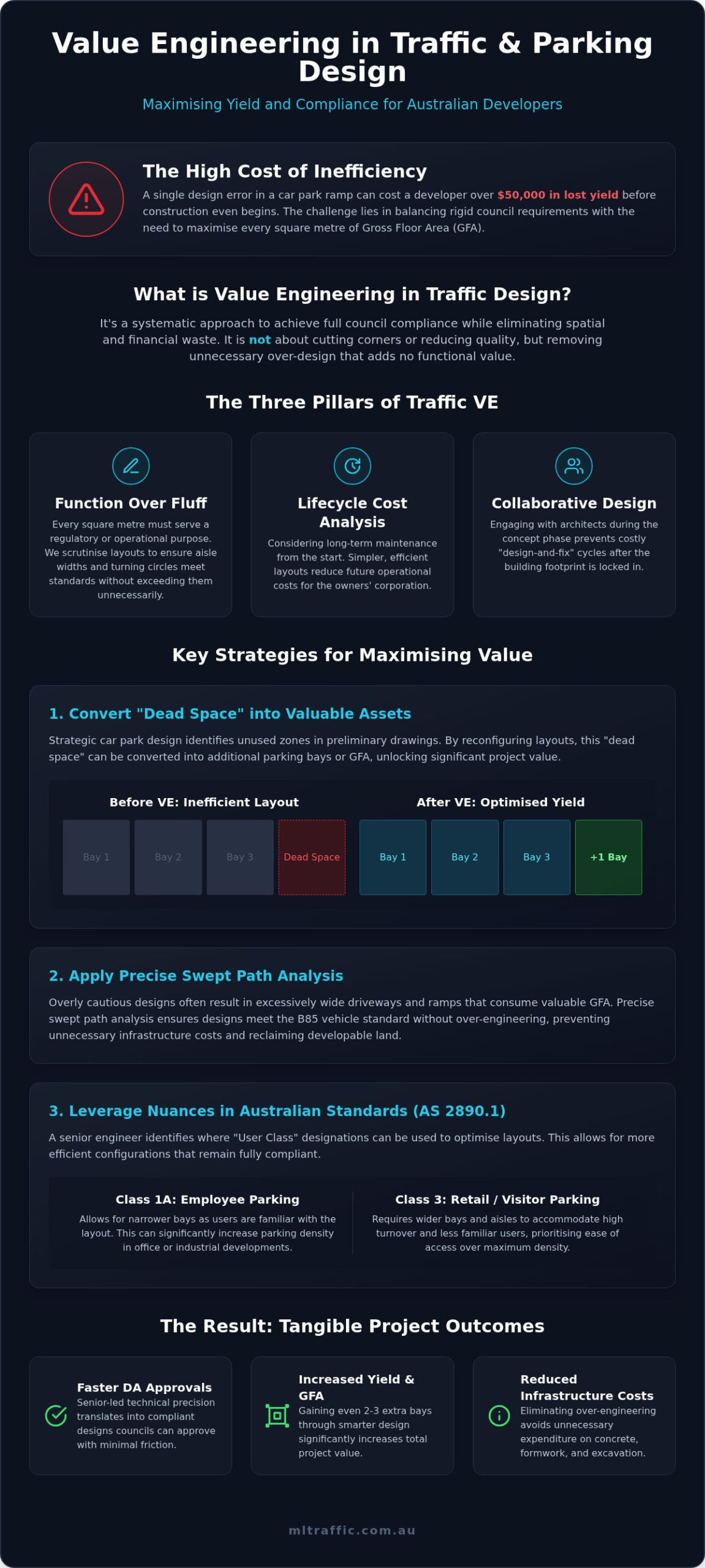
Value engineering (VE) is a systematic, organised approach to providing necessary functions in a project at the lowest cost. In the specialised field of Traffic Engineering, VE focuses on achieving full council compliance while eliminating spatial and financial waste. It isn’t about reducing the quality of materials or compromising safety. Instead, it targets the removal of unnecessary over-design that adds no functional benefit to the development. Effective value engineering in traffic and parking design distinguishes between basic regulatory compliance and strategic site optimisation.
The Core Principles of Traffic VE
Successful traffic VE relies on three primary pillars to ensure a development remains both functional and profitable:
- Function over fluff: Every square metre of bitumen or concrete must serve a regulatory or operational purpose. We scrutinise layouts to ensure that aisle widths and turning circles meet Australian Standards without exceeding them unnecessarily.
- Lifecycle cost analysis: Our process considers the long-term maintenance of traffic infrastructure. Reducing the complexity of a car park layout often lowers long-term operational costs for the future owners’ corporation.
- Collaborative design: We work with architects during the initial concept phase. This prevents “design-and-fix” cycles where traffic engineers are forced to rectify non-compliant layouts after the building footprint is already locked in.
Why Developers Prioritise VE in the Pre-DA Phase
Early intervention is the most effective way to protect a project’s profit margins. When we apply value engineering in traffic and parking design during the pre-DA stage, we prevent costly redesigns that often occur after receiving negative council feedback. A site’s commercial viability depends heavily on its parking yield. Even gaining two or three additional bays through smarter layout design can significantly increase the total value of a residential or commercial development.
A professional Traffic Impact Assessment (TIA) must be robust enough to satisfy the consent authority, yet it shouldn’t be so restrictive that it hampers the developer’s objectives. By identifying where a design exceeds requirements without adding safety value, we help clients avoid the expense of over-engineered infrastructure. This meticulous approach ensures the project meets the B85 design vehicle requirements and NCC 2025 standards while maximising the available Gross Floor Area (GFA).
Strategic Car Park Design: Maximising Yield and Compliance
Strategic car park design identifies “dead space” that often goes unnoticed in preliminary architectural drawings. By converting these unused zones into additional bays or Gross Floor Area (GFA), developers unlock significant project value. This process is a core component of value engineering in traffic and parking design. It involves rigorous testing of multiple configurations to determine the highest parking density that maintains full compliance. Much like state-level value engineering practices used in major infrastructure, our goal is to eliminate spatial waste without sacrificing functional integrity.
A senior traffic engineer identifies opportunities where “User Class” designations under AS 2890.1 can be adjusted to optimise bay widths for specific site needs. For example, employee-only parking (Class 1A) allows for narrower bays compared to high-turnover retail spaces (Class 3). AS 2890.1 provides specific formulas that allow for flexibility in aisle widths based on the combination of bay width and the design vehicle’s swept path requirements. This technical nuance allows for tighter, more efficient layouts that still accommodate the B85 design vehicle safely.
Optimising Layouts Under AS 2890.1
Efficient layouts require a deep technical understanding of blind aisles and turn-around areas. We design these elements to meet the minimum required dimensions while ensuring vehicle safety is not compromised. We also treat structural columns as opportunities rather than obstacles. By positioning columns within the “dead zone” between parking bays, we save valuable floor space that would otherwise be lost to structural requirements. This meticulous planning ensures that Car Park Certification is achievable without over-allocating precious site area to redundant circulation space.
Balancing Parking Demand with Council Requirements
Council parking rates are often generic and may not reflect the actual needs of a specialised development. We conduct bespoke Car Parking Demand Assessments to justify lower parking rates based on empirical data and site-specific factors like proximity to public transport. Applying value engineering in traffic and parking design at this stage allows for significant reductions in construction overheads. Proving that a development requires fewer spaces can occasionally lead to the removal of an entire basement level. If you need to refine a layout, our Car Park Design services provide the technical proof required for council approval.
Swept Path Analysis as a Value Engineering Tool
Swept path analysis (SPA) is often viewed as a simple compliance check to prove a vehicle can negotiate a turn. However, when applied as a component of value engineering in traffic and parking design, it becomes a powerful tool for land-use optimisation. Precision modelling determines the exact dynamic envelope required for vehicle movements, ensuring no space is wasted. Inaccurate or “lazy” modelling often results in driveways and circulation aisles that are significantly wider than necessary. By using advanced software like AutoTURN, we provide a Swept Path Analysis that is both technically robust and defensible during council negotiations. This level of detail aligns with the principles found in the Queensland Government’s Value Engineering Framework, which emphasises the importance of functional efficiency in transport infrastructure.
Reducing GFA Waste through Precision Modelling
Precision is the difference between a project that barely breaks even and one that thrives. A driveway that is unnecessarily wide by even 100mm can scale across a large site to represent several square metres of lost developable land. Over the course of a multi-level development, this spatial redundancy reduces the available Gross Floor Area (GFA) and increases construction costs. We refine ramp grades and transitions to minimise the vertical circulation footprint, ensuring every centimetre of the site is utilised effectively. Vehicle templates are selected to match the specific “design vehicle” required by Australian Standards, such as the B85 or B99 vehicle, to ensure the design remains compliant without being over-sized.
Managing Heavy Vehicle Access Efficiently
Heavy vehicle access presents unique challenges for urban developments. We optimise loading dock layouts for waste trucks and delivery vehicles to ensure they can enter and exit in a forward direction without requiring excessive manoeuvring space. Separating pedestrian paths from heavy vehicle movements is a safety requirement, but it shouldn’t result in redundant infrastructure. We focus on ensuring access for the largest anticipated vehicle, such as an 8.8m Medium Rigid Vehicle (MRV) or a 12.5m Heavy Rigid Vehicle (HRV), without over-designing the entire site for a fleet that will never visit. This targeted approach to value engineering in traffic and parking design ensures that loading areas are functional, safe, and spatially efficient.
The Intersection of Compliance and Cost-Efficiency
Compliance is often viewed by developers as the ultimate goal of a traffic layout. In reality, meeting Australian Standards represents the minimum floor for a successful design, not the ceiling. Value engineering in traffic and parking design identifies where a layout exceeds these requirements without providing additional safety or functional benefits. A qualified traffic engineer acts as a technical bridge between the developer’s budget and the council’s safety mandates. By scrutinising every design element, we ensure that infrastructure costs remain proportionate to the project’s actual operational needs. Strategic negotiation with road authorities often leads to more cost-effective intersection designs, potentially saving significant capital during the construction phase.
Avoiding the Pitfalls of Over-Engineering
Over-engineering typically stems from overly cautious assumptions made during the preliminary design phase. Many designs rely on generic peak hour traffic generation rates that may not apply to a specific site’s unique context. We utilise advanced SIDRA intersection modelling to provide a more accurate representation of traffic flow and delay. This precision often allows us to justify a reduced scope for road works or intersection upgrades. Key areas where we eliminate over-engineering include:
- Questioning “standard” assumptions about vehicle trip generation based on site-specific empirical data.
- Refining intersection geometry to avoid unnecessary land acquisition or utility relocation.
- Ensuring that Traffic Guidance Schemes are proportionate to the actual risk on-site during the construction phase.
Designing for the realistic operational environment rather than a worst-case theoretical scenario prevents unnecessary expenditure on both temporary and permanent infrastructure. This meticulous approach ensures that every dollar spent on traffic works contributes directly to the project’s success.
Negotiating with Road Authorities and Councils
Securing a cost-efficient design requires presenting authoritative, data-backed arguments to consent authorities. We draw upon historical data from over 10,000 completed projects nationally to demonstrate the safety and efficacy of our proposed design variations. Building trust with council officers is essential for securing waivers or variations to standard requirements. Our senior-led reporting provides the technical transparency required to satisfy regulatory concerns. This approach allows us to advocate for performance-based solutions that meet the intent of the law without the burden of excessive over-design.
If your project is currently stalled by expensive infrastructure requirements or overly conservative designs, contact our senior principals to discuss how we can optimise your traffic design for better commercial outcomes.
Implementing Value Engineering with ML Traffic Engineers
ML Traffic Engineers operates with a senior-led model that ensures every Traffic Impact Assessment (TIA) and car park layout is scrutinised for maximum efficiency. Our approach to value engineering in traffic and parking design is built on the direct involvement of our principals, Michael Lee and Benny Chen. With over 30 years of combined technical expertise across more than 10,000 projects completed nationally, we understand how to identify cost-saving opportunities that less experienced consultants often miss. We specialise in navigating the complexities of Australian Standards, including AS 2890.1 and AS 2890.2, to ensure your development achieves council approval without unnecessary spatial or financial waste.
Senior-Led Technical Assessments
Many larger firms delegate technical modelling to junior staff, with senior oversight limited to a final review. We believe that true value is found in the meticulous details of the design process itself. When a senior expert performs the Swept Path Analysis or Driveway Ramp Grade Assessment, they can make real-time adjustments to optimise the layout as they work. This “no-gatekeepers” approach ensures that technical precision and commercial awareness are integrated from the first draft. Our focus on detail includes:
- Identifying opportunities to reduce ramp widths while maintaining full B85 compliance.
- Refining aisle configurations to increase parking yield in constrained basement levels.
- Ensuring that swept paths for waste and delivery vehicles don’t create redundant dead space that eats into developable land.
- Providing direct access to leadership for immediate technical advice during the design phase.
From TIA Reports to Site Certification
Our involvement extends beyond the initial planning phase to provide comprehensive support throughout the entire development lifecycle. We ensure that value engineering in traffic and parking design results in outcomes that are not only compliant on paper but also buildable and certifiable on-site. This continuity of service prevents the loss of value engineering opportunities during the transition from design to construction. Whether your project requires a complex Intersection Analysis or a detailed Waste Management Plan, we prioritise your commercial success at every stage. Our goal is to move your project from feasibility to final certification with minimal friction and maximum yield.
If you’re ready to maximise your site’s potential through senior-led technical precision, discuss your next project’s traffic needs with our team today.
Optimise Your Site Yield Through Technical Precision
Achieving the best commercial outcome for your development requires more than just meeting Australian Standards. It demands a meticulous approach to value engineering in traffic and parking design where every square metre is scrutinised for potential yield. We have demonstrated throughout this guide that precision modelling and strategic car park layouts eliminate spatial waste without compromising council approval. By moving beyond basic compliance and addressing the risks of over-engineering, you protect your Gross Floor Area and reduce construction overheads.
ML Traffic Engineers brings over 15 years of consultancy experience and a portfolio of over 10,000 completed projects to your site. Our senior principals handle every assessment personally, ensuring that your project benefits from deep technical expertise in AS 2890 compliance and advanced swept path analysis. This direct access to leadership means your traffic designs are optimised from the first draft to final certification. Our results-oriented methodology ensures that your traffic infrastructure is as efficient as it is compliant.
Ready to unlock the full potential of your site? Contact ML Traffic Engineers for a Value Engineering Consultation and secure a design that maximises your development outcomes. We look forward to assisting you with your next project.
Frequently Asked Questions
What is the difference between cost-cutting and value engineering in traffic design?
Value engineering in traffic and parking design differs from simple cost-cutting because it prioritises the functional integrity of the development. While cost-cutting often reduces the quality of materials or infrastructure, value engineering removes redundant over-design that adds no practical benefit. We focus on achieving full compliance with Australian Standards while eliminating the “dead space” often found in preliminary architectural plans. This ensures the site remains safe and efficient while reducing total construction overheads.
Can value engineering help me get more parking spaces on my site?
Yes. A senior traffic engineer identifies spatial gains by refining the car park layout and testing various configurations. We often find that adjusting the “User Class” designations under AS 2890.1 allows for narrower bay widths in specific areas, such as employee-only parking. By positioning structural columns within the clearance zones between bays and reducing circulation aisles to the compliant minimum, we can frequently increase the total bay count or free up land for additional Gross Floor Area.
Will council reject a design that has been value engineered?
Council won’t reject a design simply because it has been value engineered, provided it maintains strict compliance with the relevant Australian Standards. In fact, a meticulously engineered design often speeds up the DA process. We provide data-backed reports and precise swept path diagrams that satisfy council safety requirements without unnecessary over-design. Our senior-led approach ensures that every justification for a design variation is robust, transparent, and defensible during the planning assessment.
How much can I save on construction by using a traffic engineer early?
Early involvement allows you to avoid the most expensive design errors before they’re locked in. For example, a single design error in a multi-level car park ramp can cost a developer over $50,000 in lost commercial yield before construction begins. By optimising the layout in the concept phase, we can often justify the removal of an entire basement level or reduce the scope of required road upgrades, leading to substantial savings on infrastructure and excavation.
Does value engineering apply to swept path analysis for heavy vehicles?
Absolutely. Precision modelling for heavy vehicles prevents the common pitfall of over-designing loading docks and access driveways. Using AutoTURN software, we determine the exact dynamic envelope required for vehicles like the 8.8m Medium Rigid Vehicle or 12.5m Heavy Rigid Vehicle. This ensures that driveway widths aren’t excessively wide, which protects your site’s developable land while ensuring safe, forward-direction entry and exit for all required service vehicles.
Is AS 2890.1 compliance mandatory for value engineered car parks?
Yes. Compliance with AS 2890.1 and AS 2890.2 is mandatory because these standards are referenced within the National Construction Code. Value engineering isn’t a method for bypassing regulations; it’s a technical process for meeting them as efficiently as possible. We work within the framework of the standards to find performance-based solutions that satisfy both the developer’s commercial objectives and the council’s strict safety mandates for parking facilities and vehicle access.
When is the best time to involve a traffic engineer for value engineering?
The concept or pre-DA phase is the ideal time to involve a traffic engineer. Applying value engineering in traffic and parking design early prevents the need for costly redesigns after you’ve received negative feedback from the council. By collaborating with your architect during the initial site feasibility stage, we ensure the building footprint and parking levels are optimised for both yield and compliance, protecting your project’s profit margins from the outset.
How does a Traffic Impact Assessment contribute to value engineering?
A Traffic Impact Assessment (TIA) provides the empirical data needed to justify design efficiencies. Instead of relying on generic council parking rates, we conduct a bespoke Car Parking Demand Assessment to prove that your specific development may require fewer spaces. This data-led approach allows us to argue for reduced infrastructure requirements. A robust TIA acts as the technical foundation for all value engineering decisions, ensuring they’re defensible to road authorities and planning departments.

Disclaimer
The content on www.mltraffic.com.au, including all technical articles, guides, and resources, is provided for general informational and educational purposes only. It is not intended to constitute professional advice in traffic engineering, transportation planning, development approvals, or any other technical or legal field.
While ML Traffic Engineers makes every reasonable effort to ensure the accuracy, completeness, and timeliness of the information published, we do not provide any warranties or representations (express or implied) regarding its reliability, suitability, or availability for any particular purpose. Any reliance you place on the content is strictly at your own risk.
In no event shall ML Traffic Engineers, its directors, employees, authors, or affiliates be liable for any direct, indirect, incidental, special, consequential, or punitive damages (including, without limitation, loss of profits, data, or business opportunities) arising out of or in connection with the use of, or inability to use, any information provided on this website.
The articles and guides on this site are not a substitute for engaging a qualified, registered professional traffic engineer (such as an NPER or RPEQ engineer) to assess your specific project requirements. For tailored advice, compliance assessments, or traffic engineering services, please contact a competent professional.
This disclaimer may be updated from time to time without notice. By accessing or using this website, you agree to be bound by the most current version of this disclaimer.
