
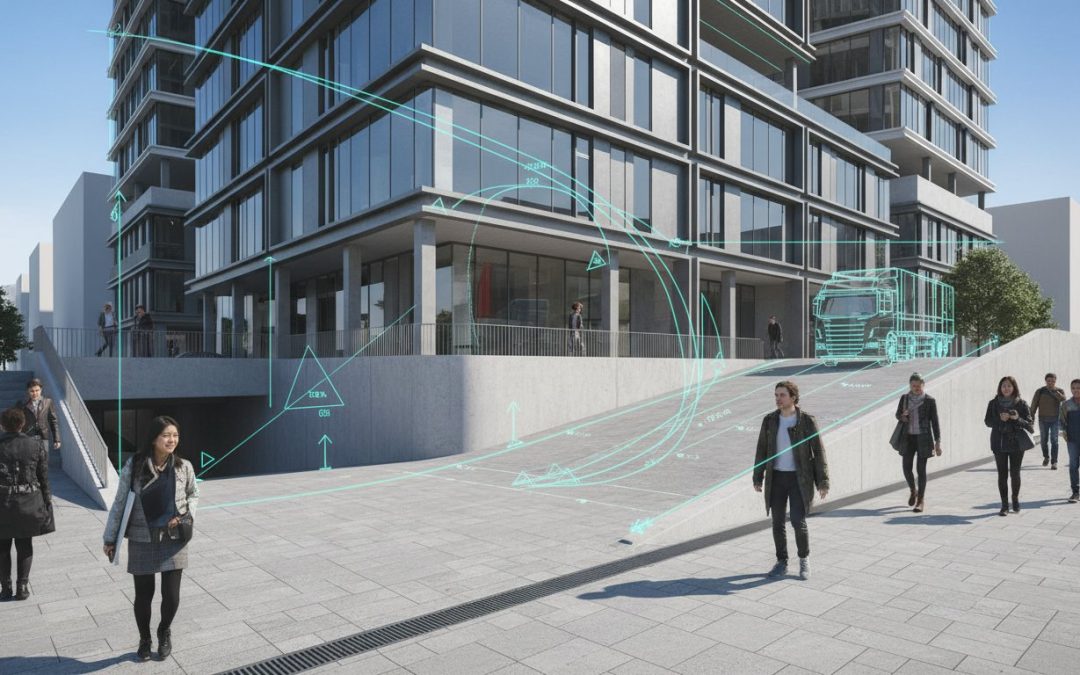
A Development Application can be rejected for numerous reasons, but few are as fundamental-and as preventable-as non-compliant vehicle access design. The technical complexities of sight lines, gradients, and swept path analysis often create significant delays and unforeseen costs for developers unfamiliar with specific council requirements and Australian Standards.
Getting this critical element right from the outset is essential for project success. A properly engineered access point is not simply about connecting a site to a road; it is a technical discipline that ensures safety, functionality, and compliance, preventing issues that can jeopardise your entire project timeline and budget.
This guide breaks down the essential principles for developers. We will clarify the core requirements for gaining council approval, from accommodating large service vehicles to satisfying technical criteria. You will gain the knowledge to confidently prepare your DA and understand precisely when engaging a professional traffic engineering consultant is a necessary investment to secure your approval without delay.
Core Principles of Safe and Compliant Vehicle Access Design
Effective vehicle access design is not an afterthought; it is a foundational component of any successful development application (DA). Its primary purpose is to create a seamless, safe, and efficient connection between a private property and the public road network. Achieving council approval hinges on demonstrating that this access point correctly balances the needs of the development with the safety of the public, ensuring a design that is both functional and compliant from the very beginning.
For a visual perspective on how access influences overall design, the following video provides a unique example:
Prioritising Safety for Drivers, Pedestrians, and Cyclists
The foremost responsibility of any access design is public safety. This requires a holistic assessment of how vehicles interact with all other road users. Key considerations include:
-
Clear Sight Lines: Drivers exiting a property must have unobstructed views of oncoming vehicles, pedestrians on the footpath, and cyclists in a bike lane. This is a non-negotiable requirement for councils.
-
User Conflict Minimisation: The design must prevent conflicts between entering and exiting vehicles and integrate safely with existing footpaths and cycleways, ensuring clear priority.
-
Adequate Lighting and Signage: Proper illumination and clear instructional signage are critical for safe operation, particularly for developments with high traffic volumes or night-time activity.
Ensuring Operational Efficiency for the Intended Use
A compliant design must also be practical for its specific purpose. Poor operational efficiency creates long-term frustrations and can impact neighbouring properties. The design must account for the expected volume and type of traffic, from passenger cars to large service vehicles. This includes providing sufficient queuing space on-site to prevent vehicles from banking up onto the public road, a common point of council objection. Furthermore, swept path analysis is essential to confirm that service and emergency vehicles, such as fire trucks and garbage trucks, can safely enter and exit the site.
The Foundation: Compliance with Australian Standards and Council Codes
Ultimately, council approval is granted based on adherence to a strict set of rules. The primary technical reference for all vehicle access design in Australia is the AS 2890 series of Australian Standards. These standards govern everything from driveway gradients and widths to the specific geometry of the connection to the public road. Many local councils supplement these standards with their own specific requirements, detailed in their Development Control Plans (DCPs). Understanding fundamental Curb cut design principles is essential, but navigating the nuances of both state-level standards and local codes is complex. Non-compliance is one of the most common reasons for a DA rejection, making the engagement of a qualified traffic engineer essential to interpret these regulations and produce a design that satisfies all council requirements.
Key Design Elements Governed by Australian Standards
A compliant and safe vehicle access point is an engineered system, not an afterthought. Every component, from where vehicles leave the public road to where they park, is governed by strict technical standards. For developers in Australia, the primary document dictating these requirements is the Australian Standard AS 2890.1: Parking facilities – Off-street car parking. Adherence to this standard is non-negotiable for achieving council approval for your development.
Vehicle Crossovers: The Gateway to Your Property
The vehicle crossover is the section of driveway located between your property boundary and the road. Councils regulate crossovers meticulously to ensure public safety and manage public infrastructure. Key requirements typically include:
-
Width: Must be wide enough for safe vehicle entry and exit but not so wide that it removes excessive on-street parking.
-
Location: A minimum clearance distance is required from street corners, intersections, utility poles, and street trees.
-
Quantity: Councils often restrict properties to a single crossover to preserve the streetscape and pedestrian access, with additional access points requiring special justification.
-
Construction: Materials and construction methods (e.g., reinforced concrete thickness) must comply with local council specifications to withstand vehicle loads.
Sight Lines and Sight Distance: Seeing and Being Seen
Adequate sight lines are critical for preventing collisions between vehicles exiting a property and passing traffic, cyclists, or pedestrians. Traffic engineers assess the available Safe Intersection Sight Distance (SISD), which is the clear line of vision required for a driver to see an approaching hazard and react safely. Common obstructions like high fences, dense landscaping, or retaining walls can compromise SISD. For a Development Application (DA), a qualified traffic engineer must certify that the proposed vehicle access design provides compliant sight lines.
*This diagram shows the triangular area at an access point that must be kept clear of obstructions to ensure drivers exiting can see oncoming traffic and pedestrians.*
Driveway and Ramp Gradients: Managing Slopes Safely
The gradient, or steepness, of driveways and ramps is a fundamental safety and compliance issue. AS 2890.1 specifies maximum permissible grades-typically 1 in 4 (25%) for short sections-and requires carefully designed transition slopes at the top and bottom. Without correct transitions, vehicles risk ‘bottoming out’ (scraping the undercarriage) or having their bumpers hit the pavement. This is especially critical in the vehicle access design for basement car parks, where steep ramps are common and poor design can render parking spaces unusable and unsafe.
*This diagram illustrates how gradual transition slopes at the crest and sag of a steep ramp prevent a vehicle’s front or rear from scraping the ground.*
Designing for Different Vehicle Types: From Cars to B-Doubles
A fundamental principle of successful vehicle access design is that there is no ‘one size fits all’ solution. The type of vehicle a development must accommodate is dictated entirely by its intended land use. Traffic engineers use the concept of a ‘design vehicle’-the largest vehicle expected to access the site regularly-to determine the required dimensions for driveways, ramps, and maneuvering areas. Selecting the correct design vehicle is a critical first step that informs all subsequent geometric design and ensures the site is functional, safe, and compliant with council requirements.
Understanding Standard Design Vehicles
Australian Standards (AS 2890) define several design vehicles used for different applications. A professional assessment will identify the appropriate vehicle for your development, which typically includes one of the following:
-
B85 Car: The standard passenger car, forming the basis for access and parking design in residential developments, office buildings, and customer-facing commercial sites.
-
Small Rigid Vehicle (SRV): A 6.4m long truck used for deliveries, couriers, or waste collection services. This is a common design vehicle for mixed-use developments, childcare centres, and small-scale commercial operations.
-
Heavy Rigid Vehicle (HRV): A 12.5m long truck required for industrial sites, supermarkets, and developments with dedicated loading docks that handle substantial goods movement.
-
Articulated Vehicles: Ranging from 19m semi-trailers to 25m B-Doubles, these vehicles are the design standard for large-scale logistics centres, transport depots, and major industrial facilities.
Case Study: Loading Dock and Service Bay Design
Consider a new supermarket or warehouse. The design vehicle will likely be an HRV or a semi-trailer. The vehicle access design must provide sufficient maneuvering area (apron space) in front of the loading dock to allow the truck to reverse into the bay safely. Critically, the layout must be proven to allow for forward entry and forward exit from the site, as councils prohibit large vehicles from reversing onto public roads. This is verified using a specialised Vehicle Swept Path Assessment, which produces a diagram demonstrating that the design vehicle can navigate the accessway without conflict.
Special Considerations for Emergency Vehicles
Beyond operational needs, all developments must provide compliant access for emergency services. This is a non-negotiable requirement checked by councils. The design must accommodate the specific turning circles and provide adequate vertical clearance for fire trucks and ambulances. Failure to demonstrate compliant emergency vehicle access is a common reason for a development application to be delayed or rejected. A thorough plan ensures first responders can access the site efficiently and safely when required.
Unsure what vehicle your site needs? Ask our experts.
The Role of Swept Path Analysis in Verifying Your Design
A successful vehicle access design is not based on assumption; it is based on verifiable proof. Swept path analysis is the industry-standard method for providing this proof. It is a technical assessment that uses specialised software to simulate the exact path a designated vehicle will take when entering, navigating, and exiting a site. For any development with constrained or complex access requirements, a swept path assessment is a non-negotiable step to demonstrate design compliance and functionality to the council.
This analysis moves the assessment beyond simple line drawings, providing a dynamic, data-driven verification that your design works in practice. It serves as definitive evidence that vehicles can manoeuvre safely and efficiently without conflicts, forming a critical component of your development application.
What is a Swept Path Diagram?
A swept path diagram is the visual output of the analysis. It is a scaled, technical drawing that overlays the vehicle’s turning path onto your site plans. The diagram illustrates the complete envelope of the vehicle, accounting for critical factors like wheel tracks, front and rear body overhangs, and steering articulation. Using industry-standard software like AutoTURN, traffic engineers can accurately model the movement of any design vehicle, from a standard car (B85/B99 vehicle as per AS 2890.1) to a large waste collection or service vehicle (SRV/HRV as per AS 2890.2). This clearly identifies potential conflicts with kerbs, columns, walls, landscaping, or other parked vehicles before construction begins.
When is Swept Path Analysis Required?
While beneficial for any project, councils will explicitly require a swept path analysis for development applications that feature non-standard or challenging layouts. Failure to provide this assessment when required will almost certainly result in a Request for Information (RFI), causing significant delays to your approval timeline. Key triggers for a mandatory assessment include:
-
Access to basement or multi-level car parks with ramps and tight turns.
-
Dedicated loading docks and service bays for commercial or industrial sites.
-
Residential flat buildings or townhouse developments with shared driveways.
-
Any site with constrained geometry, narrow access points, or proximity to complex intersections.
Ultimately, swept path analysis is a crucial tool to de-risk your project. It provides the necessary assurance to both your project team and the council that the proposed vehicle access design is safe, compliant, and functional. For professional assessment and compliant diagrams for your DA, contact the experts at ML Traffic Engineers.
Navigating the Council Approval Process for Vehicle Access
All technical design elements discussed previously serve a single, critical purpose: securing Development Application (DA) approval from the local council. A compliant and well-documented vehicle access design is not a ‘nice-to-have’; it is a fundamental requirement. Council planners and engineers must be satisfied that your proposal is safe, functional, and adheres strictly to all relevant codes and standards before they grant consent.
Documentation: The Traffic and Parking Assessment Report
The key document for council submission is the Traffic and Parking Assessment Report. Prepared by a qualified traffic engineer, this report provides a comprehensive analysis of your access proposal. It methodically demonstrates compliance with Australian Standards (such as AS 2890.1) and local council codes. Key components include a site description, a detailed review of the access geometry, and technical evidence like vehicle swept path diagrams and sight line assessments to verify safety and functionality.
Common Pitfalls and Reasons for Rejection
A council’s assessment of your vehicle access design will be meticulous. Requisitions or outright rejections are commonly caused by preventable errors that fail to meet mandatory requirements. Developers should be aware of these frequent issues:
-
Non-compliant Gradients: Driveway ramps and transitions that are too steep, posing a risk of vehicles scraping or bottoming out.
-
Insufficient Sight Lines: Inadequate visibility for drivers exiting the property to see pedestrians and oncoming traffic.
-
Inadequate Manoeuvring Space: Failure to demonstrate that the design vehicle (e.g., a B99 garbage truck) can enter and exit the site in a forward direction.
-
Conflicts with Public Infrastructure: Proposed crossovers that interfere with street trees, utility poles, pits, or bus stops.
-
Failure to Adhere to Local Codes: Overlooking specific requirements within the local council’s Development Control Plan (DCP) or engineering standards.
How a Traffic Consultant Streamlines Approval
Engaging an experienced traffic consultant is the most effective strategy to mitigate risk and ensure a smooth approval process. A specialist consultant interprets complex standards, identifies potential conflicts early, and can liaise directly with council officers to resolve issues prior to formal submission. Their certified report provides council with the independent, expert assurance it needs to approve the plan. This is an essential investment to avoid the significant costs and project delays associated with council rejection and redesign. For professional assessment of your development, contact a qualified traffic engineer.
Secure Your Development Approval with Expert Vehicle Access Design
A successful development application hinges on a design that is both functional and compliant. Adhering to Australian Standards, accommodating diverse vehicle types, and validating plans with precise swept path analysis are non-negotiable steps. Getting these elements right from the outset is essential for avoiding costly delays and rejections from council.
Navigating this complex process requires specialist expertise. With over 15 years of dedicated experience securing DA approvals across Australia, ML Traffic Engineers offers deep, practical expertise in all Australian Standards (AS 2890). We ensure your professional vehicle access design is meticulously planned, robust, compliant, and positioned for a swift approval. Every project receives direct consultation and oversight from our principal engineers, guaranteeing the highest level of scrutiny and an accountable, streamlined process.
Don’t leave your project’s approval to chance. Ensure Your Design is Compliant. Contact ML Traffic Engineers for a Quote.
Let our expertise streamline your path to a successful development outcome.
Frequently Asked Questions
What is the difference between a driveway and a vehicle crossover?
A driveway is the section of the vehicle access path located entirely within your private property boundary, connecting your parking area to the street. In contrast, the vehicle crossover is the portion that crosses the public land, such as the footpath or nature strip. The crossover connects your private driveway to the public road. Councils have specific construction and location standards for crossovers as they impact public infrastructure, pedestrian safety, and council assets.
How wide does a vehicle access driveway need to be in Australia?
Driveway width is determined by local council requirements and Australian Standard AS 2890.1. For a single residential dwelling, a width of 3.0 metres is typical. For multi-dwelling or commercial developments requiring two-way vehicle flow, widths can range from 5.5 to 6.7 metres. The final compliant width depends on the expected vehicle types, traffic volume, and site geometry. A professional assessment is required to confirm the correct dimensions for your development application.
What is AS 2890.1 and why is it the most important standard for access design?
AS 2890.1 is the Australian Standard governing off-street car parking facilities. It is the primary technical document referenced by councils nationwide for assessing all aspects of parking and access design. The standard provides the minimum geometric requirements for parking space dimensions, ramp grades, aisle widths, and sight lines. Compliance with AS 2890.1 is non-negotiable for achieving council approval, as it ensures vehicle access is safe, functional, and efficient for all users.
Do I always need a traffic engineer to design my vehicle access?
For a standard single dwelling with a simple crossover, council’s standard drawings may be sufficient. However, a qualified traffic engineer is essential for any development involving basements, multiple dwellings, commercial use, or difficult site conditions. Councils require detailed plans demonstrating compliance with AS 2890.1, including swept path analysis and sight line assessments. Engaging a professional ensures your vehicle access design meets all technical requirements, preventing costly delays and council rejections.
How does vehicle access design impact pedestrian and cyclist safety?
Proper vehicle access design is critical for protecting pedestrians and cyclists. The primary safety mechanism is providing adequate sight lines, which allows drivers exiting a property to see and be seen by people on the footpath. This is achieved through correct crossover location, compliant splay angles, and ensuring landscaping or structures do not obstruct vision. Poor design creates blind spots, increasing the risk of conflict at the property boundary-a key assessment criterion for all councils.
What are the most common mistakes to avoid in vehicle access design?
The most frequent errors include non-compliant ramp grades that are too steep, causing vehicles to scrape; inadequate sight distances at the property exit, creating a safety hazard; and failing to conduct a swept path analysis for the largest expected vehicle. Another common mistake is locating a crossover too close to an intersection, power pole, or significant street tree, which is a direct violation of most council planning schemes and will result in a rejected application.
Which areas do you service?
We are traffic engineers covering Melbourne, Sydney, Brisbane, Gold Coast, Hobart, Perth, Adelaide, Darwin and surrounding areas.
