
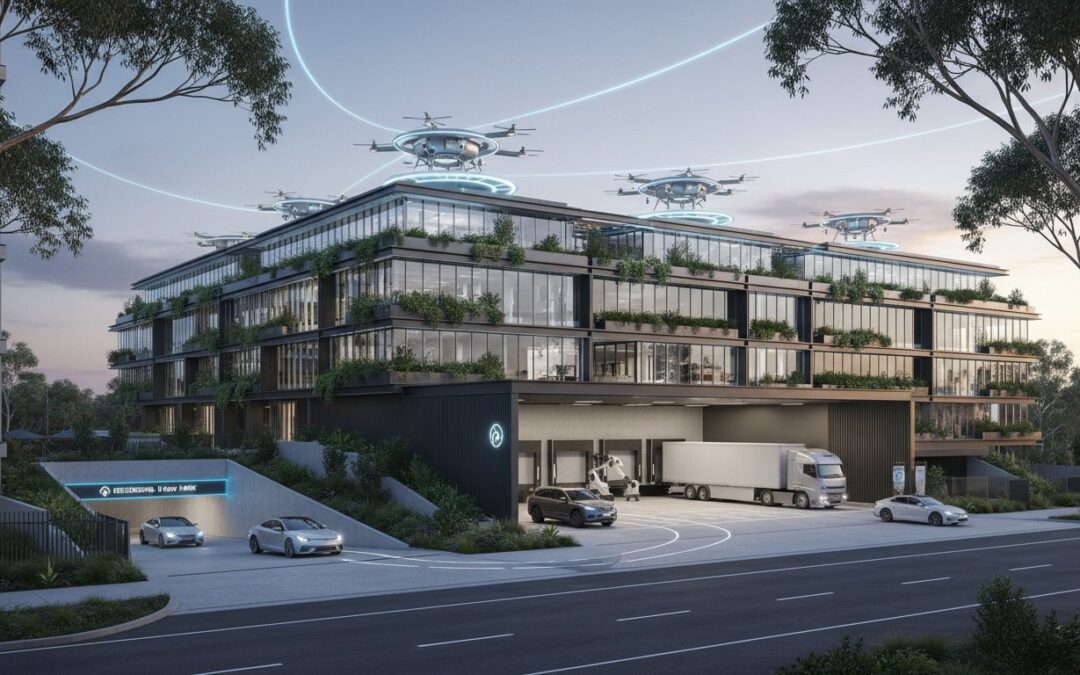
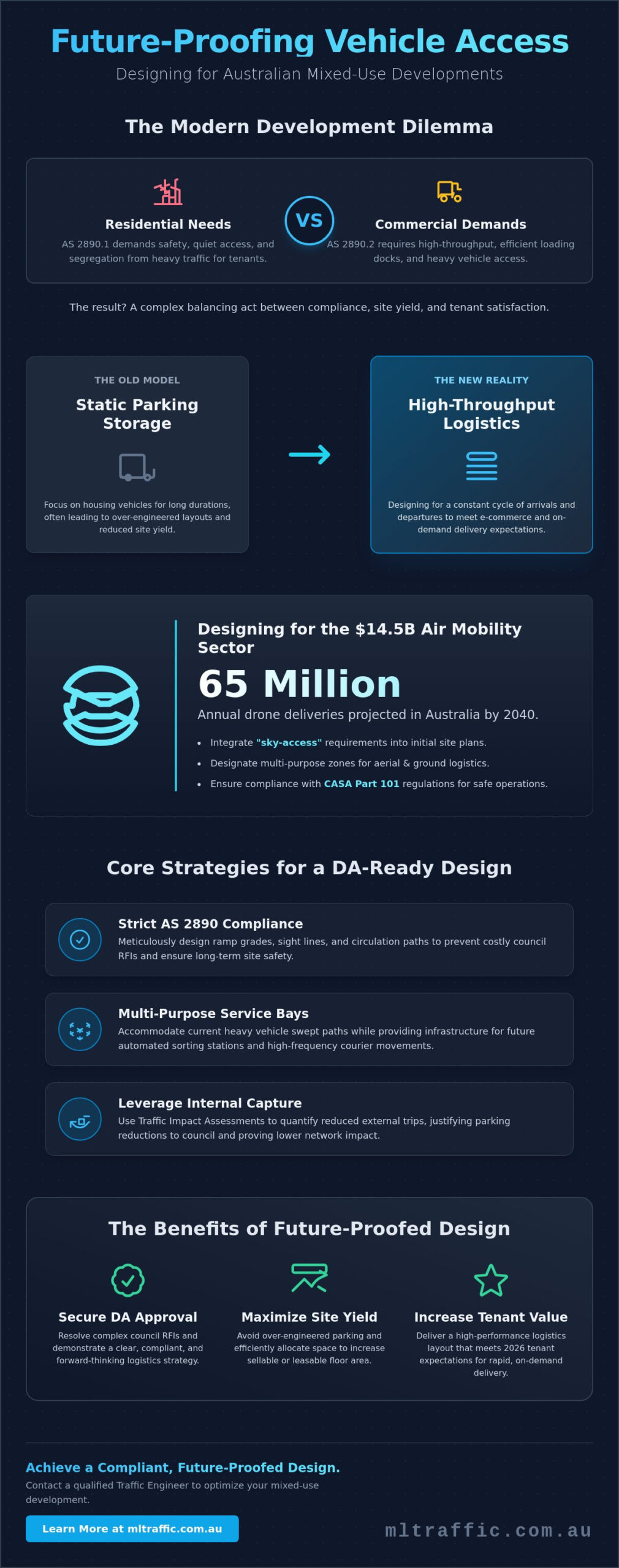
By 2040, drone delivery demand in Australia is projected to reach up to 65 million trips annually. If your current project doesn’t account for this shift, your site logistics may be obsolete before construction finishes. You likely already struggle with the tension between AS 2890.1 residential requirements and AS 2890.2 heavy vehicle loading docks, especially when council RFIs demand higher efficiency without sacrificing sellable floor space. It’s a complex balancing act that often leads to over-engineered parking and reduced site yield.
This article provides the technical clarity needed to master vehicle access design for mixed-use developments australia while future-proofing for emerging logistics. You’ll learn how to achieve a DA-ready design that strictly complies with the updated AS/NZS 2890.1:2021 standards and integrates the infrastructure required for the $14.5 billion Advanced Air Mobility sector. We will detail specific strategies to satisfy council requirements, navigate CASA Part 101 regulations, and secure a high-performance logistics layout for your tenants.
Key Takeaways
- Align your site plans with AS/NZS 2890.1:2021 and AS 2890.2 to ensure a seamless transition between residential parking and commercial service zones.
- Optimize vehicle access design for mixed-use developments australia by transitioning from static parking storage to high-throughput logistics hubs.
- Integrate sky-access requirements into initial site planning to accommodate the projected surge in drone delivery traffic without compromising ground-level operations.
- Design multi-purpose service bays that satisfy current heavy vehicle swept path requirements while providing infrastructure for future automated sorting stations.
- Leverage future-proofed logistics strategies to negotiate parking reductions and resolve complex council RFIs regarding site yield and efficiency.
Table of Contents
-
The Evolution of Mixed-Use Vehicle Access Design in Australia
-
Technical Compliance: Navigating AS 2890 for Multi-Modal Developments
-
The Drone Delivery Shift: Designing for Aerial and Ground Integration
-
Strategic Site Planning for Last-Mile Logistics and Delivery Hubs
-
Securing Council Approval for Future-Proofed Mixed-Use Projects
The Evolution of Mixed-Use Vehicle Access Design in Australia
Modern mixed-use development in Australia requires a precise balance between residential safety and commercial operational efficiency. This is no longer a matter of simply placing a driveway. It involves high-stakes planning where conflicting traffic streams must be separated to prevent congestion and safety hazards. Effective vehicle access design for mixed-use developments australia prioritizes the safe segregation of heavy rigid vehicles from pedestrian-heavy residential zones while maintaining site functionality.
Australian urban planning is currently undergoing a fundamental shift. We’re moving away from the concept of "parking storage," where the goal was simply to house vehicles for long durations. Instead, the focus has moved to "logistics throughput." This means designing for a constant cycle of arrivals and departures. To better understand the mechanical requirements of modern site access, watch this helpful video:
Traditional access designs often fail to meet 2026 tenant expectations for rapid, on-demand delivery. Over-engineered parking layouts consume valuable site yield while failing to provide the necessary clearance for modern delivery vehicles. A qualified Traffic Engineer bridges this gap. We translate complex AS 2890 requirements into practical layouts that satisfy both local council RFIs and the commercial realities of high-density logistics.
The Multi-Trip Advantage and Internal Capture
Shared land uses naturally reduce the net impact of a site on the surrounding road network. When residents work or shop within the same complex, external vehicle trips decrease. We use detailed Traffic Impact Assessments to quantify these reductions and justify lower parking rates to councils. Internal capture in 2026 mixed-use developments is the percentage of total trips that start and end within the site boundary without ever entering the public road system.
The 2026 Logistics Landscape: Drones and E-Commerce
On-demand infrastructure is now a core requirement for DA approval. The rise of e-commerce has increased last-mile delivery volumes to the point where traditional service bays are insufficient. Modern vehicle access design for mixed-use developments australia must accommodate high-frequency courier movements alongside emerging drone logistics. Councils now expect "smart-site" designs that manage these competing demands through intelligent bay allocation and optimized property boundary interfaces.
Technical Compliance: Navigating AS 2890 for Multi-Modal Developments
AS/NZS 2890.1:2021 provides the technical foundation for off-street car parking. Adherence to these standards is mandatory for gaining council approval and ensuring long-term site safety. In a mixed-use environment, the complexity increases as residential and commercial traffic streams often share a single crossover or entry point. Effective vehicle access design for mixed-use developments australia requires a meticulous approach to sight distance at the property boundary. Drivers must have clear visibility of pedestrians and oncoming traffic before exiting the site. Failure to meet these specific sight distance requirements often leads to council RFIs and costly redesigns.
User conflict is a significant risk in high-density developments. Residential tenants expect quiet, safe access, while commercial operators require efficient throughput for delivery vehicles. We manage these competing interests by designing distinct circulation paths and clear signage. This technical separation prevents delivery trucks from obstructing residential parking bays or creating bottlenecks at shared ramps.
AS 2890.1:2021 and Beyond: Ramp and Grade Standards
Driveway ramp gradients are a critical failure point in many DA submissions. We design ramp grades to prevent vehicle scraping while maximizing basement depth for sellable floor space. This involves precise calculations for the B85 and B99 vehicle design templates. We utilize detailed Swept Path Analysis to verify these compliant maneuvers during the design phase. This proactive assessment identifies potential pinch points for the 99.8th percentile vehicle before they become construction issues.
Commercial Service Access: AS 2890.2 Requirements
Commercial loading docks must comply with AS 2890.2. This standard governs the access requirements for Heavy Rigid Vehicles (HRV) and Small Rigid Vehicles (SRV). In mixed-use projects, headroom clearances are paramount. Basement loading areas must accommodate waste collection vehicles and delivery trucks without risking structural damage. Balancing these commercial needs with residential acoustic requirements is essential. We often recommend physical separation or acoustic shielding to mitigate noise from early-morning deliveries. If you require technical assistance with your site layout, our team provides comprehensive car park design services to ensure full regulatory compliance.
The Drone Delivery Shift: Designing for Aerial and Ground Integration
By 2026, site feasibility for high-density projects depends on multi-modal logistics capacity. Vehicle access design for mixed-use developments australia is no longer restricted to the ground plane. Developers must now integrate "sky-access" into their initial site layouts to accommodate the projected 46 to 65 million annual drone delivery trips expected by 2040. This shift requires a technical understanding of how aerial landing zones intersect with traditional ground-level vehicle crossovers. While ground access handles bulk goods and waste removal via heavy rigid vehicles, aerial ports manage high-frequency, low-weight e-commerce throughput.
The transition from traditional courier van access to automated drone delivery changes the site’s "last-hundred-feet" logistics. A standard delivery van requires significant swept path clearance and dedicated bay time. In contrast, drones require rapid vertical clearance and automated sorting hubs. Designing for both ensures that the $14.5 billion Advanced Air Mobility sector can be leveraged to reduce ground-level congestion. This integrated approach prevents the property boundary from becoming a bottleneck as delivery volumes increase.
Aerial Access vs. Ground Access: Design Differences
Ground-level access focuses on horizontal swept paths and ramp gradients for B85 and B99 vehicles. Aerial access requires clear-sky corridors and unobstructed approach paths. Structural planning must account for drone ports located above vehicle ramps or loading docks to maximize site yield. As of 2026, the standard for drone-to-building vertical clearance requires a minimum unobstructed buffer to satisfy both CASA safety protocols and local noise mitigation frameworks. We design these interfaces to ensure that internal transit from the rooftop landing pad to the tenant door is seamless and secure.
Regulatory Hurdles for Aerial Logistics
Navigating the regulatory landscape requires compliance with CASA Part 101 for flight safety and the Air Navigation (Aircraft Noise) Regulations 2018. Mixed-use developments face unique challenges in balancing these aerial requirements with residential acoustic comfort. Drone landing zones must be positioned to avoid interference with standard site sight lines at vehicle crossovers. We analyze these overlapping requirements to ensure that drone operations don’t compromise the safety of ground-based traffic or the privacy of residential occupants. This comprehensive approach to vehicle access design for mixed-use developments australia provides a clear path to DA approval for future-proofed assets.
Strategic Site Planning for Last-Mile Logistics and Delivery Hubs
Strategic site planning must evolve from simple loading docks to integrated logistics hubs. The delivery interface at the property boundary is a primary congestion point in high-density areas. We design dual-purpose service bays that accommodate Small Rigid Vehicles (SRVs) while providing dedicated space for automated drone-sorting stations. This approach optimizes vehicle access design for mixed-use developments australia by ensuring that high-frequency delivery cycles don’t disrupt residential traffic flow. By planning for these multi-modal hubs early, developers avoid the need for expensive retrofitting as e-commerce volumes continue to rise toward 2026 expectations.
Micro-hubs within the site footprint play a critical role in reducing traditional vehicle parking demand. Consolidating last-mile deliveries into a single internal point allows for a more efficient use of space. Integrating professional Car Park Design with automated delivery lockers allows for secure goods handling without increasing the building’s physical footprint. This strategy maximizes sellable floor space and improves tenant convenience. For a compliant and efficient layout, you can contact our senior principals to discuss your specific site requirements.
Optimizing the Swept Path for High-Frequency Delivery
We utilize AutoTURN to simulate high-frequency van movements within the restricted basements typical of mixed-use sites. Designing "drive-through" delivery lanes is a key strategy to minimize dangerous reversing maneuvers and improve overall site safety. These lanes allow couriers to enter and exit the site in a forward direction, significantly reducing the time spent in the loading zone. Our assessments include the verification of sight distances for rapid-entry delivery vehicles to ensure they don’t conflict with pedestrians at the crossover point. This technical precision is essential for satisfying council concerns regarding loading dock efficiency and safety.
Internal Logistics Flow: From Dock to Door
Internal logistics flow must be planned from the initial ground-level access point through to the final residential or commercial level. Minimizing the footprint of delivery infrastructure is vital to maintain site yield. We analyze the impact of automated delivery robots on internal corridor and ramp design to ensure long-term compatibility. These robots require specific gradients and clear path widths that differ from standard pedestrian requirements. Planning for these movements ensures that the transition from the heavy rigid vehicle dock to the tenant’s door is efficient and unobstructed. This level of detail in vehicle access design for mixed-use developments australia provides a significant advantage during the DA process.
Securing Council Approval for Future-Proofed Mixed-Use Projects
Securing a Development Application (DA) for high-density projects requires more than basic compliance. A future-ready vehicle access design for mixed-use developments australia serves as a powerful strategic advantage during negotiations. By demonstrating that a site can handle projected 2026 delivery volumes through integrated logistics hubs, developers can resolve council concerns regarding the over-saturation of local road networks. Preemptive alignment with both AS 2890 and emerging smart-city guidelines minimizes the risk of costly Requests for Information (RFIs) that can delay a project for months.
Negotiating for parking reductions is a primary goal for maximizing site yield. Councils often apply conservative parking rates that don’t account for modern internal capture or the shift toward drone-based logistics. We use technical data to prove that superior logistics efficiency reduces the need for excessive on-site parking. This approach allows developers to reclaim sellable floor space that would otherwise be lost to over-engineered basement levels. Given that developer contributions in growth areas like Western Sydney can reach $85,000 per dwelling in 2026, optimizing every square metre of the site is a financial necessity.
The TIA as a Strategic Negotiation Tool
A comprehensive Traffic Impact Assessment (TIA) is the essential tool for these negotiations in 2026. We justify departures from standard council parking requirements by providing rigorous data on multi-modal throughput. Presenting drone-delivery integration is particularly effective; it’s framed as a community benefit that removes courier vans from congested street frontages. This technical evidence transforms the TIA from a reactive report into a proactive negotiation lever. You can explore our full range of Traffic Engineering Services to see how we support complex site layouts through data-driven advocacy.
Expert Traffic Engineering: The Path to DA Success
Senior principal involvement is critical for the success of complex mixed-use projects. Navigating the intersection of CASA flight safety protocols and local Development Control Plans (DCPs) requires a level of expertise that junior staff cannot provide. We ensure that the same expert who initiates your project performs the technical work and represents the design during council meetings. This personnel continuity ensures that the integrity of the vehicle access design for mixed-use developments australia is maintained from the initial concept to final sign-off. For a project-specific assessment, contact ML Traffic Engineers Australia to speak directly with our senior leadership team.
Future-Proofing Site Logistics for DA Success
Technical compliance with AS/NZS 2890.1:2021 and the strategic integration of aerial logistics are no longer optional requirements for high-density projects. Successful vehicle access design for mixed-use developments australia requires a precise balance between ground-level heavy vehicle maneuvers and rooftop drone throughput. This integrated approach ensures your development remains functional as e-commerce volumes rise toward 2040 projections. By prioritizing logistics throughput over simple parking storage, you maximize site yield and provide a clear path to council approval.
ML Traffic Engineers Australia brings over 15 years of Australian traffic engineering experience to your project. We specialize in AS 2890 compliance and the delivery of complex mixed-use TIAs that satisfy even the most rigorous council requirements. You’ll have direct access to our senior principals throughout the entire design and negotiation process. This personnel continuity ensures your technical requirements are met without unnecessary bureaucracy or miscommunication. Secure your mixed-use DA approval with ML Traffic Engineers Australia and ensure your site is ready for the next generation of urban logistics.
Frequently Asked Questions
How does drone delivery access impact traditional AS 2890 compliance?
Drone delivery requires vertical clearance corridors that must be integrated with ground-level swept paths. AS 2890.1 and AS 2890.2 focus on vehicle dimensions; however, drone access adds a third dimension of airspace management. This integration doesn’t change the vehicle standards but requires spatial separation to prevent conflict between aerial and ground movements at the property boundary. Proper planning ensures that drones don’t interfere with the sight lines required for exiting vehicles.
Can I reduce my car parking requirements by including drone delivery infrastructure?
You can reduce parking requirements by including a Car Parking Demand Assessment that proves a reduction in vehicle trips. Demonstrating that high-frequency deliveries shift to drones allows for negotiation of lower parking rates with local councils. This relies on showing a clear logistics efficiency that offsets the need for traditional courier bays and resident parking spaces. We use technical data to justify these reductions during the DA process.
What are the specific swept path requirements for modern delivery vans in mixed-use sites?
Modern delivery vans typically require B99 vehicle design templates for maneuvering in restricted spaces. A Vehicle Swept Path Analysis must account for the 99.8th percentile vehicle to ensure couriers don’t strike structural elements. This is critical in mixed-use basements where columns and ramp gradients are often constrained to maximize sellable floor space. Designing for these larger vehicles prevents operational failures and property damage once the development is occupied.
Is a Traffic Impact Assessment (TIA) required for drone-ready developments?
A TIA is mandatory for mixed-use developments to justify the integration of new technologies like drones. The report must detail how aerial logistics will reduce the impact on the local road network. It serves as the primary technical document for council assessment and negotiation regarding site access and traffic generation. Without a professional TIA, developers often face significant delays and RFIs regarding the feasibility of their proposed logistics strategy.
How do I manage the acoustic impact of drone delivery on residential tenants?
Management involves strategic placement of landing pads away from residential balconies and adherence to the Air Navigation (Aircraft Noise) Regulations 2018. Designers should place drone hubs above commercial loading docks or near high-ambient-noise areas. Physical shielding and automated sorting hubs also mitigate noise during high-frequency delivery windows. We analyze these noise profiles to ensure that drone operations don’t compromise the acoustic comfort of residential occupants within the complex.
What are the headroom requirements for integrated delivery hubs in basements?
Headroom must meet the minimum requirements of AS 2890.2 for Small Rigid Vehicles (SRVs) or Heavy Rigid Vehicles (HRVs). Basement hubs typically require a minimum clear height of 3.5 to 4.5 metres depending on the specific waste vehicle or delivery truck. Designers must account for overhead services and fire sprinklers when calculating these final clearances. Failing to provide adequate headroom can lead to structural damage or the inability to service the site.
How do councils view autonomous delivery technology in 2026?
Councils increasingly view these technologies as a community benefit for reducing street-level congestion. They are open to "smart-site" designs that align with the Australian Government’s Infrastructure Planning Framework. However, approval remains dependent on providing a robust vehicle access design for mixed-use developments australia that proves safety and operational efficiency. Demonstrating a future-proofed layout can serve as a significant advantage when negotiating site yield and developer contributions with local planning authorities.
What is the role of a traffic engineer in future-proofing a mixed-use DA?
The traffic engineer provides technical verification through swept path analysis, ramp grade assessments, and parking demand studies. We bridge the gap between rigid regulatory standards and the commercial need for high-throughput logistics. Our involvement ensures that the site design is DA-ready and capable of adapting to future autonomous delivery trends. By involving a senior principal early, you ensure that the technical work is accurate and defensible during council negotiations.
Which areas do you cover?
We are traffic engineers servicing Melbourne, Sydney, Brisbane, Gold Coast, Hobart, Perth, Adelaide, Darwin, Canberra and surrounding areas.

Disclaimer
The content on www.mltraffic.com.au, including all technical articles, guides, and resources, is provided for general informational and educational purposes only. It is not intended to constitute professional advice in traffic engineering, transportation planning, development approvals, or any other technical or legal field.
While ML Traffic Engineers makes every reasonable effort to ensure the accuracy, completeness, and timeliness of the information published, we do not provide any warranties or representations (express or implied) regarding its reliability, suitability, or availability for any particular purpose. Any reliance you place on the content is strictly at your own risk.
In no event shall ML Traffic Engineers, its directors, employees, authors, or affiliates be liable for any direct, indirect, incidental, special, consequential, or punitive damages (including, without limitation, loss of profits, data, or business opportunities) arising out of or in connection with the use of, or inability to use, any information provided on this website.
The articles and guides on this site are not a substitute for engaging a qualified, registered professional traffic engineer (such as an NPER or RPEQ engineer) to assess your specific project requirements. For tailored advice, compliance assessments, or traffic engineering services, please contact a competent professional.
This disclaimer may be updated from time to time without notice. By accessing or using this website, you agree to be bound by the most current version of this disclaimer.
