

A single council rejection due to non-compliant truck access can stall a multi-million dollar project for months, yet many developers still treat site logistics as a secondary concern. You understand the frustration of watching a delivery truck get wedged in a narrow laneway or receiving a fine because a vehicle was forced to reverse onto a public road. On constrained urban projects, there’s no margin for error. Every millimetre of clearance counts when navigating heavy rigid vehicles through restricted boundaries.
Developing a comprehensive vehicle movement plan for tight construction sites is a technical engineering challenge rather than a simple safety checklist. It requires precision and a deep understanding of Australian regulatory frameworks to avoid shutdowns. This article provides a clear path to securing council approval while maintaining efficient site logistics that minimise downtime. We will examine the critical role of swept path analysis using AutoTURN software, the specific requirements of AS 2890.2, and how to manage “pinch points” to ensure your project remains compliant. You will learn how to navigate the complexities of constrained site access to eliminate costly delays and maintain strict adherence to national standards.
Key Takeaways
- Understand the technical requirements of a vehicle movement plan for tight construction sites to ensure seamless entry, internal circulation, and egress for heavy rigid vehicles.
- Utilise AutoTURN software for precise Swept Path Analysis to verify compliance with AS 2890.2 and prevent site collisions.
- Implement “just-in-time” delivery schedules and off-site holding areas to manage site congestion and eliminate downtime on constrained urban plots.
- Reduce the risk of council RFIs and project shutdowns by aligning your traffic strategy with the hierarchy of controls required by state transport authorities.
- Leverage senior principal expertise to solve complex access issues and ensure technical accountability throughout the project lifecycle.
The Fundamentals of a Vehicle Movement Plan for Tight Construction Sites
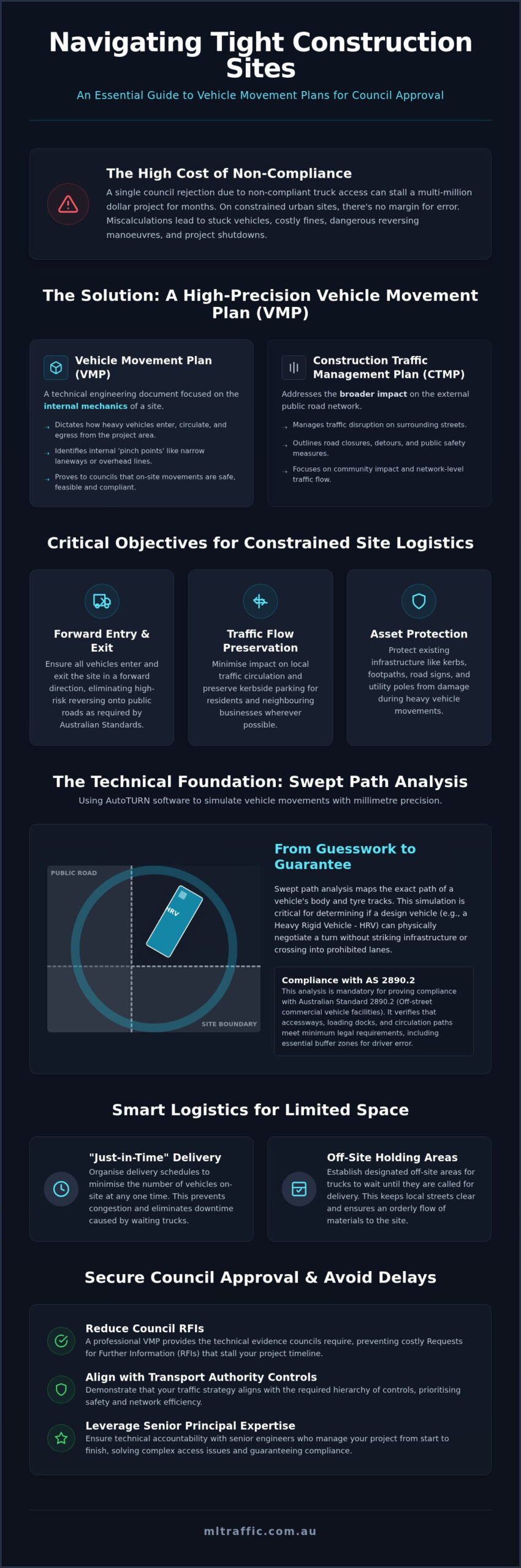
A vehicle movement plan for tight construction sites is a high-precision engineering document that dictates how heavy vehicles enter, circulate, and egress from a project area. Unlike greenfield developments where space is abundant, constrained urban sites require an analysis of every millimetre within the road reserve and site boundary. This discipline relies on the core principles of traffic engineering to manage vehicle dynamics within limited spatial envelopes. Professional planners use these documents to prove to local councils that a project is viable without causing gridlock on the surrounding network. These plans serve as the technical blueprint for maintaining operational safety in high-density environments.
To better understand the practical application of site logistics, watch this helpful video:
While a Construction Traffic Management Plan (CTMP) addresses the broader impact on the road network, the VMP focuses on the internal mechanics of the site. It identifies “pinch points” where a single miscalculation can halt all movement. Developing a robust vehicle movement plan for tight construction sites requires identifying these bottlenecks early. Common constraints include narrow laneways that barely accommodate a Heavy Rigid Vehicle (HRV), overhead power lines, and high-pedestrian zones that complicate access timings. Without a clear plan, these factors lead to congestion, fines, and project delays.
Key Objectives for Constrained Site Logistics
The primary goal is maintaining site velocity without compromising safety or public access. A well-engineered plan focuses on three critical outcomes:
- Forward Entry and Exit: Ensuring all vehicles enter and exit in a forward direction to eliminate high-risk reversing manoeuvres onto public roads, as required by Australian Standards.
- Traffic Flow Preservation: Minimising the impact on local traffic flow and preserving kerbside parking for residents and neighbouring businesses.
- Asset Protection: Protecting existing infrastructure such as kerbs, footpaths, and utility poles from damage during heavy vehicle movements.
When is a Professional VMP Mandatory?
Councils in high-density urban centres mandate a professional VMP for most Development Applications (DA). This is especially true for projects involving HRVs or articulated vehicles (AV). If your site features limited frontage or steep driveway gradients, you must prove vehicle clearance before works begin. Failing to provide this technical evidence often results in costly Requests for Further Information (RFIs) that stall your timeline. At ML Traffic Engineers Australia, we specialise in these technical assessments. We ensure that the same principal who starts your project performs the actual engineering work to guarantee accountability and compliance throughout the DA process.
Using Swept Path Analysis for Precise Vehicle Movement
Swept Path Analysis represents the technical foundation of any effective vehicle movement plan for tight construction sites. We use industry-standard AutoTURN software to simulate real-world vehicle dimensions and turning circles with millimetre precision. This process moves beyond guesswork by mapping the exact path of a vehicle’s body and its tyre tracks. For constrained urban sites, these simulations determine whether a design vehicle can physically negotiate a turn without striking permanent infrastructure or crossing into prohibited traffic lanes.
Compliance with AS 2890.2 is mandatory for off-street commercial vehicle facilities. This standard dictates the minimum requirements for access and loading areas. Our analysis factors in essential “buffer zones” to account for site variability and driver error. While a software simulation might show a 100mm clearance, real-world conditions require a larger safety margin to prevent site damage. We also analyse vertical clearances for projects involving basement loading docks or covered access points. This ensures that the height of the design vehicle, including its exhaust stacks or cooling units, clears all overhead obstructions.
The Step-by-Step Technical Analysis Process
Executing a precise swept path requires a methodical approach. We follow a rigorous four-step sequence to ensure technical accuracy:
- Step 1: Identify the largest design vehicle required for the construction phase, such as an 8.8-metre Heavy Rigid Vehicle (HRV) or a 19-metre Articulated Vehicle (AV).
- Step 2: Map the existing road geometry, including kerb lines, traffic islands, and site entry points.
- Step 3: Run simulations for every required manoeuvre, including entry, internal circulation, and forward egress.
- Step 4: Adjust site hoarding, gate locations, or temporary structures based on simulation failures to create a viable access route.
Critical Compliance Checks for Swept Paths
A simulation is only valid if it meets regulatory safety criteria. We verify that vehicle paths don’t encroach on opposing traffic lanes where such movements are prohibited by local councils. We also check for adequate clearance from street furniture, utility poles, and existing trees. Articulated vehicles present unique challenges due to their “swing-out” characteristics and significant blind spots. Our engineers meticulously map these swing-out areas to ensure they don’t pose a risk to pedestrians or adjacent property. If you’re facing a site layout that appears impossible to navigate, our vehicle swept path analysis services provide the technical proof needed to secure approval.
Organising Site Logistics: Staging and Scheduling for Limited Space
Managing a constrained site is a complex logistical balancing act. A vehicle movement plan for tight construction sites only succeeds if deliveries are perfectly synchronised with site capacity. Just-in-time (JIT) delivery schedules are essential in this context. They prevent a queue of concrete agitators or steel delivery trucks from blocking public thoroughfares. If the site can only handle one Heavy Rigid Vehicle (HRV) at a time, the second vehicle must remain at a designated off-site holding area. These areas are typically located in nearby industrial zones where trucks can wait without impacting local traffic until the site foreman provides clearance via radio.
Managing Heavy Vehicle Arrivals
Space constraints often force difficult manoeuvres within the site boundaries. Our goal is to minimise reversing through the strategic placement of site sheds, cranes, and material storage. When reversing is unavoidable, the use of trained spotters and traffic controllers is mandatory under Australian safety regulations. These personnel manage pedestrian interfaces and guide drivers through the tight clearances identified during the engineering phase. Clear communication via two-way radio allows the foreman to confirm the site is clear before a vehicle enters the gate, preventing “pinch point” blockages.
Integrating Swept Path Analysis into daily site inductions ensures every driver understands the physical limits of the site. This technical data shouldn’t stay in the office; it belongs on the site board where it’s visible to all personnel. As the project moves from excavation to structural and finally fit-out phases, the site footprint changes. A vehicle movement plan for tight construction sites must be reviewed and updated whenever site hoarding moves or internal storage areas are relocated. This ensures that the engineering logic used for heavy machinery during excavation still applies as the project evolves.
Navigating Regulatory Compliance and Council Approvals
Securing approval for a vehicle movement plan for tight construction sites requires navigating a multi-layered regulatory environment. You must satisfy the requirements of local councils, state transport authorities, and occasionally the police for high-impact movements. A failure to coordinate these stakeholders often results in project delays. While many contractors confuse a Traffic Guidance Scheme (TGS) with a VMP, they serve distinct purposes. A TGS illustrates the placement of signage and barriers on public roads to protect workers and the public. Conversely, a VMP is a technical engineering document mapping the specific physics of vehicle ingress and egress within the site’s constrained boundaries.
A professionally engineered VMP is your primary tool for reducing Requests for Further Information (RFIs). Councils scrutinise these plans to ensure that heavy vehicle movements don’t compromise public safety or damage infrastructure. Developing a robust vehicle movement plan for tight construction sites allows you to address community concerns regarding noise, dust, and traffic disruption before they become formal objections. Meticulous planning demonstrates to the council that you have considered the impact on local residents and have a viable mitigation strategy in place. This proactive approach builds trust with planning officers and accelerates the approval timeline.
Common Pitfalls in DA Traffic Reports
Many Development Applications (DA) fail because the submitted traffic reports lack technical rigour. We frequently see reports that fail to account for real-world variables. Common errors include:
- Using generic vehicle templates that don’t match the modern fleet sizes actually used by subcontractors.
- Ignoring the presence of permanent kerbside parking, which significantly narrows the effective road width for turning circles.
- Proposing “illegal” movements that violate local traffic ordinances, such as reversing onto a classified road or crossing double white lines.
- Failing to account for the vertical clearance of overhead utility lines or low-hanging trees.
The Value of Expert Engineering Testimony
When a site is exceptionally constrained, standard codes might be impossible to meet. In these cases, you need data-backed evidence to justify a departure from standard requirements. Providing a comprehensive Traffic Impact Assessment allows you to anticipate and answer council objections through quantitative analysis. Our senior principals are directly involved in every project, ensuring that the engineer who performs the assessment is the one who presents the findings. Every plan is signed off by a qualified Traffic Engineer, ensuring it meets the professional standards required for legal and regulatory scrutiny. If you require a compliant traffic strategy that stands up to council review, contact our experts today for a technical consultation.
Why Professional Traffic Engineering is Critical for Site Success
Professional traffic engineering serves as the final safeguard against project failure on constrained urban developments. A vehicle movement plan for tight construction sites demands more than a basic understanding of safety; it requires the technical precision of a qualified engineer to navigate the physical and bureaucratic hurdles that often derail projects. With over 15 years of experience in the Australian market, ML Traffic Engineers Australia specialises in solving complex access puzzles that others might find impossible. We move beyond “cookie-cutter” templates to deliver bespoke site solutions that reflect the unique geometry of each development. This authoritative approach ensures that every simulation and report stands up to the most rigorous council scrutiny.
Engaging a professional early in the design phase often saves developers thousands of dollars in rework. By identifying access limitations before building footprints or basement ramps are finalised, we ensure that the site remains operational throughout every construction phase. This proactive engineering prevents the need for expensive structural modifications or the last-minute relocation of site gates. Our senior principals provide direct accountability, ensuring that technical rigour is maintained from the first assessment to the final project handover. We focus entirely on demonstrating expertise through results rather than unnecessary narrative or flashy presentations.
The ML Traffic Engineers Australia Approach
We specialise in turning “impossible” tight sites into compliant, workable plans. Our Traffic Engineering services cover the full project lifecycle, from initial feasibility to final council sign-off. Unlike larger firms that delegate technical work to junior staff, we maintain a commitment to senior-level oversight on every vehicle movement plan for tight construction sites. This ensures that the professional who initiates the relationship is the one performing the complex swept path simulations and regulatory analysis. Our clients receive direct access to leadership, which eliminates the gatekeepers typically found in larger consultancies and ensures project continuity.
Ready to Secure Your Site Approval?
Don’t let access issues stall your development application or lead to costly council rejections. Our senior principals provide direct accountability and the technical rigour required to secure approvals in the most challenging urban environments. We handle the technicalities and bureaucratic requirements so you can focus on construction. Contact our senior principals today for a confidential discussion about your site and learn how we can streamline your logistics. Get in touch with ML Traffic Engineers Australia to ensure your project remains compliant, safe, and on schedule.
Optimise Your Site Logistics for Success
Transitioning from theoretical planning to practical site execution requires more than a simple checklist. A robust vehicle movement plan for tight construction sites acts as a high-level risk mitigation strategy that protects your project timeline and your bottom line. By integrating advanced engineering simulations with real-world logistical constraints, you ensure that every heavy vehicle movement is both safe and compliant with national standards. This technical foundation is what allows a project to proceed without the constant threat of council interventions or logistical gridlock.
ML Traffic Engineers Australia leverages over 15 years of specialised experience to transform high-risk urban access into a streamlined operational advantage. Our unique approach ensures that a senior principal is involved in every technical report, maintaining strict adherence to AS 2890.1 and AS 2890.2. The difference between a stalled development and a successful build often lies in the precision of your traffic engineering data. Whether you are managing complex phase transitions or seeking to eliminate council RFIs, our team provides the technical rigour required for success.
Secure the technical expertise your project demands today. Consult with our Senior Traffic Engineers for your VMP and move forward with absolute certainty. We look forward to providing the engineering solutions that keep your site moving.
Frequently Asked Questions
What is the difference between a VMP and a TGS?
A Vehicle Movement Plan (VMP) focuses on the internal mechanics and physics of vehicle ingress and egress within the site boundaries. A Traffic Guidance Scheme (TGS) focuses on external traffic control devices like signs and bollards on public roads. While a TGS protects the public and workers on the road reserve, a VMP ensures the design vehicle can physically navigate the site’s constrained geometry without damaging infrastructure or property.
Does my tight construction site really need a Swept Path Analysis?
Yes, if your site has limited clearance or complex access points, a Swept Path Analysis is essential for council approval. It provides technical proof that heavy vehicles can negotiate the site without striking permanent structures. Councils often mandate this analysis to prevent illegal reversing manoeuvres onto public roads. Using AutoTURN software, we verify that your vehicle movement plan for tight construction sites is physically viable before you begin works.
Which Australian Standards govern vehicle movement on sites?
The primary standards are AS 2890.1: Parking facilities, Off-street car parking and AS 2890.2: Parking facilities, Off-street commercial vehicle facilities. These documents specify the minimum turning circles, gradients, and clearances required for different vehicle classes. Compliance with these standards is a core requirement for most Development Applications in Australian urban centres. Our reports ensure your site layout adheres strictly to these national regulatory requirements to avoid project rejections.
Can I use a standard truck for my swept path analysis, or do I need specific dimensions?
You must use the specific dimensions of the largest vehicle expected on site, often referred to as the design vehicle. Using a standard truck template is a common pitfall because modern fleet dimensions vary significantly. We utilise accurate vehicle profiles in AutoTURN to reflect actual Heavy Rigid Vehicles (HRV) or Articulated Vehicles (AV). This precision prevents costly on-site errors where a truck cannot physically clear a gate, laneway, or overhead obstruction during delivery.
How much detail does a local council require for a vehicle movement plan?
Councils require a high level of technical detail, including scaled drawings showing the exact swept paths of design vehicles. Your plan must identify entry and exit points, internal circulation routes, and any required traffic control personnel. It should also address the timing of deliveries to avoid local peak hours. A professionally engineered vehicle movement plan for tight construction sites reduces the likelihood of receiving a Request for Further Information (RFI) from planning officers during the assessment.
What happens if a vehicle cannot enter or exit my site in a forward direction?
Reversing onto a public road is generally prohibited by Australian councils due to significant safety risks. If forward entry and exit are physically impossible, you must implement strict traffic management controls, such as dedicated spotters and temporary road closures. In many cases, you’ll need to redesign site hoarding or gate locations to achieve a compliant forward-moving solution. Our engineers specialise in solving these complex access puzzles to secure DA approval for constrained urban developments.
How often should a Vehicle Movement Plan be updated during construction?
A VMP is a live document that requires updating whenever the site layout changes significantly. This typically occurs during transitions between major project phases, such as moving from excavation to structural works or internal fit-out. If hoarding is relocated or a new crane is installed, the original swept paths may no longer be valid. Regular reviews ensure ongoing compliance with safety standards and prevent logistical bottlenecks that can lead to fines as the site footprint evolves.

Disclaimer
The content on www.mltraffic.com.au, including all technical articles, guides, and resources, is provided for general informational and educational purposes only. It is not intended to constitute professional advice in traffic engineering, transportation planning, development approvals, or any other technical or legal field.
While ML Traffic Engineers makes every reasonable effort to ensure the accuracy, completeness, and timeliness of the information published, we do not provide any warranties or representations (express or implied) regarding its reliability, suitability, or availability for any particular purpose. Any reliance you place on the content is strictly at your own risk.
In no event shall ML Traffic Engineers, its directors, employees, authors, or affiliates be liable for any direct, indirect, incidental, special, consequential, or punitive damages (including, without limitation, loss of profits, data, or business opportunities) arising out of or in connection with the use of, or inability to use, any information provided on this website.
The articles and guides on this site are not a substitute for engaging a qualified, registered professional traffic engineer (such as an NPER or RPEQ engineer) to assess your specific project requirements. For tailored advice, compliance assessments, or traffic engineering services, please contact a competent professional.
This disclaimer may be updated from time to time without notice. By accessing or using this website, you agree to be bound by the most current version of this disclaimer.
