

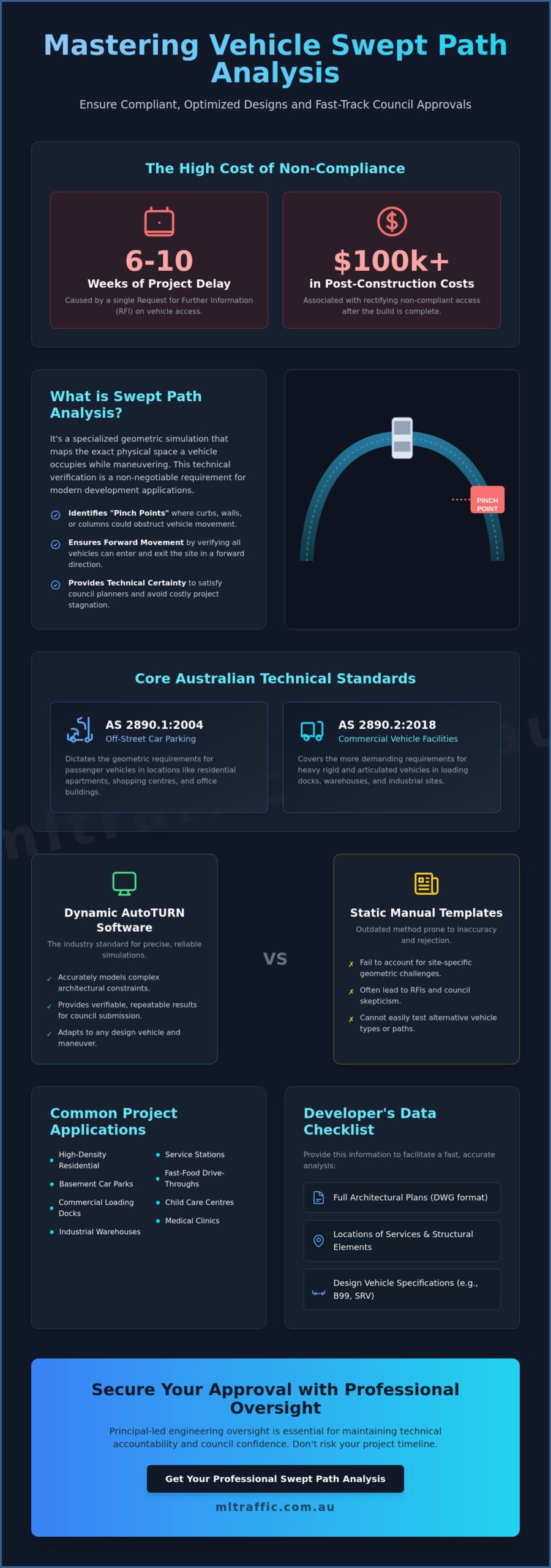
A single Request for Further Information (RFI) regarding vehicle access can stall your development for six to ten weeks, often at the most critical stage of the planning process. You likely view these technical requirements as a frustrating bureaucratic hurdle that threatens your site yield and project timeline. Interpreting complex standards like AS 2890.1:2004 and AS 2890.2:2018 is difficult, especially when every square metre of your site is valuable. It’s a common challenge to see a layout compromised by inefficient access design that fails to meet strict council expectations.
This article provides the technical certainty you need to master vehicle swept path analysis adelaide, ensuring your layout is both compliant and optimized for maximum density. You will learn how to secure fast-tracked council approvals by adhering to the latest 2026 industry standards and utilizing specialized software like AutoTURN. We will examine the specific requirements for visibility triangles, the impact of increasing vehicle sizes on parking bay lengths, and how professional assessments prevent the $100,000 costs often associated with post-construction modifications.
Key Takeaways
- Learn how digital maneuvering simulations act as a critical tool for securing planning approvals and optimizing site density.
- Differentiate between the technical requirements of AS 2890.1 for off-street parking and AS 2890.2 for commercial vehicle facilities.
- Recognize the advantages of dynamic AutoTurn software over static templates for interpreting complex architectural constraints.
- Prepare a comprehensive data checklist, including DWG files and service locations, to facilitate a professional vehicle swept path analysis adelaide.
- Understand why principal-led engineering oversight is essential for maintaining technical accountability and council confidence.
What is Vehicle Swept Path Analysis for Adelaide and National Projects?
Vehicle swept path analysis is a specialized geometric simulation used to map the horizontal footprint of a vehicle as it executes a specific maneuver. This process relies on fundamental vehicle turning principles to ensure that proposed site layouts are physically viable before any construction begins. By modeling the precise geometric boundaries of a design vehicle, engineers identify “pinch points” where curbs, walls, or columns might obstruct movement. This technical verification is a non-negotiable requirement for modern development applications.
Professional vehicle swept path analysis adelaide provides the technical certainty required to satisfy council planners and avoid project stagnation. A Request for Further Information (RFI) regarding non-compliant access typically delays a project by six to ten weeks, often at the most critical stage of the planning process. Our senior principals use industry-standard software to simulate vehicle movements against your CAD site plans. This process identifies potential collisions in your layout, allowing for adjustments that protect your site yield while maintaining strict compliance with national standards.
To better understand this concept, watch this technical demonstration:
The Role of Swept Paths in the Planning Process
The primary function of a swept path report is to establish proof of access for residential, commercial, and industrial developments. Modern planning authorities require these simulations to ensure that every vehicle can enter and exit a site in a forward direction without compromising safety. Swept path analysis is the technical verification of a vehicle’s horizontal envelope during a turn. This verification ensures that your development complies with national safety and accessibility guidelines from the earliest design phase, reducing the risk of costly post-construction modifications.
Common Project Environments Requiring Analysis
Technical assessments are necessary across a vast range of project types where vehicle movement is a critical operational factor. Our expertise covers high-density residential developments and basement car parks where structural columns create tight maneuvering tolerances. We also provide simulations for commercial loading docks and service vehicle access points to ensure efficient logistics. Other common environments include service stations, fast-food drive-throughs, child care centres, medical clinics, and industrial warehouses where large rigid or articulated vehicles require specific turning radii to function safely.
Technical Standards: Integrating AS 2890.1 and AS 2890.2
Compliance with Australian Standards is the foundation of any successful development application. For projects in South Australia, vehicle swept path analysis adelaide must demonstrate strict adherence to AS 2890.1:2004 and AS 2890.2:2018. These documents dictate the geometric requirements for every vehicle maneuver on your site. AS 2890.1 focuses on off-street car parking for passenger vehicles, while AS 2890.2 covers the more demanding requirements for commercial vehicle facilities and heavy rigid vehicles. Failing to integrate these standards correctly often leads to layouts that are physically impossible for larger vehicles to navigate.
Successful site optimization requires integrating these standards during the initial design phase. We use these benchmarks to validate aisle widths, turn-around areas, and ramp grades. A common failure in DA submissions is the presence of “blind aisles” without adequate turning provisions. Our analysis ensures that every vehicle can enter and exit the site in a forward direction; this is a non-negotiable requirement for most metropolitan councils. Professional vehicle swept path analysis adelaide verifies that your site functions safely under peak demand without compromising structural integrity.
Design Vehicle Selection for Australian Projects
Selecting the correct design vehicle is a technical decision that directly impacts site yield. The B99 vehicle is the standard for 99.9% of passenger cars in Australia, measuring 5.2 metres in length. For commercial access, we assess Small Rigid Vehicles (SRV) at 6.4 metres and Heavy Rigid Vehicles (HRV) at 12.5 metres. Industrial hubs often require Articulated Vehicle (AV) simulations, specifically the 19-metre articulated vehicle, to ensure loading docks remain functional without compromising safety or blocking public roads.
Aisle Width and Maneuvering Clearance
Aisle widths are not arbitrary figures. They are calculated based on the design vehicle’s turning circle and the required clearance from fixed objects like pillars, walls, or landscaping. Our simulations strictly follow these parameters:
- 300mm Clearance Rule: We maintain a minimum 300mm buffer between the vehicle’s swept path envelope and any permanent structure.
- 90-Degree Maneuvers: These require the widest aisles to accommodate the vehicle’s body swing during the turn.
- Angled Parking: While angled bays can optimize narrow sites, they necessitate specific one-way circulation patterns that must be verified through simulation.
- Visibility Triangles: We ensure a 2.0m by 2.5m clear visibility area at the property boundary to protect pedestrians.
Our team provides technical certainty by ensuring your car park design aligns with these rigorous national metrics from the first draft. This proactive approach prevents the need for expensive modifications after the concrete is poured.
AutoTurn Simulations vs. Manual Turning Templates
Manual turning templates were once the standard tool for traffic engineers, but they’re now largely obsolete for professional vehicle swept path analysis adelaide. These static, 2D overlays lack the technical rigor required by modern planning authorities. A manual template represents a single, fixed radius that doesn’t account for the dynamic transition as a driver turns the steering wheel. This limitation often leads to “over-designing” access paths. When you use conservative manual methods, you waste valuable site area on unnecessarily wide aisles, directly compromising your site yield and project profitability.
Dynamic software like AutoTurn 2026 has become the industry standard because it models real-world vehicle physics. It accounts for steering lock, vehicle speed, and the complexity of multi-point maneuvers. For instance, a heavy rigid vehicle doesn’t follow a perfectly circular path; its body swing and tail swing change based on the angle of articulation. Digital simulations provide the accuracy needed to design “tight but right” layouts that maximize every square metre while ensuring operational safety. This precision is essential for modern developments where basement space and loading docks are increasingly constrained.
The Precision Advantage of Digital Swept Paths
Digital analysis allows us to overlay vehicle paths directly onto your CAD site plans with millimetre precision. We can simulate specific driver behaviors, such as the delay in steering response or the need for a three-point turn in a confined space. This capability enables rapid iteration. If a simulation identifies a collision with a structural pillar, we can adjust the layout and re-run the path in minutes. This iterative process ensures the final design is the most efficient version possible, protecting your investment from the start.
Why Manual Templates Risk Council Rejection
Local councils in Adelaide and across Australia now expect digital proof of access as a standard component of a Development Application. Manual templates fail to address several critical factors:
- Vertical Clearances: Manual methods cannot model the impact of ramp grades on vehicle “hang-up” or overhead clearance.
- Multi-Part Maneuvers: Complex reverse-in and forward-out movements for service vehicles are nearly impossible to map accurately with static templates.
- Regulatory Scrutiny: Planning officers view manual templates as less reliable, which often triggers a Request for Further Information (RFI).
The high cost of design revisions after a council rejection far outweighs the initial investment in professional vehicle swept path analysis adelaide. By providing a CAD-based simulation, you offer the technical certainty that planning authorities require for a fast-tracked approval. Our senior principals perform this work personally, ensuring that the simulations are not just software outputs but expert-verified engineering solutions.
Preparing Your DA: A Developer’s Data Checklist
Data precision is the most significant factor in securing a fast-tracked council approval. To perform a rigorous vehicle swept path analysis adelaide, we require clean, unencrypted CAD files in DWG or DXF format. These files must include the latest architectural revisions to ensure the simulation reflects the physical reality of the site. Inaccurate site boundaries or missing structural details lead to RFIs that stall your project for weeks. Providing a complete data set from the outset allows our senior engineers to identify potential access issues before they become permanent structural constraints.
Your data checklist for a successful submission should include:
- Clean CAD Files: Provide DWG or DXF files with clear layers for site boundaries and structural elements.
- Fixed Constraints: Mark all structural pillars, retaining walls, landscaping zones, and utility services like fire boosters or electrical substations.
- End-Use Requirements: Define the heaviest vehicle expected on site, such as a waste collection truck or a furniture delivery van.
- Maneuver Protocols: Specify if vehicles must enter and exit in a forward direction, which is a standard requirement for most Adelaide councils.
Essential CAD Data and Site Constraints
Architectural plans must do more than show horizontal space; they need to account for verticality. Ensure your site plans include existing and proposed levels and gradients, as these are essential for a driveway ramp grade assessment. We also require clearly marked overhead clearances for basement entries, mezzanine levels, and any overhanging building elements. A successful analysis requires four primary data points: the site plan, the design vehicle type, the required maneuver sequence, and the exact location of all physical obstacles.
Defining Service Vehicle Requirements
Consulting with waste management and delivery providers early in the design phase prevents the need for expensive post-construction modifications. You must determine if your site needs to accommodate a Medium Rigid Vehicle (MRV) or a Heavy Rigid Vehicle (HRV) based on its commercial or industrial end-use. These requirements are often linked to the broader Traffic Impact Assessment, which evaluates how your development interacts with the surrounding road network. Identifying these needs early ensures your site layout remains functional without sacrificing valuable site yield.
Consult with our senior principals to finalize your vehicle swept path analysis adelaide and avoid costly design revisions.
Securing Approval with Professional Engineering Oversight
Council planning officers prioritize technical certainty and regulatory compliance above all else. A report signed by a senior engineer with national certification carries significantly more weight during the assessment process than a generic layout. By engaging ML Traffic Engineers Australia, you ensure your vehicle swept path analysis adelaide is performed by experts who understand the specific bureaucratic requirements of local authorities. This high level of professional oversight reduces the likelihood of receiving an RFI, which directly fast-tracks your approval timeline. Technical accountability is the cornerstone of our consultancy; it provides you with a reliable foundation for your development application.
The Professional Traffic Engineer Advantage
Direct access to leadership is a core signature of our professional service. You won’t deal with gatekeepers or administrative layers; you speak directly with the senior principals responsible for your technical work. This personnel continuity promise means the expert who initiates your project is the one performing the vehicle swept path analysis adelaide. Our principal-led approach eliminates communication errors and ensures every technical decision is backed by decades of practical experience. ML Traffic Engineers Australia has solved complex access challenges across thousands of diverse project environments nationwide, including:
- High-density residential basements and multi-deck car parks.
- Industrial logistics hubs and heavy vehicle loading docks.
- Service stations, fast-food drive-throughs, and child care centres.
- Medical clinics, retail shopping centres, and mixed-use developments.
- Educational campuses and community infrastructure projects.
Every report we produce meets the meticulous standards of AS 2890.1 and AS 2890.2. This rigorous adherence to national guidelines provides the technical proof councils need to approve complex site layouts without hesitation.
Optimizing Site Yield and ROI
Professional swept path analysis is a strategic tool for maximizing your return on investment. Precise digital simulations allow us to reclaim square footage that might otherwise be lost to overly conservative manual design methods. By identifying the exact maneuvering requirements, we can often reduce aisle widths or optimize parking bay placement. This creates space for additional yield or improved landscaping. This level of precision prevents unnecessary over-engineering and reduces overall construction costs. A layout that is “tight but right” maximizes land value while ensuring operational safety for all users. It’s a results-oriented approach that prioritizes your project’s profitability. Contact our senior engineers for a project-specific swept path assessment.
Secure Your Site Layout and Planning Approval
Securing a successful development application requires more than just meeting basic requirements. It demands technical precision and a deep understanding of how vehicles interact with your specific site constraints. By moving beyond static manual templates and utilizing dynamic AutoTurn simulations, you protect your project from the 6 to 10 week delays often caused by council RFIs. This professional approach ensures your layout is both compliant and optimized for maximum density and yield.
Our team brings over 15 years of specialist traffic engineering experience to every vehicle swept path analysis adelaide. We provide technical certainty by guaranteeing compliance with AS 2890.1 and AS 2890.2. Every assessment undergoes Senior Principal oversight to ensure the highest standards of accuracy and accountability. This direct access to leadership means your project remains in expert hands from the initial data checklist through to final council submission.
Don’t let inefficient access design compromise your site’s potential or project timeline. Get a professional Swept Path Analysis for your project to secure your planning approval with confidence. We’re ready to help you optimize your development layout.
Frequently Asked Questions
What is vehicle swept path analysis and when is it required?
Vehicle swept path analysis is a digital simulation used to map the horizontal envelope of a vehicle during a maneuver. It is required for most Development Applications where councils must verify that vehicles can safely navigate the site without colliding with structures. A professional vehicle swept path analysis adelaide ensures that your site layout functions correctly for its intended use, from residential driveways to industrial loading docks.
Does my small residential development need a swept path report?
Small residential developments often require these reports if they feature basement parking or shared access ways. Councils typically mandate that all vehicles enter and exit a property in a forward direction. A swept path assessment provides the technical proof that your layout allows for these maneuvers within the constrained footprint of a high-density site, protecting your project from planning delays.
Which Australian Standards govern vehicle maneuvering and access?
The primary standards are AS 2890.1:2004 for passenger vehicles and AS 2890.2:2018 for commercial facilities. These standards define the geometric requirements for parking bays, aisle widths, and heavy vehicle maneuvering. Adherence to these benchmarks is critical for securing planning approval and ensuring operational safety across all Australian project environments, including high-density urban developments.
What is the difference between a B99 and an HRV design vehicle?
The B99 vehicle is a 5.2 metre standard used to represent 99.9% of passenger cars in Australia. In contrast, a Heavy Rigid Vehicle (HRV) is a 12.5 metre commercial vehicle used for loading dock and service area assessments. Choosing the correct design vehicle is essential to prevent under-designing access paths or wasting site area on unnecessary clearances that compromise site yield.
Can I provide my own turning templates for council submission?
Static turning templates are rarely accepted by modern planning authorities due to their lack of precision. Dynamic software like AutoTurn is the industry standard because it models steering lock transitions and vehicle physics accurately. Councils view professional simulations as more reliable evidence of site functionality than manual, 2D overlays, which often fail to account for real-world driver behavior.
What data do I need to provide for a professional swept path analysis?
Developers must provide clean CAD files in DWG or DXF format showing accurate site boundaries and structural constraints. This data set should include the locations of pillars, walls, landscaping, and utility services like fire boosters. Providing comprehensive information from the outset allows for a more accurate vehicle swept path analysis adelaide and prevents the need for expensive design revisions later in the process.
How long does it typically take to produce a swept path report?
Technical reports are typically finalized within three to five business days following the receipt of accurate site plans. The timeline depends on the complexity of the maneuvers and the number of design vehicles required for the assessment. Senior principal involvement ensures that the work is performed efficiently without sacrificing the technical rigor required for council trust and accountability.
How does swept path analysis help in avoiding council RFIs?
Professional assessments identify non-compliant design elements before your application reaches the planning officer. By addressing “pinch points” and clearance issues early, you eliminate the technical errors that trigger a Request for Further Information (RFI). This proactive approach prevents the average 6 to 10 week delays associated with council inquiries and fast-tracks your project toward a successful approval.

Disclaimer
The content on www.mltraffic.com.au, including all technical articles, guides, and resources, is provided for general informational and educational purposes only. It is not intended to constitute professional advice in traffic engineering, transportation planning, development approvals, or any other technical or legal field.
While ML Traffic Engineers makes every reasonable effort to ensure the accuracy, completeness, and timeliness of the information published, we do not provide any warranties or representations (express or implied) regarding its reliability, suitability, or availability for any particular purpose. Any reliance you place on the content is strictly at your own risk.
In no event shall ML Traffic Engineers, its directors, employees, authors, or affiliates be liable for any direct, indirect, incidental, special, consequential, or punitive damages (including, without limitation, loss of profits, data, or business opportunities) arising out of or in connection with the use of, or inability to use, any information provided on this website.
The articles and guides on this site are not a substitute for engaging a qualified, registered professional traffic engineer (such as an NPER or RPEQ engineer) to assess your specific project requirements. For tailored advice, compliance assessments, or traffic engineering services, please contact a competent professional.
This disclaimer may be updated from time to time without notice. By accessing or using this website, you agree to be bound by the most current version of this disclaimer.
