

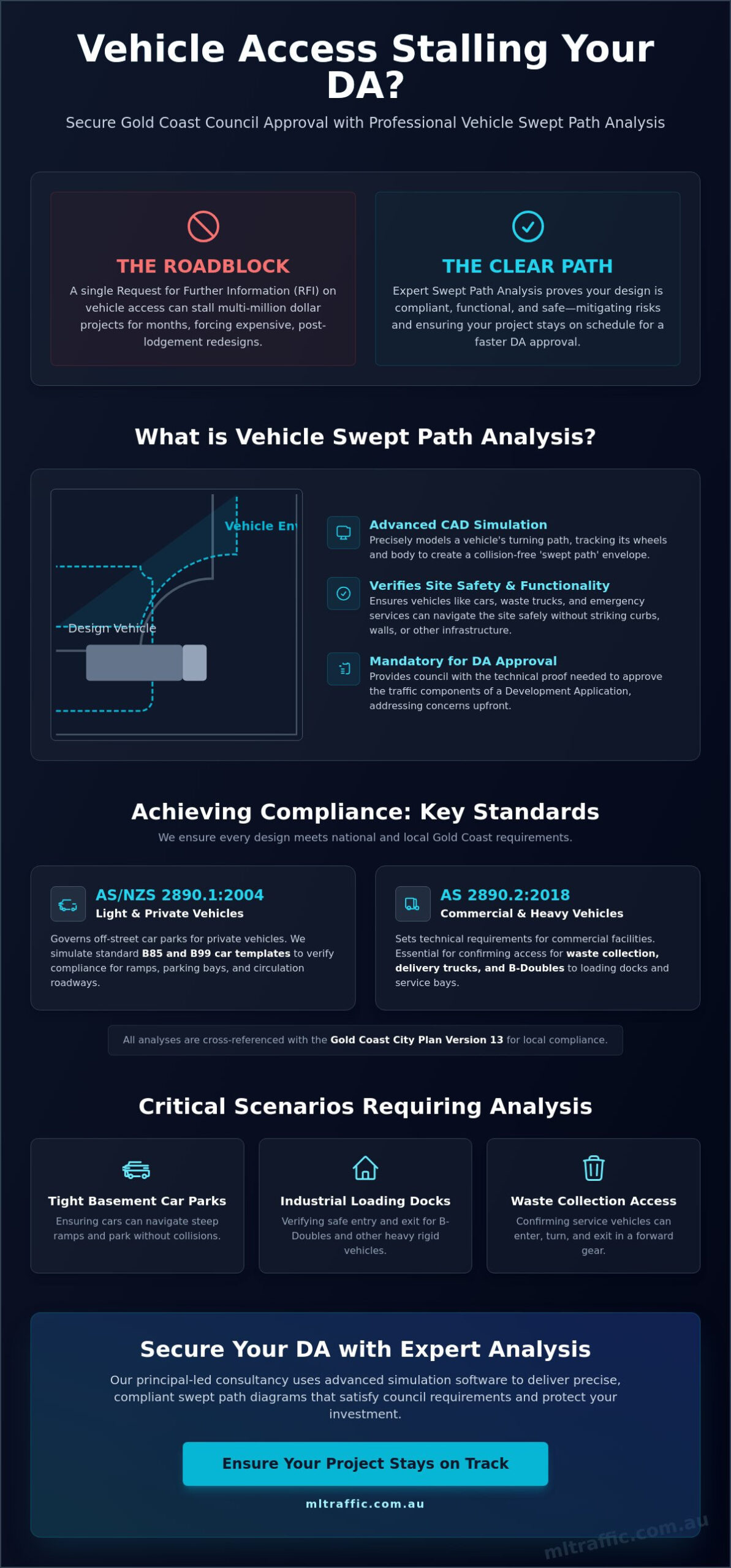
A single Request for Further Information (RFI) regarding vehicle access can stall a multi-million dollar development for months. You likely already know that the Council of the City of Gold Coast maintains rigorous standards for site access and maneuverability. Failing to account for the exact turning requirements of a heavy rigid vehicle or a standard B99 car often results in expensive redesigns after you’ve already lodged your DA. Utilizing professional vehicle swept path analysis gold coast is the most reliable way to mitigate this risk and ensure your project remains on schedule.
It’s frustrating to face delays because a waste truck cannot technically clear a basement ramp or a driveway gradient doesn’t meet AS/NZS 2890.1:2004 requirements. We’ll show you how to leverage AutoTURN 2026 simulations to secure council compliance and prevent design errors before they become permanent. This guide covers the essential technical standards, including the latest City Plan Version 13 updates and the AS 2890.2:2018 commercial vehicle requirements. You’ll learn how to produce a site layout that is functionally efficient, safe, and ready for a fast DA approval.
Key Takeaways
- Understand why computer-simulated vehicle movements are mandatory for Australian Development Applications to prevent costly post-lodgement design errors.
- Ensure your site layout achieves full compliance with AS 2890.1 for light vehicles and AS 2890.2 for commercial facilities.
- Learn how professional vehicle swept path analysis gold coast utilizing AutoTURN software replaces outdated manual templates to meet strict council standards.
- Identify critical maneuvering requirements for complex scenarios, including tight residential basement car parks and industrial B-Double loading docks.
- Benefit from a principal-led consultancy model that ensures senior expertise and accountability throughout the entire traffic engineering process.
What is Vehicle Swept Path Analysis and Why is it Critical for DAs?
Vehicle swept path analysis is a technical CAD-based simulation that tracks the outer path of a vehicle’s body and its wheel paths during various maneuvers. This assessment ensures that the physical dimensions of a vehicle, known as the envelope, do not collide with curbs, walls, or other vehicles within a proposed site. For developers seeking council approval, a vehicle swept path analysis gold coast is a mandatory requirement to prove that the proposed site can accommodate the specific design vehicles intended for the land use. It’s a fundamental step in demonstrating that a site is safe and functional before any construction begins.
The process establishes operational feasibility for essential services. If a site cannot accommodate a standard waste collection vehicle, an ambulance, or a delivery truck, the design is fundamentally flawed. Engineers use specialised software to model these movements with precision. This ensures that the design vehicle can navigate every corner without crossing into opposing traffic lanes or striking infrastructure. This early technical intervention prevents colossal costs associated with post-construction modifications. Our team provides these detailed assessments as part of our comprehensive traffic engineering services.
To better understand how these simulations function in a design environment, watch this demonstration of vehicle tracking software:
The Role of Swept Path Analysis in Planning Approvals
Gold Coast planning officers utilize these diagrams to evaluate safety and traffic flow efficiency. A common hurdle in the development application process is the Request for Further Information (RFI). These requests often arise when a submission lacks clear evidence that vehicles can enter and exit a site in a forward gear. By providing professional vehicle swept path analysis gold coast, you address council concerns regarding the impact on the public road network. This demonstrates that the site layout adheres to the City Plan Version 13 requirements and relevant Australian Standards. Precise diagrams provide the assurance that council engineers need to approve the traffic components of your DA.
The Consequences of Ignoring Vehicle Maneuverability
A site layout that results in a dead-end driveway unable to accommodate a three-point turn for a waste truck will invariably lead to a council rejection or a forced, expensive redesign. There are also significant legal and safety implications if a design forces heavy vehicles to reverse onto high-traffic public roads. Retrofitting basement ramps, widening driveways, or relocating structural columns after the build has commenced creates a massive financial burden. This often exceeds the cost of an initial professional assessment by a significant margin. Ensuring maneuverability at the design stage protects your investment and ensures long-term site safety.
Ensuring Compliance with Australian Standards AS 2890.1 and AS 2890.2
Compliance with national regulatory frameworks is not a suggestion; it’s a mandatory requirement for development on the Gold Coast. Planning authorities rely on two primary standards to evaluate the adequacy of site layouts. AS/NZS 2890.1:2004 covers off-street car parking for private and light vehicles. Conversely, AS 2890.2:2018 provides the technical requirements for off-street commercial vehicle facilities. A professional vehicle swept path analysis gold coast ensures your design meets these specific benchmarks before you submit your DA.
These standards dictate minimum turn radii and clearance requirements based on statistical vehicle data. Engineers utilize the 85th percentile (B85) and 99.8th percentile (B99) vehicle templates to model real-world scenarios. The B85 template accounts for the majority of cars on Australian roads, while the B99 template represents a “worst-case” scenario. Using these templates correctly prevents operational failures and ensures that almost every vehicle that enters your site can navigate it safely. If you are unsure which standard applies to your specific land use, you can contact our senior engineers for direct guidance.
Off-Street Parking for Light Vehicles (AS 2890.1)
AS/NZS 2890.1:2004 is the benchmark for residential and small-scale commercial parking. Designers use the B85 vehicle template for standard parking maneuvers and aisle widths. However, the B99 template is required for accessible (disabled) parking spaces and critical access points to guarantee accessibility. Beyond horizontal movement, this standard also mandates specific clearance heights and ramp gradients. For residential developments with basement parking, these gradients must be carefully calculated to prevent vehicle “grounding” or scraping at the transition points.
Commercial and Heavy Vehicle Access (AS 2890.2)
Designing for industrial sites or retail centers requires adherence to AS 2890.2:2018. This standard distinguishes between the Design Service Vehicle (DSV) and the Check Service Vehicle (CSV). The DSV is used to set the standard dimensions for loading docks and internal roads. The CSV is used to check that larger vehicles can still navigate the site, even if clearances are tighter. Waste management plans are particularly sensitive to these requirements. Councils now demand specific swept path simulations for Heavy Rigid Vehicles (HRVs) to ensure that garbage trucks don’t block public roads while waiting to enter a site. To see how we apply these standards to complex projects, explore our full range of traffic engineering services.
The Technical Process: How Engineers Simulate Vehicle Movements
Modern traffic engineering has moved beyond static assessments to dynamic computer-aided simulations. We utilize industry-standard software like AutoTURN to model realistic vehicle dynamics with high precision. Manual templates or acetate overlays are no longer accepted by most modern planning authorities. These legacy methods fail to account for the complex interaction between steering lock angles, vehicle overhangs, and articulating joints. A professional vehicle swept path analysis gold coast provides a high-fidelity representation of how a specific design vehicle interacts with the built environment.
The simulation process is not merely about drawing lines on a plan. It involves verifying the buildable nature of the path. An engineer must ensure that the proposed movement is achievable by a driver of average skill without excessive shunting or risk of collision. If a path requires unrealistic precision or near-perfect steering, it’s likely to fail in real-world application and will be flagged by council reviewers. This technical rigour is why senior oversight is essential for every vehicle swept path analysis gold coast project we undertake.
Input Variables for Accurate Simulations
Accuracy in simulation depends entirely on the quality of the input data. We set realistic speeds for low-speed maneuvers, typically between 5km/h and 10km/h for confined parking areas and loading docks. Higher speeds naturally result in wider turn radii, while low speeds allow for tighter, more controlled tracking. We also account for lock-to-lock time, which is the duration required for a driver to turn the steering wheel from one extreme to the other. This variable is critical for assessing multi-point turns in tight residential basements or commercial service yards. The software specifically calculates the swept width of a vehicle’s body, which is always wider than its wheel path due to front and rear overhangs during a turn.
Interpreting Swept Path Diagrams
A standard swept path diagram uses distinct coloured lines to represent different vehicle components and safety margins. Usually, one colour tracks the outer chassis envelope, while another tracks the inner and outer wheel paths. We also incorporate a clearance buffer, which is the 300mm minimum safety margin required by most local councils. This buffer ensures that even with minor driver error or vehicle variance, the chassis will not strike structural columns, walls, or curbs. Identifying these conflict points during the design phase allows for immediate adjustments to the site layout. This proactive approach ensures that the final DA submission is both safe and compliant with the Gold Coast City Plan requirements.
Common Scenarios Requiring Detailed Swept Path Diagrams
Different land uses present unique challenges for vehicle maneuverability. Residential developments often involve tight basement car parks where structural columns and tandem spaces complicate the path of a standard car. We model these environments to ensure residents can park and exit without multiple shunts or risk of property damage. Industrial sites require a higher level of technical rigour, specifically for B-Double and semi-trailer access. These larger vehicles exhibit significant rear-axle off-tracking, making precise vehicle swept path analysis gold coast essential for functional loading dock design.
Mixed-use developments introduce the complication of pedestrian safety within shared zones. We analyze the conflict points between high-traffic pedestrian areas and delivery vehicle paths to minimize operational risks. Emergency access is another non-negotiable requirement for any DA submission. Fire appliances must be able to reach all necessary points on a site, including hydrants and booster assemblies, without being obstructed by landscaping or architectural features. If a fire truck cannot navigate the internal road network, the development won’t meet essential safety requirements.
Waste Management and Service Vehicle Access
Council regulations strictly mandate that waste and service vehicles must enter and exit most sites in a forward direction. We simulate the path of a Small Rigid Vehicle (SRV) versus a Medium Rigid Vehicle (MRV) to determine which vehicle type is most suitable for the specific site constraints. This simulation proves to the council that the proposed waste collection area is operationally viable and doesn’t require dangerous reversing maneuvers onto the public road. You can learn more about our AS 2890.1 compliance expertise to see how we handle these light and medium vehicle requirements.
Driveway Ramp and Intersection Analysis
A complete assessment often requires combining swept path analysis with driveway ramp grade assessments. We analyze the entry and exit maneuvers from the public road into the private driveway to ensure the vehicle doesn’t bottom out or scrape during the transition. This intersection analysis also verifies that sight distances are maintained throughout the vehicle’s turning arc. Maintaining a clear line of sight for both the driver and oncoming traffic is critical for safety and council approval. Our team ensures every turn is modeled against the latest City Plan standards to avoid RFIs. If you need technical certainty for your development submission, book a professional vehicle swept path analysis gold coast with our senior principals.
Why Choose ML Traffic Engineers Australia for Your Swept Path Analysis?
Selecting a consultancy for your vehicle swept path analysis gold coast requires a partner who understands the nuances of local regulatory environments. ML Traffic Engineers Australia operates on a Principal-Led model. This is our specific promise that the senior expert who initiates your project is the same professional who performs the technical work and signs the final report. We don’t delegate critical design assessments to junior staff. This approach provides direct technical accountability and removes the barriers common in larger firms. You have direct access to our senior leadership throughout the entire development application process.
Our firm brings over 15 years of experience navigating complex council requirements. We focus on buildable designs that translate into functional site layouts. A simulation is only valuable if it maximizes your site’s yield while maintaining safety. We understand the high value of land on the Gold Coast. Our goal is to ensure compliance with Australian Standards without sacrificing usable space. This meticulous attention to detail is a hallmark of our results-oriented expertise.
Our Commitment to Quality and Compliance
Every report is prepared to withstand rigorous council scrutiny and the risk of traffic-related RFIs. Our vehicle swept path analysis gold coast integrates seamlessly with Traffic Impact Assessments (TIA) for a holistic approach to site access. We maintain rapid turnaround times because we understand that development timelines are strict. This efficiency is achieved through deep technical knowledge and a streamlined review process that never compromises on precision.
Expert Consultation for Your Next Project
Engaging us during the early design phase is a strategic way to save costs. We assist architects and developers by identifying access constraints before the site layout is finalized. This prevents the need for expensive structural changes or basement redesigns after the DA has been lodged. Contact our senior principals today for a tailored quote for your development. You can reach us directly through our Contact ML Traffic Engineers Australia page. We are ready to secure your approval with dependable, senior-led technical assessments.
Secure Your Development Approval with Technical Precision
A successful development application requires more than just a conceptual layout. It demands technical proof that every vehicle, from private cars to heavy rigid waste trucks, can navigate your site safely. Professional vehicle swept path analysis gold coast provides this evidence by aligning your design with the specific requirements of the Gold Coast City Plan. By identifying potential conflict points early, you eliminate the risk of costly RFIs and ensure your site is operationally viable from day one.
ML Traffic Engineers Australia provides over 15 years of specialist traffic engineering experience to every project. Our principal-led approach ensures that a senior expert personally handles your technical simulations, providing direct accountability and deep-seated expertise. We offer comprehensive national coverage for all Australian councils, ensuring your project meets local requirements regardless of location. It’s our goal to provide the technical certainty you need for a seamless submission.
Get an Expert Swept Path Analysis for Your Development Application
We look forward to assisting you in achieving a fast and compliant council approval.
Frequently Asked Questions
What is a vehicle swept path analysis?
A vehicle swept path analysis is a technical simulation that tracks the space occupied by a vehicle’s body and wheels during a specific maneuver. It establishes the “envelope” required for a design vehicle to turn without striking physical obstructions like curbs, walls, or structural columns. This assessment is essential for verifying that a site layout is functionally safe and accessible for its intended use.
Is a swept path diagram mandatory for all Development Applications?
While requirements vary, most medium to large scale projects require a vehicle swept path analysis gold coast to secure council approval. If your development involves basement parking, commercial loading docks, or onsite waste collection, the council will demand technical proof of accessibility. Providing these diagrams in the initial submission often prevents a formal Request for Further Information (RFI) regarding traffic safety.
What vehicles are typically used in a swept path simulation?
The choice of vehicle depends entirely on the land use and council requirements. Residential projects usually focus on B85 and B99 passenger vehicle templates. Conversely, industrial and retail sites require simulations for Heavy Rigid Vehicles (HRV) or articulated vehicles like B-Doubles. We also simulate emergency fire appliances and waste collection trucks to ensure the site meets all essential safety and service standards.
Can swept path analysis help reduce construction costs?
Yes, this analysis identifies critical design errors before construction begins. By discovering that a basement ramp is too narrow or a structural column obstructs a turning path during the design phase, you avoid expensive retrofitting or demolition later. It also helps developers maximize site yield by ensuring that trafficable areas are designed with the minimum necessary dimensions for safe operation.
What software do traffic engineers use for these assessments?
Professional engineers utilize CAD-based software such as AutoTURN to conduct these assessments. This software models realistic vehicle dynamics, including specific steering lock angles, lock-to-lock times, and articulating joints. Modern planning authorities no longer accept manual templates or overlays because they fail to provide the technical accuracy required for complex multi-point turns or heavy vehicle maneuvers.
What is the difference between AS 2890.1 and AS 2890.2?
AS/NZS 2890.1:2004 dictates the requirements for off-street parking for light vehicles, such as cars and vans. AS 2890.2:2018 covers off-street facilities for commercial and heavy vehicles, including delivery trucks and waste management units. Each standard has distinct turn radii, clearance heights, and gradient requirements that must be meticulously followed to ensure full regulatory compliance for your development.
How long does it take to complete a swept path assessment?
The duration depends on the site complexity and the volume of maneuvers required for the assessment. A standard residential driveway analysis can often be completed within a few business days. Complex industrial sites with multiple loading docks or shared zones may require more time for detailed modeling. We prioritize rapid turnaround times to ensure your DA submission remains on schedule.
What happens if the simulation shows a vehicle cannot make a turn?
If a maneuver fails the simulation, we collaborate with the design team to adjust the site layout. This proactive approach allows us to widen access points, relocate columns, or modify driveway gradients before the plans are finalized. Resolving these issues during the simulation phase ensures that your final design is buildable, safe, and ready for council scrutiny without the risk of rejection.

Disclaimer
The content on www.mltraffic.com.au, including all technical articles, guides, and resources, is provided for general informational and educational purposes only. It is not intended to constitute professional advice in traffic engineering, transportation planning, development approvals, or any other technical or legal field.
While ML Traffic Engineers makes every reasonable effort to ensure the accuracy, completeness, and timeliness of the information published, we do not provide any warranties or representations (express or implied) regarding its reliability, suitability, or availability for any particular purpose. Any reliance you place on the content is strictly at your own risk.
In no event shall ML Traffic Engineers, its directors, employees, authors, or affiliates be liable for any direct, indirect, incidental, special, consequential, or punitive damages (including, without limitation, loss of profits, data, or business opportunities) arising out of or in connection with the use of, or inability to use, any information provided on this website.
The articles and guides on this site are not a substitute for engaging a qualified, registered professional traffic engineer (such as an NPER or RPEQ engineer) to assess your specific project requirements. For tailored advice, compliance assessments, or traffic engineering services, please contact a competent professional.
This disclaimer may be updated from time to time without notice. By accessing or using this website, you agree to be bound by the most current version of this disclaimer.
